
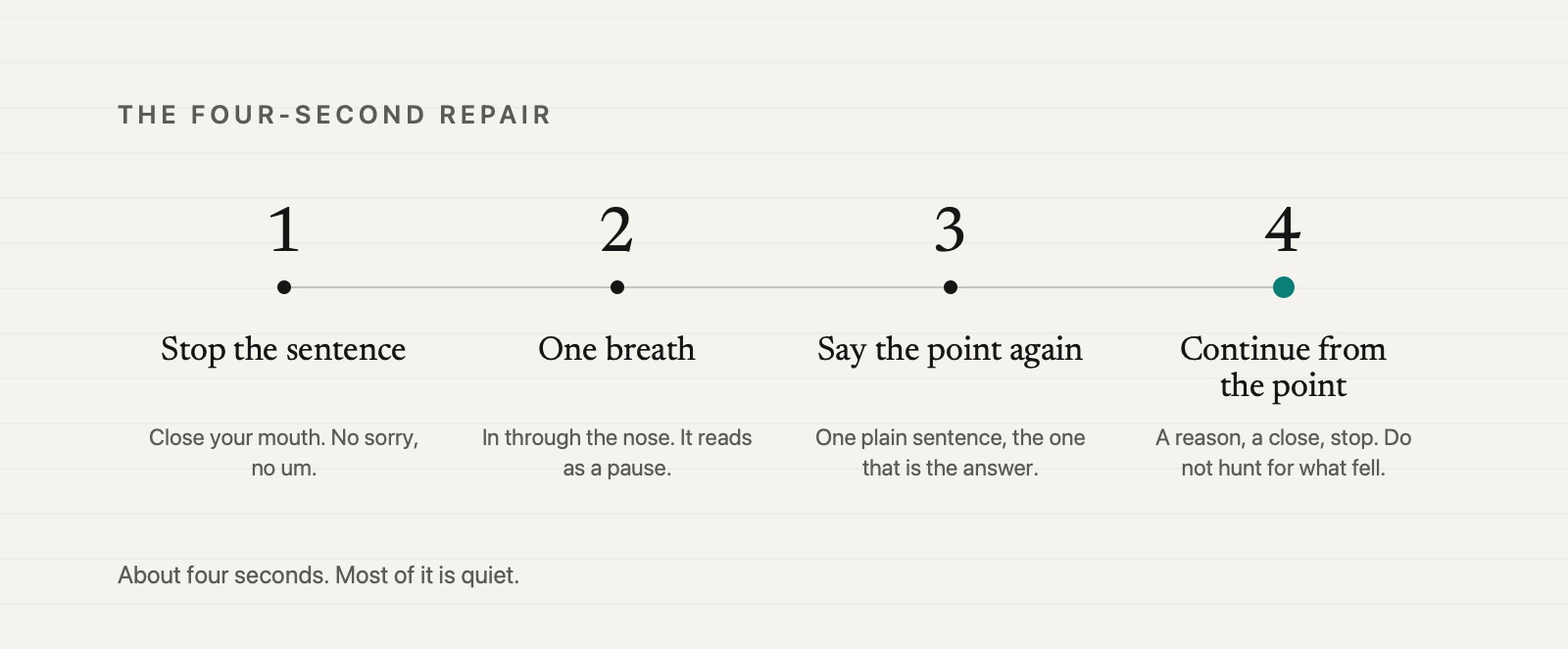
Stop the sentence where it is, take one quiet breath, say the point of your answer again in one plain sentence, and continue from there. That is how to recover when you lose your train of thought mid-answer. The whole repair takes about four seconds, and most of it is silence.
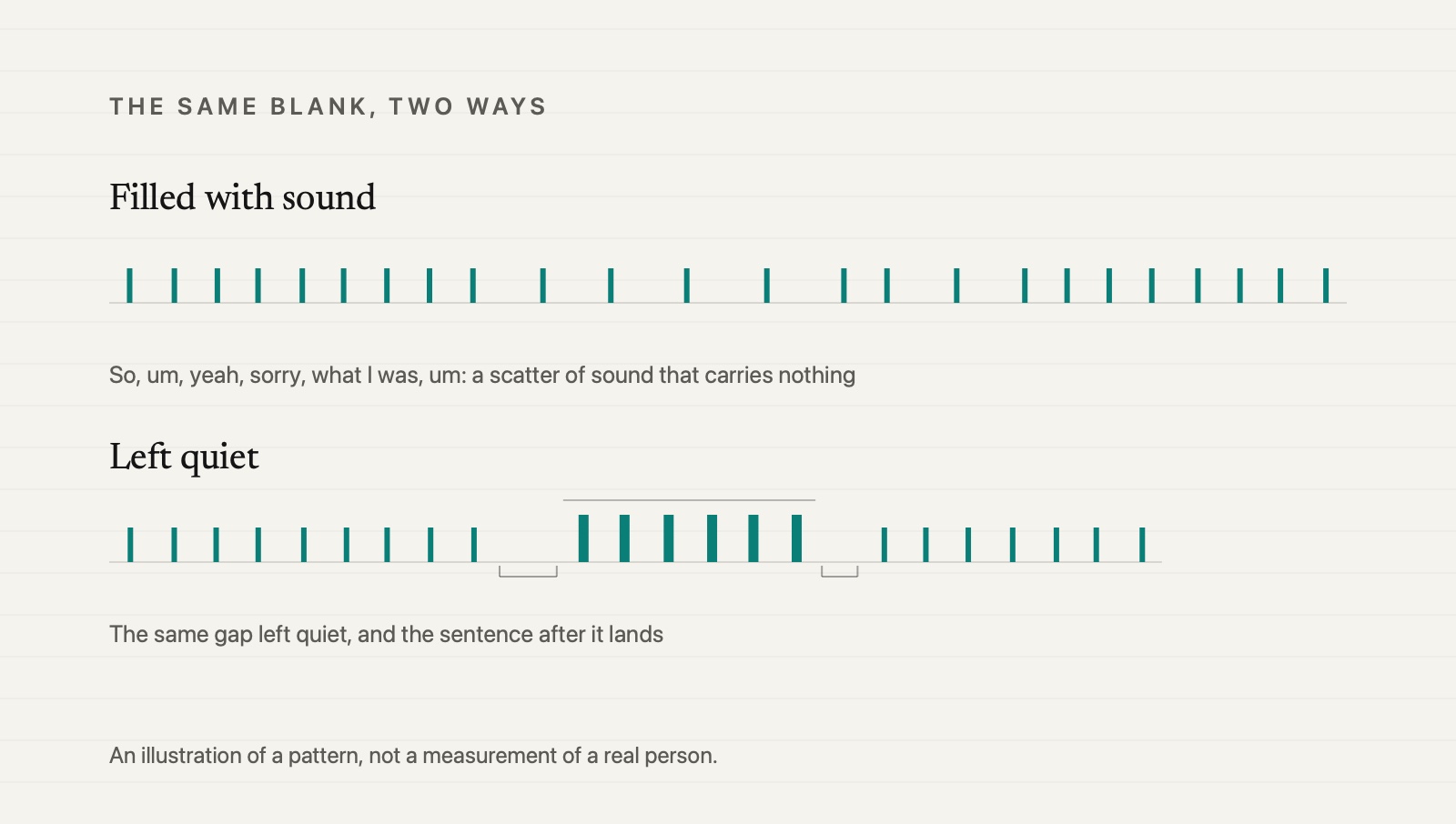
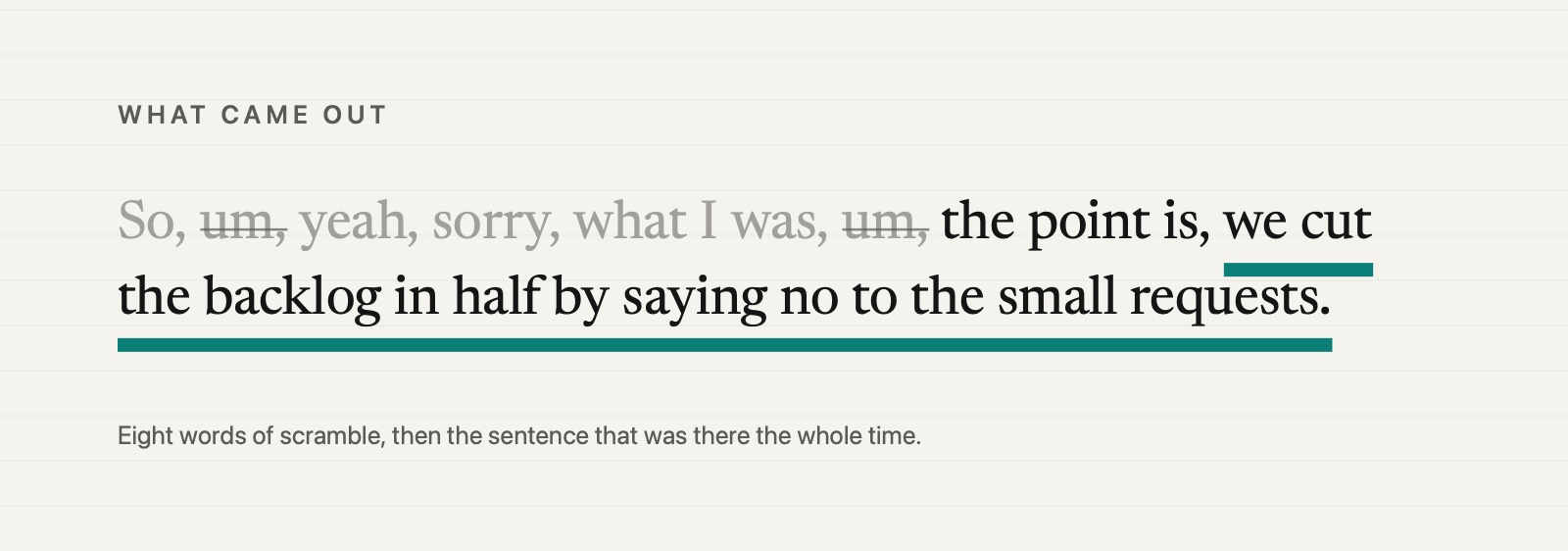
What usually happens instead is the opposite. The thread drops, and the mouth keeps going. "So, um, yeah, sorry, what I was, um." Eight words that carry nothing, said faster and higher than the rest, with an apology attached. The listener did not notice the blank. They noticed the scramble.
This post is about those four seconds, and about why the thread drops in the first place. The same repair works in an interview, in a meeting, and in the hallway.
Why your train of thought drops mid-answer
Speaking out loud is two jobs at once. One part of you is saying the current sentence. Another part is holding the next one, plus the point you are heading toward, plus a running check on how it is landing. When any of those gets heavier, something falls, and it is usually the next sentence.
It happens most in the moments you care about, because being watched adds weight, and the more you monitor yourself, the less room there is for the words.
Toastmasters treats a blank as a normal event with a drill attached. A 2018 piece in its magazine says to practice a "blanking" recovery plan ahead of time, "like a disaster drill for speaking" (Toastmasters International).
The same piece makes a point most people find surprising. Memorizing a speech word for word, it says, "can also lead to an increased risk of blanking." A script has one path through it. Lose the path, and there is nowhere to stand. Knowing your point gives you somewhere to stand.
Step 1: Stop the sentence where it is
When the thread drops, stop talking. Do not finish the sentence with sound, do not start a new one to cover, and do not say "sorry."
The instinct to keep going comes from the pause you are afraid of. From inside, that pause feels like a hole opening in the room. From the listener's chair it is a short quiet, which is what a person looks like when they are choosing a word. Ordinary conversation is full of these.
What the listener does notice is sound without content. In a well-known study of filler words, listeners assumed "um" came from nervousness or a lack of preparation, although the study found that ums do not seem to come from either, and the ums still shaped how listeners judged the speaker, even when they could not say they had heard any (Christenfeld, Journal of Nonverbal Behavior, 1995). Nobody can see that the thread dropped. What they can hear is the scramble that follows.
So the moment you notice the thread has gone, close your mouth. The quiet that follows is the beginning of the repair, not a failure of it.
Step 2: Take one breath in the gap
Use the quiet for one thing: a breath. Not a sigh, not a deep theatrical inhale, one ordinary breath in through the nose.
This does two jobs. It gives the pause a shape, so it reads as deliberate rather than stuck. And it lowers your speed. People who have lost the thread often speed up when they find it again, as if to make up the lost time, and the sped-up version is where the next blank comes from.
Toastmasters' own advice for a mind gone blank starts in the same place. "Take a deep breath, or several of them," says Ed Tate, a former world champion of public speaking, in a Toastmasters sidebar on exactly this moment. Then pause, find your place, make eye contact, and "calmly resume" (Toastmasters International).
Step 3: Say your point again
Now the repair itself. Say the point of your answer, again, in one plain sentence.
Not the sentence you lost. The point. Every answer worth giving has one sentence that is the answer. "The point is, we cut the backlog in half by saying no to the small requests." That sentence is the anchor. It was there before the blank and it is still there.
Patricia Fripp, a speaking coach quoted in the same Toastmasters sidebar, says that if you blank, repeating a key phrase you chose ahead of time "gives you a moment to regroup." Your point sentence does the same job. The listener hears a speaker who is sure of their point and is putting it back in front of them. In most answers that is an improvement, because the point gets said twice and the detail that fell was the part nobody would have remembered.
If your answer did not have one sentence that was the point, you have found something more useful than a recovery line. That is the problem how to stop rambling when you answer is about: the talking started before the point existed, so there was nothing to come back to. Deciding the point first, before you speak, is both the prevention and the cure.
Step 4: Continue from the point, not from where you fell
After the anchor, continue with whatever comes next from the point: one reason, one example, the close. The detail that dropped is gone, and hunting for it is how the second blank arrives. If it does not come back on its own, the listener never knew it was coming.
This is also where you keep the answer short. A blank tends to make people over-correct with length, adding two more examples to prove they are back. Say the reason, land the close, stop.
That is the whole of how to recover when you lose your train of thought, in the order it happens: stop, breathe, point, continue. The listener hears a short pause and a clear sentence.
What to say when the point is gone too
Sometimes the blank takes everything, including the point. It happens most when the question had two parts, and you answered the first and lost the second on the way.
Say so, without the apology. "I've lost the thread of the second part. Could you say the question again?" Interviewers hear this often, and they tend to repeat the question with a little more detail than the first time. In a meeting, "Say the question again?" is enough.
Two phrases to avoid. "Sorry, I'm so nervous" hands the listener a story about you that they were not writing. And "where was I," said to yourself while scanning the ceiling, puts the listener in charge of your answer. Do not narrate the search.
If the question was one you never had an answer to, that is a different problem with its own shape, and how to answer an interview question you don't know covers it. The blank this post is about is the other case: you had the answer, and the thread dropped on the way to it.
Why it keeps happening in the same place
If you lose the thread at the same point in the same answer every time, the answer is the problem, not your memory. Usually it is a scripted answer. A line you memorized word for word has one route through it, and the route runs through exactly the words that go missing under pressure: the connectors and the fancy ones. The Toastmasters advice is to internalize rather than memorize: know the point and a few key words, and let the sentences come out different each time.
There is a simple test. Say the answer three times, and change the wording each time on purpose. If you cannot, you have a script, and a script will drop you. If you can, you have a point, and a point will hold.
The other common cause is an answer with too much in it: three examples where one would do, a backstory before the point, a caveat on every claim. The more you are carrying, the more there is to drop. Cutting the answer down is also the fix for the fast, breathless delivery that comes with it, covered in how to stop talking too fast.
Try it now: how to recover when you lose your train of thought in five minutes
Five minutes, your voice, and a timer that makes a sound. Pick one question you expect to be asked this month. Decide its point in one sentence before you start, and say that sentence out loud once.
Set the timer for a number of seconds between 15 and 40, and start answering. When it goes off, treat it as the blank: stop mid-sentence, wherever you are, even mid-word. Breathe once. Say the point sentence again. Continue to a close. Then stop.
Run it three or four times with the timer set differently each time. On the first run, many people flinch at the sound and reach for "um" before they catch themselves. By the third run the stop is clean and the point sentence comes out in about the same tone as everything around it.
That tone is the whole skill. The repair is not a trick for hiding a blank. It is proof, to you, that the point survives the blank, and after a few hearings the blank stops being frightening.
The drill works best with a recorder running, because the question afterward is not "did I blank" but "what did the recovery sound like." You are listening for one thing: whether the gap was quiet, or whether you filled it.
The moment the thread drops is the one part of an answer almost nobody has heard themselves recover from, because the scramble that covers it is invisible from the inside. Sayforth, a 30-day iPhone program coming soon, has you answer one question out loud a day while the screen stays quiet, then shows the answer as a single speaking line, strokes for speech and gaps for pauses. You can see where the pauses fell and how long they ran, and carry one change into tomorrow.
Be first to know when Sayforth is live.
Get launch updatesFrequently Asked Questions
What should I say when I lose my train of thought in an interview?
Say the point of your answer again in one plain sentence, after a short quiet breath. If the point is gone too, ask for the question again in one sentence, without an apology. Do not narrate the search.
Is it bad to pause when you lose your train of thought?
No. A pause of a second or two reads as a person choosing a word, and conversation is full of them. What listeners notice is the sound you make to cover the gap, and a breath in the pause makes it read as deliberate.
Why do I lose my train of thought when I speak?
Speaking is two jobs at once: saying the current sentence while holding the next one and the point. When attention goes to watching yourself, which happens most when the answer matters, the next sentence drops. Memorized scripts make it worse because they leave only one path through the answer.
How do I stop losing my train of thought mid-answer?
Decide the point in one sentence before you speak, keep the answer small enough to hold, and practice the recovery on purpose with a timer so the stop and the breath become automatic. The blank will still happen sometimes. The difference is that it stops costing you the answer.