If you want to know how to stop talking too fast, you have probably already been told to slow down. It is the most common advice there is, and it rarely works. The reason is simple. You cannot hear your own speed while you are talking, so "slow down" gives you nothing to steer by.
This post takes a different route. You will find your own normal pace first, then the exact places where you speed up, and then slow only the sentences that need it. You do not need to sound slow. You need to stop rushing the parts that matter.
Why "just slow down" doesn't work
Speed is hard to feel from the inside. While you talk, most of your attention goes to the next sentence. Very little is left over to notice how quickly the current one is coming out. That is why so many people are surprised the first time they hear a recording of themselves.
The second problem is that "slow down" is a command for your whole voice. Most people do not talk too fast all the time. They talk at a fine pace for a while, then speed up at one or two moments: the opening, the part they feel unsure about, or the point they care most about. Slowing everything down to fix two moments makes the rest of the answer sound strange and labored.
There is also no single correct speed to aim for. Comfortable speaking rates vary a lot from person to person and from setting to setting. A slow, careful speaker and a quick, bright one can both be easy to follow. What a listener struggles with is not a number. It is a sudden rush, where words pile up with no gaps between them.
Is talking fast a nerves problem?
Sometimes, but not always, and that matters for how you fix it. A 2025 systematic review of research on stress and speech found the evidence on speech rate was mixed: one study saw people speak faster under stress, while three others found no change (Schewski and colleagues, PLOS ONE).
In other words, there is no rule that says nervous people speed up. Some do. Some go quiet. Some do not change at all. That is the best reason to stop comparing yourself to a general rule and start comparing yourself to yourself. Your speed only means something next to your own normal.
How to stop talking too fast in five steps
The steps below go in order. Each one depends on the one before it, so resist the urge to skip to the last one.
Step 1: Find your normal pace
Before you change anything, record yourself talking about something easy. Pick a topic you could talk about half asleep, such as how you got to work this morning or what you did last weekend. Talk for about a minute. Do not try to sound good.
This is your baseline. It is what your voice does when nothing is at stake. Play it back once and just listen. Notice where you naturally pause, how long your sentences run, and how your voice sounds when it is relaxed.
Keep this recording. Every later recording gets compared to it, not to a speaker you admire and not to a number from the internet.
Step 2: Find where you speed up
Now record a harder answer. Pick a real question you might face at work or in an interview, such as "What did you work on last quarter?" or "Why are you leaving your current role?" Answer it out loud for about a minute.
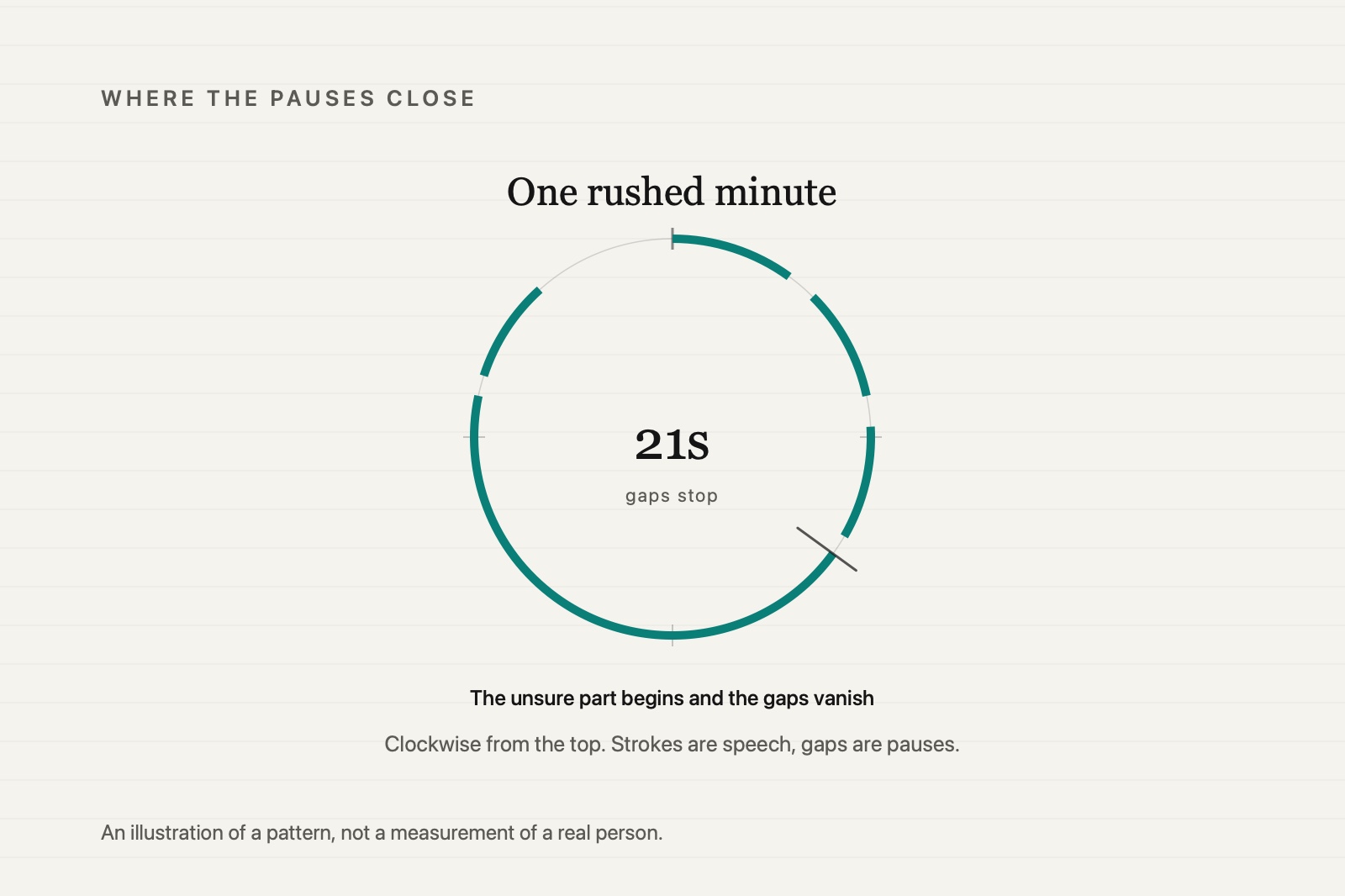
Play it back and listen for one thing only: the moment the gaps disappear. Rushing rarely sounds like faster words at first. It sounds like the pauses closing up. Sentences start running into each other, and the breath between them goes missing.
For most people, this happens in one of three places:
- The opening. You are not sure how to start, so you push through the first few sentences to get going.
- The uncertain part. You reach a detail you are less sure of and speed up to get past it.
- The point. You reach the thing you care about most and rush it, as if saying it quickly makes it safer.
Mark the second on the recording where the gaps close. That is the only place you need to work on for now.
Step 3: Slow the sentence that matters, not every sentence
Once you know where you rush, slow down there and nowhere else. Usually that means one or two sentences per answer. Everything else can stay at your normal pace.
How you slow down matters too. Research on "clear speech," the way people talk when they are trying hard to be understood, describes it as slower than everyday conversation, with pauses added in (Yoo and colleagues, Journal of Audiology and Otology). The same paper reports that clear speech was easier to understand for listeners with hearing loss and for non-native listeners.
You can borrow two things from that. First, add a pause before the sentence you tend to rush. Second, finish the ends of your words in that sentence. Saying the last sound of each word clearly is a quiet brake. It is very hard to rush a sentence while you are landing every ending.
You do not need to stretch every word or lower your voice. One pause and clean word endings on one sentence are usually enough to change how the whole answer feels to a listener.
Step 4: Give every sentence its own breath
Fast talkers often run three sentences together on one breath. That forces speed, because you are racing to the end before the air runs out.
The fix is mechanical. Take a small breath at every full stop, whether you feel you need one or not. This puts a natural gap between sentences and resets your speed each time. It also makes long sentences uncomfortable, which nudges you toward shorter ones.
If your sentences are long to begin with, that is worth fixing on its own. Shorter sentences are easier to say and easier to follow, a point covered in more detail in how to stop saying um. Here the reason is speed: a short sentence ends sooner, so you reach the next breath sooner.
Step 5: Say less, so you have time to say it
Here is the part most advice skips. Many people talk fast because they are trying to fit too much into too little time. If you have five things to say and one minute to say them, speed feels like the only option.
So before a meeting or an interview answer, cut one thing. Then cut another if you can. When you have less to fit in, you stop racing the clock, and your pace settles without you forcing it. This is the same habit behind how to stop rambling when you answer: decide the point first, then say only what supports it.
Expect your answers to get a little longer in seconds even as they get shorter in words. That is fine. The extra time is going into pauses, not filler, and pauses are what give a listener room to take in what you said.
Try it now: a five-minute pace check
You need a voice recorder and a timer. Do this once today.
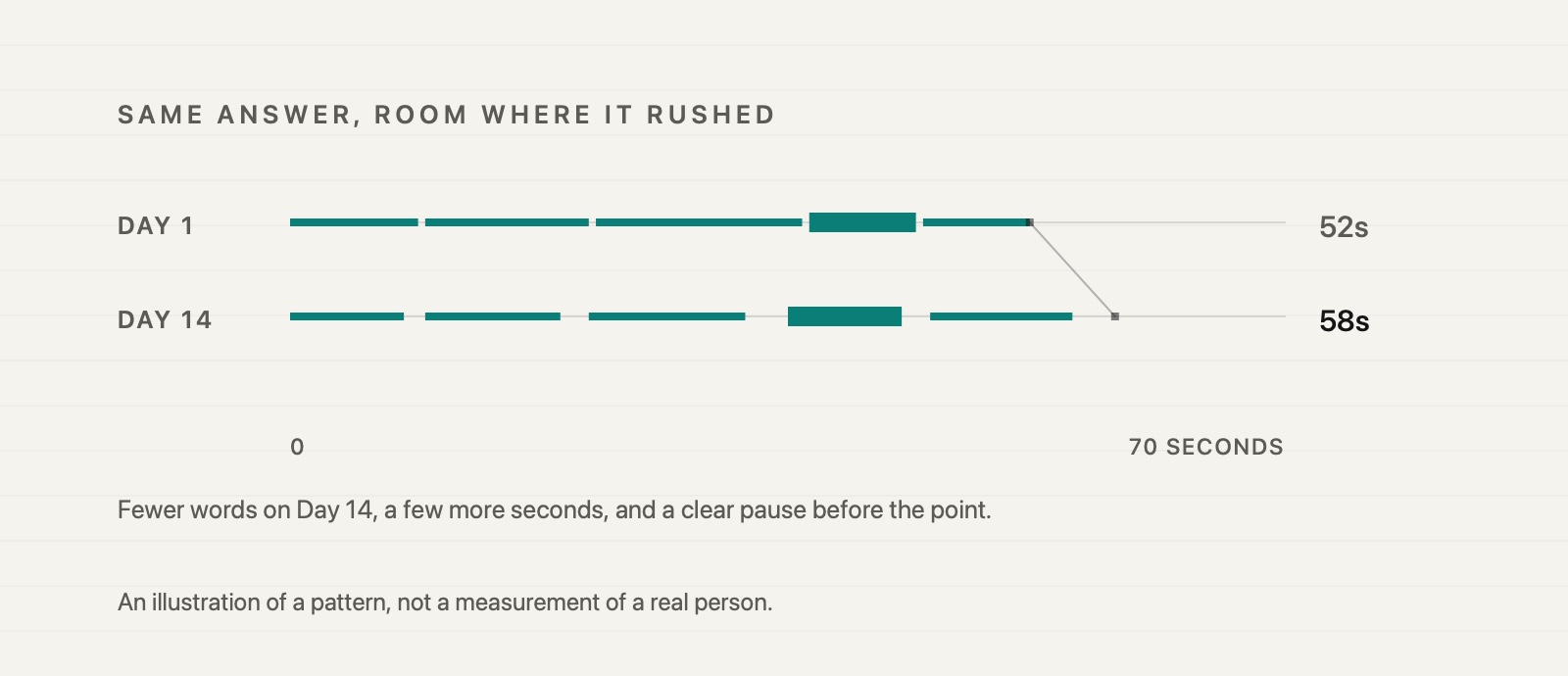
- Record your baseline. Talk for one minute about something easy, like your morning. Do not listen back yet.
- Record a real answer. Answer one question you might face at work, for one minute.
- Find the rush. Play the real answer back and mark the one moment where the pauses close up.
- Plan one change. Decide where you will pause before that moment, and which sentence you will say with clean word endings.
- Record it again. Same question, one minute, with that one change. Then play both versions back to back.
Do not judge the second recording by how slow it is. Judge it by whether the moment you marked now has room in it. If it does, you have done the work for today.
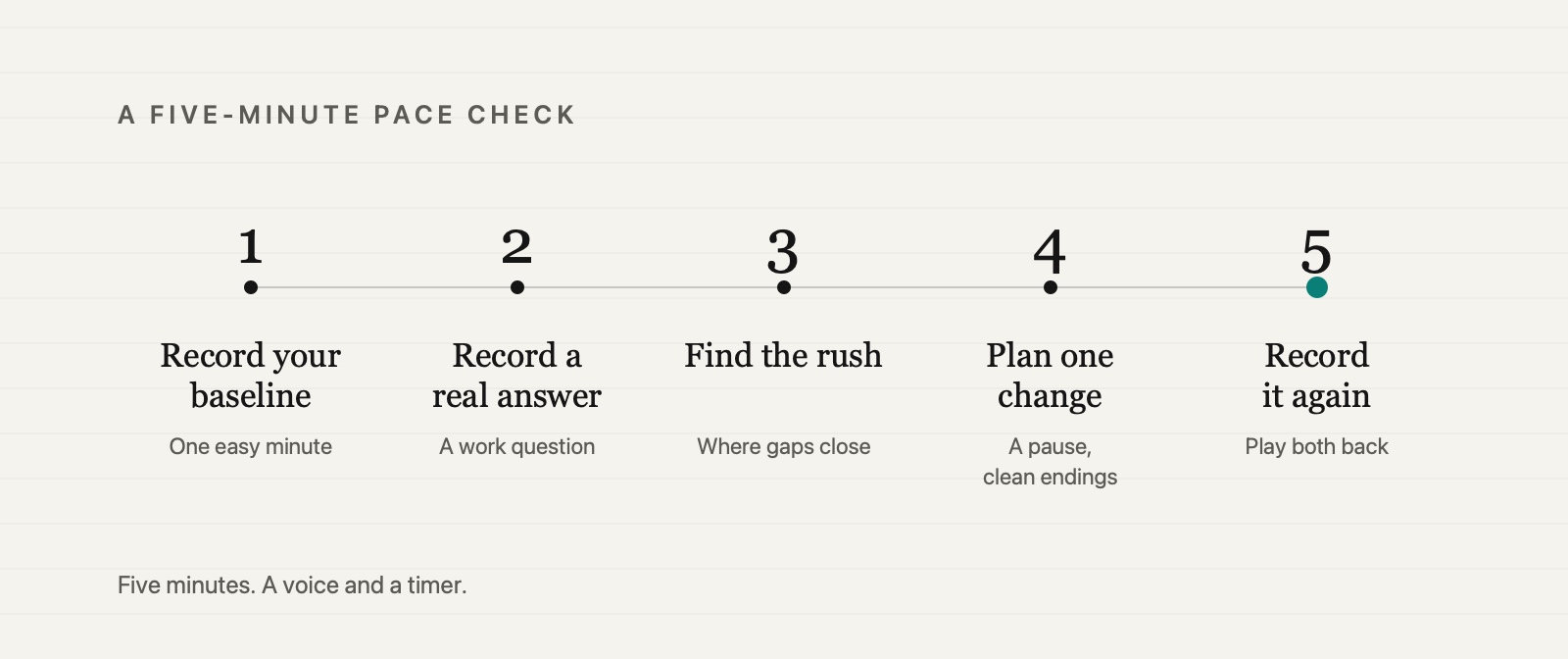
You cannot hear your own speed while you talk, and that is the gap Sayforth is built for: a 30-day iPhone program, coming soon, where one short coached answer a day is drawn as a single speaking line, your pace is compared only with your own Day 1, there are no scores, and you get one change to carry into tomorrow.
Be first to know when Sayforth is live.
Get launch updatesIf you want to see what a single day of practice looks like first, the full routine is on the site.
Frequently Asked Questions
Why do I talk so fast when I'm nervous?
Some people speed up under pressure to get through the uncomfortable part quickly, but research on stress and speech is mixed, and several studies found no change in speaking rate at all. The useful question is not why, but where. Record yourself and find the exact moment your pauses disappear.
Is talking fast a bad thing?
Not on its own. Plenty of fast speakers are easy to follow because they still pause between ideas. Speed becomes a problem when the gaps vanish and sentences run together, which leaves a listener no time to take in what you said.
How do I slow down my speech without sounding boring?
Slow only the sentences that matter, not your whole voice. Put a pause before your main point and say that sentence with clean word endings. The rest of your answer can stay at your natural pace, which keeps it sounding like you.
How long does it take to stop talking too fast?
There is no fixed timeline, because it is a habit rather than a fact you learn once. A minute of recorded practice a day works better than one long session. Compare each recording with your own first one, and listen for more room around your main point before you expect your overall pace to shift.