
Most practice apps count how many days in a row you have shown up. Miss one, and the number drops back to zero. We decided early that Sayforth would not work that way. A speaking practice habit is hard enough to start, and a counter that punishes one missed day makes it easier to quit than to come back.
This post explains the thinking behind that choice and how we are designing the week instead. It also gives you the habit advice we use ourselves, which works with a phone, a notebook, or nothing at all.
The problem with counting days in a row
A day-in-a-row counter feels great while it is climbing. Every day you show up, the number grows, and the number starts to feel like the point. Then life happens. You get sick, you travel, a deadline eats your evening, and the counter goes back to zero.
That moment is where a lot of people stop. Two consumer researchers tested this across seven studies and found that people engage more after seeing an unbroken run than a broken one (University of Colorado Boulder). The drop was bigger when people blamed themselves for the break. It was smaller when they could repair the break instead of starting over. Almost everyone blames themselves for a missed practice day, so a design that punishes a miss hits hardest where people are already hard on themselves.
Why speaking practice is extra fragile
Most habits that apps track are neutral. Drinking water does not make anyone nervous. Speaking out loud is different. For many people, even a one-minute practice answer brings a small dose of the same tension they feel in the interview or the meeting itself.
That means the habit starts with a cost. Add guilt about the days you missed, and the practice becomes a chore you avoid instead of a few minutes you can handle.
There is a second problem. When the number is the goal, people start protecting the number instead of practicing. They rush a single answer at 11:58 at night just to keep the count alive. The count survives, but the practice did not really happen.
We wanted the opposite. A missed day is a day you did not practice. It is not a debt you owe the next day.
What the research says about missed days
Here is the good news. In a well-known study of how habits form, researchers at University College London followed people who were building a new daily habit for 12 weeks. A single missed day had little effect on how automatic the habit became over time (British Psychological Society).
The same study found that the time it took to build a habit varied enormously, from a few weeks to many months, and that missing a lot of days did add up. So consistency still matters. It just does not need to be perfect.
How we are designing the week
What Sayforth does at launch is simple: one question a day, answered out loud, across a 30-day path. If you miss a day, you can make it up by practicing the next day, up to two days a week. You can see a full day of practice on how it works.
The next step is how the week gets counted. This is the approach we are building toward, not something built yet, so read it as how we think about practice rather than a feature list.
- We count practice days in the week. The number that matters is how many days you practiced this week, not how many in a row.
- A missed day never resets anything. Your practice days stay counted. Nothing drops to zero.
- Every Monday is a fresh week. Last week's count is done, and you start the new one clean.
The fresh week on Monday is not an accident. Research on what is called the fresh start effect found that people are more likely to start working toward goals at the beginning of a new week, month or year (Association for Psychological Science). A new week gives a missed day somewhere to go: it belongs to last week, and this week has not had a chance to go wrong yet.
How to build a speaking practice habit that survives a bad week
You do not need an app for any of this. These are the habits we lean on, and they work with a voice recorder and a paper calendar.
Tie it to something you already do
The people in the habit study tied their new habit to a cue from their existing day, such as "after morning coffee." Do the same. Choose one moment that happens every day without effort: after you park, after lunch, after you close your laptop. Practice right after that moment, not "sometime today," which is where practice goes to disappear.
Make the daily version tiny
One question. One minute. Out loud. That is enough. A small practice you do most days beats a big one you do twice and then avoid. The minimum is what keeps the habit alive on the hard days.
Count the week, not the run
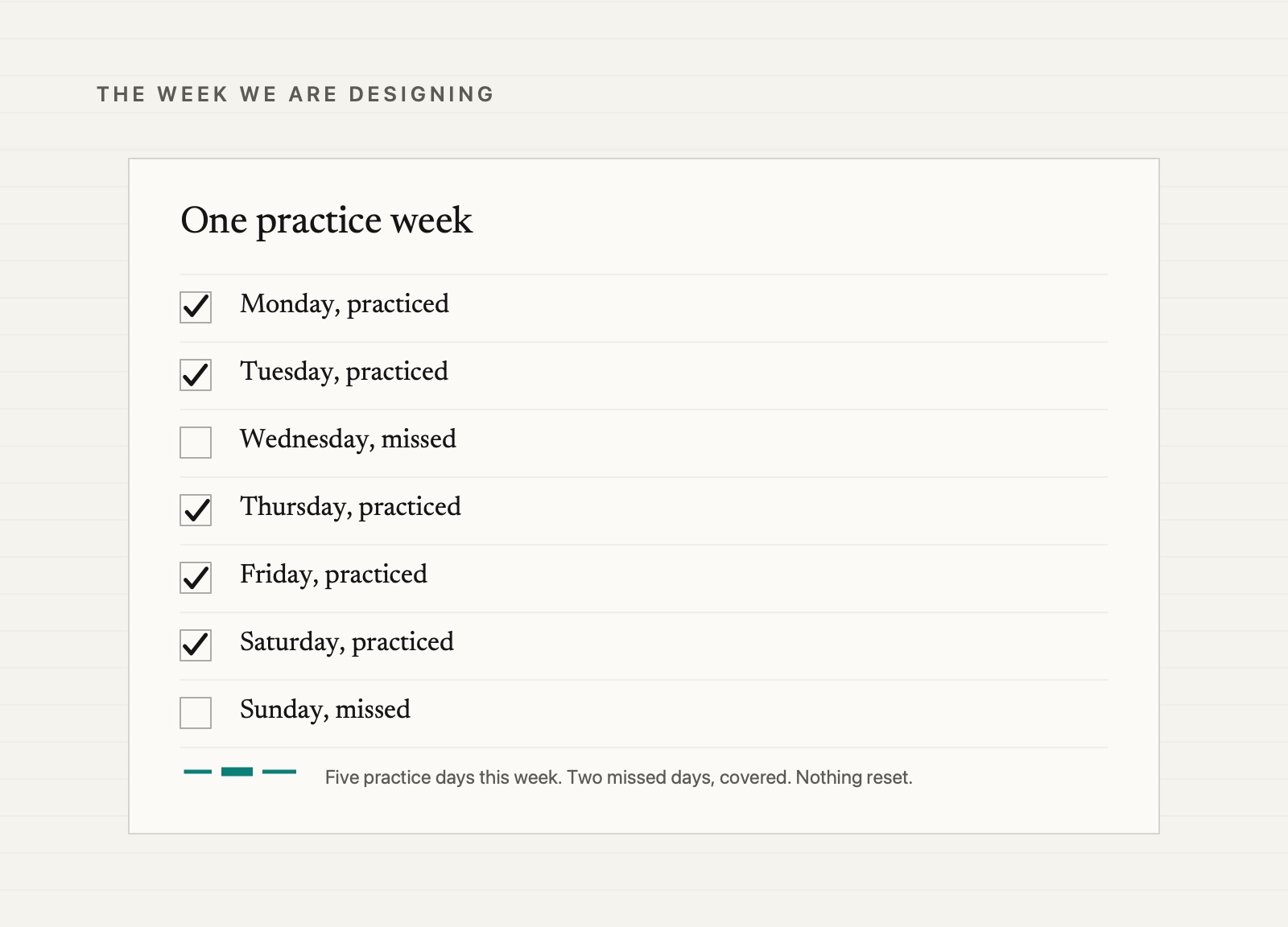
Draw seven boxes for the week on a sticky note or a calendar page. Tick each day you practice. If you practiced on most days of the week, it was a good week, even if the boxes are not all in a row.
This one change takes the panic out of a missed day. A blank box on Wednesday is just a blank box. Thursday still gets its own box. And if a whole week falls apart, let it go on Sunday night. Monday brings seven empty boxes, and there is nothing to make up.
Decide now what you will do the day after a miss
The day after a missed day is the one that matters most, because that is when guilt can turn one miss into a week of misses. Plan it ahead of time. Our suggestion: the day after a miss, do the smallest version possible. Thirty seconds out loud counts. On a busy day, record and stop; save listening back, which we cover in how to practice for an interview alone, for days with a few extra minutes. The goal is only to get back into the box.
Try it now: set up your practice week in five minutes
You need a voice recorder on your phone, a timer, and something to write on.
- Pick your cue. Write down the one daily moment you will practice after. Be specific: "after I close my laptop for the day."
- Pick a question. Choose one you might really face, such as "What are you working on right now?" or "Tell me about yourself."
- Answer it out loud. Set a timer for one minute and answer the question. Do not stop to fix anything.
- Draw your week. Draw seven boxes, Monday to Sunday, and tick today.
- Write your miss plan. Under the boxes, write one line: "The day after a miss, I will answer one question for thirty seconds."
That is your whole habit. Tomorrow, after your cue, answer one question. If you miss a day, look at your miss plan, not at the blank box.
If you have quit a speaking practice habit before because one missed day made the whole thing feel ruined, that is the problem Sayforth is designed around: a 30-day iPhone program, coming soon, with one question a day answered out loud and a missed day you can make up instead of starting over.
Be first to know when Sayforth is live.
Get launch updatesIf you are practicing to cut filler words, the same short daily rhythm is what makes how to stop saying um work.
Frequently Asked Questions
How often should I practice speaking to build a habit?
Aim for most days of the week, with one short answer out loud each time. A single missed day does little harm, while frequent misses add up.
What should I do after I miss a day of practice?
Do the smallest version you can the very next day, such as a thirty-second answer out loud. The goal is to get back into the routine, not to cram two days into one.
Is it better to practice a little every day or a lot once a week?
A little, often. Short daily practice builds the habit and gives you more chances to try one change at a time, while a long weekly session is easier to skip.
How long does it take to build a speaking practice habit?
It varies a lot from person to person, from a few weeks to many months. Judge your progress by how many days you practice each week, not by a date on the calendar.