
How long should you pause when speaking? Shorter than you fear, and longer than you usually do. Between two thoughts, a pause of about one breath is enough. Before your key point, let it run a little longer. The pause that feels huge to you almost always sounds normal to the person listening.
Below: where pauses help in interviews and meetings, when they start to feel awkward, and how to practice them.
Why a pause feels longer than it is
When you stop talking, your mind is racing: checking the next sentence, watching the listener's face, wondering if the silence has gone on too long. That makes a short gap feel enormous.
The listener is still taking in your last sentence. For them, the pause is a moment to catch up, not a hole in the conversation. That is why the first deliberate pauses you try will feel too long even when they are not.
So the first rule is to stop trusting the feeling. If a pause feels slightly too long to you, it is probably about right.
Four places a pause helps
Not every gap is equal. Some pauses do real work for the listener. These are the four worth using on purpose.
Before you start answering
When someone asks you a question in an interview, you are allowed to think before you speak. A short pause before your first word shows you heard the question and are choosing an answer, not reciting one. It also gives you a moment to pick your first sentence, which is the sentence that matters most.
If you need longer than a breath, say so. "Let me think about that for a second" buys you time and sounds calm.
After a complete thought
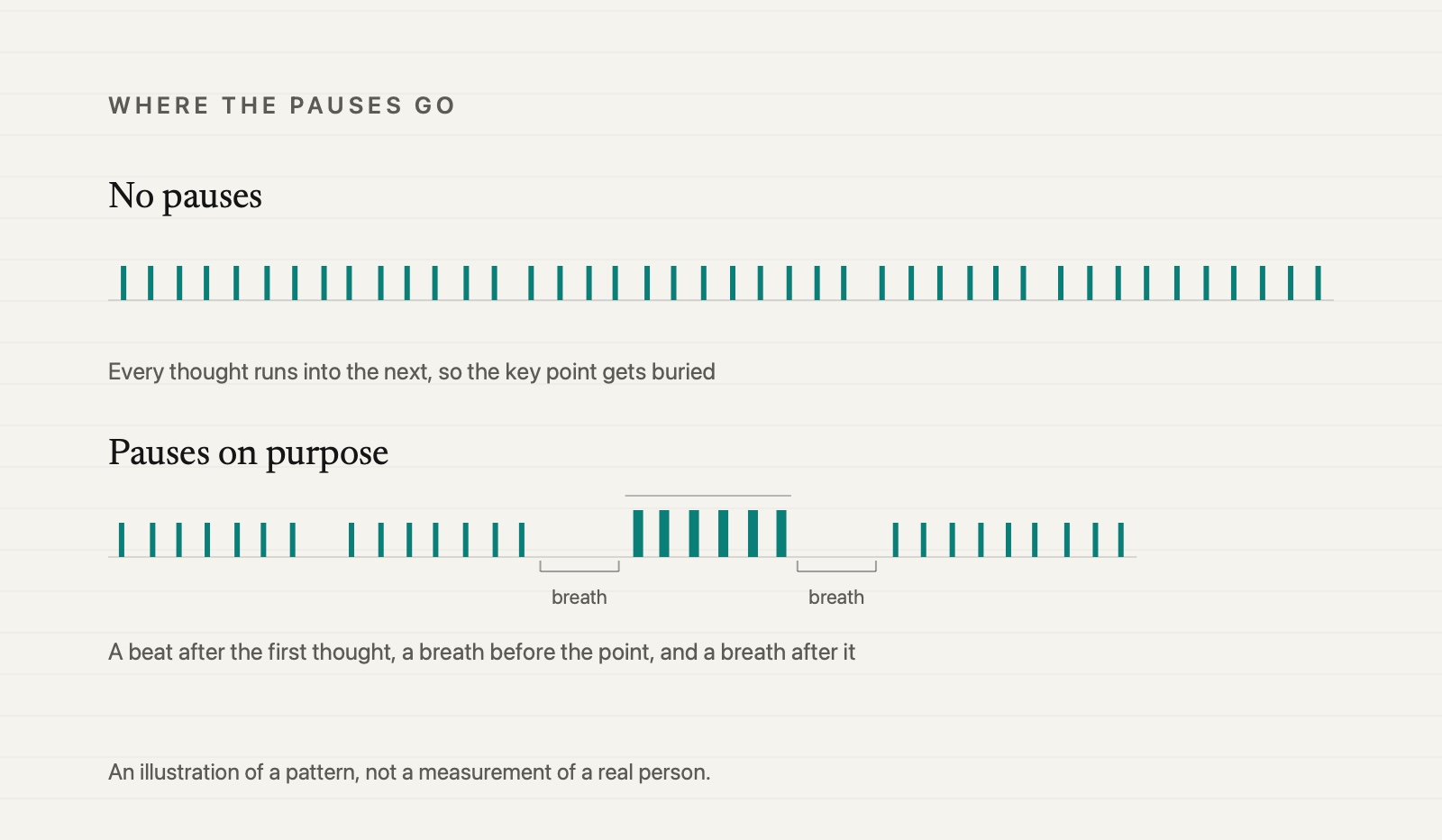
This is the most common pause, and the shortest. When you finish a sentence or a full idea, stop for a beat before starting the next one. It works like a period on a page. It tells the listener one idea is done and another is coming.
Toastmasters calls this kind of short break a micro-pause and describes it as no longer than one second, often shorter (Toastmasters International). It is small, but without it, sentences pile into each other and the listener loses track of where one ended.
Before your key point
This is the pause that does the most work, and the same Toastmasters article recommends placing a pause right before the key word or phrase. If you tend to rush that sentence, how to stop talking too fast shows how to slow just that one.
There is early lab research behind this. In one study published in the journal Neuropsychologia, listeners heard sentences with and without a silent pause before the final word. In a surprise memory test later, they were more likely to recognize words that had come right after a silent pause (University of St Andrews research portal). A pause does not just sound better. It can help the next words stick.
Make this one a little longer than your between-sentence pause. One slow breath in and out is a good guide.
After your key point
Once you say the thing that matters, stop. Let it sit. This pause gives the point time to land before you add a reason or an example. Many people rush past their best sentence because the silence after it feels exposed.
A pause is not a filler
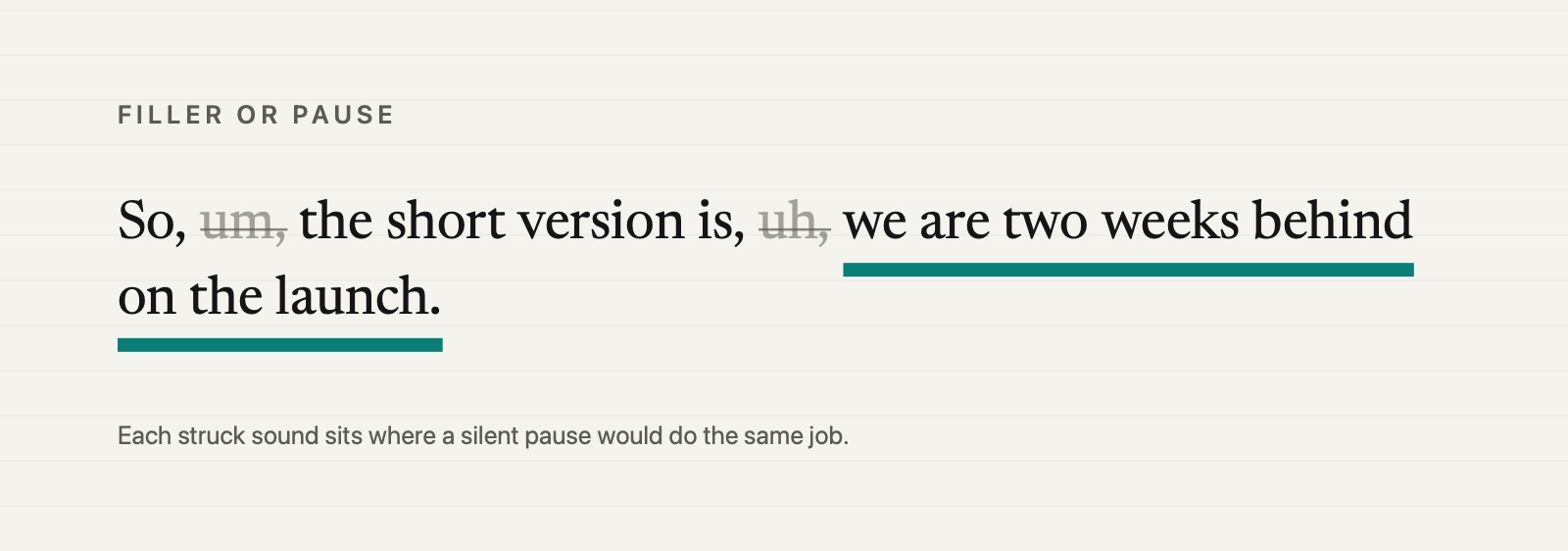
A filler like um or uh fills the same gap a pause would, but it tells the listener you are still deciding, while silence tells them you have decided. Swapping even a few fillers for silence makes an answer sound more deliberate, and how to stop saying um walks through that swap step by step.
When a pause starts to feel awkward
Pauses inside your answer are rarely the problem. The awkward kind of silence is different: it is the quiet after someone finishes talking, when nobody picks up the conversation.
Researchers at the University of Groningen found that a silence of just a few seconds in a conversation was enough to disrupt its flow and make people feel a sense of rejection (University of Groningen). Notice when that silence happens: between speakers, not in the middle of a clear answer.
That difference gives you a simple rule for meetings and interviews:
- A pause in the middle of your answer is yours. As long as you are clearly not finished, listeners wait.
- A long silence at the end of your answer is shared. When you finish, the floor passes to someone else. If the silence runs on, it is not your job to fill it with more words.
A pause gets awkward in the middle of an answer only when it turns into a search. If you have lost your thread, a quiet breath still beats a scramble, and how to recover when you lose your train of thought walks through what to say next.
Pausing on video calls
Video calls add a small delay, so two people often start at once. Leave a short gap after the other person stops before you begin, and you avoid talking over them.
How long should you pause when speaking? A quick guide
Exact lengths matter less than the pattern, and everyone's natural rhythm is a little different. Use these as starting points, then adjust to your own voice.
- Between sentences: a beat, about one second or less.
- Before your first word in an interview answer: one breath while you choose your opening sentence.
- Before your key point: one slow breath in and out.
- After your key point: about the same, so it can land.
- At the end of your answer: stop cleanly and let the other person take over.
If you only change one thing, make it the pause before your key point.
Try it now: a five-minute pause drill
You need a voice recorder on your phone and a timer.
- Pick a question. Choose something real, such as "What did you work on this week?" or "Why do you want this role?"
- Find your point. Before recording, decide the one sentence that answers the question.
- Record once without thinking about pauses. Answer for about a minute, as you normally would.
- Record again with two pauses. Same question. This time, take one slow breath right before your key sentence, and another right after it.
- Play both back to back. Listen for one thing only: in which version does your key sentence stand out?
Listen for how much shorter the pauses sound on playback than they felt. Repeat with a different question each day. The goal is not to count pauses but to make the pause before your point feel normal. If you want more on pausing with confidence, see how to sound confident in an interview.
You cannot hear your own pauses while you talk, which is why most people pause less than they think. Sayforth is built for that gap: a 30-day iPhone program, coming soon, where you answer one question a day out loud and then see your answer as a single line, with strokes for speech and gaps for your pauses, plus one change to try tomorrow.
Be first to know when Sayforth is live.
Get launch updatesFrequently Asked Questions
How long is too long to pause when speaking?
A pause inside your answer rarely feels too long to the listener, as long as it is clear you are not finished. Silence starts to feel uncomfortable when it comes between speakers and nobody picks up the conversation. If you lose your words mid-answer, take one breath and say your point again.
Is it OK to pause before answering an interview question?
Yes. A short pause before your first word shows you are thinking about the question rather than reciting an answer. If you need more time, say "Let me think about that for a second," then give your answer in a clear first sentence.
Do pauses make you sound more confident?
They usually do, especially the pauses right before and after your main point. A silent pause sounds deliberate, while a filler like "um" sounds like you are still deciding.
How can I practice pausing when I speak?
Record yourself answering one question, then record it again with a slow breath before and after your key sentence. Play both versions back to back, and repeat with a new question each day.