Most advice on how to sound confident in an interview is about feeling confident first: breathe, prepare, believe in yourself. That helps a little. But the interviewer cannot hear how you feel. They can only hear what you say and how it comes out. And the things they hear as confidence are small, specific habits you can change today, even with your heart still racing.
This post covers five of them, in the order they show up in an answer. None of them ask you to be louder, faster or more impressive than you are. They ask you to commit to your answer out loud.
What an interviewer actually hears as confidence
Speech researchers have a name for the pattern that makes people sound unsure. They call it powerless speech. It is made of small things: hedges like "I guess" and "kind of," hesitations, and statements that rise at the end like a question. The opposite, which they call powerful speech, is not louder or more forceful. It is simply the same content without those small things.
This has been tested with job interviews. In one study, listeners heard audio recordings of interviews that differed only in speech style. The candidates who used the powerful style were rated as more competent and more employable (Parton and colleagues, Journal of Language and Social Psychology, 2002). Same answers, different delivery, different judgment.
The voice matters too, not just the words. Researchers at McGill University studied how listeners pick up a speaker's confidence from sound alone. Voices that listeners heard as doubtful had higher pitch and more up-and-down intonation. Voices heard as confident were flatter and more settled (Society for Personality and Social Psychology).
Put those together and the answer to how to sound confident in an interview gets much more practical. You do not need to become a different person. You need to remove the signals that tell a listener you are not sure you mean it.
Step 1: Say the answer in your first sentence
The first place doubt shows up is the opening. When you are nervous, you start talking before you know your answer, so the first few sentences are you looking for it. The listener hears that search as uncertainty.
Take a common question: "Tell me about a project you are proud of." A nervous opening sounds like "So, there are a few, I guess, and it depends a bit on what you mean by proud." A confident opening sounds like "I am proud of rebuilding our onboarding emails."
The second version is not braver. It is just decided, and being decided is most of how to sound confident in an interview. You picked the project before you spoke, and you said it first. Everything after that sentence is explanation, and explanation is easy to deliver once the answer is already on the table.
If your answers tend to wander before they arrive, how to stop rambling when you answer a question goes deeper on the opening. For confidence, the rule is simple: take one quiet second, choose your first sentence, then say it.
Step 2: Cut the hedges from the sentence that matters
A hedge is a word that softens a claim so you cannot be wrong. "I think." "Kind of." "Sort of." "Probably." "I guess." One of them is normal. Three in one sentence tell the interviewer you are not willing to stand behind what you just said.
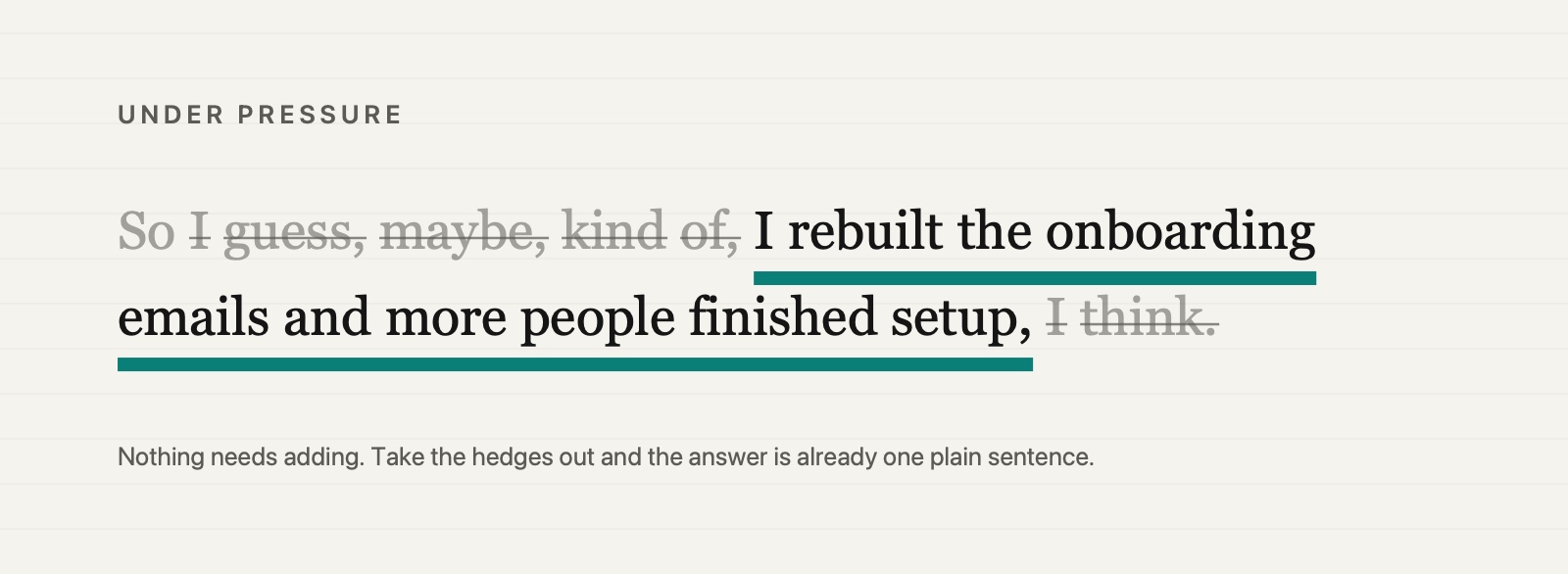
Here is the onboarding answer the way it often comes out under pressure: "So I guess, maybe, kind of, I rebuilt the onboarding emails and more people finished setup, I think."
Now read it with the hedges gone: "I rebuilt the onboarding emails and more people finished setup." That sentence was inside the nervous version the whole time. Nothing was added. Nothing was exaggerated. It just stopped apologizing for itself.
Hedges hide in the most important sentence, because that is the one you are most afraid to get wrong. So you do not need to scrub every "I think" from every answer. Find the one sentence that carries your answer and make sure that one is clean.
Step 3: Let your sentences land instead of rising
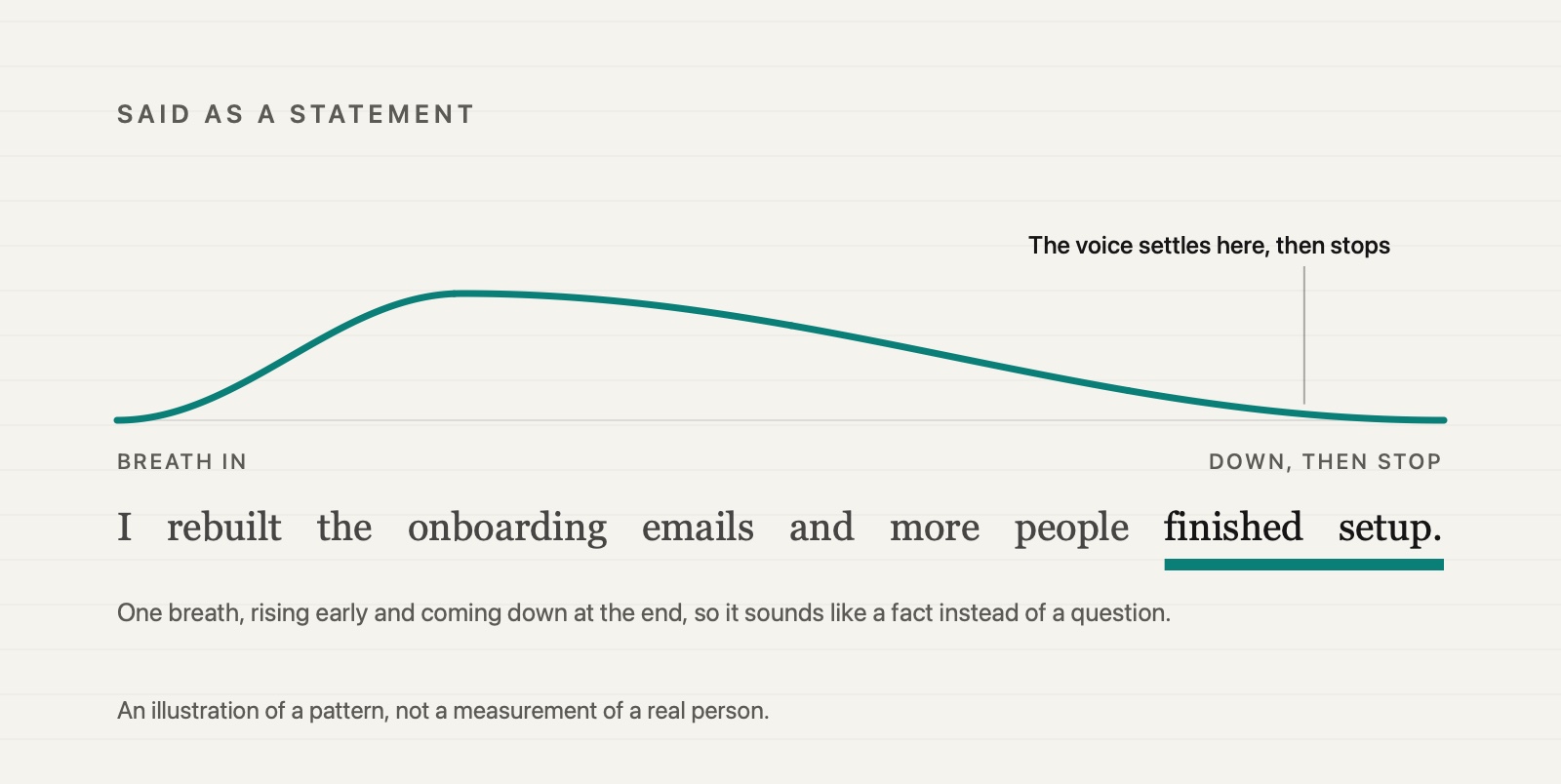
Listen to how many nervous answers end on an upward note, as if each statement were a question. "I led the redesign? And it went out in March?" Rising at the end of a statement is sometimes called uptalk. Plenty of people use it in casual talk, and it is not a flaw in itself. In an interview, though, a statement that goes up at the end sounds like you are asking permission for it to be true.
The fix is to let the pitch come down at the end of the sentence that matters. You do not need to force a deep voice. Just finish the sentence the way you would finish the last line of a story: settled, and then stop.
This is easier with short sentences. A long sentence runs out of breath before it ends, and the ending trails off or lifts. A sentence you can say in one breath has room to come down cleanly. So build your key sentence to fit in one breath, and put the part you want remembered at the end, where your voice settles. The clean sentence from Step 2 works well: "I rebuilt the onboarding emails and more people finished setup." Say it once going up at the end, then once coming down on "finished setup." The second one sounds like a fact.
Step 4: Pause on purpose, before and after the point
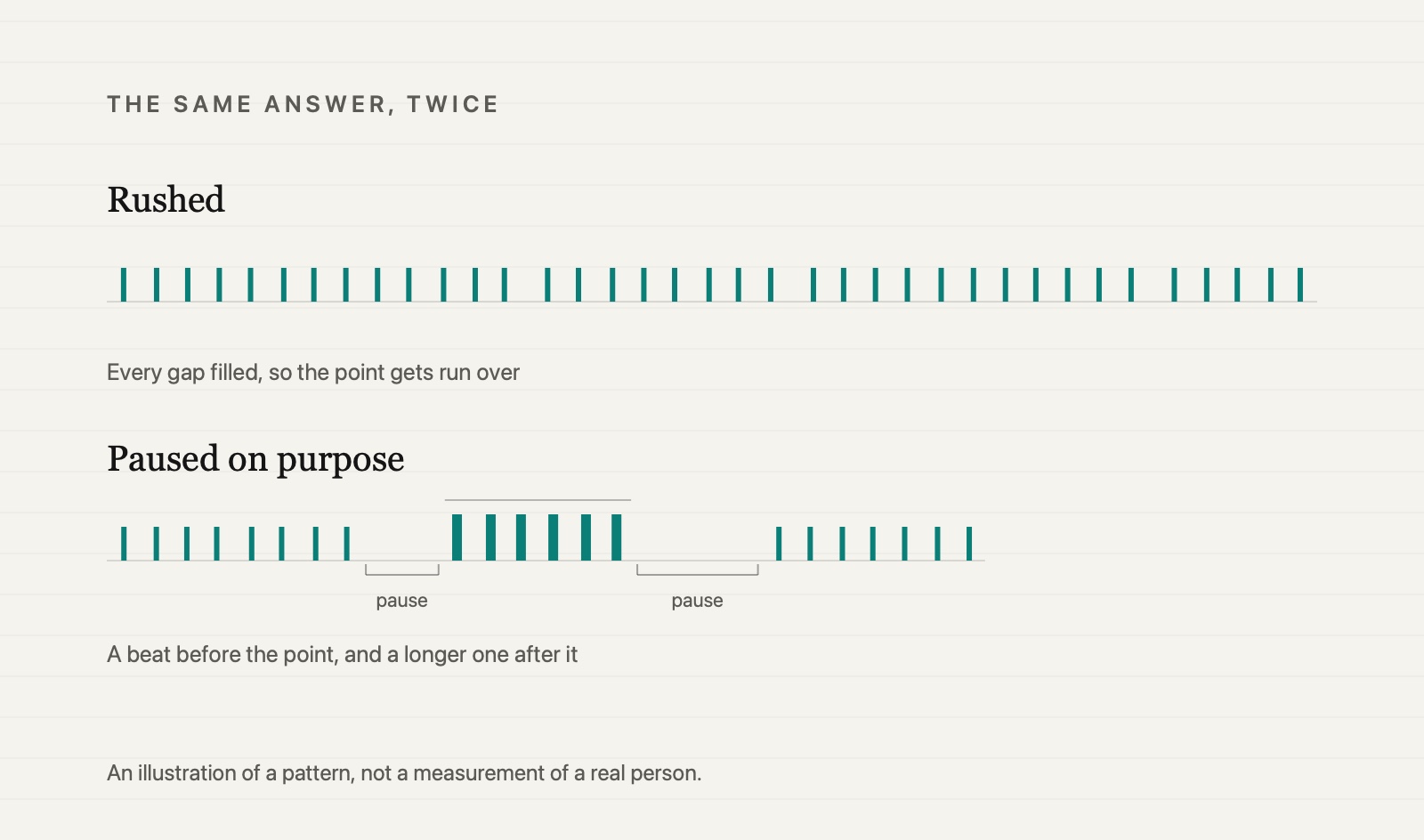
Nervous speakers rush. Silence feels dangerous, so every gap gets filled, and the answer comes out as one unbroken run. The listener never gets a moment to take in the part that matters.
A confident speaker does the opposite, and it is not because they feel calmer. They pause on purpose in two places: just before the main point, so it stands out, and right after it, so it has a moment to land. That second pause is the hard one. It feels long to you. To the interviewer it sounds like someone who knows they just said something worth hearing.
You can practice this directly. Say your key sentence, then count one silent beat in your head before you say anything else. If the next thing you were going to say was "so, yeah," the beat will show you that you did not need it.
Step 5: End on your answer, not on a question
The last habit is at the very end. Nervous answers often close by asking for approval: "Does that make sense?" "If that answers your question?" "I don't know if that is what you were looking for." Researchers who study powerless speech count these tag questions among the signals of uncertainty, and you can hear why. You just gave a solid answer, then asked whether it was okay.
End on your answer instead. Of all the ways to sound confident in an interview, this one is the quickest to learn. Say your last sentence, let it come down, and stop. If the interviewer wants more, they will ask. Answering a follow-up question is easier than guessing what else to add, and it turns the interview into a conversation instead of a speech.
Sounding confident is not the same as sounding certain about everything. If you truly do not know something, saying so plainly, in one clear sentence, sounds far more confident than a long guess. How to answer an interview question you don't know covers exactly that situation.
Try it now: how to sound confident in an interview in five minutes
You need your phone's voice recorder and a timer. That is all.
- Pick one question you expect to get, such as "Tell me about a project you are proud of."
- Record yourself answering it once, cold, with no preparation. Keep it under ninety seconds.
- Listen back once, and listen for only two things: the hedges in your key sentence, and whether that sentence went up or came down at the end. Write down what you heard.
- Now decide your key sentence. Write it with no hedges, short enough to say in one breath.
- Record the answer again. Say the key sentence first, let it come down, pause for one beat, add one reason, then stop. No "does that make sense."
- Play both takes back to back.
The second take will not sound like a different person. It will sound like you, sure of what you said. That is the whole skill of how to sound confident in an interview: not a new voice, just your own voice without the apologies. Do the same question again tomorrow and compare it with today, not with anyone else.
If you can hear the hedges when you listen back but still cannot catch them while you are talking, that is a practice problem, and practice is what fixes it. Sayforth is a 30-day iPhone program built on exactly this: one short spoken answer a day, drawn as a single line so you can see where your point landed and where you paused, with one change to carry into tomorrow. It is coming soon, and you can see how the daily practice works now.
Be first to know when Sayforth is live.
Get launch updatesFrequently Asked Questions
How can I sound confident in an interview if I am nervous?
Learning how to sound confident in an interview is mostly about what the interviewer hears, not how you feel. Say your answer in the first sentence, remove the hedges from that sentence, and let it come down at the end instead of rising. Nerves can stay; these habits still come through clearly.
Does uptalk make you sound less confident in an interview?
It can. A statement that rises at the end sounds like a question, so the listener hears you asking whether your answer is right. You do not need to remove it everywhere; just make sure the sentence that carries your answer comes down at the end.
Is it okay to say "I think" in an interview?
Yes, when you are giving a real opinion or you are honestly unsure. The problem is stacking hedges on things you know for a fact, like what you did or what happened. "I led the project" is stronger than "I think I kind of led the project," and it is also more accurate.
How do I sound confident without sounding arrogant?
Confidence comes from committing to plain facts, not from praising yourself. "I rebuilt the onboarding emails and more people finished setup" is confident. "I am the best at onboarding" is arrogant. Say what you did clearly, give one reason or example, and let the interviewer draw the conclusion.