Say the true thing, give the part of the answer you do have, and name how you would find the rest. That is how to answer an interview question you don't know, and it takes about fifteen seconds. The guess that tries to cover the gap takes two minutes, and the person across from you usually hears it for what it is.
Almost nobody is expected to know everything on the list. Interviewers ask questions past the edge of a resume on purpose, because what happens at that edge is more interesting than another rehearsed story. The problem is that the edge arrives without warning, and the first thing most people reach for is words.
Why not knowing feels worse than it is
The freeze is not really about the question. It is about the silence that comes after it.
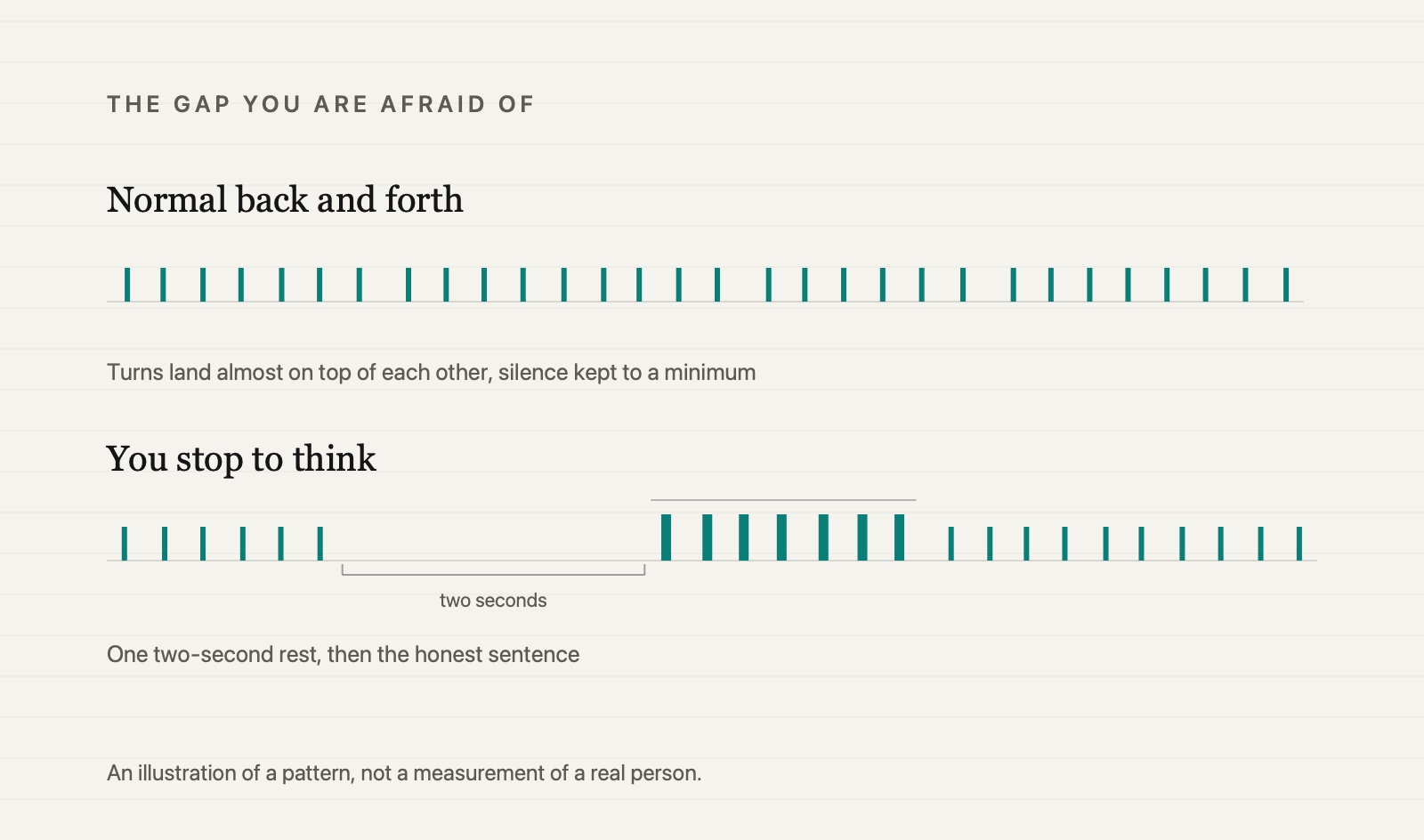
Conversation runs on very small gaps. A study of ten languages, from small indigenous communities to major world languages, found the same underlying pattern in all of them: speakers avoid talking over each other and keep the silence between turns to a minimum, and the average gap varies by only about a quarter of a second from one language to the next (Stivers et al., Proceedings of the National Academy of Sciences).
That is the rhythm you break when you stop to think. Two seconds of quiet sits well outside the normal beat of a conversation, so from the inside it feels like the room has stopped moving. From the other chair it reads as somebody taking the question seriously.
So the pause is cheap. The words you spend avoiding it are expensive, because every one of them is a word you have not thought about yet.
Say the true thing first
Put the honest sentence at the front, before anything else. Not buried, not hedged, not after a paragraph of throat-clearing.
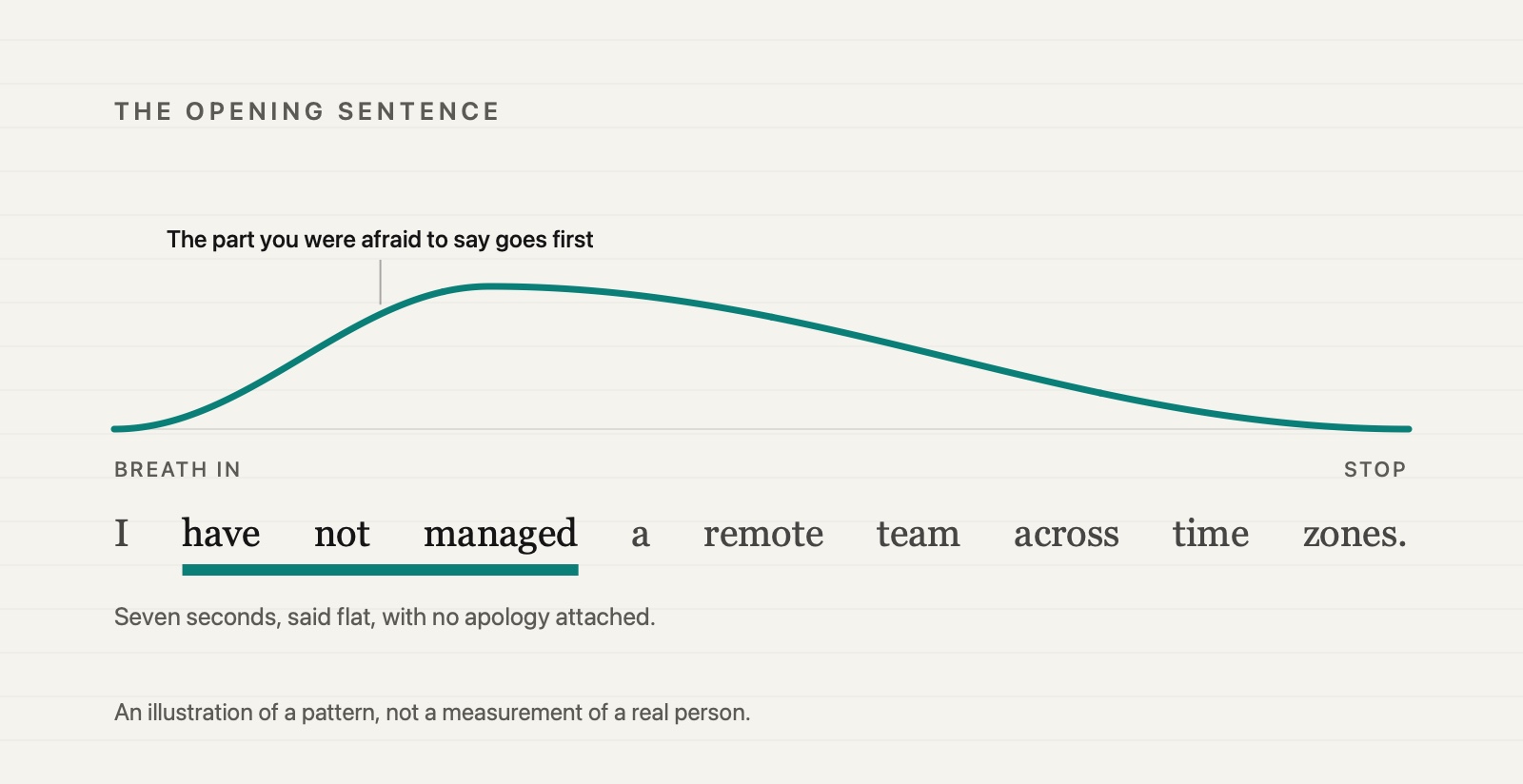
Take a real case. The interviewer asks whether you have ever managed a remote team across time zones, and you have not. The sentence is: "I have not managed a remote team across time zones."
That is the whole opening. Seven seconds, said flat, no apology attached. It is short enough to say in one breath, which is the practical test for any sentence you want a listener to hold in one piece.
Two things happen when you lead with it. The interviewer stops waiting to find out whether you are going to claim it, which is the thing they were actually listening for. And you stop carrying it, so the rest of your attention is free for the part of the answer that is real.
The version that fails is the one that arrives late: ninety seconds of adjacent detail, and then, quietly, near the end, the admission. By then the interviewer has already worked it out and has spent the whole time watching you avoid it.
Give the part of the answer you do have
Almost no question is a total blank. The honest sentence closes the door on the thing you have not done, and the next sentence opens the one next to it.
Staying with the same question: "I have managed a team of six in one office, and for two years I worked daily with a supplier eight hours ahead, so I have run the handover part of it without the management part."
That is specific, checkable, and it answers the question the interviewer was really asking, which is almost never "have you done this exact thing" and almost always "what will you be like when you do it."
Career guidance lands in the same place. Indeed's advice on how to answer an interview question you don't know puts redirecting to familiar ground among its ten steps, alongside admitting the gap honestly, and notes that staying honest "can show integrity, which many employers value" (Indeed). The Muse gives the same move as one of four, connecting the unfamiliar question to related experience you can speak to with confidence (The Muse).
The trap is letting the adjacent part run long to make up for the missing part. It does not make up for it. Give it in one or two sentences and stop.
Say how you would find out the rest
The third move is the one most people skip, and it is the one that does the most work.
"If I picked this up on Monday, I would start by asking the two people already doing it what breaks first, and I would look at where the handovers sit before changing anything."
You have now told the interviewer how you think, which is what the question was for. Indeed's guidance calls this thinking aloud and offering the route to the answer rather than the answer. It works because it is the only part of the response that shows the thing a resume cannot.
Keep it to one sentence. A method described at length starts to sound like a method you are inventing on the spot.
The long guess is the actual mistake
Here is the comparison that matters. The same question, two answers.
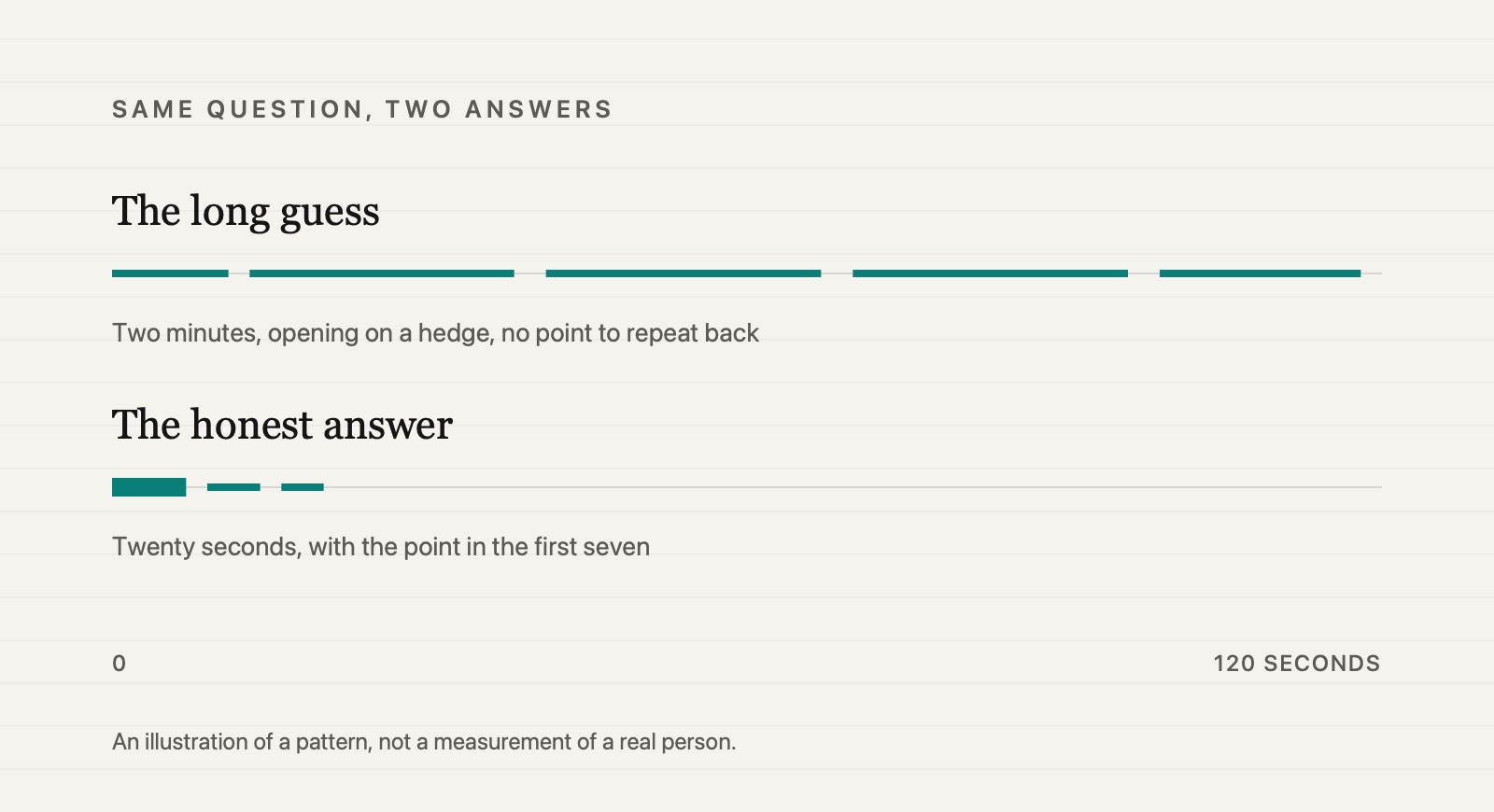
The long guess runs about two minutes. It opens with a hedge, circles through three things that are almost relevant, never arrives anywhere a listener can repeat back, and finishes by trailing off. The honest version runs about twenty seconds, and the point is in the first seven.
The long guess is not neutral. It costs you the time, and it also tells the interviewer that when you do not know something you will keep talking anyway, which is a genuinely useful thing for them to learn about you and a bad thing for them to learn.
If you recognize that pattern outside of the questions you cannot answer, it is the same habit described in how to stop rambling when you answer: the talking starts before the point exists.
When you genuinely have nothing
Sometimes there is no adjacent experience and no sensible method, because the question is about a thing you have never encountered. Two options are both fine.
Ask a real clarifying question. Not stalling, an actual question: "When you say forecasting, do you mean the quarterly plan or the weekly reorder?" Half the time the question you could not answer becomes one you can.
Or ask to come back to it. Indeed lists offering to return to a complex question later among its ten steps, and interviewers generally take it well, because the alternative is a made-up answer they then have to work around.
What does not work is filling the space with sound. If the gap keeps coming out as "um" rather than silence, that is a separate and fixable habit, covered in what to do about the filler that fills the gap.
Try it now: how to answer an interview question you don't know in five minutes
Five minutes, your voice, a timer, and your phone's recorder.
Pick three questions you would hate to be asked. The ones where your stomach drops slightly. Write only the questions, not the answers.
Record yourself answering the first one, cold, with one rule: the first sentence has to be the honest one. Then the adjacent experience. Then the method. Stop when you get there, even if it feels too early, and let the recording run for two more seconds of silence before you end it.
Do the same for the other two. That is about four minutes of talking.
Now listen to the first one back and check one thing only: how many seconds until the honest sentence. If it is under ten, the shape is right. If the honest sentence is not in there at all, you already know what happened, because it is what happens in the room too.
Run the three again tomorrow. The goal is not a script. It is that the true sentence stops feeling like a loss and starts feeling like the opening it is.
The few seconds after an unexpected question are the part you cannot rehearse into a script, and the part almost nobody ever hears themselves do. That is the gap Sayforth is built for, a 30-day iPhone program, coming soon, where one short coached spoken answer a day is drawn as a single speaking line with strokes for speech and gaps for your pauses, one change to carry into tomorrow, no scores, progress measured only against your own Day 1, and recordings that stay on your phone.
Be first to know when Sayforth is live.
Get launch updatesFrequently Asked Questions
Is it bad to say "I don't know" in a job interview?
On its own, no. Saying it and stopping there is what causes trouble. Say the honest sentence, then add the part of the answer you do have and how you would find the rest, and the admission reads as judgment rather than a gap.
How long should I pause before answering a question I don't know?
About two seconds, which is much longer than a normal gap between conversational turns and far shorter than it will feel to you. A short silence before a considered answer is read as thinking. The thing interviewers notice is not the pause, it is a stream of words with no point in it.
Should I make an educated guess instead of admitting I don't know?
Say that you are reasoning rather than recalling, and then reason out loud. "I have not seen this case, but working from how the similar one behaves, I would expect" is a fair answer. A guess delivered in the voice of a fact is the version that goes wrong, because the follow-up question arrives immediately.
What if I don't know the answer to a technical question?
The same three moves work, and the method sentence carries more weight than usual. Name what you have not used, say the nearest thing you have used, and describe how you would work it out, including what you would look up and who you would ask. Technical interviewers are usually watching the route more closely than the destination.