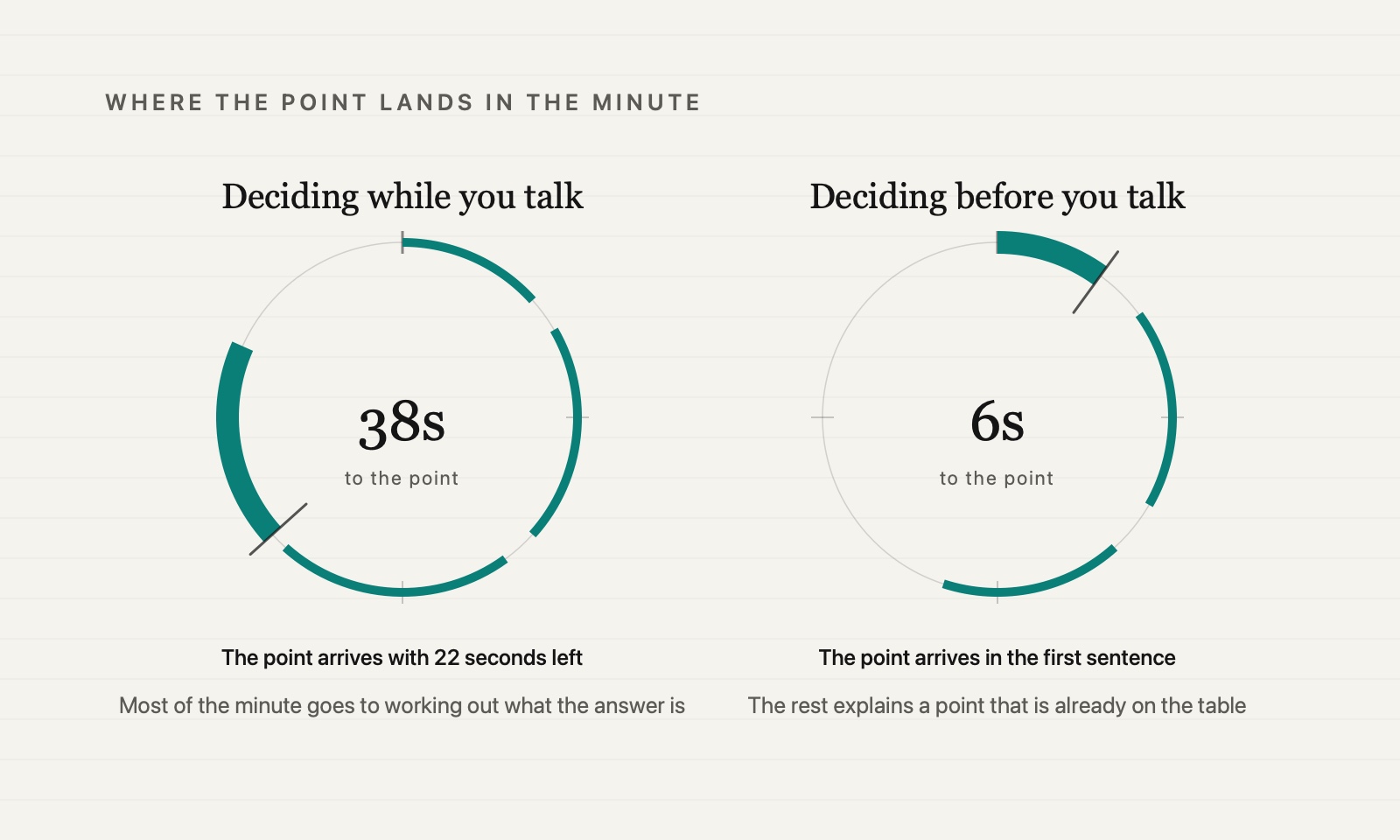
Rambling doesn't usually start in the middle of an answer. It starts at the opening, before you've said anything, while you're still deciding what to say. The Muse describes this as a habit of "wordiness" that shows up most when someone isn't sure yet what their actual point is, and keeps talking while they figure it out in real time (The Muse). That's a useful reframe: rambling often isn't too much content. It's thinking happening out loud, with the listener stuck waiting for it to resolve into a point.
Three things fix most of it: how you open, how you use pauses, and how you end. None of them require you to think faster.
Fix the opening first
If you don't know your point until you're halfway through saying it, the first half is where the rambling lives. The fix isn't "think faster." It's deciding the point before you start talking, even if the decision takes a beat of silence first.
Harvard Business Review's guidance on filler words makes a related point: much of what sounds like uncertainty in speech is really just the gap between finishing a thought and starting the next sentence, filled with "um" instead of left empty (HBR). The same gap exists before you start an answer at all. Taking a full second of silence to decide your first sentence, before you say a word, almost always produces a shorter, more direct answer than starting to talk immediately and hoping the point arrives.
A workable opening habit: answer the question in one sentence, out loud, as your first sentence. Not "so, that's an interesting question," the actual answer. Everything after that first sentence is explanation, and explanation is much harder to let run long once the point is already on the table.
Pauses are punctuation, not dead air
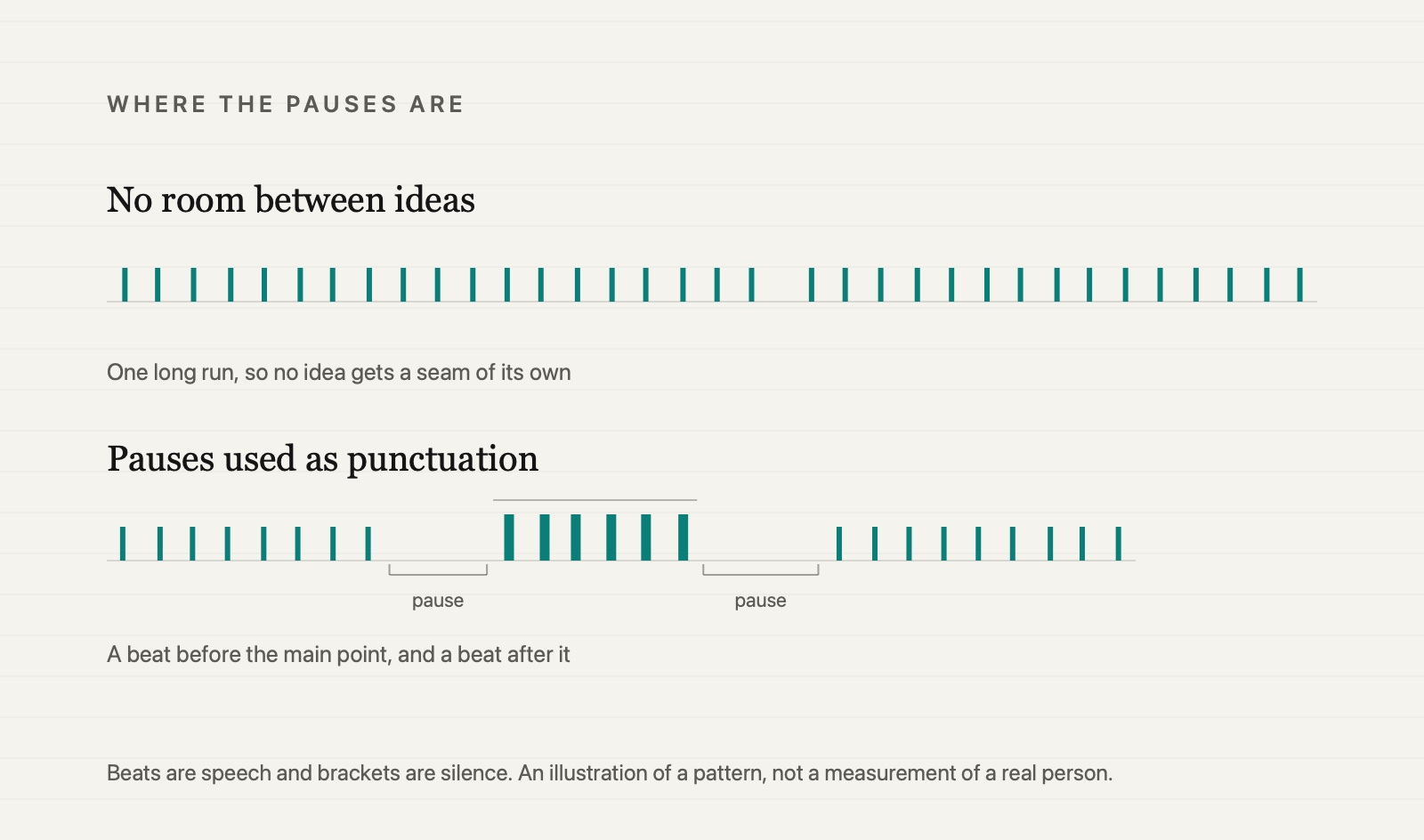
A pause before or after an important point is a well-documented tool in speaking coaching, not just a gap to be nervous about. VirtualSpeech recommends pauses of roughly two to five seconds at moments of emphasis (before a key point, between sections of an answer, after a number or a result), precisely because the silence gives the idea room to land instead of getting run over by the next sentence (VirtualSpeech). Manner of Speaking makes the same case from the opposite direction: most speakers who feel like they paused too long actually paused for less than two seconds, because silence feels much longer to the person producing it than to the person listening to it (Manner of Speaking).
This matters for rambling specifically because a pause is what a run-on answer is missing. If you never stop, there's no natural seam where the listener, or you, can tell that one idea ended and a new one is starting. Adding a real pause after your opening point, and another after your supporting example, does two things: it gives the listener a chance to absorb what you said, and it gives you a natural place to decide whether you're actually done, instead of continuing because the silence felt uncomfortable to sit in.
End on purpose, not when you run out of things to say
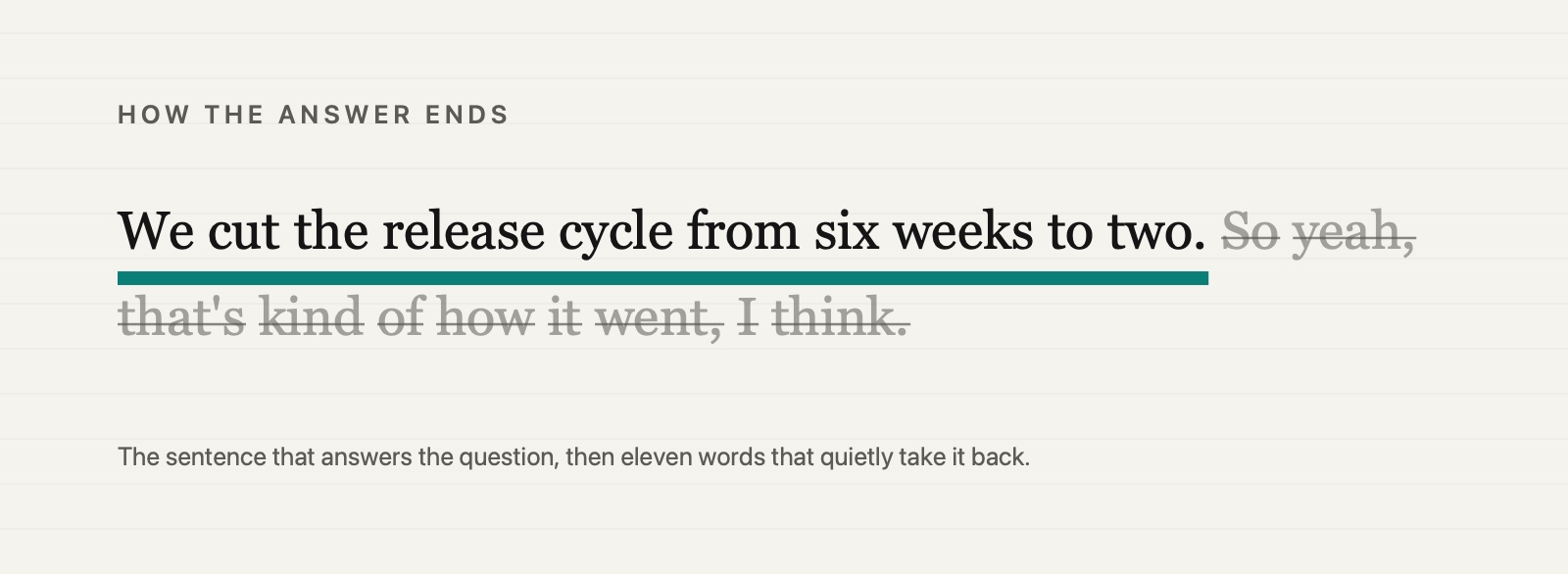
The other half of rambling is not knowing when to stop, which usually shows up as trailing off into a string of qualifiers ("so yeah, that's kind of how it went, I think") rather than an actual ending. A useful discipline: decide your last sentence the same way you decided your first one, before you get there. If your point was "I shortened our release cycle from six weeks to two," your last sentence can just be a restatement of the result, not a new thought bolted on because the silence after "two weeks" felt like it needed filling.
Stopping on a clear sentence, then staying quiet, is uncomfortable the first few times. It's also the single clearest signal to a listener that you knew what you meant to say and you said it. That's a different, more durable kind of confidence than talking fast enough to seem sure.
Try it now: the one-breath ending
This takes about two minutes and needs nothing but your voice.
- Pick a real question you might actually get: a project you worked on, a decision you made, something that went wrong and what you did about it.
- Before answering, decide your last sentence first. Say it silently to yourself: the exact words you'll end on.
- Answer the question out loud, however long it naturally takes.
- When you reach the ending sentence you planned, say it, take one full breath, and stop talking. Don't add "yeah" or "so" or an extra qualifier after the breath, even if it feels abrupt.
- Notice how it feels to stop on purpose instead of trailing off. It should feel slightly too soon. That's usually a sign it landed right.
Do this with two or three questions and the "trailing off" pattern gets much easier to catch, because you're comparing what actually came out of your mouth against the ending you'd already decided on.
What Sayforth does with the same idea
The exercise above works with nothing but a decision and a breath. Sayforth takes the same three things (the opening, the pauses, the ending) and draws them as a single line for each answer you record, so you can see exactly where your point landed and how long your pauses actually were, instead of relying on how the answer felt while you were giving it.
If you want to see whether it's actually working, not just whether it feels better, here's where to start.
Be first to know when Sayforth is live.
Get launch updates