
When an interviewer asks "how do you prioritize your work," give your one rule in your first sentence. Then tell one real moment when that rule decided something, name what you did first and what you made wait, and say how it turned out. Aim for about a minute.
Most people prepare for this question by learning a system. They come ready to explain a matrix, a color code or a to-do app. The trouble is that a system is easy to describe and hard to believe. Anyone can name one. This post shows why that answer falls flat, builds a one-minute answer you can say out loud, and ends with a five-minute exercise you can do today.
What the interviewer is really asking
This question sounds like it is about your calendar. It is really about your judgment. Every job has more work than time, so the person hiring you wants to know what happens on a day when not everything can get done.
Three things sit behind the question:
- Can you tell what matters? Or does the loudest request always win?
- Can you say no to something, or at least "not yet"? Choosing one task means another one waits.
- Do other people know where they stand? A good choice that nobody hears about can still leave a teammate stuck.
Notice that none of these is "which tool do you use." Your tool can come up later. The interviewer wants to hear how you think when the list is too long.
Why naming a framework falls flat
The usual answer starts with a method. "I use a priority matrix. I sort tasks into four boxes, then I color code my list, then I block time on my calendar." All of that may be true. But it describes a tool, and it could come from anyone who read the same article.
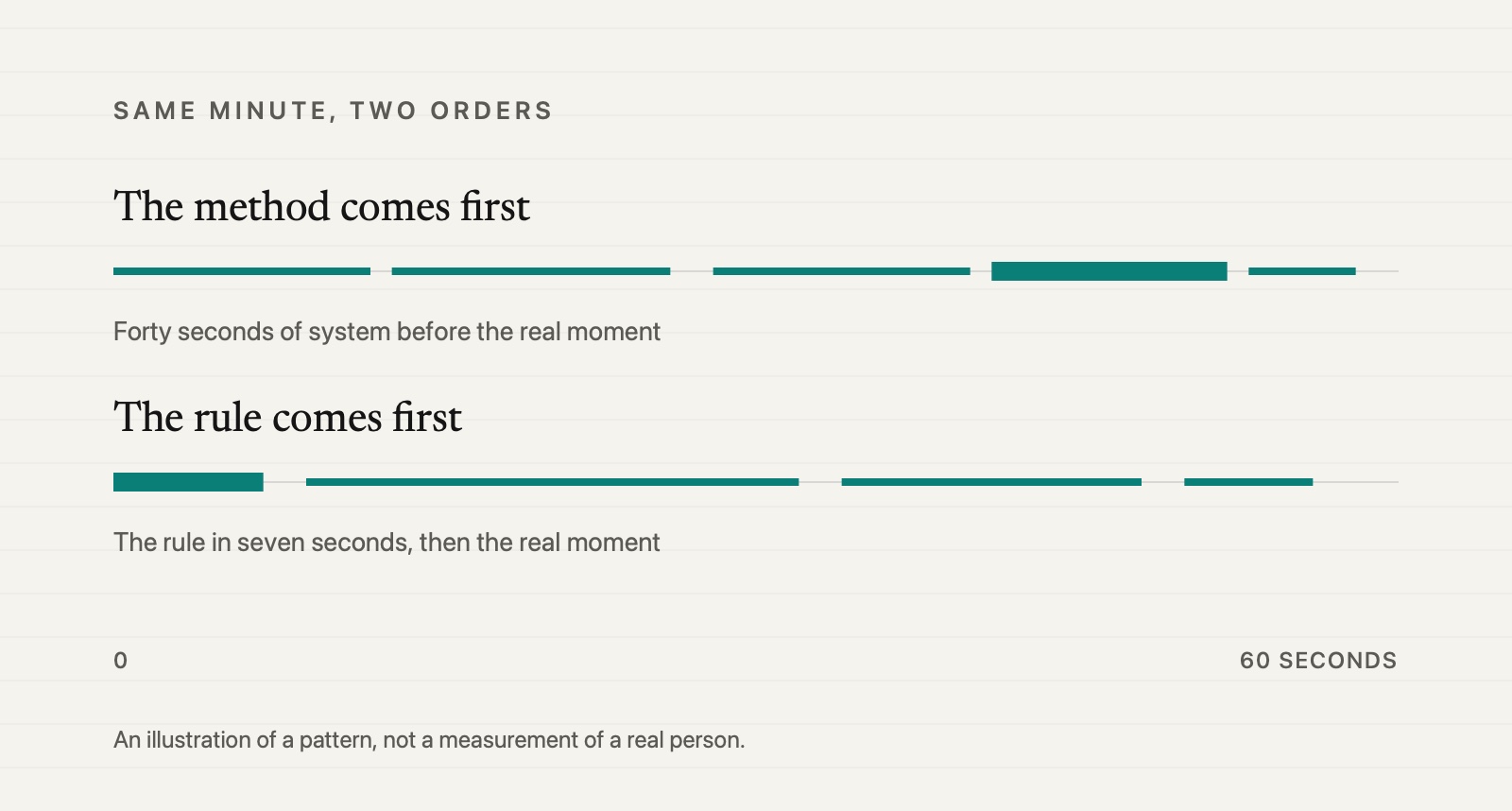
It also pushes the real proof to the end. A framework takes a while to explain, so the one real example shows up after forty seconds, if it shows up at all. By then the interviewer has heard a lesson, not a person.
So flip the order. Your rule comes first, in plain words. The example comes right after it, and it gets most of the minute. If the interviewer wants to know your system, they will ask.
How do you prioritize your work? A one-minute answer
Here is one example answer, built part by part. The details are an illustration, not a real person's story.
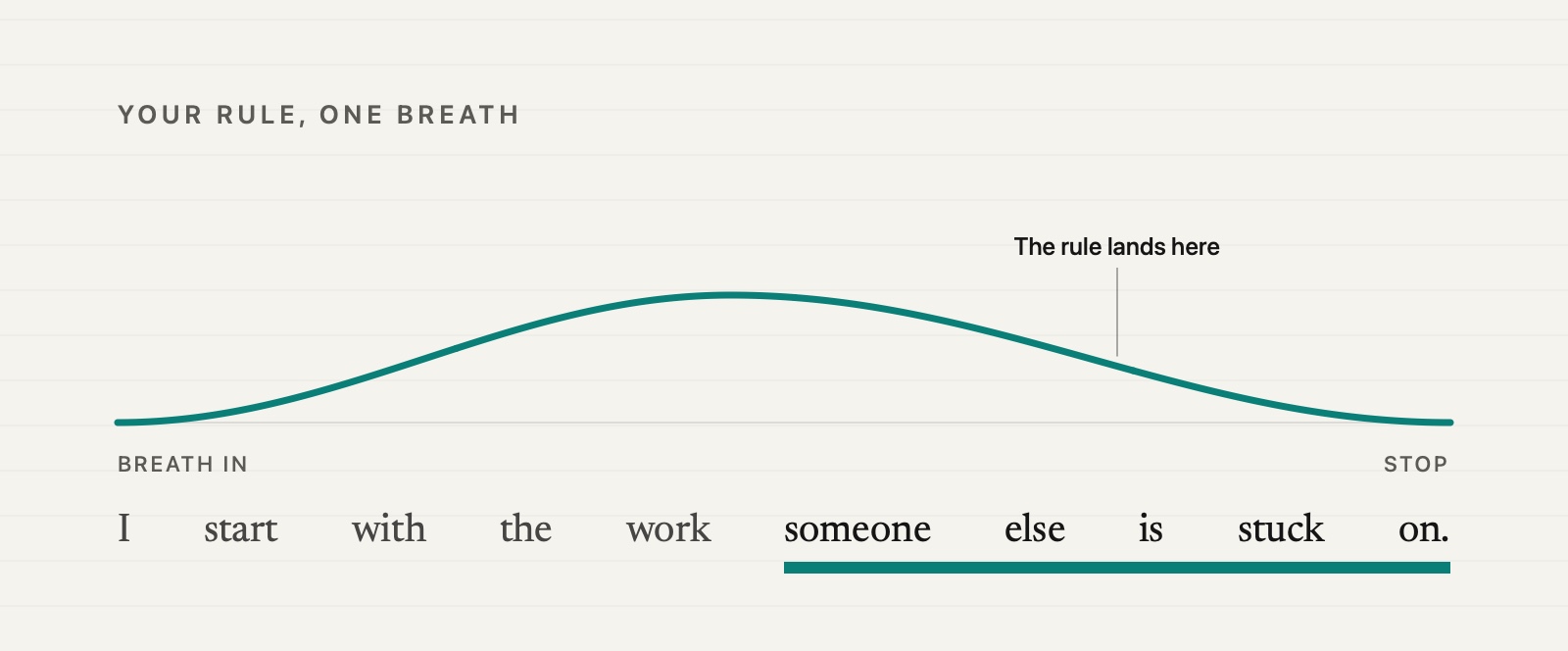
1. Your rule, in one sentence. "I start with the work someone else is stuck on."
2. One moment when the rule was tested. "One Tuesday at my last job, three things hit at once: a month-end report, a vendor form due at noon, and slides my manager wanted by Friday."
3. What you did first, and what you made wait. This is the longest part, because it shows your judgment. "Two teammates could not close the month without my report, so I did that first. The vendor form took ten minutes, so I signed it next. The slides could wait until Wednesday, and I told my manager that before lunch, so there was no surprise."
4. How it turned out. "The month closed on time, the form went in before noon, and the slides were done a day early."
That is about a minute out loud, and it fits what most interviewers hope to hear. If you want more on timing, our post on how long an interview answer should be covers it.
Some interviewers will turn this into a story question and ask for a specific time you had to prioritize. The same answer works. The career center at MIT suggests spending about 60 percent of a STAR story on the actions you took (MIT CAPD). Here, your actions are what you did first and what you made wait, so that part stays the longest.
Say your rule in one sentence
The rule is the part most people never write down. They know how they choose, but they have never said it. So it comes out long: "I try to look at everything and see what is most pressing, and it depends on the day."
That sentence says nothing, because everyone could say it. A real rule is short enough to say in one breath, and it could be wrong for someone else. Here are a few that work:
- "I start with the work someone else is stuck on."
- "I do the thing that gets harder to fix the longer it waits."
- "I protect the customer's deadline first, then my team's."
To find yours, think of your last busy week. What did you do first, and why that one? The reason you give is usually your rule, even if you have never called it that. Pick the one you can back up with a real moment, not the one that sounds best.
Then say it and stop. Do not add "and also." One rule that you actually use is stronger than three that you are listing.
Urgent is not the same as important
The most useful idea in prioritizing is also the oldest. In a 1954 speech, President Eisenhower quoted an unnamed former college president: "I have two kinds of problems, the urgent and the important" (American Presidency Project). That line is often given as the root of the popular matrix named after him.
The split matters because urgency pulls hard. A 2018 study in the Journal of Consumer Research found that people tended to choose time-sensitive tasks over more important ones, even when there was no good reason to, a pattern the researchers called the mere urgency effect (Psychology Today summary). So when you say you noticed the difference, you are showing something that does not come automatically.
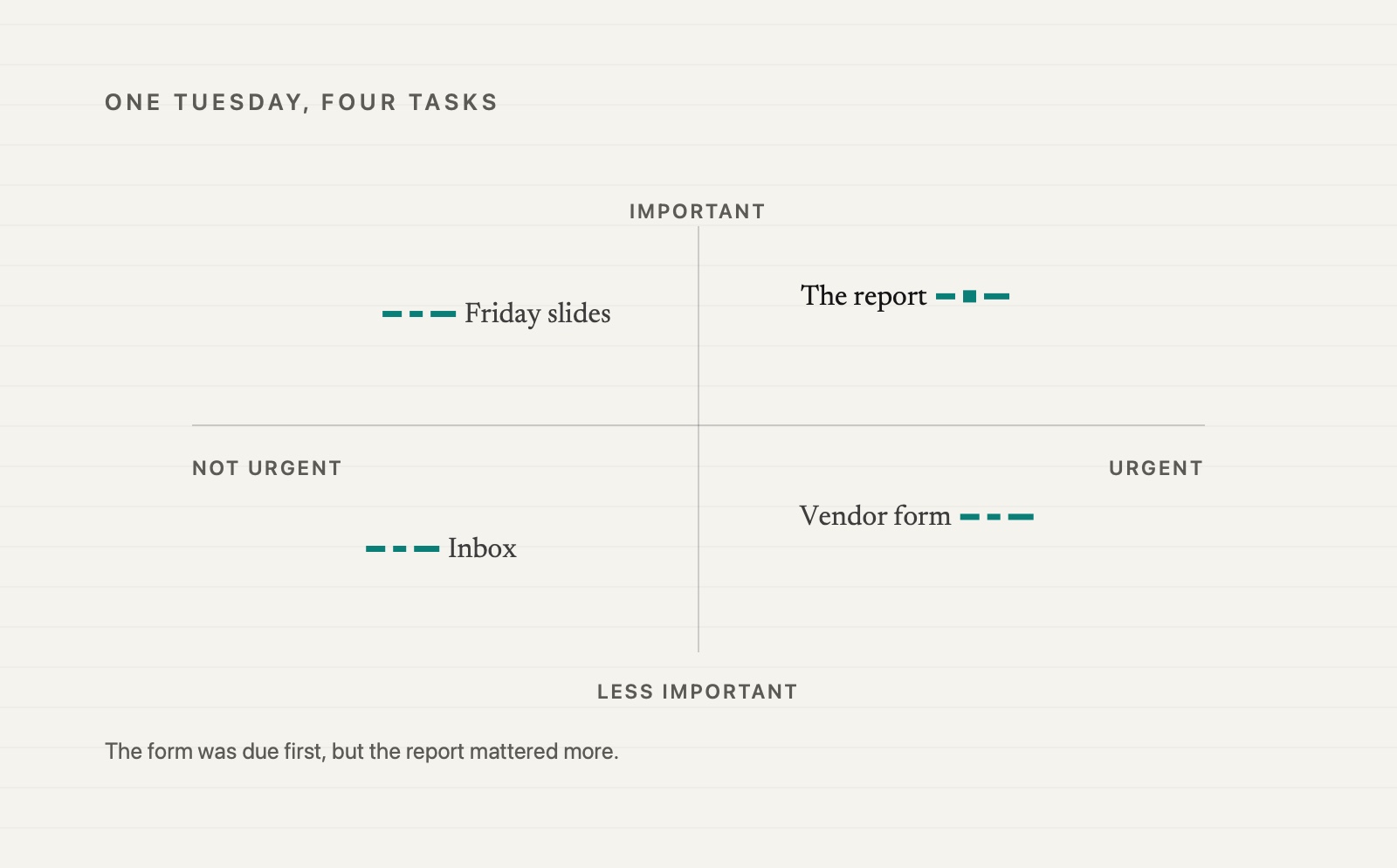
You do not need to say the word matrix. You only need to show the split in your example. In the story above, three things hit at once, plus the inbox that was always there. Here is how each one sorted:
- The report: urgent and important, because two people were stuck. It went first.
- The vendor form: urgent, but small. It got ten minutes.
- The slides: important, but not due yet. They got a time on Wednesday.
- The inbox: neither one. It waited until the end of the day.
Saying this in one line sounds like judgment: "The form was due first, but the report mattered more, so the report went first." That single sentence does more than a full tour of your system.
Say what waited, and who you told
This is the part that sets a strong answer apart. Most answers only list what got done. But prioritizing means something did not get done, at least not yet. If nothing waited, you did not prioritize. You just worked through a list.
So name the thing that waited. It takes one short sentence, and it often feels risky, as if you are admitting a failure. You are not. You are showing that you can make a trade and own it.
Then say who you told. Interviewers often worry about the person who quietly drops something. One clause fixes that: "I told my manager before lunch." If the choice was not fully yours to make, say that too. "I asked my manager which one mattered more" is a strong answer, not a weak one. Knowing when to check is part of knowing what comes first.
If your example is really about one hard due date, our post on how to answer "tell me about a time you met a tight deadline" goes deeper on that story.
When the interviewer asks for more
Good interviewers follow up. Have a one-sentence answer ready for the common ones.
"What tools do you use?" Now you can name them, briefly. "A shared board for the team and a short list for my day." Then stop.
"What if your manager and a coworker both need something today?" Use your rule first, then be open about it. "I would look at who is more stuck, and if it is close, I would tell them both and ask my manager to make the call."
"What if everything is urgent?" Say you would find out what breaks first if it waits, and check the order with your manager. Our post on handling stress and pressure covers that kind of day.
"What did you get wrong?" Have one honest case. "I once put a quiet task last, and it turned out a client was waiting on it. Now I ask who is waiting before I sort my list."
Try it now: a five-minute practice
You need your voice, a timer and your phone's voice recorder.
- Find your rule (one minute). Think of your last busy week. What did you do first, and why? Write that reason as one sentence, starting with "I."
- Find your moment (one minute). Pick a day when that rule was tested. A shift at work, a class project or a volunteer role all count. Write down what went first and what waited.
- Say the whole answer out loud and record it (one minute). Start with the rule. Do not read the rest.
- Listen back (one minute). How many seconds passed before the real moment began? Did you say what waited? Did you say who you told?
- Say it again (one minute). Same rule, same moment. This time, name what waited in one short sentence.
Most people find the second take is shorter and sounds more like a choice they made.
If your rule comes first on paper but your answer still drifts into explaining your system, that is a speaking habit, and you can only catch it by talking. Sayforth is an iPhone app, coming soon, built for that: a 30-day program with one question a day, answered out loud, then shown after you finish as a single speaking line so you can see where your main point landed, with one change to try tomorrow.
Be first to know when Sayforth is live.
Get launch updatesFrequently Asked Questions
How do you answer "how do you prioritize your work" with no work experience?
Use school, volunteering or a part-time job. Your rule can be simple, such as "I start with what other people are counting on." Then give one moment, like a group project due the same week as an exam, and say what you did first and what waited.
Should I mention the Eisenhower Matrix in an interview?
Only if it helps, and only after your rule and your example. Naming a method on its own proves little, since anyone can name one. If you do use it, say how it changed one real decision.
How long should my answer be?
Aim for about a minute. That leaves room for your rule, one example and the result. If the interviewer wants more about your tools or your process, they will ask.
What if my priorities change during the day?
Say so, because they do. Give one example of a change, what you moved to make room for it, and who you told. Showing that you can reorder your day calmly is often a better answer than a perfect plan.