
Here is how to answer "tell me about a time you made a decision without all the information." Say the decision in your first sentence. Then name what you knew, the one thing you did not know, and the check you set so a wrong call would show up early. End with what happened. Aim for about a minute.
Most people have a good story for this question. The trouble is the order they tell it in. The story starts with everything that was unclear, and the decision shows up near the end, almost as an afterthought. By then the interviewer has spent a minute listening to uncertainty and has not yet heard you decide anything. This post builds one example answer part by part, shows how to say the gap in one sentence, and ends with a five-minute exercise.
What the interviewer is really asking
Behavioral questions ask about the past to predict the future. A story about a decision without all the information predicts what you will do the next time the facts are thin and someone needs an answer from you. That happens in almost every job, which is why the question is so common.
Some companies say plainly what they want to hear. Amazon's published leadership principles describe "Bias for Action" this way: many decisions can be undone and do not need long study, and the company values risk taken on purpose (Amazon leadership principles). Other employers use different words, but the question tests the same three things:
- Did you actually decide? Or did you wait until the choice made itself?
- Was the risk calculated? Did you know what you were missing, and roughly what it could cost?
- Did you protect the downside? If you were wrong, how soon would you have found out?
Notice that none of these is "were you right." A good answer can end with a decision that turned out wrong, as long as you caught it early and fixed it.
Why the answer turns into a story about uncertainty
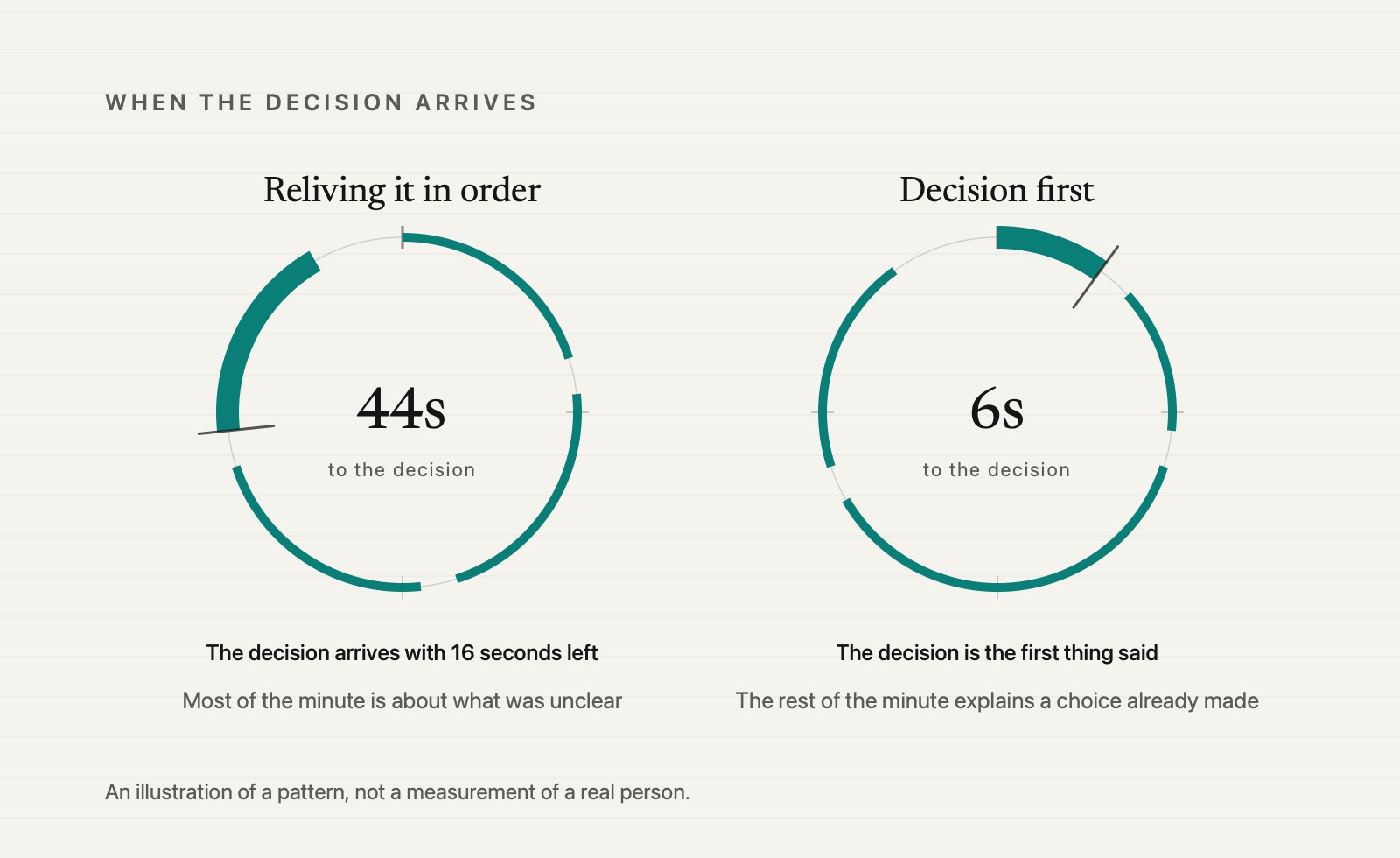
When people tell this story out loud, they tend to relive it in order. First the confusion, then the pressure, then the options, then the meetings, and only then the choice. It feels honest, because that is how it happened. To the listener, it sounds like someone still deciding.
There is a second pull, too. The question is about missing information, so it seems natural to spend the answer on what was missing. But the gap is only the setting. The decision is the story.
So flip it. The decision goes first, in one sentence, before any background. Then the gap has a job: it explains why the decision was hard, instead of standing in for it.
How to answer a decision without all the information in four parts
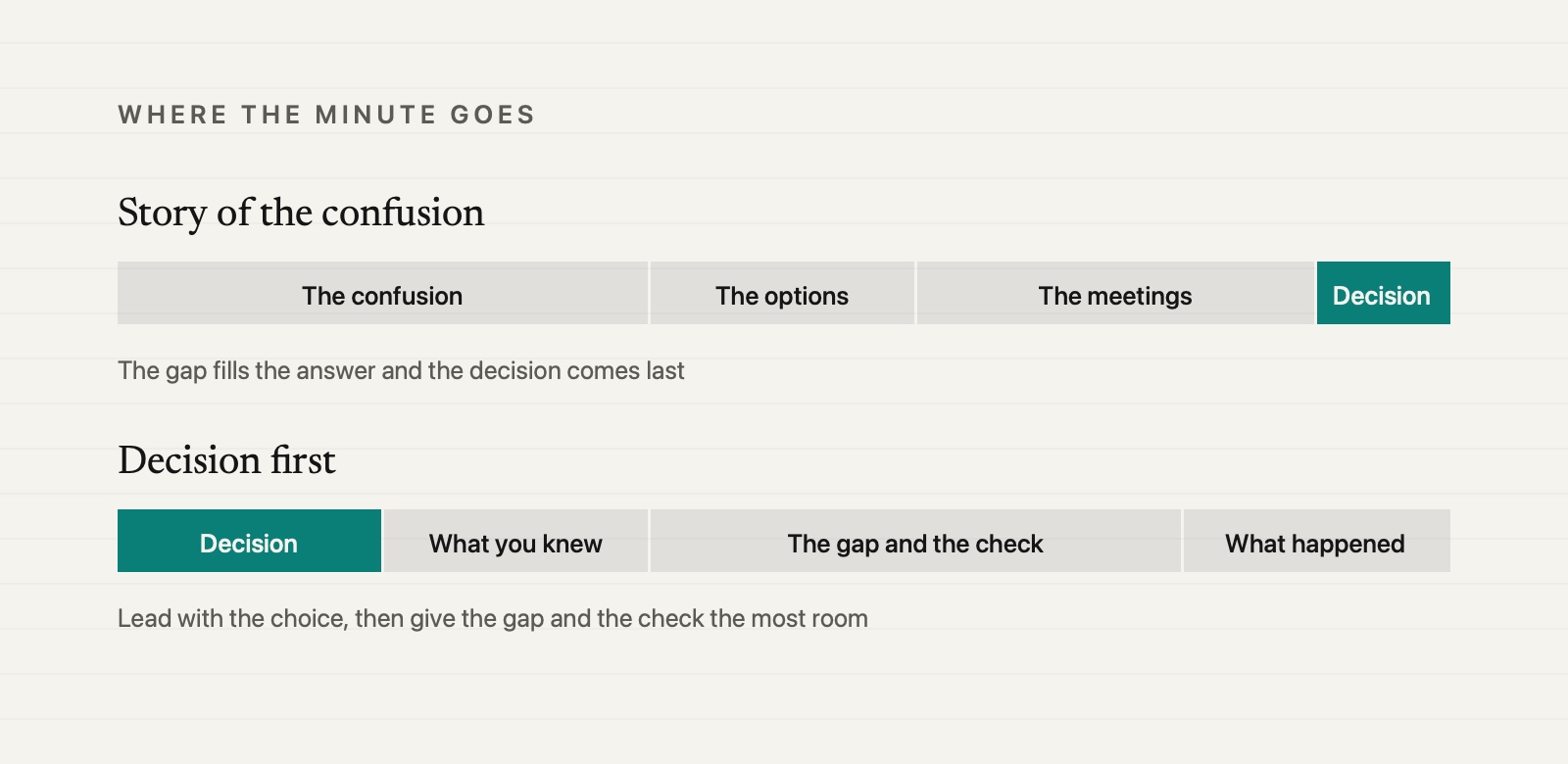
The order matters more than the wording. Here is one example answer, built part by part. The details are an illustration, not a real person's story.
1. The decision, in one sentence. "Nine days before a customer training day, our venue canceled, and I booked a smaller replacement the same afternoon without knowing if its projector setup would work for us."
2. What you knew. Keep it to what made the choice reasonable. "I knew our date, I knew we had about forty people coming, and I knew this venue held forty-five and could confirm that day. Invitations had to go out by Friday."
3. What you did not know, and the check you set. This is the longest part, because it shows your judgment. "What I did not know was whether their screens would work with our laptops. A second venue was nicer but could not confirm until after Friday. So I booked the first one, kept the second as a backup, and set up a walk-through for Monday to test the screens. If they failed, I would still have time to switch."
4. What happened. "The walk-through found we needed one adapter, which we bought that week. The training ran on the original date, and the invitations went out on time. I also learned to ask about screens and adapters on the first call to any venue."
That is about a minute out loud. If you want more on timing, our post on how long an interview answer should be covers it.
The shape also fits the STAR method if your interviewer expects it. The career center at MIT suggests spending about 20 percent of a STAR story on the situation and about 60 percent on the actions you took (MIT CAPD). In this answer, the gap and the check are your actions, so they get the most time.
Say the gap in one sentence
The part that usually goes wrong is the gap itself. Asked what they did not know, people often list everything: the budget was unclear, the timeline might move, the other team had not replied, the client might change their mind. A list like that sounds like a project with no plan.
Pick the one unknown that actually made the decision hard. In the example, it is whether the screens would work. Everything else either was known or did not change the choice.
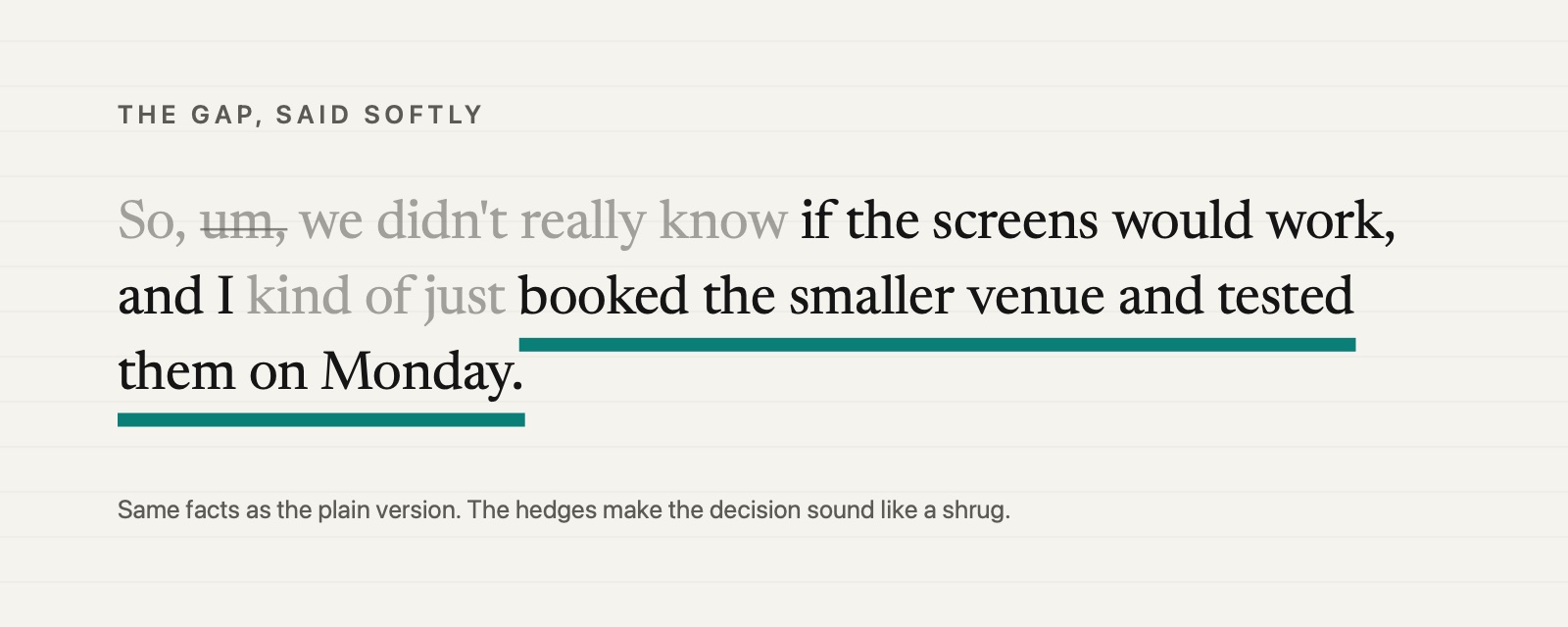
Then say it plainly. When the gap comes out, people tend to wrap it in "we didn't really know" and "kind of just," which makes the decision sound like a shrug. Compare the two versions out loud:
- Soft: "So, um, we didn't really know if the screens would work, and I kind of just booked the smaller venue and tested them on Monday."
- Plain: "I did not know if the screens would work, so I booked the smaller venue and tested them on Monday."
The second version has the same facts. It just puts you in charge of them.
How much information was enough
Interviewers sometimes push on the timing of a decision without all the information. Why not wait a few more days? It helps to have a simple way to explain why you moved when you did.
In his 2016 letter to shareholders, Jeff Bezos wrote that most decisions should be made with around 70 percent of the information you wish you had, and that waiting for 90 percent usually means you are being slow. He added that if you are good at correcting course, being wrong costs less than you might think (Amazon 2016 letter). The same letter describes many decisions as reversible.
You do not need to quote anyone in your answer. But the idea gives you a clean way to explain your timing in one sentence:
- What waiting would have cost. "If I had waited for the second venue, the invitations would have gone out late."
- Whether the choice could be undone. "The booking could be canceled up to five days out, so I had room to switch."
- How you would know you were wrong. "The walk-through on Monday would tell us."
Those three sentences show a calculated risk, not a gamble.
When the decision turned out wrong
Some of the best stories about a decision without all the information are about a call that did not work. Do not hide that. Interviewers often trust a story with a wrong turn more than one where everything went perfectly.
The order stays the same. Say the decision first. Then say what went wrong, how early you caught it, and what you changed. "The screens did not work at all, and the walk-through showed it on Monday. I switched to the backup venue that afternoon and sent the update with the invitations." The check you set is the hero of that story, and the check was your idea.
What to avoid is blaming the missing information. "If they had told us sooner, it would have been fine" is true of almost every hard decision, and it moves the story away from you. If your story is mostly about owning a mistake after the fact, our post on how to tell your boss you made a mistake covers that conversation in more detail.
When the interviewer asks for more
Good interviewers follow up. Have a one-sentence answer ready for the common ones.
"What would you have done with more time?" Name the one piece of information you would have gotten. "I would have visited both venues before booking." Keep it short and honest.
"How did you decide what you could skip?" Say what did not change the choice. "The catering and parking were the same at both, so they did not matter for the decision."
"Who else was involved?" Give credit plainly, then say which part was your call. "My manager agreed on the budget, and the venue choice was mine."
If a follow-up asks something you truly do not know, such as a detail you no longer remember, our post on how to answer an interview question you don't know has a fifteen-second way through it.
Try it now: a five-minute practice
You need your voice, a timer and your phone's voice recorder.
- Pick the story (one minute). Think of a time you made a decision without all the information you wanted. A school project, a volunteer role or a shift at work all count.
- Write two sentences (one minute). The first is the decision, starting with "I." The second is the one thing you did not know.
- Say the whole answer out loud and record it (one minute). Start with the decision sentence. Do not read the rest.
- Listen back (one minute). How many seconds passed before the decision? Did the gap come out as one thing or a list? Did you mention a check?
- Say it again (one minute). Same story. This time, the decision is your first sentence, the gap is one sentence, and you say the check you set.
Most people find the second take is shorter, and the decision finally sounds like something they chose.
If the decision comes first on paper but still slides to the end when you speak, that is a habit you can only hear by talking. Sayforth is a 30-day iPhone program built for that: one question a day, answered out loud, then shown after you finish as a single speaking line so you can see where your main point landed, with one change to try tomorrow. It is coming soon, and you can see how the daily practice works now.
Be first to know when Sayforth is live.
Get launch updatesFrequently Asked Questions
How do you answer "tell me about a time you made a decision without all the information"?
Open with the choice you made, starting with "I." Give one sentence on what you knew and one on the gap that made it hard. Then spend most of the minute on the check you set and what happened.
What is a good example of a decision with incomplete information?
The best decision without all the information for this answer has a real deadline, a cost to waiting, and a call you owned. Booking a vendor, changing a plan when a key person was out, or choosing between two options before all the data arrived all work. Avoid stories where the choice was trivial or someone else decided.
What if my decision turned out to be wrong?
That can still be a strong answer. Say the decision, say how early you found out it was wrong, and say what you changed. Interviewers listen for whether you caught it and fixed it, not whether you were right every time.
Should I use the STAR method for this question?
STAR works well here. Keep the situation short and lead with the decision, then spend most of the answer on what you did not know and the check you set. Those are the actions the question is really about.