
Here is how to tell your boss you made a mistake. Say what happened in your first sentence. Say what it affects in your second. Say what you are doing about it in your third. Then stop talking and let them respond. Four short moves, about thirty seconds, and the hardest one is the last.
Most people know they should own the mistake. The trouble is the moment itself: you mean to be direct, and what comes out is a minute of background and two apologies, with the mistake tucked near the end. This post shows how to build the thirty-second version and rehearse it out loud.
Why the mistake gets buried
When the bad news is about your own work, you reach for cover. You start with the context, because it makes the mistake look reasonable. You add an apology, then another. Each sentence feels like it is softening the blow.
It is doing the opposite. While you talk around the mistake, your boss is sitting with the worst version of it, because they can tell something went wrong and they do not know what yet. A minute of preamble feels like a minute of suspense from their side of the desk. By the time you reach the point, they have imagined three worse things.
So the first rule of how to tell your boss you made a mistake is simple. The mistake goes first, in plain words, before anything that explains it.
Step 1: Say what happened in the first sentence
Decide on one sentence that names the mistake as a fact. Not a feeling and not a story. Use "I" and an action verb, and leave out anything that sounds like a defense.
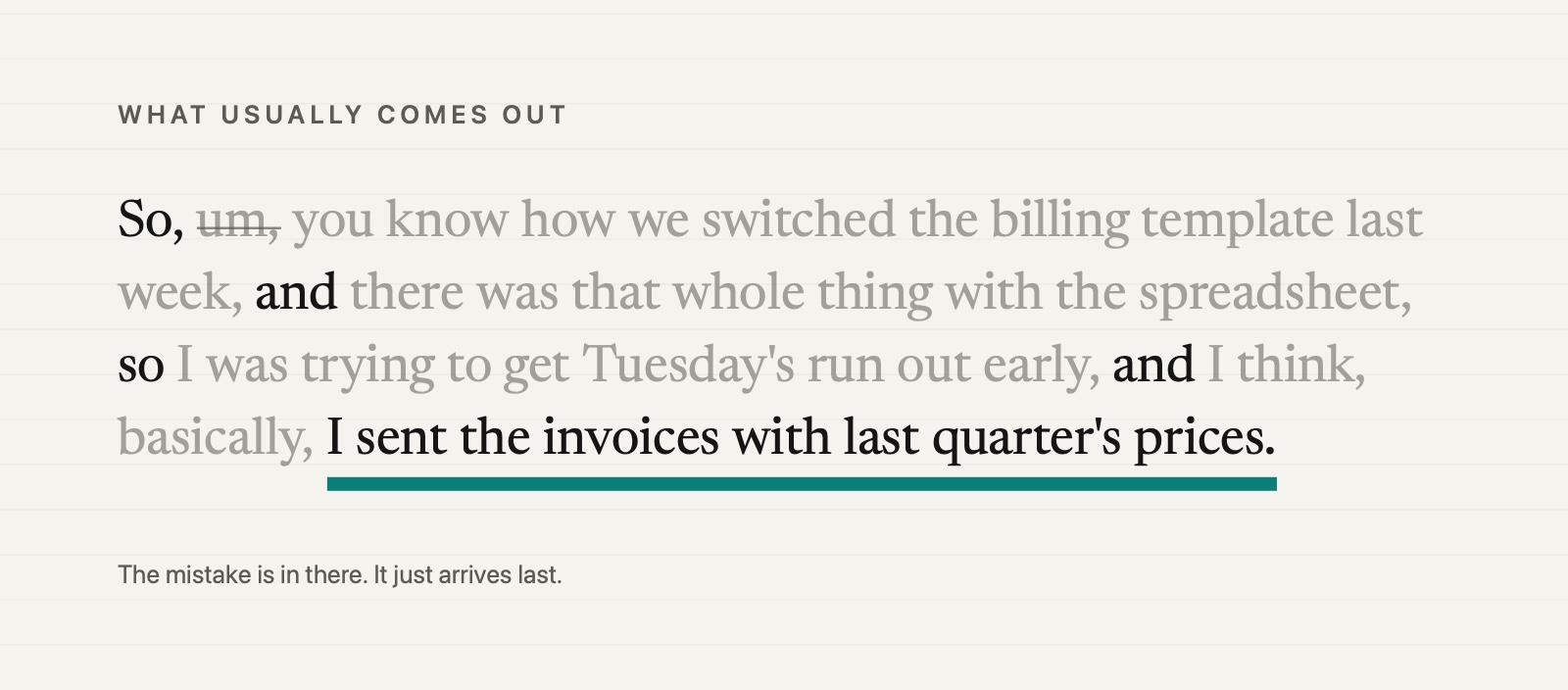
Here is a common example. You ran the invoices on Tuesday and used last quarter's prices by accident. This is what usually comes out:
"So, um, you know how we switched the billing template last week, and there was that whole thing with the spreadsheet, so I was trying to get Tuesday's run out early, and I think, basically, I sent the invoices with last quarter's prices."
And this is the same news said first:
"I sent Tuesday's invoices with last quarter's prices."
Nine words. Your boss now knows exactly what happened. The template change and the spreadsheet may matter later, if your boss asks how it happened. They do not belong in front of the fact.
Notice the words that dropped out along with the background: "I think," "basically," "um." Hedges like these make a clear fact sound uncertain, and uncertainty is the last thing your boss needs from you right now.
Step 2: Say what it affects
Your second sentence answers the question your boss is already asking: how bad is it? Give the scope in concrete terms. Who is affected, how many, how much, and whether it is still happening.
"Thirty-one customers were charged the old rate, about forty dollars too much each. Nothing else in the run was wrong."
It uses real numbers rather than "a few" or "some," so your boss can judge the size without asking. And it draws the edge of the problem. Saying what is not affected is often the most reassuring thing you can offer, and it is only believable because you said the bad part plainly first.
If you do not know the full scope yet, say what you know and when you will know the rest. "So far it looks like thirty-one customers. I will have the full list by two o'clock." That is still a clear sentence. Guessing low to make the moment easier is the one move that turns a mistake into a trust problem.
Step 3: Bring the fix, or the first step of one
The third sentence moves the conversation from the past to the next hour. Come in with a fix, or at least the first step toward one.
"I have a correction email drafted and the refunds are ready to go out today, if you are happy with the wording."
You do not need a complete solution before you speak up. If the fix is not clear yet, bring your first move and your best option: "I have paused the next run so it cannot happen again while we sort this out. My suggestion is that we refund and send a short note today." A plan you can name in one sentence shows your boss that the problem is already being handled. That is what they most want to hear, more than any apology.
Keep the apology to one short line, after the fix. "I am sorry about this one" is enough. Apologizing three times does not show that you care more. It just pushes the useful sentences further away.
Step 4: Stop, and let your boss respond
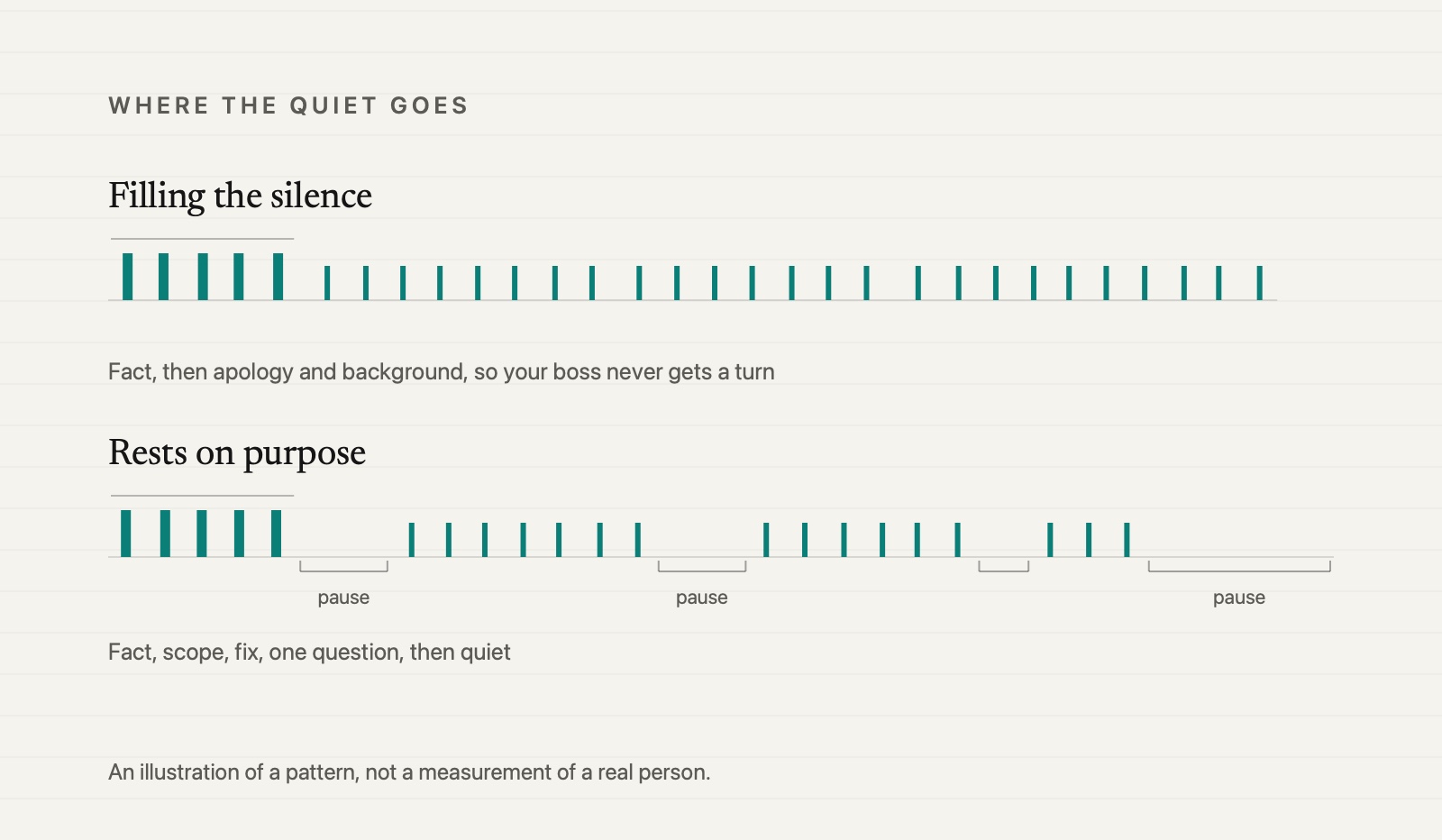
This is the step people skip. You have said the fact, the scope and the fix. Now the silence arrives, and it feels unbearable, so you fill it. More apology. More background. A second explanation of the spreadsheet. A promise that it will never happen again.
Resist it. The pause after your third sentence is your boss thinking about what to ask. If you keep talking, you take their turn away and start undoing the clarity you just built.
End on a real question that hands the conversation over, then stop. "Do you want to see the email before it goes out?" One question, then quiet. Three seconds of quiet will feel long to you. To your boss, it is simply time to think.
Step 5: Tell them soon, and in the right room
When you tell your boss you made a mistake, timing matters as much as wording. Tell your boss as soon as you are sure of the basic fact, and before they can hear it from someone else. A customer complaint that reaches your manager before you do turns your honest report into a reaction to being caught.
Pick a private moment. A quick call or a one-on-one beats a team meeting or a long message, because you can answer questions right away. If your boss is hard to reach, a short message that leads with the fact and asks for five minutes is fine: "I made an error on Tuesday's invoices and have a fix ready. Do you have five minutes today?"
Do not wait to feel ready. That is how a mistake you found on Tuesday becomes a conversation on Friday.
What not to say when you tell your boss you made a mistake
A few phrases reliably make the conversation harder. Learn to hear yourself reach for them.
- "It's only a small thing, but..." Minimizing invites your boss to wonder what else you are minimizing. Let the scope sentence set the size.
- "The system did it" or "nobody told me." Even when there is a real cause outside you, leading with it sounds like blame. Mention the cause later, as part of how to prevent it next time.
- "I'm so stupid." Harsh words about yourself force your boss to comfort you instead of solving the problem. Keep it about the work.
- "I promise this will never happen again." You cannot promise that. You can say what you have changed: "I have added a price check before every run."
Why speaking up early helps the whole team
It can feel like admitting a mistake puts a mark on you. The research on teams points somewhere more useful. Amy Edmondson's study of 51 work teams at a manufacturing company described team psychological safety as "a shared belief held by members of a team that the team is safe for interpersonal risk taking," and counted behaviors such as seeking feedback and discussing errors as the ways a team learns (Edmondson, Administrative Science Quarterly, 1999). In that study, the teams with more of that shared belief did more of that learning.
You cannot build a team's culture in one conversation. But every clear, early report of a mistake is one small example of that kind of speaking up, and it makes it easier for the next person to bring a problem forward while it is still small.
Try it now: rehearse telling your boss in five minutes
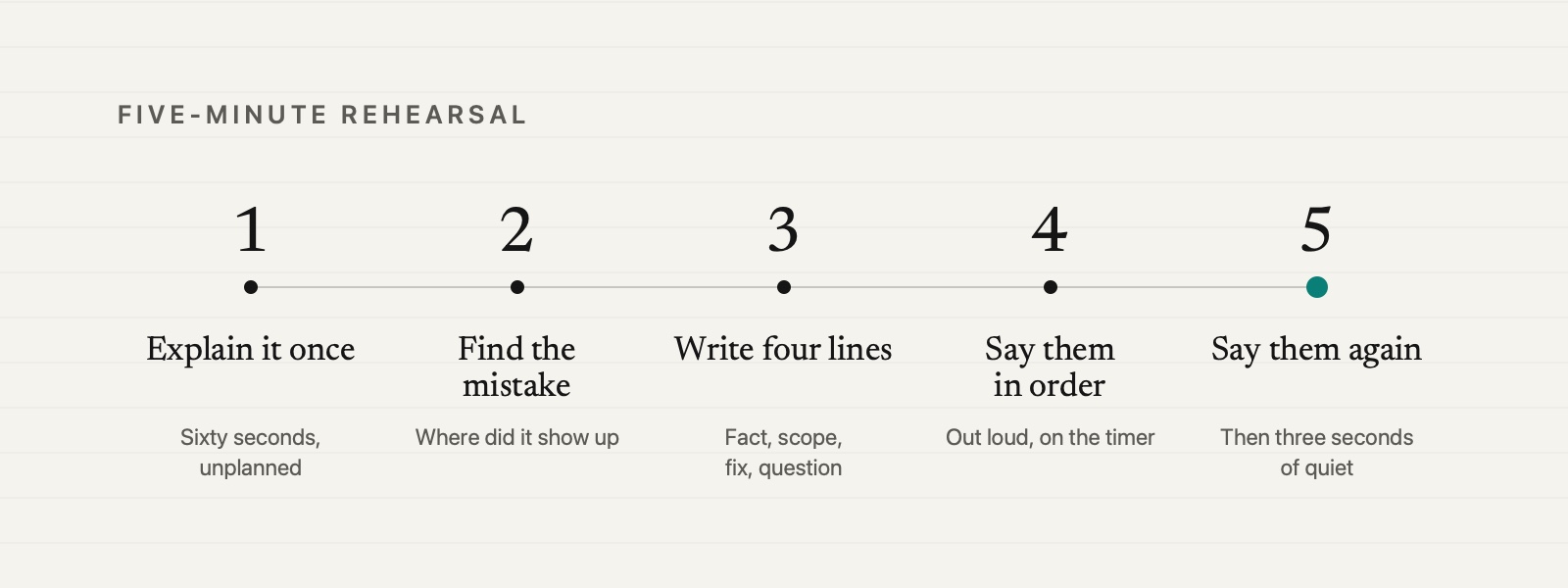
You will tell your boss you made a mistake more clearly if you have said it out loud once before. This takes five minutes and needs only your voice and a timer.
- Pick a real mistake, recent or old. Set a timer for sixty seconds and explain it out loud the way you naturally would. Do not plan it.
- Notice where the actual mistake showed up. Most people find it near the end, behind the background.
- Write four short lines: what happened, what it affects, what you are doing about it, and the question you will end on.
- Set the timer again and say those four lines out loud, in that order. It will probably take twenty to thirty seconds.
- Say them once more, and this time stay silent for a full three seconds after your question. That silence is the part you are practicing.
Nothing about the mistake changed between the first attempt and the last. You moved the part that matters to the front and learned to stop after it.
If the fact keeps sliding to the end no matter how often you plan it, that is a habit you can only hear by speaking. Sayforth is a 30-day iPhone program for exactly this: one question a day, answered out loud, shown afterward as a single speaking line so you can see where your point landed, with one change to carry into tomorrow. It is coming soon.
Be first to know when Sayforth is live.
Get launch updatesTwo related posts go further on the same skill. If you report on your work every week, how to give a status update in a meeting puts the state of the work first, even when the news is bad. And if an interviewer asks how you handle criticism, how to answer "tell me about a time you received critical feedback" shows how to talk about being corrected without defending yourself. You can also see how the daily practice works.
Frequently Asked Questions
Should I tell my boss about a mistake in person or by email?
In person or on a quick call is usually better, because you can answer questions right away and your tone carries part of the message. If your boss is hard to reach, send a short message that names the mistake in the first line and asks for five minutes, then talk it through live.
How soon should I tell my boss I made a mistake?
As soon as you are sure of the basic fact, and before they hear about it from someone else. You do not need the full fix first. Bring what you know, your first step, and when you will know more.
How do I tell my boss I made a mistake without getting fired?
No script can promise how your boss will react. What you control is how clearly you report it: the fact first, the real scope, a fix or a first step, and one short apology. That is the version that gives your boss the most confidence in how you handle problems.
How do I apologize to my boss for a mistake without overdoing it?
Say it once, briefly, after you have explained the fix. "I am sorry about this one" is enough. Repeated apologies push the useful information further away and can make your boss feel they need to reassure you.