

Here is how to introduce a speaker: say why this topic matters to this room, say why this person is the one to hear it from, and finish with the title of the talk and their name. Then turn to them, start the applause, and sit down. Three short parts, about 45 seconds, with the name as the very last word.
That is the whole job. You are not giving a talk. You are opening a door for someone else, and most introductions go wrong by trying to do too much.
Why most speaker introductions fall flat
The usual mistake is reading the bio. Someone sends over a paragraph with every degree, past job and award, and the host reads it out word for word. It sounds like a form being filled in, and the speaker walks up to a room that has already drifted.
The other mistakes pull the other way. The host tells a joke that lands better than the speaker's opening. The host shares their own view on the topic, so the talk starts with a second speaker nobody asked for. Or the host says "she needs no introduction" and then gives one anyway. A public speaking textbook from Lumen Learning puts it simply: be brief, skip the jokes and clichés, and do not upstage the speaker.
All of these come from the same place: in the moment, the introduction feels like it is about you. Once you accept that your job is to hand over the room, most choices make themselves.
Step 1: Ask the speaker what they want said
Do this a few days before, not in the hallway five minutes before. Send a short message: "I'm introducing you on Thursday. Is there anything you would like me to say, or leave out? And how do you say your name?"
Speakers know which part of their background fits this talk, and they may want to skip a detail that is out of date. Toastmasters tells speakers to give their written remarks to the person introducing them well before the event, so the host has time to read, practice and ask questions.
The name matters more than anything else you will say. If you are not sure how to pronounce it, ask, and then say it out loud ten times until it feels normal in your mouth. Getting it right sounds like respect.
Step 2: Open with why this topic matters to this room
Your first sentence is not about the speaker. It is about the people in the seats. Why should they care about this topic, today, in this building?
Say you are introducing Dana, who runs safety at one of your company's warehouses, at an all-hands. A weak opening is "Our next speaker is Dana Okafor, who has worked here for six years." A stronger one is "Last spring, both of our warehouses reported more near misses in one quarter than in the whole year before."
The second version makes the room lean in. It names a problem they share, so they want to hear what comes next. Keep it to one or two sentences. You are pointing at the problem, not solving it. Solving it is the speaker's job.
Step 3: Give one or two reasons this person is the one to hear
Now bring in the speaker, but only the parts of their background that connect to this talk. Ask yourself: what is the one fact that makes the room think "this person knows"?
For Dana, it might be: "Dana has run safety at the Reno site for six years. In that time, she cut its safety checklist from forty items to twelve." That is it. Her degree, her last employer and her volunteer work can all stay on the event page.
One or two facts beat a full bio because people can hold them. A university handout on introducing speakers makes the same point from the other side: if the room already knows the speaker, only the major highlights are needed. Even with strangers, pick the facts that tie to the topic and let the rest go.
Step 4: Save the speaker's name for the last line
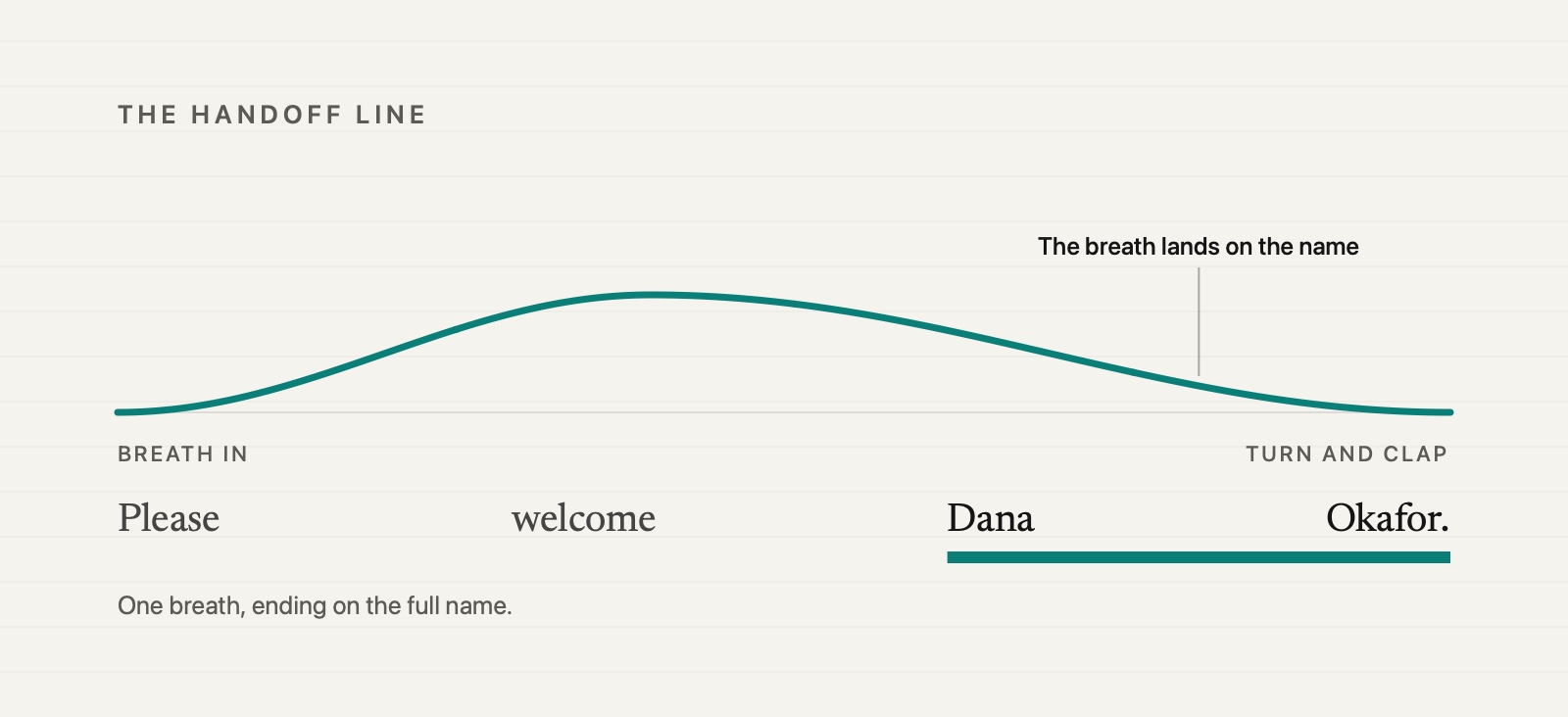
This is the step that makes an introduction sound practiced. Say the title of the talk, then the person's full name, and make the name the very last word you say. "Her talk is called 'The Twelve That Matter.' Please welcome Dana Okafor."
The name is a cue. When the room hears it, people clap and the speaker stands. Say it early and you end up talking over a speaker who is already walking up. Say it last and everyone moves at the same moment.
You can use a first name earlier, as the full example below does. But the full name, said clearly, goes at the end. Slow down for it. For many people in the room it is a new word, and new words need a moment to land.
Try to say the whole handoff line in one breath: the title, "Please welcome," and the name. A breath in the middle of it makes the name sound like an afterthought. One breath, landing on the name, sounds like an ending.
Step 5: Say it to the room, then hand over
Write your introduction down, and bring it with you. Reading from a card is fine for an introduction, and much better than losing a fact halfway through. But practice it enough that you can look up for most of it.
Face the audience while you speak. You are talking to them about the speaker, not to the speaker about themselves. Turn toward the speaker only at the end, as you say the name. Then lead the applause, wait for them to arrive, greet them, and step away. Lumen Learning's advice is to sit down promptly rather than linger on stage.
If the room is noisy, wait at the front and let it go quiet before your first sentence. The post on how long to pause when you speak shows why a pause feels so much longer from where you are standing.
How to introduce a speaker: a full example
Here are the three parts put together, as you would say them out loud.
"Last spring, both of our warehouses reported more near misses in one quarter than in the whole year before. Most of us have heard the safety talk so many times that we no longer hear it at all. Dana has run safety at our Reno site for six years. In that time, she cut its checklist from forty items to twelve, and she is here to tell us which twelve, and why. Her talk is called 'The Twelve That Matter.' Please welcome Dana Okafor."
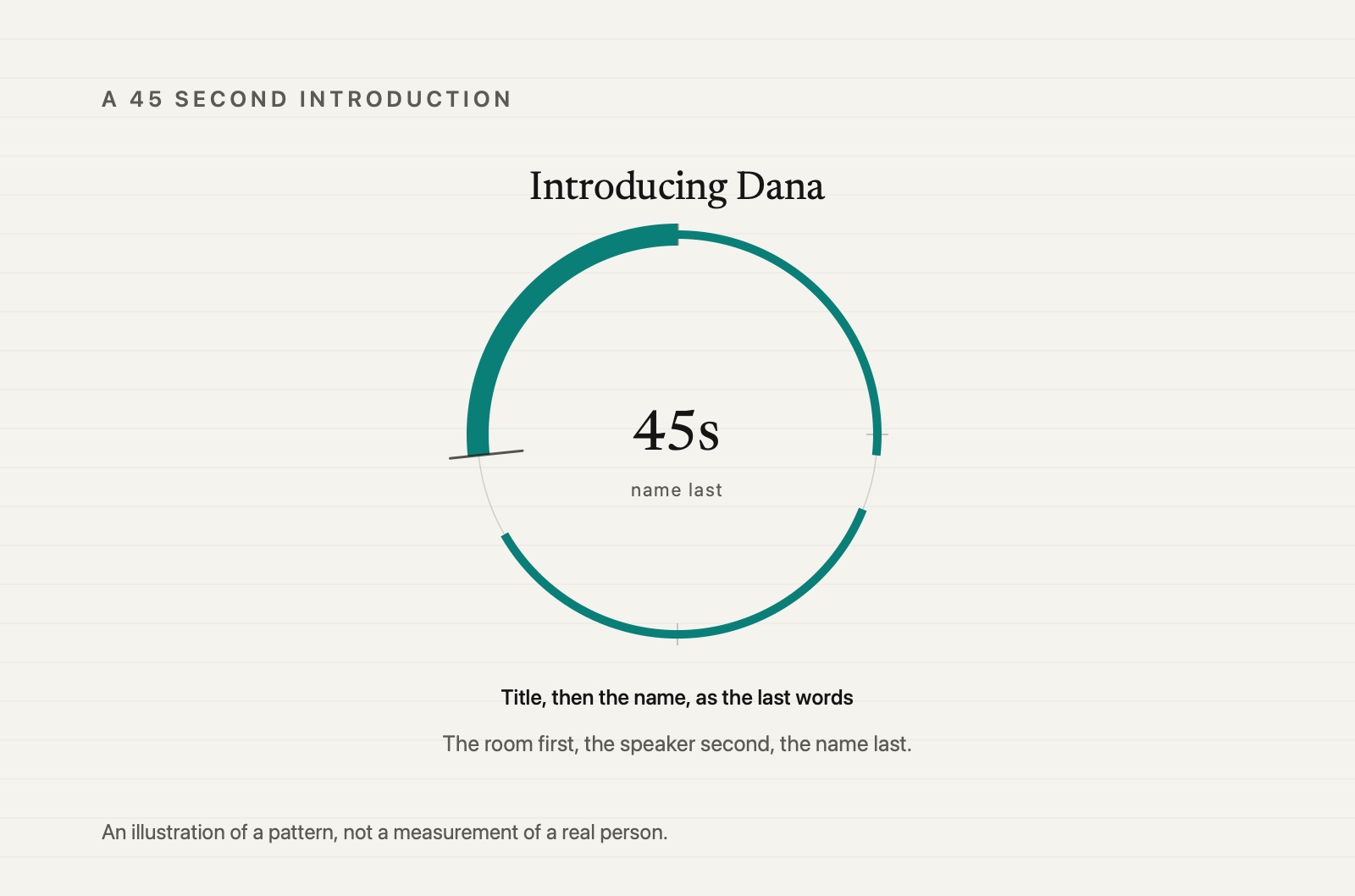
Read at an easy pace, that runs about 35 to 45 seconds. The first two sentences are about the room. The next two are about Dana. The last two are the handoff. Nothing is about the host.
How long should a speaker introduction be?
Shorter than you think. Guides differ a little, but they agree on the range. The Agnes Scott handout suggests about a minute. Toastmasters gives a rule of thumb: make the introduction about 15 percent of the talk, which is 45 seconds for a five-minute speech.
For most work events, aim for 30 to 60 seconds. A keynote that runs an hour might earn a little more. A ten-minute slot at a team meeting needs less. If your introduction runs past a minute, it is almost always because you are reading the bio. Cut it back to one or two facts.
What not to say when you introduce a speaker
A few lines turn up in almost every weak introduction. Listen for them when you practice.
"Our speaker needs no introduction." Then why are you giving one? This line is a cliché, and the room knows it.
"Without further ado." It adds nothing. Go straight from the last fact to the title and the name.
A joke at the speaker's expense. Even a friendly one puts the speaker on the back foot before they say a word.
Your own take on the topic. You may know a lot about it. Today is not your turn.
A big promise. "This talk will change how you think about safety" sets the speaker up to fall short.
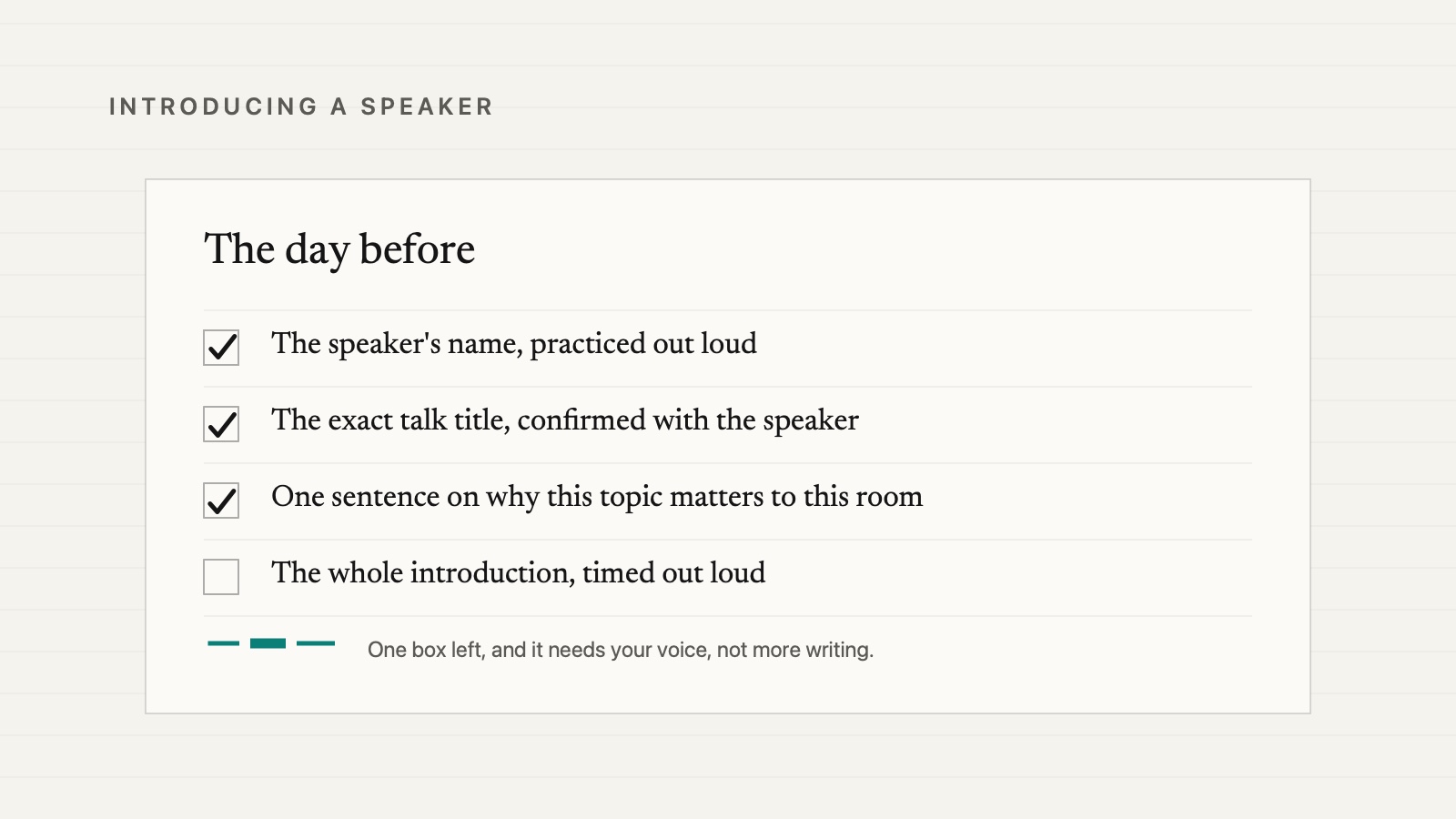
The day before: what to have ready
Most of the work happens before you walk to the front. The day before, check the few things a smooth introduction needs, and make any changes the speaker asked for.
The last item is the one people skip. Reading your introduction silently tells you almost nothing about how long it takes or where you will stumble. Saying it out loud, with a timer running, tells you both.
Try it now: a five-minute introduction drill
You need your voice, a timer and the recorder on your phone. Pick a real person you might introduce, or a colleague you know well.
- Write one sentence on why their topic matters to the people in the room.
- Write one or two facts about them that connect to that topic. Only one or two.
- Write the handoff: the talk title, then "Please welcome," then their full name.
- Start the timer and the recorder. Say all of it out loud, to an empty chair as if it were the room.
- Listen back. Check three things. Did it run under 60 seconds? Was the name the last thing you said? Did your voice slow down for the name, or did it rush?
Do it twice more. If you rushed the name on the first take, slow it down on the next.
The shape is close to the one in how to introduce yourself in a meeting: a few short sentences, a reason the room should care, and a clean stop.
If your words are fine on paper but rush or trail off once you say them, that is a speaking habit, and you only notice it by talking. Sayforth is an iPhone app, coming soon, built for that kind of practice: one question a day, answered out loud, shown after you finish as a single speaking line so you can see where your main point landed, with one change to try tomorrow. You can see how the daily practice works first.
Be first to know when Sayforth is live.
Get launch updatesFrequently Asked Questions
How long should an introduction for a speaker be?
For most events, 30 to 60 seconds. Toastmasters suggests about 15 percent of the talk's length, which is 45 seconds for a five-minute speech. If yours runs longer, you are probably reading too much of the bio.
What do you say when introducing a guest speaker?
Say why the topic matters to this audience, give one or two facts that show why this person is the right one to speak on it, and end with the talk title and their full name. "Please welcome" followed by the name is a clear, simple handoff.
Should you read the speaker's bio word for word?
No. A full bio read aloud sounds like a form, and the room stops listening quickly. Pick the one or two facts that connect to this talk, and leave the rest on the event page or the program.
How do you end a speaker introduction?
End on the speaker's full name, said slowly and clearly. Turn toward them as you say it, start the applause, and step away once they reach the front. Saying the name last gives everyone the same cue to clap and gives the speaker a clean start.