
Here is how to end a presentation: decide your last sentence before you build anything else, signal the end once, take questions before your close, say that sentence, and stop. The whole ending takes about thirty seconds. Most talks do the opposite. They reach the last slide, slow down, and fade out on "So, yeah, that's about it. Any questions?"
That fade is not a small flaw. You may have spent twenty good minutes making a case, and the room's last memory of it is you running out of things to say. The fix does not take talent or a clever line. It takes one sentence, chosen in advance, and the nerve to stop right after it.
Why the ending matters more than its length
Your ending is only a small part of the time you spend in the room, but it does a lot of work. Psychologists call the reason the peak-end rule. People do not remember an experience as a full record. They tend to judge it by its most intense moment and by how it finished. The Nielsen Norman Group gives a clear summary of the idea and the research behind it in its article on the peak-end rule.
That research did not study presentations, so treat it as a reason to care, not as a law of public speaking. There is also a practical reason. The last thing you say is the thing people carry out of the room. If your last words are "any questions," that is a line nobody can use.
Step 1: Write your last sentence first
Before you open your slides, write the one sentence you want people to remember. It should say what you want them to think or do, in words you would really say out loud.
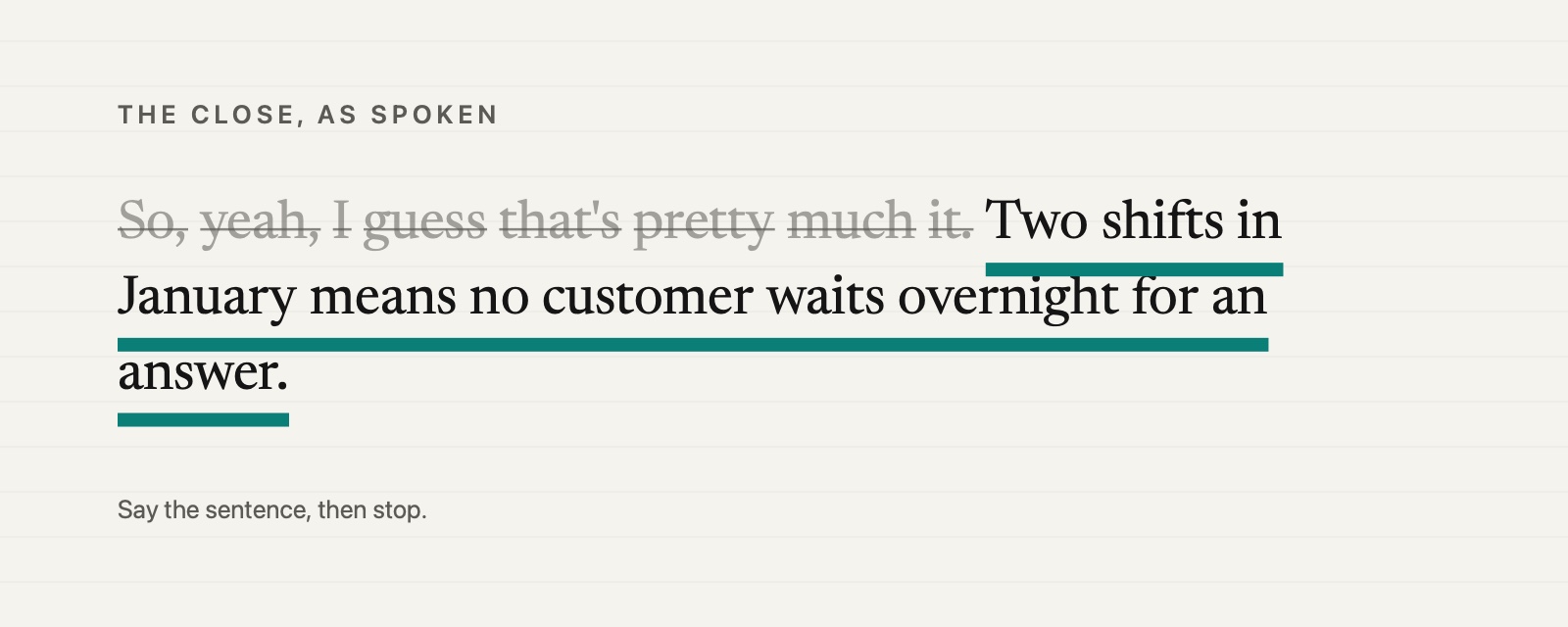
Say you are proposing a change at work: moving your support team to two shifts starting in January. Here is a topic: "That's the overview of the staffing options." Here is a last sentence: "Two shifts in January means no customer waits overnight for an answer."
The second one can stand alone. Someone who walked in late could hear only that sentence and know what you think. That is the test. If your sentence would make no sense to a person who missed the talk, it is a summary of the agenda, not an ending.
Keep it short enough to say in one breath. Long closing sentences are hard to say under pressure, and they are the first thing to fall apart when you are nervous. Once you have it, write it at the bottom of your notes and leave it alone. It should not change on the day.
Step 2: Signal the end once
People listen harder when they know the finish is close. So tell them, one time, in plain words: "One last thing." Or "Here is where I want to leave you."
The key words are one time. A good signal is a promise, and a broken one costs you. If you say "to wrap up" and then talk for five more minutes, the room stops believing you. Worse is the talk with three endings, where each one feels final and then another slide appears. Once you signal the end, you have about thirty seconds left.
Your voice can help too. Slow down a little and let the pitch come down at the end of your sentences. Your tone can show the room the talk is closing before the words do.
Step 3: Take questions before your final line
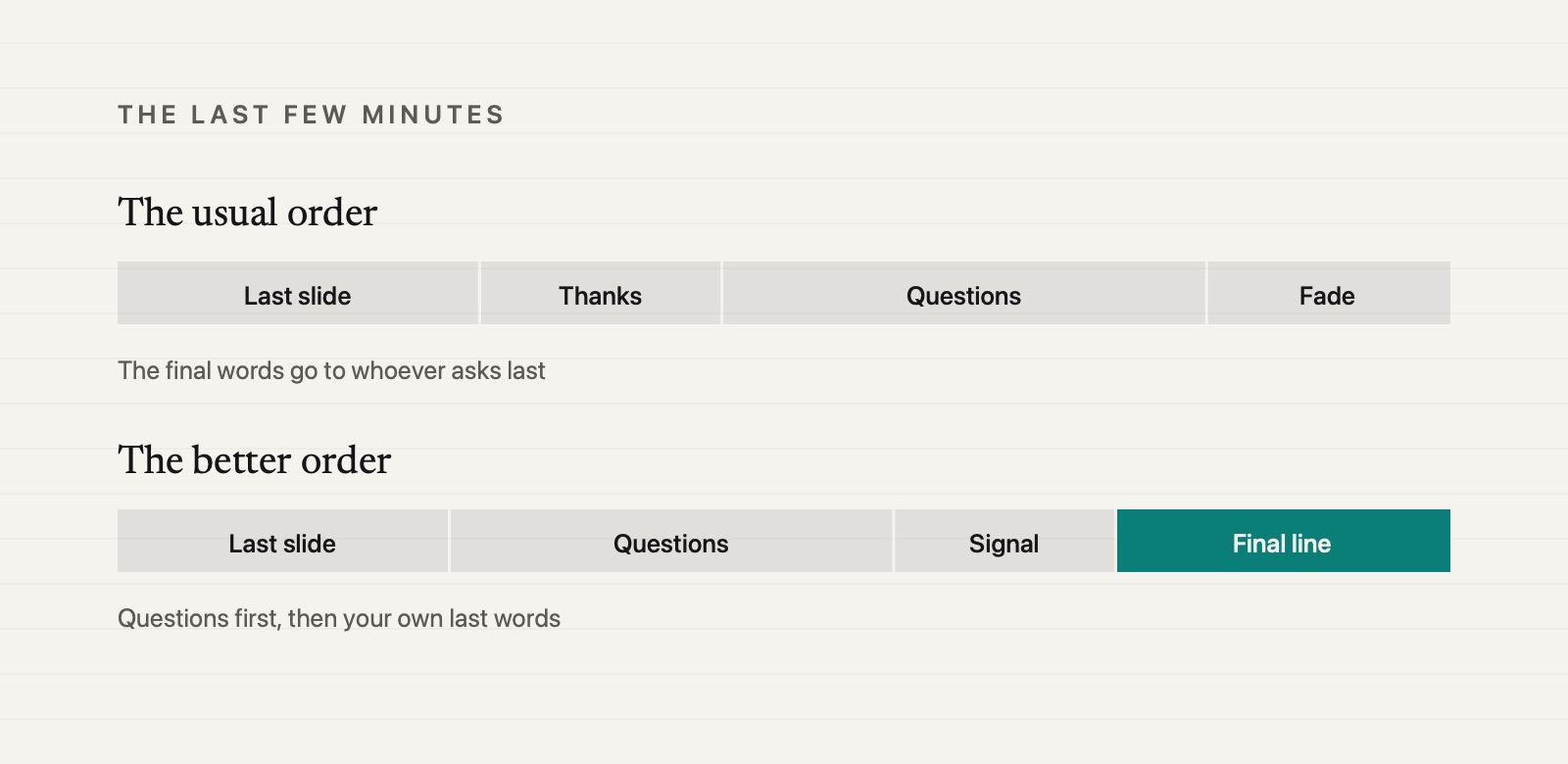
This is the step that changes most endings, and it is a simple change of order. The common order puts questions last. That hands your final words to whoever asks the last question, and that question may be about a side detail on slide four.
Try this order instead. When your content is done, say: "What questions do you have?" Take them. Then, when the time is up or the questions run out, come back and give your real ending. You get the Q&A and you still get the last word.
If you are worried about time, set the limit out loud. "We have five minutes for questions, then I will close." Then keep to it. When the last answer is done, take one breath and go straight to your signal and your final sentence.
Step 4: Say your point again, then give one next step
Your closing does not need to review every section. Open public speaking textbooks say a full recap can help in long or technical talks, but should be avoided in short ones. Stand Up, Speak Out says the summary device can help with technical material or talks over thirty minutes, and should be avoided in short speeches. For most work presentations, one sentence of recap is enough.
What the room does need is a clear next step, when there is one. Who does what, and by when? Be exact. "Let me know what you think" gives nobody a job. "I need a yes or no from this group by Friday" does.
Put together, the close for the shifts proposal could sound like this: "One last thing. I am asking for a yes by Friday, so we can set schedules before January. Two shifts in January means no customer waits overnight for an answer." That runs about fifteen seconds. Notice the order: the action first, then the sentence you want them to remember.
If you are presenting to people who make decisions, the same idea applies with more force. The post on how to present to senior leadership covers putting the ask first and returning to it at the close.
Step 5: Stop talking
This is the hardest step in how to end a presentation, because nothing about it feels natural. You say your final sentence, and then there is silence. It is tempting to fill it. Most of the damage to a good ending happens in the three seconds after it, with "So, yeah," or "Anyway, that's all I've got," or a rushed "Thanks."
Instead, hold still. Look at the room, keep your face calm, and count two beats in your head. That pause gives your last sentence time to land. It is also what tells the room you are done, so you do not have to say so. If pauses make you uneasy, the post on how long to pause when you speak shows how much shorter they feel from the other side.
After the two beats, say "Thank you," if you want to. A short thank-you is polite, and in many rooms people expect it. The trouble only comes when it replaces your ending. Your last sentence goes first, then the pause, and then the thanks.
Three ways to end a presentation that work
Your last sentence can take a few different shapes. Pick the one that suits your talk, not the one that sounds the most impressive.
Return to your opening
If you started with a story, a problem or a question, finish it. Open with the customer who waited eleven hours for a reply, and end with what would have happened under the new plan. The Towson University public speaking center also suggests tying your ending back to your introduction. This is often the strongest choice, because the room feels the talk come full circle.
End on the ask
If you want a decision or an action, make that your final sentence. "I am asking you to approve two shifts today." This is the right choice for most work meetings, because it leaves nobody wondering why they were there.
End on one picture
If your talk is about why something matters, end with a single plain image of the result. "A customer writes in at midnight and has an answer by one." One sentence, with no build-up. A concrete picture stays with people longer than a general statement like "this will improve our service."
What not to say at the end of a presentation
Most weak endings use the same few lines. Look for these when you practice.
"So, yeah, that's it." This tells the room the talk ran out instead of finished.
"Sorry for going over." An apology makes your last words about your timing. If you ran long, cut the rest and go straight to your close.
"I don't know if that made sense." This takes back what you just said. If you worry about it, ask for questions before you close.
"Thank you for your time. Any questions?" Thanks and questions are both fine. Together, in that order, as your last words, they leave nothing for anyone to remember.
A new point. The closing is not the place for something you forgot. If it matters, it belongs earlier. If you leave it out, nobody will know.
Try it now: a five-minute closing drill
You need your voice, a timer and the recorder on your phone. Use a real talk you have coming up, or a recent one.
- Write your last sentence. Say it out loud once. If you run out of breath, shorten it.
- Start the recorder. Say "One last thing," then your next step, then your last sentence.
- Stay silent for two full seconds after the sentence. Count them. Then stop the recording.
- Listen back and check two things only. Did your voice come down on the last word, or did it go up like a question? Did you add anything after the sentence?
- Do it twice more. Most people add words on the first take, even a tiny "so." The goal is a take where the last sentence is really the last thing on the recording.
Then practice the join: pretend someone just asked a question, answer it in one sentence, take a breath, and go straight into your close.
If your ending is clear on paper but you still hear yourself trail off at the end, that is a speaking habit, and you can only catch it by talking. Sayforth is an iPhone app, coming soon, built for that: a 30-day program with one question a day, answered out loud, then shown after you finish as a single speaking line so you can see where your main point landed, with one change to try tomorrow. You can see how the daily practice works first.
Be first to know when Sayforth is live.
Get launch updatesFrequently Asked Questions
What is a good closing sentence for a presentation?
A good closing sentence says the one thing you want people to remember or do, in plain words, and it makes sense on its own. "Two shifts in January means no customer waits overnight for an answer" works because someone who missed the talk would still understand it. Avoid general lines like "I hope this was helpful."
Should you say thank you at the end of a presentation?
Yes, if you want to, but not instead of your ending. Say your last sentence, pause for two beats, and then say thank you. That way the thanks is a courtesy and the last idea in the room is still yours.
How long should the end of a presentation be?
For most work presentations, about thirty seconds or a few sentences. That is enough for a signal, a next step and your last sentence. Longer talks can use a short recap of the main points, but a close that runs for minutes starts to feel like a second talk.
Should you end a presentation with questions?
Take questions near the end, but not as the very last thing. Ask for questions before you close, then return for your final sentence once they are done. You get the discussion and you still choose the last words people hear.