
Here is how to talk about your accomplishments without bragging. Say what changed in one plain sentence. Add the one detail that makes it concrete, usually a number or a before and after. Credit the person who helped, by name, in one short line. Then stop. The whole thing takes about fifteen seconds, and it sounds like information, not like a speech about yourself.
Most people get this wrong in one of two ways. Some never say it, so their manager hears about the work secondhand or not at all. Others bury it in backstory and "it was nothing, really" until the result gets lost. This post is about the plain version: why it reads as honest, how to say it out loud, and how to practice it before your next one-on-one or review.
Why talking about your work feels like bragging
Bragging is not about the facts. It is about the shape. A brag usually has three marks: it is longer than it needs to be, it compares you to other people, and it asks the listener to be impressed. "Honestly, I don't think anyone else could have pulled this off" has all three.
A plain report of a result has none of them. "We now close the month in three days instead of six" is short, it compares the work to how it used to be rather than to a coworker, and it asks nothing of the listener except to know it. Your manager needs that sentence to do their job. They report upward, plan the next quarter and argue for budgets, and they can only use what they actually heard.
So the goal is not to sound humble. It is to sound clear. That is most of how to talk about your accomplishments without bragging: keep the facts and drop the shape. Clear and short leaves no room for the parts that make a brag a brag.
Why the humble version backfires
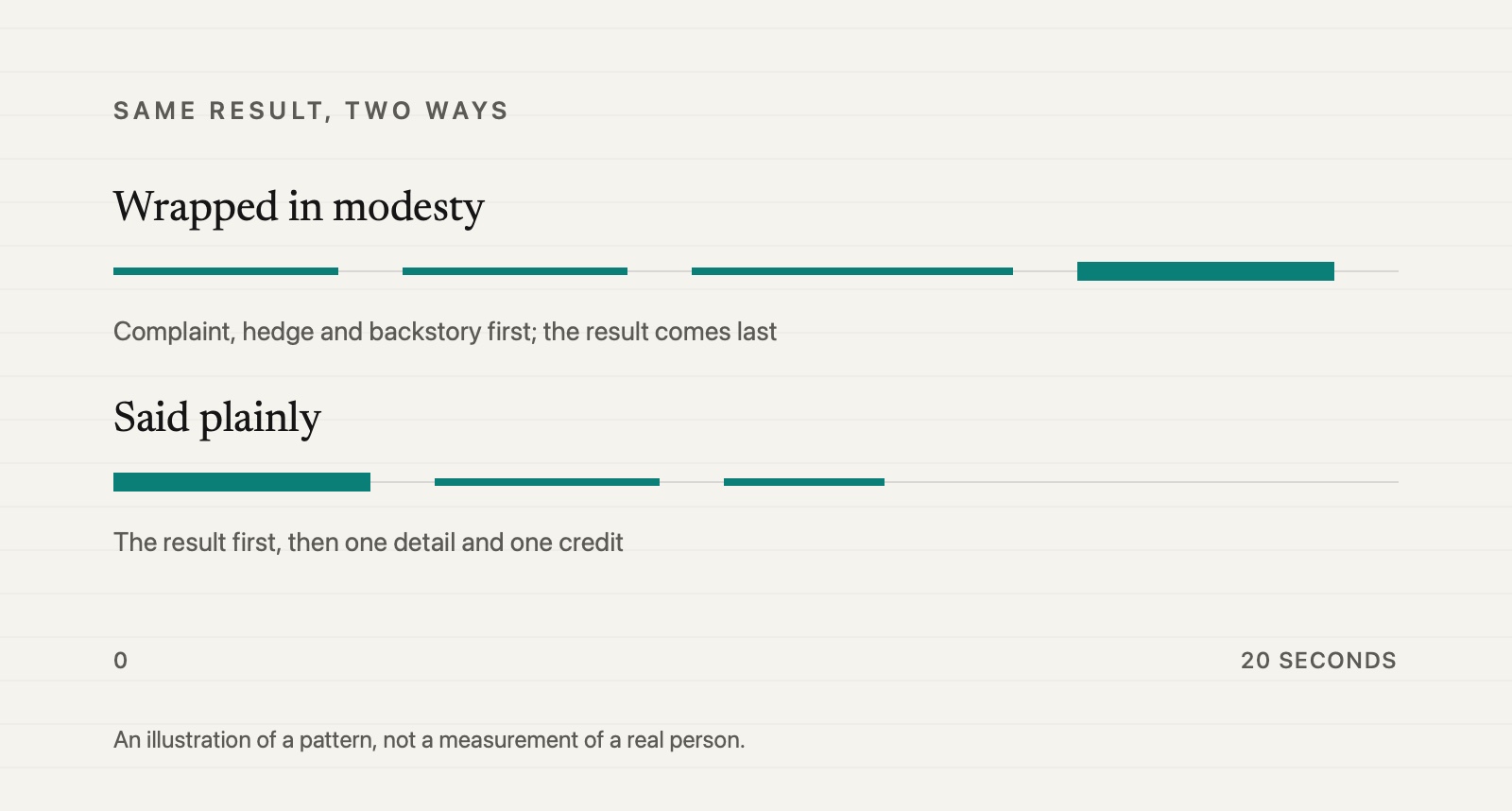
The common workaround is to wrap the result in modesty or a complaint. "I was so swamped I barely slept, but somehow the launch went fine." "I'm sure it was mostly luck, but the numbers did go up." This is often called a humblebrag, and it feels like the polite middle path.
Researchers have tested it. In a set of nine studies published in the Journal of Personality and Social Psychology, Ovul Sezer, Francesca Gino and Michael Norton found that humblebrags, whether dressed up as a complaint or as humility, were less effective than simply bragging. People who humblebragged were liked less and seen as less competent, and the main reason was that they came across as insincere (Sezer, Gino and Norton, 2018).
That is useful news. If you want to talk about your accomplishments without bragging, you do not need a clever framing. The plain sentence is the honest one, and listeners can tell the difference.
There is a second cost to the wrapped version when you say it out loud. All the hedging comes first, so the actual result lands late, often in the last few seconds, after your listener has started thinking about something else.
How to talk about your accomplishments without bragging in four steps
Here is one example to carry through the rest of this post. Dana leads a small support team. Over the last quarter she rewrote the guide new hires use in their first weeks. New hires used to need about three weeks before they could take tickets on their own. Now it takes about eight days. Her manager asks, in their one-on-one, "Anything you want to flag from this quarter?"
Step 1: Say the result in one sentence
Start with what is different now. Not what you did, not how hard it was. What changed.
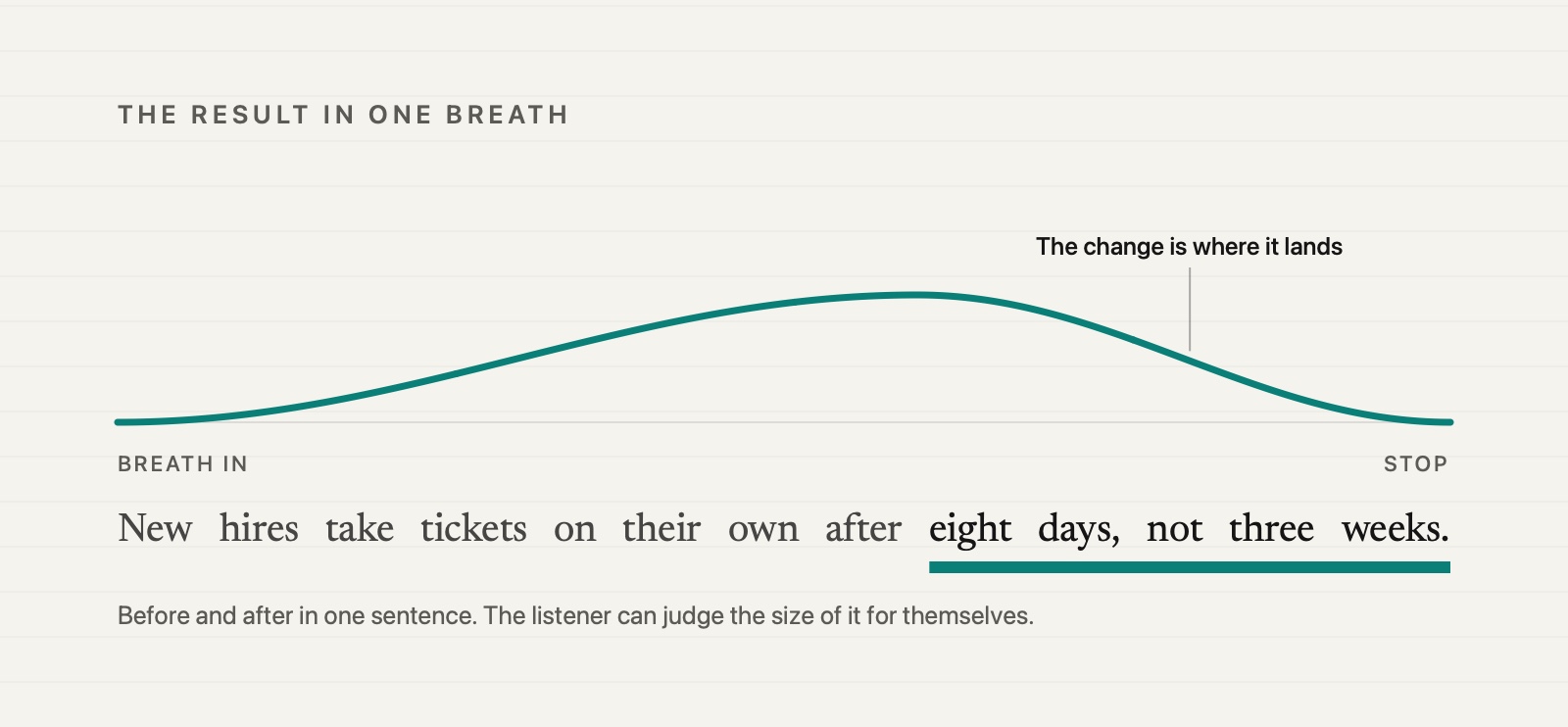
"New hires take tickets on their own after eight days now, not three weeks."
That sentence works because it carries a before and an after. The listener does not have to judge whether it was impressive. They can see the size of the change for themselves. This is the same instinct as giving the state of the work first in a status update: the sentence someone can act on goes first.
Keep the sentence short enough to say in one breath. If you run out of air before the number, the number gets swallowed, and the number is the part that matters.
Step 2: Add one detail that makes it real
Next, one sentence on what you did. Pick the single decision that caused the result, not the full list of tasks.
"I rewrote the onboarding guide around the twenty tickets we see most."
One detail shows the result was not an accident, and it gives your manager something to repeat upward. Nobody can repeat a list of ten tasks.
Step 3: Credit one person by name
Then say who helped, plainly. "Marcus ran the first two groups of new hires through it and fixed half the gaps."
This is not a modesty move. It is accuracy. Almost every result at work had help, and naming the help makes your account more believable, not less. Keep it to one person or one team and one specific thing they did. "Thanks to everyone" is vague. "Marcus fixed half the gaps" is a fact.
Notice that the credit comes after the result, not before it. If you open with "I couldn't have done it without the team," you are back to hedging first, and the result lands late again.
Step 4: Stop
This is the step people skip. After the credit, stop talking. Let your manager respond.
Silence after good news can feel like the listener is unimpressed. Usually they are just taking it in. If you fill the pause with "anyway, it was a team thing, it's not a big deal," you undo the first three steps. You can also close with a short question that moves things forward: "Should I write it up for the other teams?"
Put together, Dana's whole answer is four sentences:
"New hires take tickets on their own after eight days now, not three weeks. I rewrote the onboarding guide around the twenty tickets we see most. Marcus ran the first two groups through it and fixed half the gaps. Should I write it up for the other teams?"
About fifteen seconds. No adjectives about herself. Nothing for anyone to roll their eyes at.
Where to say it: one-on-ones, reviews and meetings
The four steps work almost anywhere, but the setting changes how much you say.
In a one-on-one, say it early, before the agenda fills up. Your manager has time there to ask a follow-up question.
In a performance review, have two or three of these ready, each in the same four-sentence shape. A review is not the time to remember your quarter live. Pick the results that mattered most to your team, not the ones that took the most hours.
In a team meeting, shrink it to the first sentence and the credit. "Quick one: new hires are independent in eight days now, down from three weeks. Marcus did a lot of that." Then let the meeting move on.
With senior leaders, lead with the result in their terms, like time, cost or customers, and keep the detail for questions. The same idea runs through presenting to senior leadership: the sentence they need comes first.
Writing for The Muse, Alexandra Franzen makes a related point about sharing good news: keep it brief, give people a reason to care, and do not shrink good news, since most people enjoy hearing it (The Muse). Brief is the part most of us miss when we say it out loud.
Phrases that tip into bragging, and what to say instead
A few patterns turn a plain result into a brag, or into a humblebrag. Each one has a simple swap.
- Comparing yourself to others. "Nobody else on the team could have done it." Swap for a comparison to the past: "It used to take three weeks."
- Adjectives about yourself. "I really crushed it this quarter." Swap for the number: "We closed the month three days sooner."
- The complaint wrapper. "I was buried in this for months, but it finally shipped." Swap for the result and stop: "It shipped on the twelfth."
- The modesty wrapper. "It was probably luck." Swap for the decision: "The change that mattered was moving the review earlier."
- The long setup. Two minutes of context before the result. Swap the order: result first, context only if they ask.
If you hear yourself starting one of these, do not restart. Just say the plain sentence next.
Try it now: a five-minute practice
You can do this today with your phone's voice recorder and a timer.
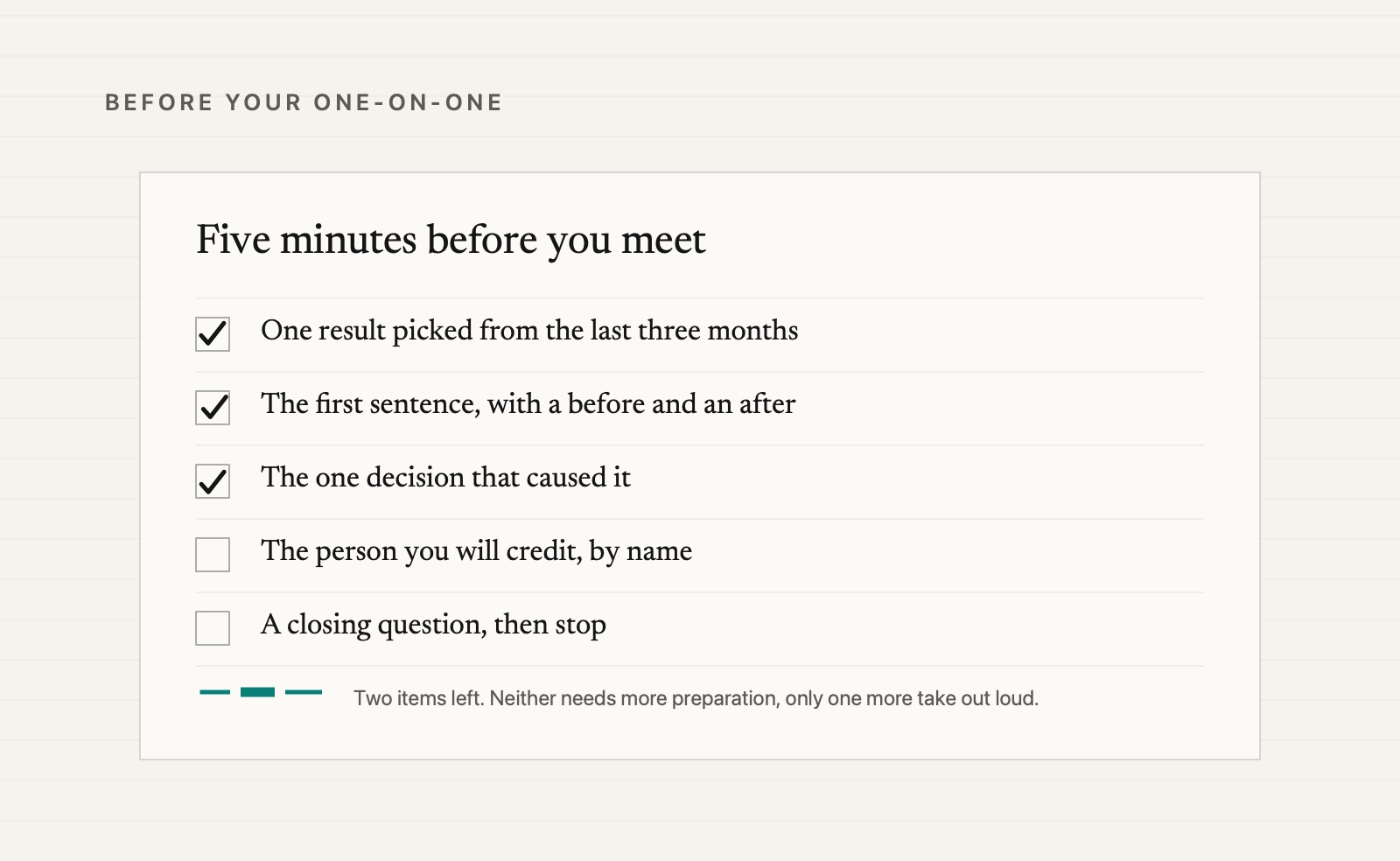
- Pick one result from the last three months (one minute). Something that changed: a number, a deadline, a process that got shorter, a customer who stayed.
- Write the first sentence (one minute). Before and after, in one breath. Read it aloud once to check it fits.
- Record the whole thing (one minute). Result, one detail, one credit, a closing question, stop. Do not read it. Say it.
- Listen back once (one minute). Ask one question only: did the result come in the first sentence? If there was a "so, basically" or a story before it, notice where.
- Record it again (one minute). Change only that one thing. Leave everything else alone.
The second take is usually shorter. Hearing yourself is the fastest way to learn how to talk about your accomplishments without bragging, because the wrapper is easy to miss in your head and obvious on a recording.
If you can hear the hedging but still can't get rid of it, that is a speaking habit, and habits change with short daily practice out loud more than with reading. Sayforth is an iPhone app, coming soon, built for that: a 30-day program with one question a day, answered out loud, shown afterward as a single speaking line so you can see whether your main point came first, plus one change to carry into tomorrow. You can see how the daily practice works first.
Be first to know when Sayforth is live.
Get launch updatesFrequently Asked Questions
How do you talk about your accomplishments without sounding arrogant?
To talk about your accomplishments without bragging, say what changed, not how good you are. One sentence with a before and after, one detail about what you did, and one line of credit to someone who helped. Arrogance usually comes from comparing yourself to others or adding adjectives about yourself, so leave both out.
Is it bad to humblebrag at work?
It usually backfires. Research by Sezer, Gino and Norton found that humblebrags were less effective than plain bragging because listeners saw them as insincere. If you have good news, a short, direct sentence is the more honest choice and the better received one.
How do I mention my accomplishments to my boss?
Bring it up early in a one-on-one, in about fifteen seconds: the result first, the one decision behind it, the person who helped, then a question such as whether to share it with other teams. Your boss needs that information to report upward and plan, so you are doing them a favor by making it easy to repeat.
How do I talk about my achievements in a performance review?
Prepare two or three results ahead of time, each in the same short shape: result, one detail, credit. Choose the ones that mattered most to your team rather than the ones that took the most effort, and practice saying each one out loud at least once before the meeting.