
If you have tried to work out how to practice a presentation by yourself, you probably know the usual version. You open the slides, click through them in silence, mutter a few lines, and call it a rehearsal. Then you stand up in the real room and find that the talk you had in your head does not come out of your mouth in the same shape.
The fix is not more hours. It is a different order. You practice the parts that break first, out loud, and you save the full run-through for when the parts already work. This post walks through that order in six steps, plus a five-minute drill you can do today with nothing but your voice and a timer.
Why it is hard to practice a presentation by yourself
Practicing a single spoken answer is a tidy job. You say it, you record it, you listen back, you change one thing. We wrote up that routine in how to practice for an interview alone, and it works because one answer is short enough to replay many times.
A presentation breaks that loop. A ten-minute talk takes ten minutes to say and ten more to hear. Nobody listens back to that five times in an evening. So solo practice drifts into something easier: reading the slides, fixing fonts, and running the talk in your head, where every sentence comes out smooth.
That last habit is the one to drop. Saying material out loud helps you remember it better than reading it silently. Memory researchers call this the production effect, and their review describes producing words by speaking, writing or typing as yielding "substantial memory improvements relative to silent reading" (MacLeod and Bodner, Current Directions in Psychological Science). Those studies measure memory for words, not how a talk lands. But the direction is clear enough: a rehearsal in your head is not a rehearsal.
The method below keeps practice out loud while keeping the listening short. You work in pieces first, then put them together, which is also what the speech lab at Grand Valley State University recommends: break the talk into parts, practice each one, and only then run the presentation in its entirety (GVSU Speech Lab).
Step 1: Say the spine out loud in one minute
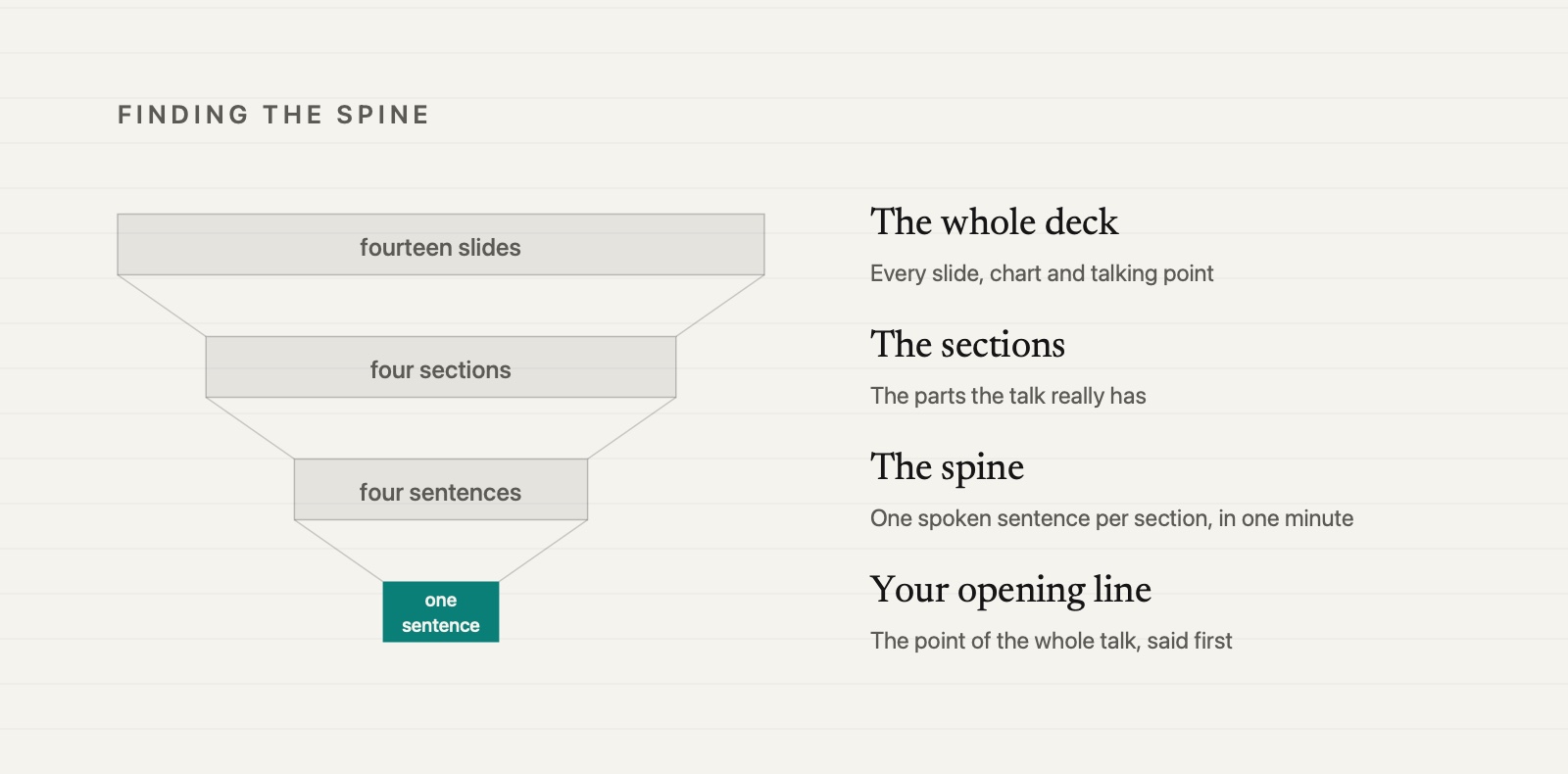
Before you rehearse any slide, find out whether you know what the talk is saying. Close the deck. Set a timer for one minute. Say one sentence for each section of the talk, in order, out loud.
That list of sentences is the spine. For a typical work talk it is three to five sentences. If you have fourteen slides, you probably have four sections, and each section has one sentence that is its point.
Most people discover something in this minute. One section has no sentence. You talk around it ("and then there's the stuff about the vendor") because you have not decided what it says. That is the section that will fall apart in the room, and you found it in sixty seconds instead of on the day.
Write the spine on one card. If you can say it twice in a row without looking, the structure is in your head and the slides become reminders, not a script. That is the same reason writing centers steer speakers toward note cards rather than a full script (Blinn College Writing Centers).
Step 2: Practice the joins between sections
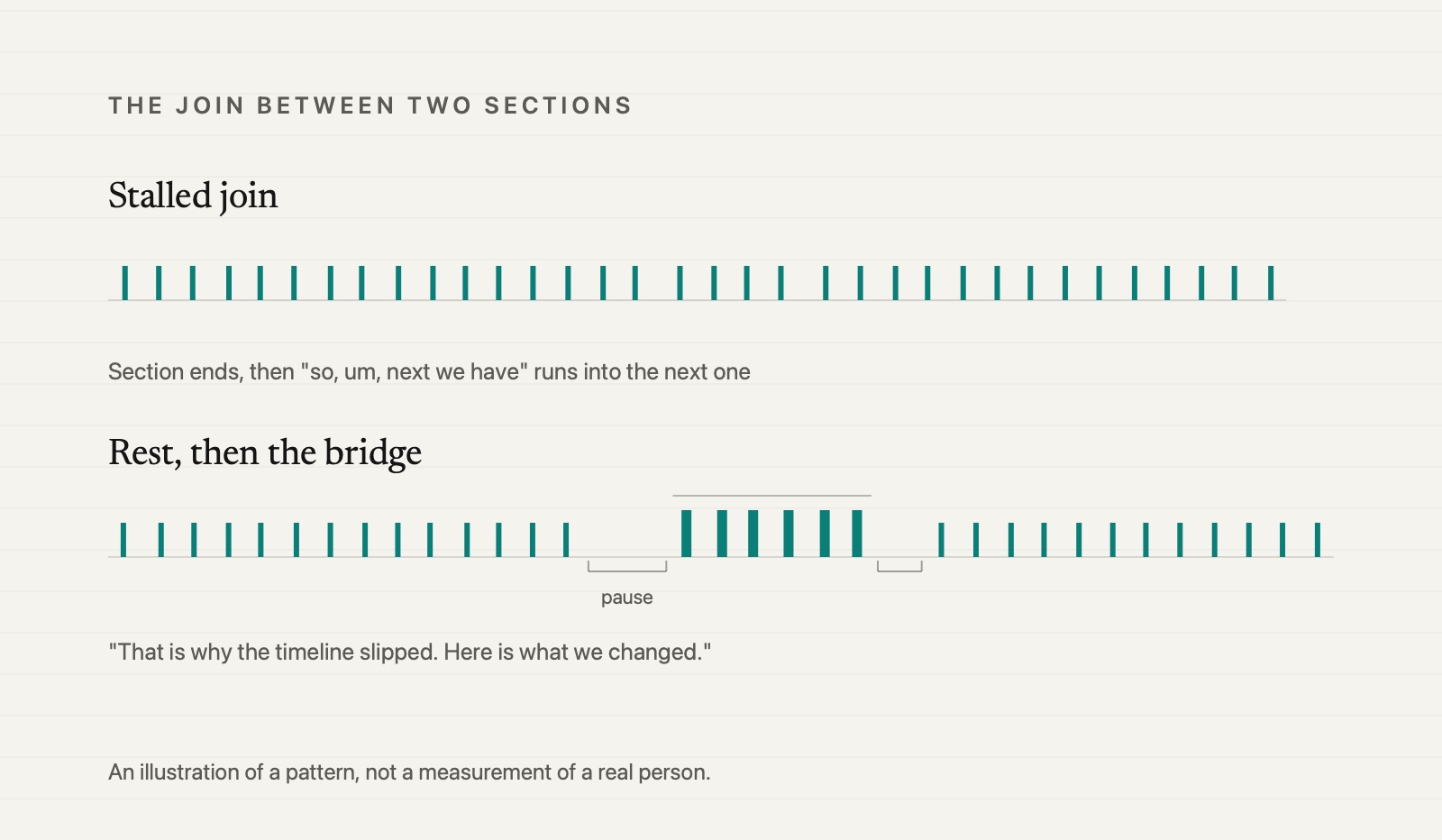
When a solo rehearsal stalls, it rarely stalls in the middle of a section. It stalls at the seams. You finish a point, glance at the next slide, and fill the gap with "so, um, next we have..." while your brain catches up.
The audience hears those seams as the moments you lost the thread. So practice them on purpose. For each join between two sections, write one bridge sentence that closes the last point and opens the next one. For example: "That is why the timeline slipped. Here is what we changed."
Then rehearse only the joins. Say the last sentence of section one, stop for a short beat, and say the bridge into section two. Do it for every join in the talk. It takes two or three minutes for a whole presentation, and it fixes the part that sounds least practiced.
The beat matters as much as the sentence. A clean stop gives the listener a moment to file the last point before you hand them the next one. Rushing straight from one section into another is how a talk starts to sound like one long run-on.
Step 3: Rehearse the first and last minute on their own
The opening and the close are the two parts people remember, and they are also the two parts that get the least practice. Full run-throughs start strong and fade, so by the time you reach the end you are tired and you wing it.
Pull them out and rehearse them separately. For the opening, say your first two sentences out loud five times. The first sentence should be the point of the whole talk, not "thanks for having me" or a tour of the agenda. For the close, rehearse your last sentence until you can stop on it cleanly without adding "so, yeah, that's it."
If the ending is the weak spot, our post on how to end a presentation covers writing the last line first and stopping on it. For this step, the rule is simple: the first minute and the last minute should each feel boring to say, because you have said them so many times.
Step 4: Do one full run standing up, with checkpoint times
Now put it together. Stand, because you will stand on the day. Open the deck the way you will present it. Start a timer and run the whole talk, out loud, to an empty room.
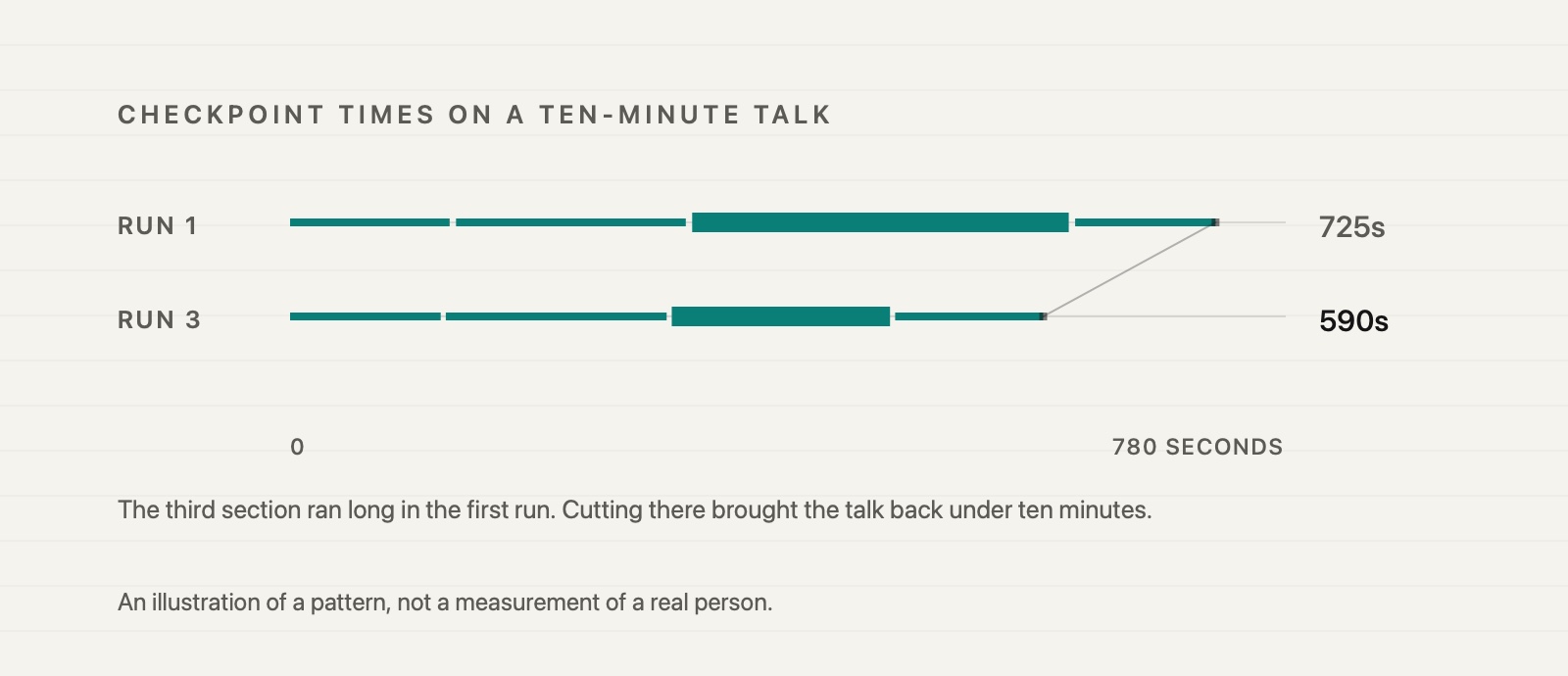
Before you start, write down a target time for the end of each section. A ten-minute talk with four sections might have checkpoints at two, five, eight and ten minutes. During the run, glance at the timer at each join and note where you actually are.
Checkpoints tell you more than the total. A talk that runs twelve minutes is not "two minutes long" in general. It is usually one section that runs long while the others are fine. The split times point straight at it, so you cut in the right place instead of rushing everything.
Do not stop to fix things during this run. If you stumble, keep going, the way you would in front of people. Recovering mid-sentence is part of what you are practicing.
Step 5: Listen back to the joins and the edges only
Record the full run on your phone. You do not need to listen to the whole thing. Listen to three places: the first sixty seconds, each join between sections, and the last sixty seconds. For a four-section talk, that is about four minutes of listening instead of ten.
As you listen, ask one question per spot. Opening: did the first sentence say the point? Joins: did you stop, then bridge, or did you fill the gap? Close: did you stop on your last line? Write down only the single biggest problem you hear.
Then change that one thing, and nothing else, on the next run. Fixing one thing per run is slower on paper and faster in practice, because you can tell whether the change worked. Try to fix five things at once and the next run just sounds different, not better.
Step 6: Spread the runs over days and add two questions
One long evening of rehearsal feels productive, but most of it is repetition while tired. Spread it out instead. The GVSU speech lab suggests starting at least a week before the presentation and practicing in parts at different times of day (GVSU Speech Lab). A workable schedule for a week out looks like this:
- Day one: the spine and the joins.
- Day two: the first and last minute.
- Day three: one full timed run, then listen to the joins and edges.
- Day five: a second full run with your one change.
- The day before: the spine once, the opening once, the close once. No full run.
On the second full run, add the questions. Write down the two questions you would least like to be asked, and answer each one out loud in under a minute: the answer in your first sentence, one reason, then stop. Practicing a presentation by yourself can never copy a live room, but it can make sure the hardest question is not the first time you hear your own answer to it.
Try it now: a five-minute presentation practice drill
You can do this today, even if your presentation is weeks away. You need a phone and a timer.
- Minute one. Close the slides. Say the spine of your talk out loud, one sentence per section.
- Minute two. Pick the weakest join. Write one bridge sentence for it.
- Minute three. Record yourself saying the last line of one section, a short rest, and the bridge into the next.
- Minute four. Record your first two sentences of the whole talk.
- Minute five. Play both clips once. Write down the one thing you would change.
That is the whole method in miniature: out loud, in pieces, and one change at a time. Repeat it tomorrow with the change in place and you will hear the difference.
The hard part of practicing alone is hearing yourself clearly, because you cannot listen while you talk. Sayforth, an iPhone app that is coming soon, gives you one question a day to answer out loud, then shows your answer back as a single speaking line with one change to try tomorrow, so you can see where your point landed. You can read how the daily practice works first.
Be first to know when Sayforth is live.
Get launch updatesFrequently Asked Questions
How many times should I practice a presentation by myself?
There is no single number that fits every talk. A practical target is two or three full timed runs spread over different days, plus short sessions on the spine, the joins, and the first and last minute. The short sessions do most of the work.
Should I practice my presentation in front of a mirror?
A mirror shows you your face, which pulls your attention away from what you are saying. A phone recording is more useful, because you can listen back as the audience would. If you want to check posture or gestures, record a short video of one section instead of watching yourself live.
Is it better to memorize a presentation word for word?
Usually not. A memorized script breaks the moment you lose one word, and it tends to sound recited. Memorize the spine, your first two sentences and your last line, and let the rest come from knowing what each section says.
How do I practice a presentation when I have no time?
Skip the full run and do the five-minute drill: say the spine, fix one join, and rehearse the opening and closing lines. If you only have one minute, say the spine out loud once. Knowing the structure matters more than polishing any single slide.