Most advice on how to practice for an interview alone sends you straight to a mirror. Stand up, look at yourself, run through your answers. It is the first suggestion almost everyone gives, and it is close to the least useful tool in the room.
A mirror hands back the one channel the interviewer is paying least attention to. Nobody is grading your face. They are listening to an answer and quietly deciding three things: did it answer the question, did it have a point, and did it end. You cannot see any of that in a mirror. Worse, watching yourself talk splits your attention at the exact moment you need all of it.
The tool that does work is already in your pocket. Practicing alone well means saying the answer out loud, recording it, listening back in a fixed order, and changing one thing per round. That is the whole method. The rest of this post is how to run it.
Why practicing alone does more than it sounds like it should
There is a reason saying something out loud sticks better than reading it over in your head. Memory researchers call it the production effect: producing material by saying, writing or typing it "can yield substantial memory improvements relative to silent reading" (MacLeod and Bodner, Current Directions in Psychological Science).
Be careful about how far that stretches. Those studies measure memory for words and text, not how an interview went. But the direction is useful, and it matches what anyone who has done this notices. An answer you have only thought about is smooth, because thinking skips the hard parts. An answer you have said out loud is a real object with a beginning, a middle and a length.
The second reason is simpler. You cannot hear yourself properly while you are talking. Producing speech takes nearly everything you have, which is why a sentence that felt fine in the moment can sound like three sentences taped together when you play it back an hour later. Recording is how you get to be the listener instead of the speaker.
University career advice lands in the same place. UCLA's career center tells students to practice answers aloud, then record and watch it back "so you can see how you come across, if you exhibit any distracting verbal fillers or non-verbal cues, and if your responses are too short, too long, or disjointed" (UCLA Career Center). That short list is worth keeping. Most of what solo practice can fix is on it.
Step 1: Pick five questions, not fifty
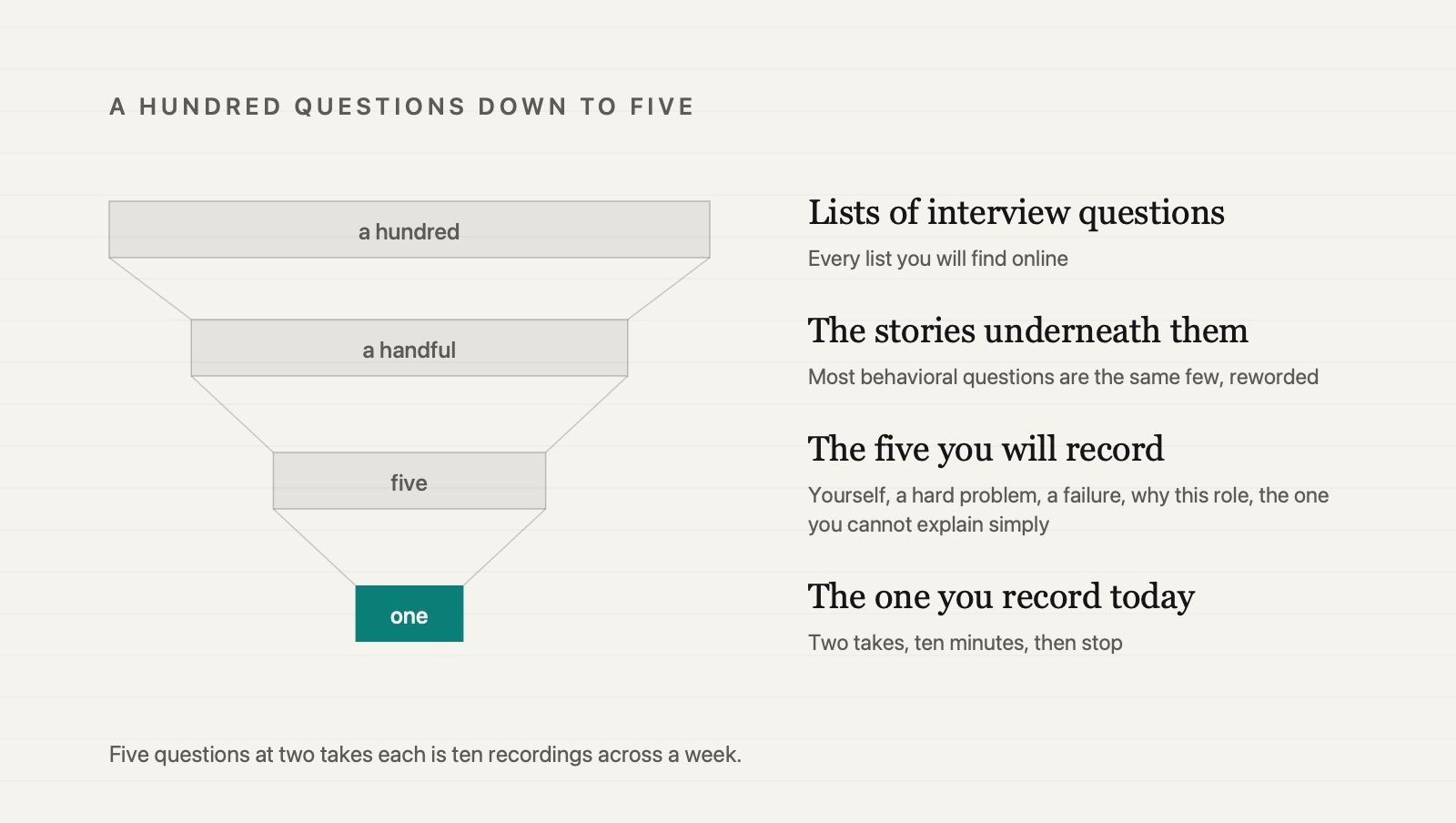
Search for interview questions and you will find lists of a hundred. Those lists are a way to feel busy. You cannot practice a hundred answers, and you do not need to, because most behavioral questions are the same few stories wearing different hats.
Pick five and stop:
- Tell me about yourself.
- Tell me about a hard problem you solved.
- Tell me about something that went wrong.
- Why this role, and why now.
- One piece of your own work you find hard to explain simply.
That fifth one is the quiet winner. The question you dread is usually the one hiding a story you have never said out loud in plain words, and it tends to show up in interviews wearing a different hat anyway.
Five questions also fits the time you actually have. Two takes each is ten recordings, which is a week of ten-minute rounds, not a project.
Step 2: Record the cold take before you prepare anything
Record the first answer before you feel ready. Not after you have written notes, and definitely not after you have written a script.
Open the voice memo app on your phone. Read the question out loud, start recording, and answer it the way you would answer it today. Then stop. Do not re-record because it went badly. It is supposed to go badly.
That first take is the only honest starting point you will get, and once you have prepared, it is gone forever. Keep it. In a week it is the thing that shows you the difference, and the difference is much easier to hear than to remember.
Two rules for the cold take. No script, because reading a written answer teaches you to recite, and a recited answer falls apart the moment the question is phrased slightly differently. And no stopping halfway. Finish badly rather than restart, because finishing badly is information and restarting is avoidance.
Step 3: Listen back in this order, not the order you notice things
Here is where most solo practice goes wrong. You play the recording, you hear yourself say "um" four times in the first ten seconds, and the rest of the playback is you wincing at ums. You have now spent your attention on the least important thing in the recording.
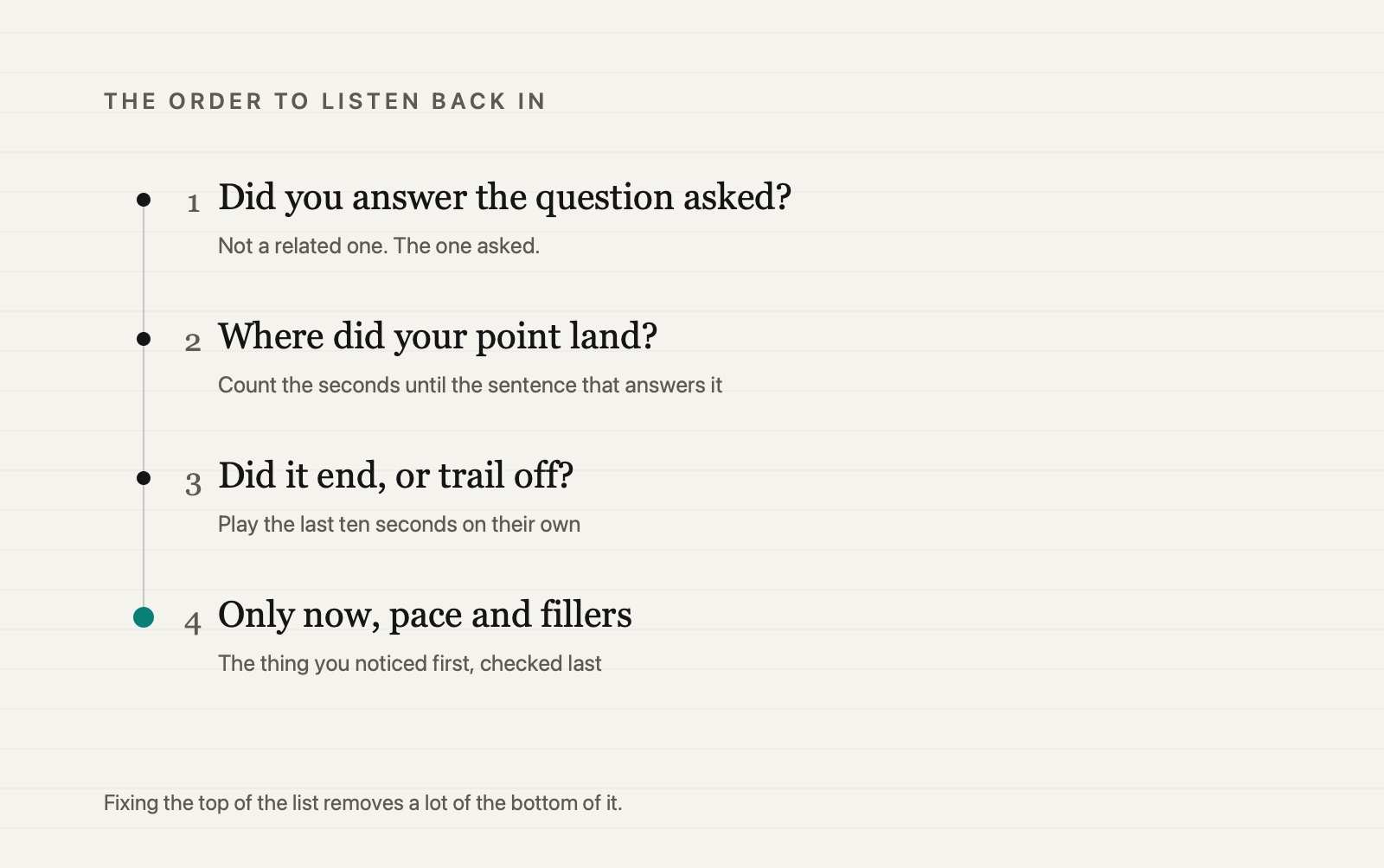
Listen for four things, in this order:
- Did you answer the question that was asked? Not a related question. The one asked.
- Where did your point land? Count the seconds until the sentence that actually answers it. If that is at forty seconds, you have found the real problem.
- Did it end, or did it trail off? Listen to the last ten seconds on their own. An answer that ends sounds finished. One that trails off sounds like you ran out.
- Then, and only then, pace and fillers. How fast, and where the ums cluster.
The order matters because the top of the list causes most of the bottom of it. Fillers gather in the stretch where you have not decided what you are saying yet, so deciding the point earlier removes a surprising number of them without any work on the fillers themselves. That is also why hearing where your fillers actually land beats counting them.
Write one line per recording. Not a report, one line: what the point was, when it arrived, how it ended.
Step 4: Change one thing, then record the same answer again
Now take two. One change only.
Say the change out loud before you press record, in a full sentence: "This time, my first sentence is the answer." Or: "This time, I stop after the result and say nothing else." Naming it turns a vague intention into something you can check.
One change is not a productivity trick, it is the only way the round tells you anything. Change five things at once and the second take is better or worse for reasons you cannot separate. Change one and you know exactly what moved.
Two takes per question is usually enough for one sitting. A third take starts to memorize, and memorizing is what you were trying to avoid. Come back to the same question tomorrow instead, which is the next step.
Step 5: Spread it over days, not one long evening
The night-before marathon is the most common way to practice alone, and it is the weakest version of every part of this.
Learning research has been clear on this for a long time. Spacing sessions out means "you will be able to learn more information and retain it longer," and unlike cramming, "each session is shorter" (UC San Diego Department of Psychology). Five ten-minute rounds across a week will do more than one ninety-minute evening, and take less total time.
There is a second reason that has nothing to do with memory. A long panicked session the night before teaches your body that this subject is an emergency. Ten quiet minutes a day teaches it that this is just a thing you do, which is roughly the state you want to be in when you join the call.
A simple week: one question a day, cold take, one line of notes, one change, second take. Ten minutes. On the last day, play your Day 1 recording and your most recent one back to back and listen to the difference instead of trying to remember it.
That is how to practice for an interview alone across a week, and it is deliberately small enough that you will actually do it on the day you do not feel like it.
Try it now: how to practice for an interview alone in five minutes
You need a phone, a timer and a door you can close.
- Minute 0. Pick one question from your five. Say it out loud.
- Minutes 0 to 1. Record your answer, cold. Stop when you are done, even if it was bad.
- Minutes 1 to 3. Play it back once. Answer the four questions from Step 3, in that order, and write one line.
- Minute 3. Say your one change out loud, as a full sentence.
- Minutes 3 to 4. Record the same answer again with that one change and nothing else.
- Minutes 4 to 5. Play both takes back to back. Keep them both.
That is one round. Five of those, on five different days, and you will have heard yourself answer the questions you were dreading ten times, which is nine more times than most people manage.
Most guides on how to practice for an interview alone stop at "record yourself." Listening back honestly is the part almost everyone skips, because playing back your own voice is uncomfortable and it is hard to know what to listen for. That is the gap Sayforth is built to close: a 30-day iPhone program, coming soon, where one short coached answer a day is drawn as a single speaking line with strokes for speech and gaps for your pauses, one change to carry into tomorrow, no scores, progress measured only against your own Day 1, and recordings that stay on your phone.
Be first to know when Sayforth is live.
Get launch updatesFrequently Asked Questions
Is practicing for an interview alone actually worth it if I have nobody to practice with?
Yes. Knowing how to practice for an interview alone fixes the things that are yours to fix: whether you answer the question, where your point lands, how long you run, and how you end. Those are all audible in a recording of yourself. What solo practice cannot do is surprise you or ask a follow-up, so use a person as well when you can find one.
Should I use a mirror to practice interview answers?
A mirror is a weak tool for this. It shows you your face, which is the channel that matters least, and watching yourself while you speak splits the attention you need for speaking. A voice recording gives you the thing the interviewer is actually judging, and it lets you be the listener instead of the speaker.
How long should my practice answers be?
Most answers land somewhere between thirty seconds and two minutes depending on the question, and the length matters less than where your point sits inside it. We looked at that in detail in how long an interview answer should be.
How far ahead of the interview should I start?
A week of ten-minute rounds is plenty, and it beats a long session the night before on both memory and nerves. If you have two days, do two rounds a day rather than one long one, and keep the cold take from the first round so you have something to compare against.