Here is how to answer "tell me about a time you solved a difficult problem." In your first sentence, say what was wrong and what fixed it. In the next, say what made it hard. Then give the one clue that led you to the cause and what you did with it. End on what changed. Aim for about a minute.
Most people pick a good problem. The trouble is the order. They walk through the search as it happened, and the fix shows up in the last ten seconds. This post shows how to put the fix first, pick the clue worth telling, and practice it out loud in five minutes.
What the interviewer is really listening for
Employers say plainly that they care about this skill. NACE, the National Association of Colleges and Employers, reports that nearly 90 percent of employers who answered its Job Outlook 2025 survey look for evidence that a student can solve problems on a resume (NACE). In an interview, this question asks for that evidence out loud.
The question comes in many forms. The University of Bath's list of behavioral interview questions includes "Describe a time when you had to resolve a difficult problem on your own. How did you go about it?" (University of Bath). The wording changes. The test stays the same.
The second half of that question, "How did you go about it?", is the part people miss. The interviewer is listening for three things:
- Did you find the real cause? Or did you patch the symptom and hope?
- How did you think? What did you notice that other people missed?
- Did it stay fixed? A good answer ends with something that changed and held.
Notice what is not on that list: how many hours it took, how many things you tried, how frustrating it was. Those are easy to remember, so they are what most people say.
Why problem answers turn into an investigation log
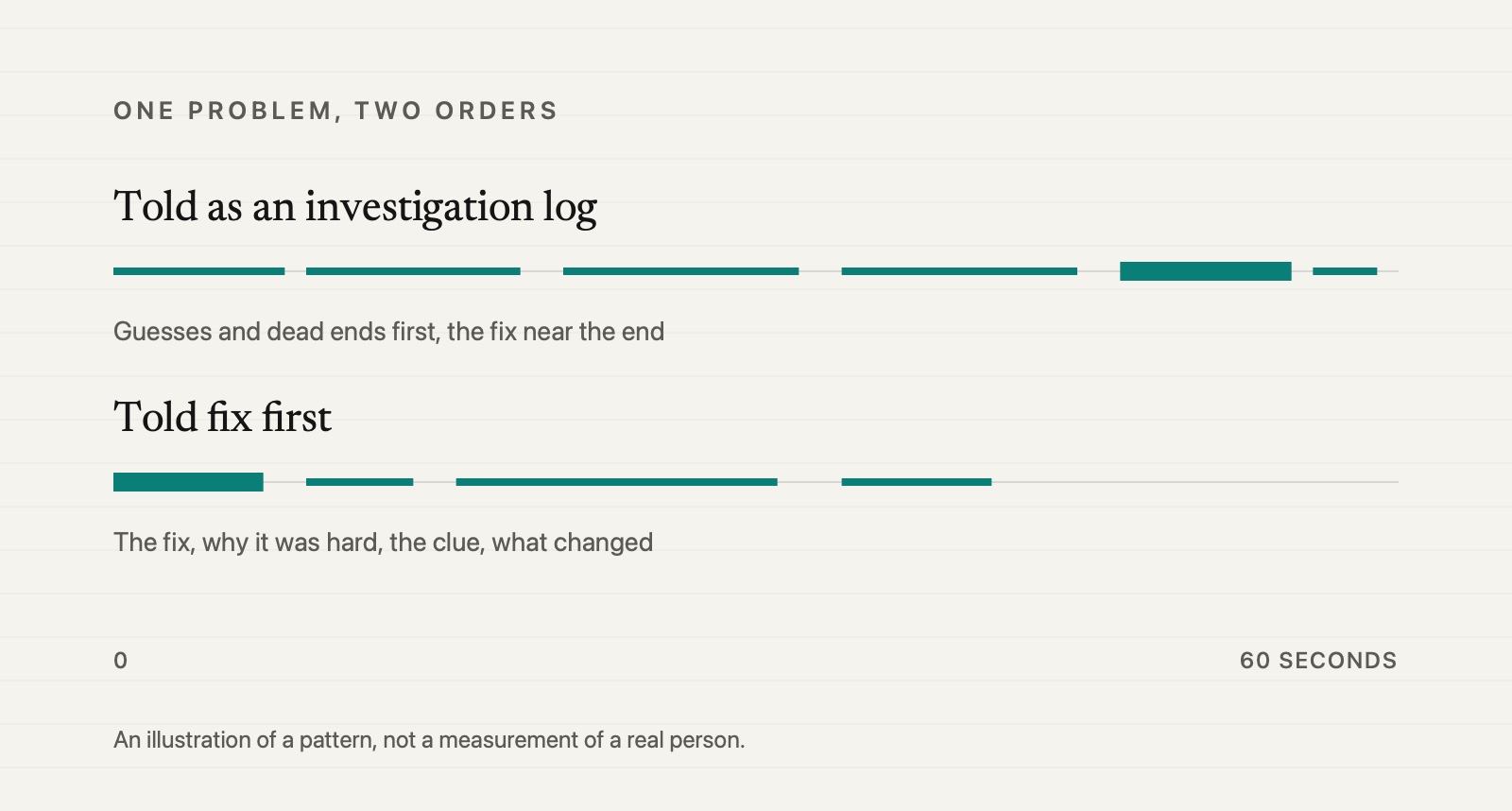
A hard problem lives in your memory as a search. First you noticed something was off. Then you checked the obvious thing, and it was fine. Then you asked someone, and they were not sure. Then you tried a second idea. Then, finally, you saw it.
Each step is true. Said in that order, they fill the minute with dead ends, and the fix and the clue that found it arrive at the very end, squeezed into one rushed sentence.
The fix is to move one sentence. Say what was wrong and what fixed it first. Once the interviewer knows where the story ends, every sentence after it is proof instead of suspense.
How to answer tell me about a time you solved a difficult problem in four parts
Here is one example, built around a kind of problem many teams have: a number that is wrong only some of the time.
Part one, the problem and the fix, in one sentence. "Our weekly sales report was coming out a few percent off every few weeks, and I traced it to two systems that closed the week at different hours, so I moved them to the same cutoff." That sentence is the whole story in short. If the interviewer remembers one thing, it should be this.
Part two, why it was hard, in one sentence. "It was hard because most weeks the report was right, so nobody could make the error happen on purpose." A problem that only shows up sometimes is a real kind of difficult, and the listener understands it at once.
Part three, the clue and what you did, in three or four sentences. "I lined up the bad weeks side by side and noticed every one of them had a large order placed late on Sunday night. That told me the issue was timing, not the math. I checked both systems and found one closed the week at midnight in our time zone and the other at midnight in a different one. I set both to the same cutoff and rebuilt the last three months of reports to confirm the numbers matched." This is where the interviewer hears how you think.
Part four, what changed, in one sentence. "The report has matched the source numbers every week since, and the team stopped double-checking it by hand." End there. A clear change is enough. You do not need a big number.
That is about a minute out loud. If you want more on timing, our post on how long an interview answer should be covers it in detail.
Tell the one clue, not every dead end
The best answer to "tell me about a time you solved a difficult problem" has one turning point: the moment you noticed something that pointed to the cause. In the example, it is the late Sunday orders. That clue is what makes the story yours. Anyone can say "I investigated." Only you can say what you saw.
So before the interview, find that moment. Ask yourself, "What did I notice that changed where I was looking?" It might be a pattern, a question nobody else had asked, or a test that ruled out half the possible causes at once.
You may mention one dead end, and only if it shows good thinking. "I first checked the formulas, because that is where report errors usually live, and they were fine" tells the interviewer you start with the likely cause. Three dead ends in a row tell them only that it took a while.
If your problem was technical, keep the clue in plain words. The interviewer may not share your field, and a clue they cannot follow does not help you. Our guide to explaining technical work to non-technical people shows how to say the same thing without the jargon.
Pick a problem that was hard for the right reason
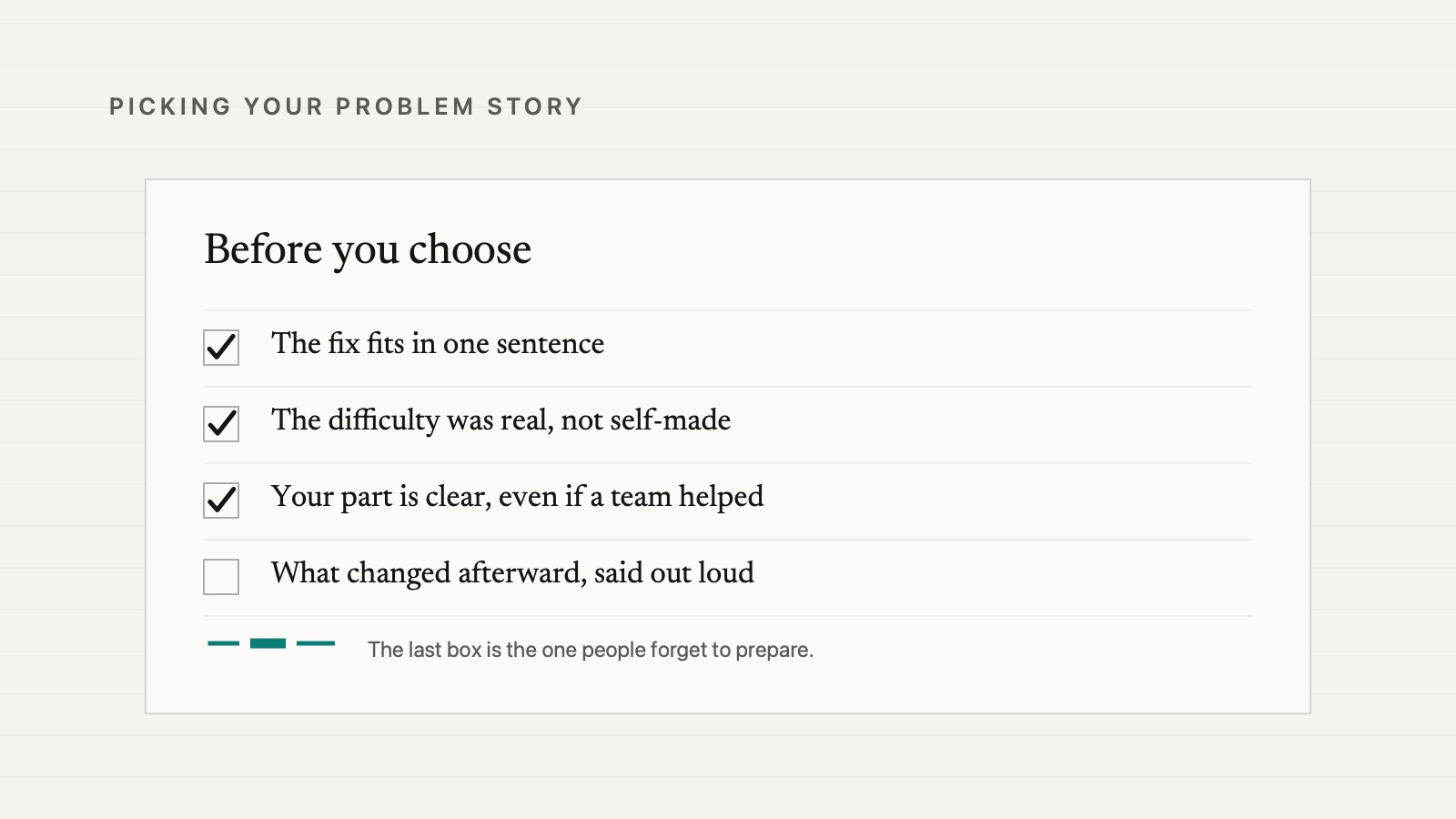
Not every hard problem makes a good answer. Before you settle on a story, check it against the four questions in the card below. A story that passes all four is strong even if it is small: a confusing form, a schedule that kept double-booking a room, a recurring customer complaint. A big story where you were one of twelve people in the room is weaker than a small one where the clue was clearly yours.
Some stories are better saved for other questions. If the hard part was the clock, not the cause, that is a deadline story, and our post on answering "tell me about a time you met a tight deadline" fits it better. If the hard part was choosing without the facts you needed, that is a decision story, and making a decision without all the information covers that shape. This question is about finding a cause, so pick a story where finding it was the hard part.
Say the first sentence in one breath
Your first sentence carries the most weight, so say it well. Two things tend to go wrong.
The first is a long run-up. "So, this was at my last job, and we had this report, and it was kind of a mess..." uses up five seconds and says nothing. Start with the problem itself.
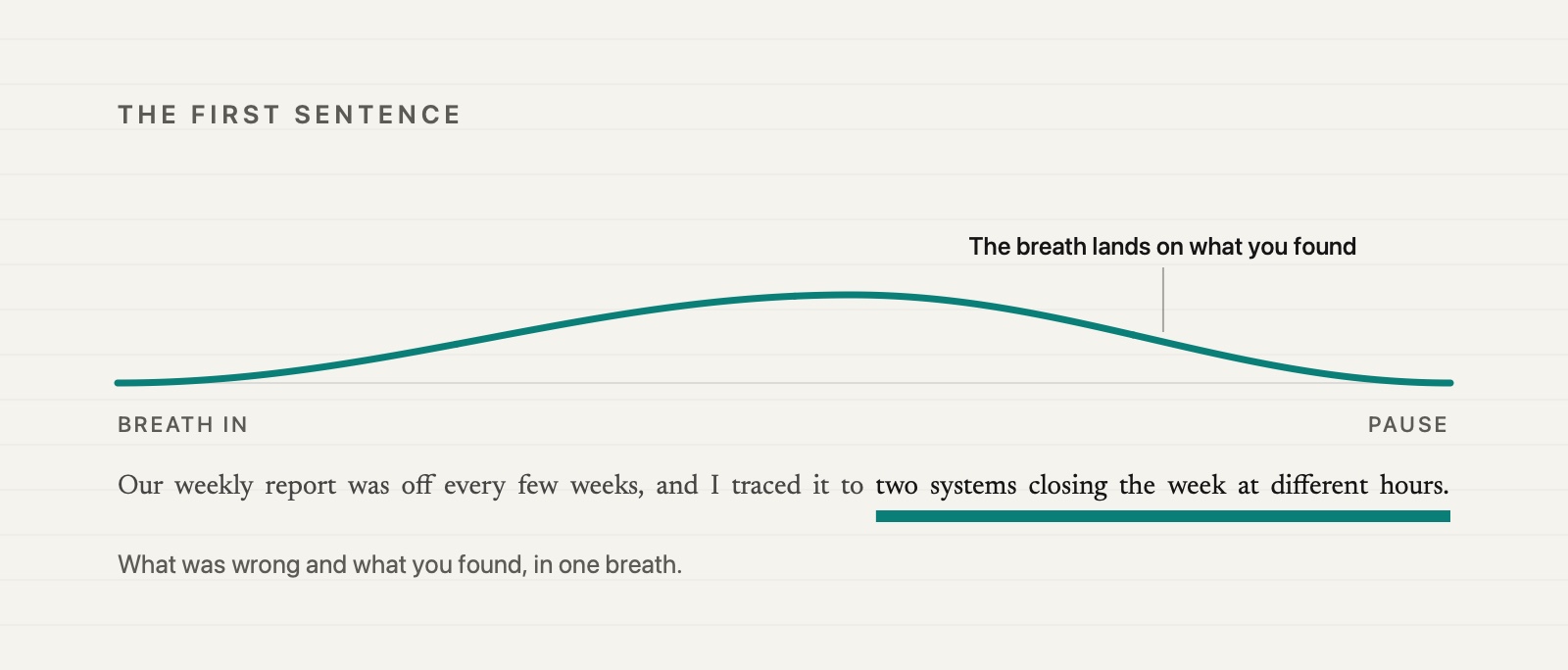
The second is splitting the problem and what you found into two sentences with a pause in between. The listener hears what was wrong, then waits, and the answer sounds like an afterthought. Keep them in one sentence, said in one breath, and let it land on what you found. Out loud, the example becomes: "Our weekly report was off every few weeks, and I traced it to two systems closing the week at different hours." Then pause for a beat. That small pause tells the listener the main point has been said.
When the interviewer digs in
Follow-ups are common here, because the interviewer wants to see how deep your thinking went.
"How did you know that was the cause?" Go back to your clue and add the check you ran. "Once I set both systems to the same cutoff, I rebuilt three months of reports, and every one matched."
"What would you do differently?" Pick one thing and keep it short. "I would have compared the bad weeks side by side on day one instead of checking the formulas first."
"Did anyone help you?" Be honest and specific. Say "I" for the decisions you made and "we" for the work the team did. Sharing credit clearly is not a weakness. Hiding your own part is.
Try it now: practice in five minutes
You need your phone's voice recorder and a timer.
- Write one sentence that says what was wrong and what fixed it. Read it out loud. If it needs a second breath, cut words until it does not.
- Write one sentence on why it was hard.
- Write the clue: what you noticed that changed where you looked. Then write what you did with it in two or three short sentences.
- Write one sentence on what changed.
- Start the timer and the recorder. Ask yourself out loud, "Tell me about a time you solved a difficult problem." Answer from your notes. Count silently to three before you stop.
- Play it back and listen for one thing: how many seconds passed before you said the fix? If it was more than five, move it and record again.
A fix-first answer is easy to plan on paper. Under a real question, the old investigation order tends to come back, and that is a habit you can only hear by speaking. Sayforth is a 30-day iPhone program built for that: one question a day, answered out loud, then shown after you finish as a single speaking line so you can see where your point landed, with one change to try tomorrow. It is coming soon, and you can see how the daily practice works now.
Be first to know when Sayforth is live.
Notify meFrequently Asked Questions
How do you answer "tell me about a time you solved a difficult problem"?
Start with one sentence that says what was wrong and what fixed it. Then say why it was hard, give the clue that led you to the cause and what you did with it, and end on what changed. About a minute is enough.
What is a good example of solving a difficult problem at work?
A problem where you found the real cause and can say what you noticed. A report that was wrong only some weeks, a recurring customer complaint, or a schedule that kept breaking are all good examples. Small is fine if your part is clear.
Should I use the STAR method for this question?
STAR (situation, task, action, result) is a useful checklist for what to include. For this question, say the result and the fix first, then use the situation and actions as proof. That way the interviewer knows where the story is going from the first sentence.
What if the problem was solved by a team?
That is fine. Say "we" for the team's work and "I" for the parts you did yourself, especially the clue you noticed or the check you ran. The interviewer wants to know what you would bring, so make your own part easy to hear.