
Here is how to answer "tell me about a time you met a tight deadline." Say the decision you made in your first sentence, usually the thing you chose to cut or move. Give the deadline in one sentence: what was due, and why time ran short. Spend most of the answer on what you did. End with one sentence on the result. Aim for about a minute.
Most people have a deadline story. The trouble is how they tell it. A tight deadline happens in time order, so the story comes out in time order, and the one decision that made it work shows up near the end, if at all. This post builds one example answer around that decision, shows why the time-order version buries it, and ends with a five-minute exercise you can do today.
What the interviewer is really listening for
The question sounds like it is about speed or stamina. It is mostly about judgment. Boston University's School of Public Health uses "Tell me about a time when you had to meet a tight deadline" as a sample behavioral question, and its model answer is about making a detailed plan, breaking the work into tasks, sharing them out across the team, and checking expectations with the person who set the deadline (Boston University School of Public Health). The same page calls the action part "the core of your response."
So the interviewer is listening for three things. What did you decide when there was not enough time for everything? Who did you tell, and when? And did the important part get done?
Notice what is not on that list. How late you stayed. How stressful it was. How many people let you down. Those are the parts that are easiest to remember, so they are the parts most people say. They are not what the question is asking.
Why the answer turns into a project history
A deadline story has a built-in clock, and the clock pulls you along. First the project started, then the client changed something, then the date moved, then there was a long week, then it shipped. Each step is true. Together they are a project history, and the interviewer has to dig the decision out of it.
There is a second reason the decision gets buried. Many tight deadlines were tight partly because the plan was too hopeful. Social psychologist Roger Buehler, who studies this, describes the planning fallacy as a bias in which people underestimate how long their own tasks will take, and notes that it shows up in careful planners and procrastinators alike (Society for Personality and Social Psychology). If the squeeze was partly your own estimate, it is tempting to talk around that, and talking around it takes time.
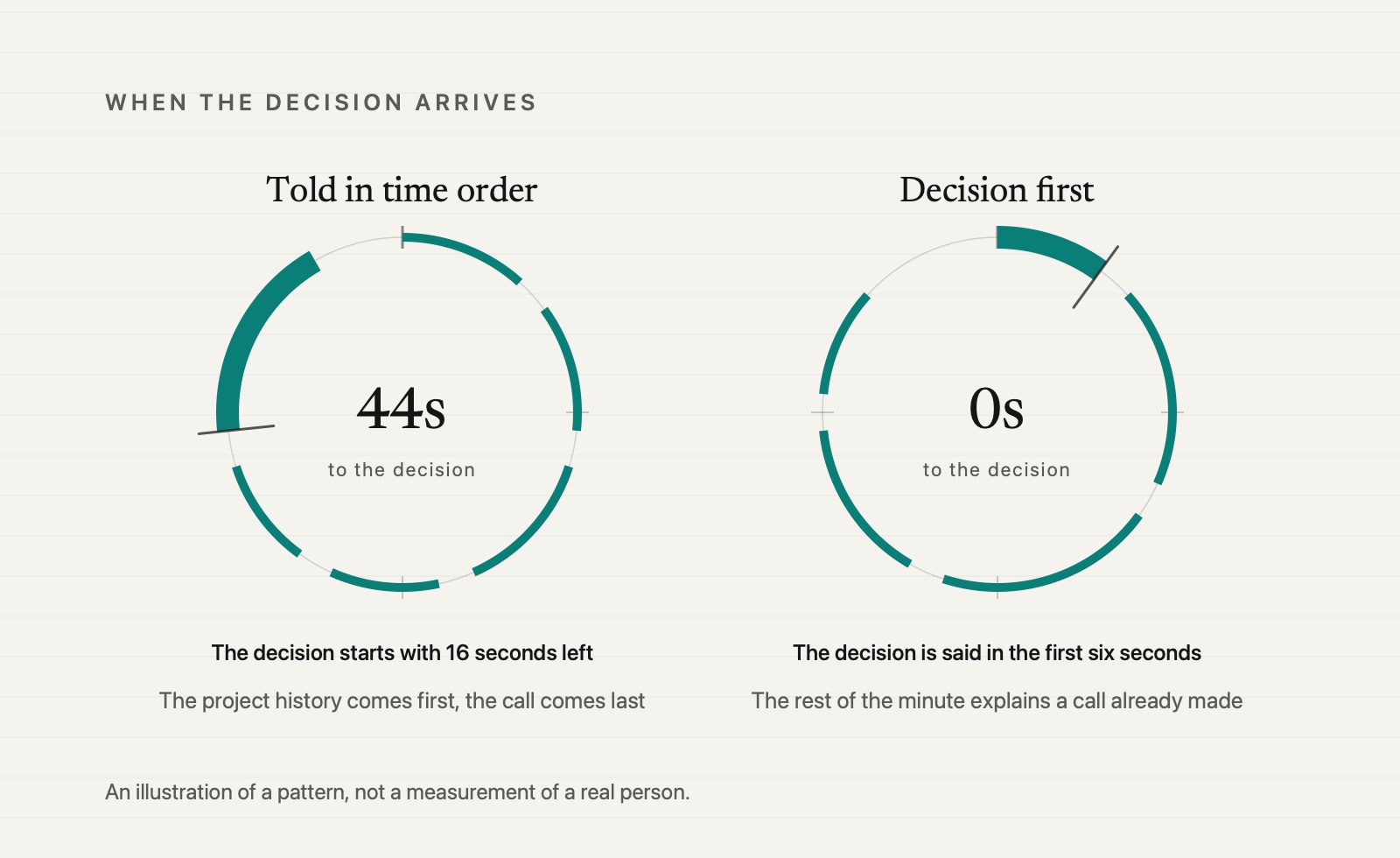
The result is an answer where the decision lands in the last fifteen seconds of a minute, after the interviewer has already started to wonder what the point is.
How to answer tell me about a time you met a tight deadline in four parts
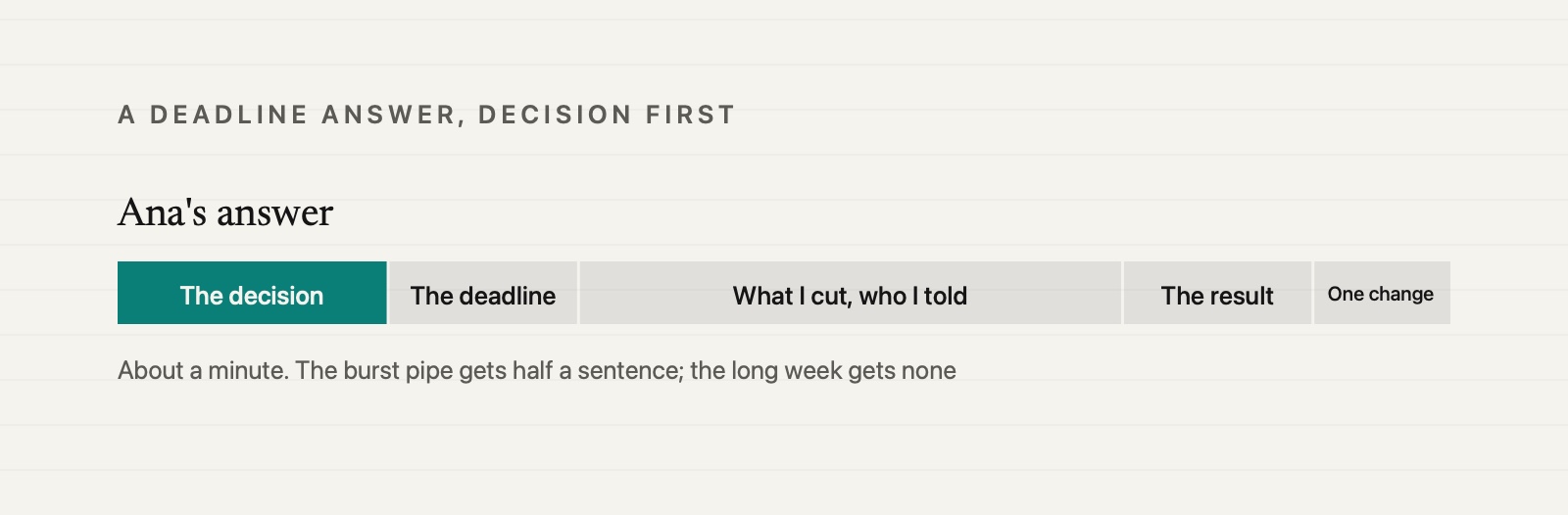
The answer has four parts. The order does most of the work.
Part one, the decision, in your first sentence. "The decision that saved it was to keep the date and cut the program in half." This is the sentence the interviewer will repeat to the hiring team, so it goes where it cannot get lost.
Part two, the deadline, in one sentence. What was due, by when, and what made the time short. One sentence. If the short time was partly your planning, say so plainly here, in a few words, and move on.
Part three, what you did, in three or four sentences. This is most of the answer. What you cut or moved, who you told and when, and what you kept for yourself. Use "I" for the calls you made and "we" for the work the team did.
Part four, the result, in one sentence. Something a person could have seen. If you changed how you plan because of it, that can be a short second sentence. Then stop.
Here is the example for the rest of this post. Ana runs events for a small nonprofit and is interviewing for an operations role. Asked about a time she met a tight deadline, she says:
"The decision that saved it was to keep the date and cut the program down to what a smaller room could hold. Nine days before our yearly fundraiser, the venue told us a burst pipe had closed the hall, and about two hundred guests had already said yes. The only room we could get on that date seated about a hundred and twenty, so I dropped the seated dinner for a standing reception and cut the speakers from five to two. That afternoon I asked our director to call the three speakers we were dropping herself, and I took the guest email, the caterer and the new floor plan. We opened the doors on the original date and both speeches ran on time. Since then, every event we plan has a backup room on hold."
About a minute, and the decision is in the first six seconds. The burst pipe gets half a sentence. The long week is not mentioned at all, because it was not the point.
Pick the decision, not the hours
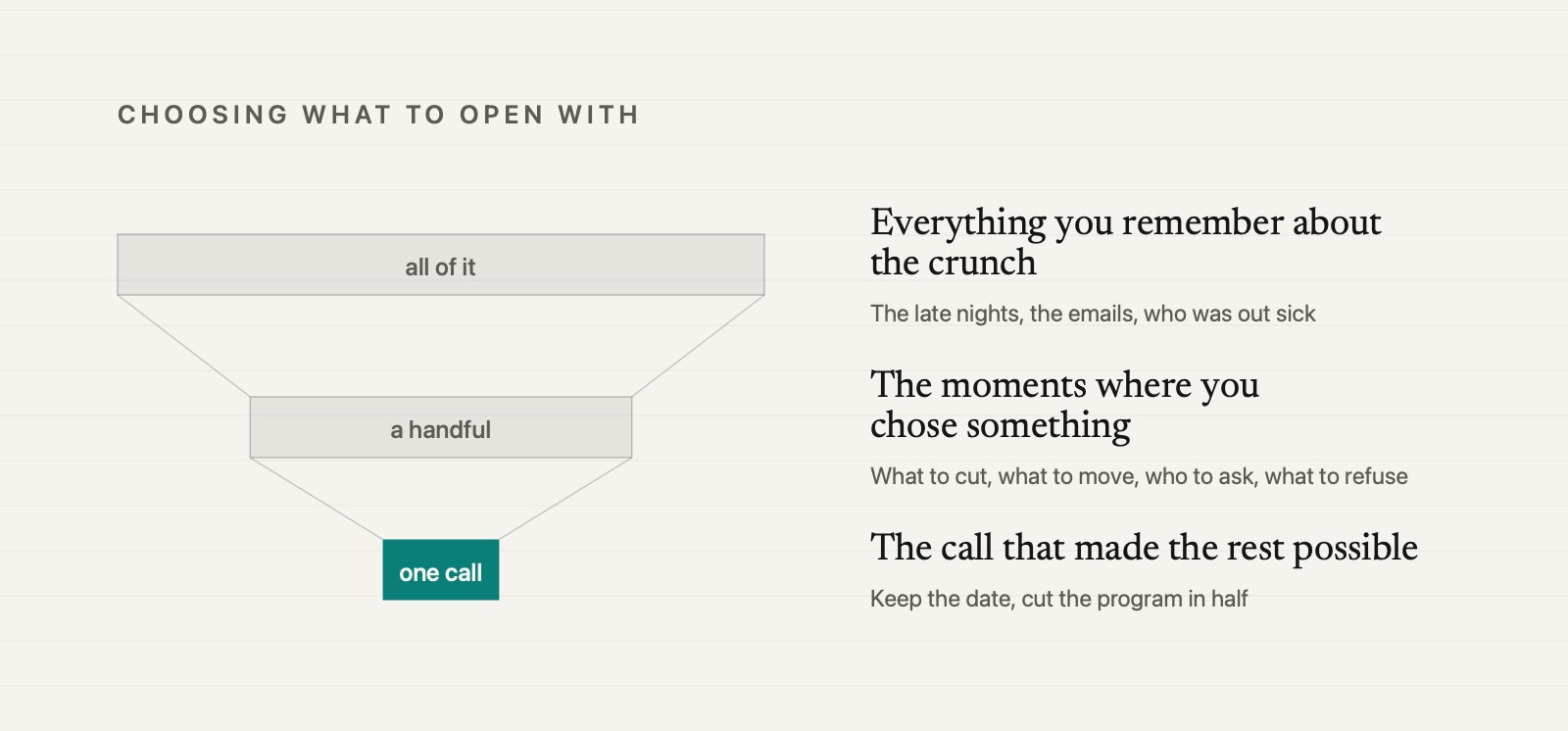
The example you choose matters more than the wording. A good deadline story is not the one where you worked hardest. It is the one where you made the clearest call.
Start with everything you remember about the crunch, which is usually a lot. Then keep only the moments where you chose something: what to cut, what to move, who to ask, what to say no to. Out of those, pick the one that made the rest possible. That is your first sentence.
Three filters help.
Pick a story with a real trade-off. "I worked all weekend" is effort, not a decision. "I shipped the report without the appendix and sent it two days later" is a decision. Interviewers hire for the second.
Pick a story where you told someone early. The moment you raised the problem is often the most impressive part, and people leave it out because it felt ordinary. Say who you told and when.
Pick a story with a result you can name. It shipped, it opened on time, the client signed. If the deadline was missed, that can still work, but it is a different question, and you should answer it the way Boston University's guide suggests for missed deadlines: own your part and do not blame someone else.
Say the trade-off without apologizing
On paper, Ana's answer is clean. Out loud, the sentence most people fumble is the one about what got cut. It is the only sentence about something that did not happen, so it picks up a softener at the front ("so, unfortunately, we kind of had to") and speeds up all the way through.
Say the cut at the same pace as the sentence before it. "I dropped the seated dinner for a standing reception." A cut said plainly sounds like a decision. A cut said quickly, with an apology in front, sounds like something that happened to you, which is the opposite of what the question is checking.
The same goes for owning a planning miss. "Our first plan assumed the venue was safe, and it was not" takes four seconds and costs you nothing. Spending twenty seconds explaining why the plan was reasonable costs you most of the minute. Our post on how to sound confident in an interview goes through the hedges that creep into sentences like this one by one.
When the interviewer pushes
Short follow-ups are normal here, and the four-part shape handles them.
"What would you do differently?" Name one change to how you plan, in one sentence. Buehler's work points to a simple one: base the estimate on how long similar work took last time, not on the plan alone. "I now plan from how long the last event took, not from the ideal schedule." Then stop.
"How did you handle the stress?" One honest sentence, then back to what you did. "It was a hard week, so I wrote the plan down that first afternoon and worked from the list." Do not relive the week.
"Have you ever missed a deadline?" Most people have. Say so, name your part in it, and say what you changed. This is where the planning-fallacy honesty from earlier pays off: you have already shown you can talk about your own estimate without flinching.
"Can you give me another example?" Have a second story in the same shape, shorter: the decision in one sentence, the deadline in one, what you did in two. If you are not sure how long either should run, our post on how long an interview answer should be covers the timing.
Try it now: practice in five minutes
You need your phone's voice recorder and a timer.
- Write your decision in one sentence, starting with "The decision that saved it was." Then write the deadline in one sentence: what was due, by when, and why time ran short.
- Write three sentences on what you cut, who you told and what you kept, and one sentence on the result. Read it silently. Cross out any sentence that is about how hard the week was.
- Start the timer and the recorder. Ask yourself out loud, "Tell me about a time you met a tight deadline." Answer from your notes. Count silently to three before you stop the recording.
- Play it back and listen for two things only. How many seconds went by before the decision? Did the sentence about the cut come out faster than the rest?
- Change one of those and record it again. If you have a minute left, ask yourself, "What would you do differently?", and answer in one sentence.
The second take is almost always shorter, and the decision moves up. For a routine that runs this across several questions, see our post on how to practice for an interview alone.
If your decision is clear on paper but the project history comes back the moment someone actually asks, that is a practice problem, not a knowledge problem, and a few minutes a day is what fixes it. Sayforth is a 30-day iPhone program built for that: one short coached spoken answer a day, drawn as a single answer line after you finish, so you can see how far into the answer your point arrived, plus one change to try tomorrow. It is coming soon, and you can see how the daily practice works now.
Be first to know when Sayforth is live.
Get launch updatesFrequently Asked Questions
How do you answer "tell me about a time you met a tight deadline"?
Say the decision you made in your first sentence, usually what you cut or moved. Give the deadline in one sentence, spend three or four sentences on what you did and who you told, and end with one sentence on the result. About a minute, then stop.
What is a good example of meeting a tight deadline?
One with a clear trade-off you chose, such as cutting scope, moving part of the work later, or asking for help early, and a result you can name. Avoid stories where the only thing you did was work longer hours, because effort is not the judgment the interviewer is asking about.
Should I use the STAR method for this question?
The parts of STAR are all there, but the order changes. Lead with the action that mattered most, the decision, and keep the situation to one sentence. The interviewer hears the point before the background instead of after it.
What if I missed the deadline?
Then answer the question honestly as a missed deadline. Name your part in it without blaming anyone, say what you did once you knew it would slip, and say what you plan differently now. A plain account of a miss often lands better than a story where everything went perfectly.