
Here is how to answer "tell me about a time you received critical feedback." Say what you changed in your first sentence. Give the feedback itself in one plain sentence, close to the words the person used. Spend most of the answer on what you did differently. End with one sentence on what it changed. Aim for about a minute.
The hard part is not remembering a time you received critical feedback. Everyone has one. The hard part is saying it out loud without the first thirty seconds turning into a defense of yourself. This post builds one example answer part by part, shows what the defensive version sounds like next to it, and ends with a five-minute exercise.
What "tell me about a time you received critical feedback" really asks
The question sounds like it is about the feedback. It is not. The interviewer is asking whether you can hear something hard about your work and do something with it. The University of Florida's career center groups this question with the weakness and failure questions and says they exist to find out whether you "have a strong sense of self and are able to put into action a process for self-improvement" (UF Career Connections Center). The same guide says the result part of a behavioral answer should cover what you learned and why it matters for the job.
So the interviewer is listening for three things. Can you repeat the criticism plainly, without softening it or arguing with it? Did you actually change something, and can you say what? And is the change still in place?
Notice what is not on that list. Whether the feedback was fair. Whether the person gave it kindly. Whether you agreed at first. Those are the things most people spend their answer on. You are not being asked whether the feedback was fair. You are being asked what you did with it.
Why this one is hard to say out loud
Receiving criticism is hard for almost everyone. Harvard Business Review's summary of Sheila Heen and Douglas Stone's work on feedback puts it bluntly: nearly everyone, from new hires to executives, struggles with receiving it (Harvard Business Review). A write-up of their book from Ohio State's Fisher College of Business describes three triggers that distort how feedback lands. A truth trigger, when the content seems wrong or unfair. A relationship trigger, when the problem is who said it. And an identity trigger, when the feedback threatens how you see yourself (Fisher College of Business, Ohio State).
All three show up in the interview answer, years after the feedback itself. They come out as a preface. "Honestly, I don't get a lot of critical feedback, but." "It was kind of unfair, because." "I was only trying to." The preface is the trigger talking, and it tells the interviewer you have not fully taken the feedback in.
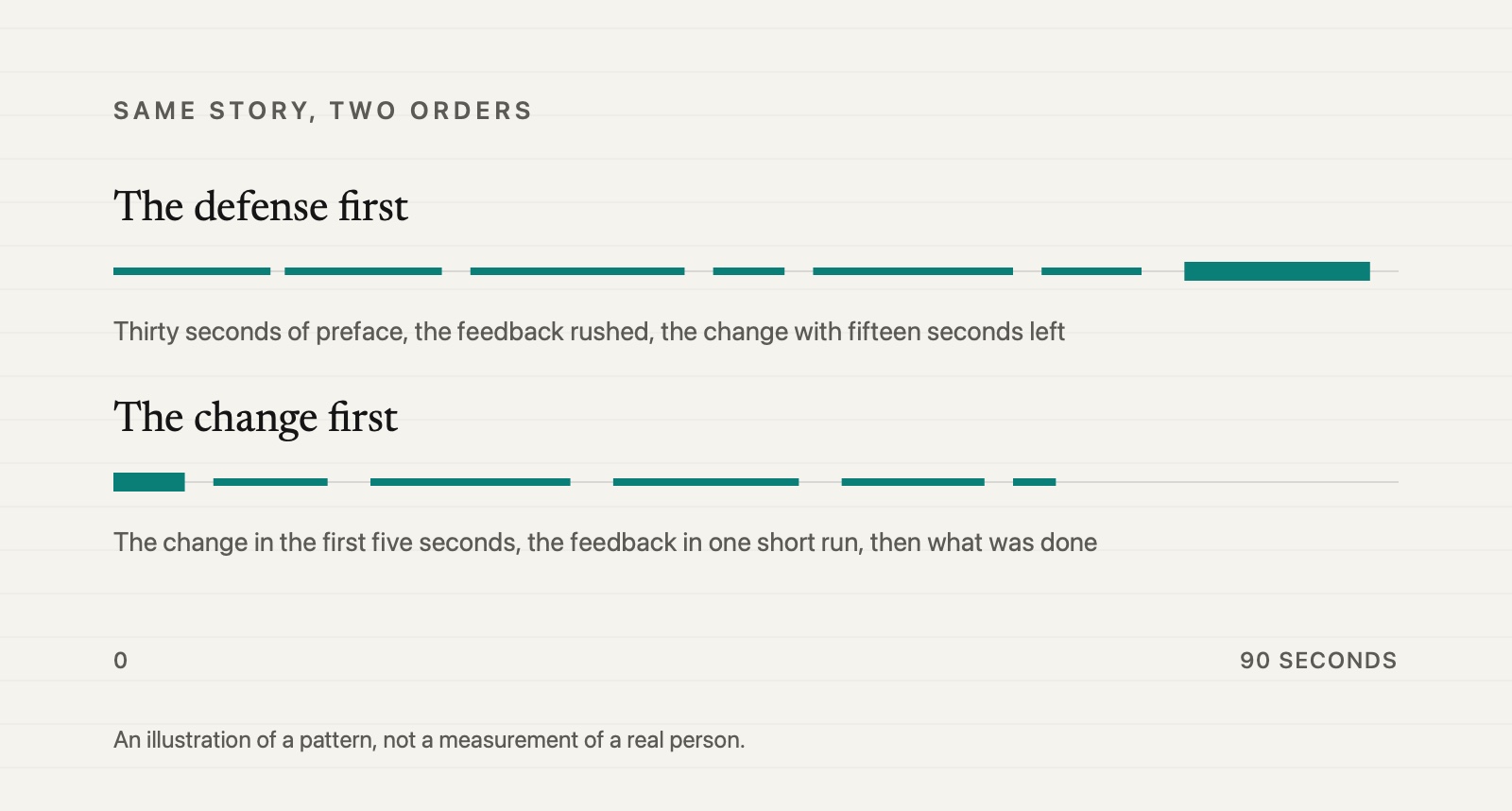
There is a second tell that only shows up when the answer is spoken. People say the feedback sentence faster than the rest, and the story slows down again as soon as they reach the part where they fixed it. A listener hears that speed change as discomfort, even when the words are fine.
How to answer tell me about a time you received critical feedback in four parts
The answer has four parts. The order matters more than the wording.
Part one, the change, in your first sentence. Not the setup, not the project, not the person. "The change I made was to stop answering for my team." This is the sentence the interviewer will remember, so it goes where it cannot get lost.
Part two, the feedback, in one sentence. Say what the person told you, close to their words, and say who they were. One sentence. Do not grade it, do not explain why it was partly wrong, and do not apologize for it.
Part three, what you did, in three or four sentences. This is most of the answer. What you noticed once you looked, the specific thing you started doing differently, and how long it took to feel normal. Use "I" here.
Part four, what changed, in one sentence. Something a person could have seen. Then stop.
Here is the example for the rest of this post. Luis leads a small support team and is interviewing for a team lead role at a larger company. Asked about a time he received critical feedback, he says:
"The change I made was to stop answering for my team. Last year my manager told me that in our weekly handoff I was jumping in on questions meant for the people who did the work, and that they had stopped speaking up. My first thought was that I was saving time. Then I watched one meeting and counted, and I had answered six of the eight questions aimed at someone else. So I made one rule for myself. When a question goes to someone on my team, I wait, and if the room is quiet I say their name and hand it over. It felt slow for about two weeks. By the end of the quarter two people on the team were running their own sections of the handoff, and the questions got better because they were going to the person who knew."
About a minute, and the change is in the first five seconds. Nothing in it argues with the manager. The one honest reaction, "my first thought was that I was saving time," takes a few words and then gets out of the way.
What the defensive version sounds like
Here is what many people say instead, and most of them do not hear it. "So, honestly, I don't get a lot of critical feedback, but I guess one time my manager mentioned something about how I ran meetings, which I think was a little unfair because I was just trying to keep things moving, but anyway I took it on board and I've definitely been working on that."
Count what the interviewer actually learned. The feedback was "something about meetings." The change was "working on that." Everything else is about whether the feedback was deserved. Most of a minute, no decision, no result.
The defensive version is not a character flaw. It is what the triggers sound like in a sentence. That is why the order helps: putting the change first means you have already told the interviewer the feedback was right before any part of you can argue with it. Our post on how to sound confident in an interview goes through the hedges that creep into answers like this, one by one.
Say the feedback sentence like a fact
Of the four parts, the feedback sentence is the one people get wrong in the mouth, even when they have it right on paper. It is the only sentence about something you did badly, so it gets a hedge in front, a softener in the middle, and a speed-up all the way through.
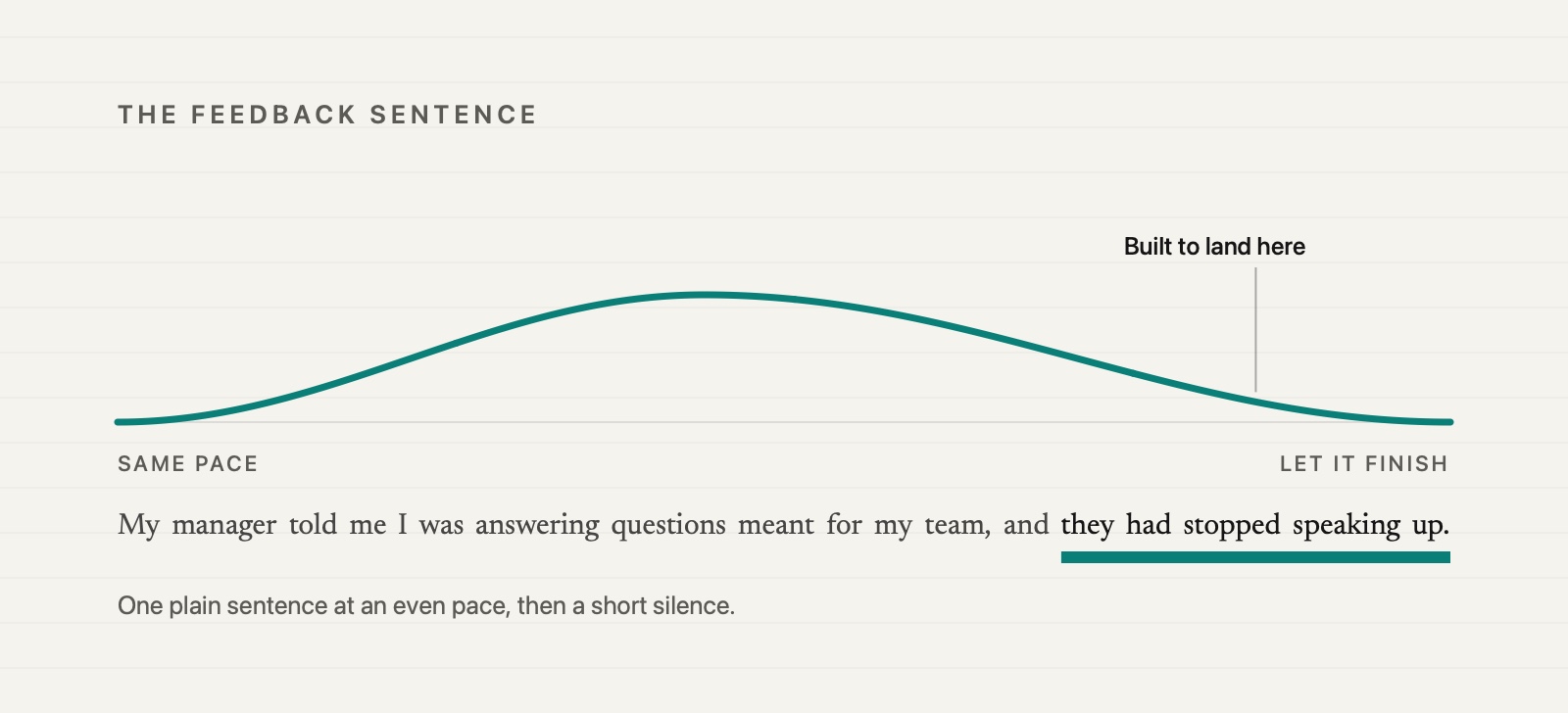
Write it as one plain sentence and keep it that way. "My manager told me I was answering questions meant for my team, and they had stopped speaking up." Say it at the same pace as the sentence before it, and let it finish. The small silence after a plainly stated criticism tells the room you have made peace with it. Softening it tells the room the feedback still stings.
One detail worth keeping: the last few words of that sentence, "they had stopped speaking up," are the ones that mattered to the manager. That is the consequence, and the part Luis changed. If the sentence is built to land there, the interviewer hears the stakes without being told.
Pick the feedback that shows a change
The example you choose does more work than the wording. Three filters help.
Pick feedback about a habit, not a core skill for this job. If you are interviewing for an analyst role, do not choose "my numbers were wrong." Choose something you could change by deciding to: how you ran a meeting, how you wrote updates, how you handed off work.
Pick feedback you acted on, not feedback you survived. "I learned to take criticism better" is not a change. "I stopped answering for my team" is. If you cannot name the specific thing you started or stopped doing, choose a different example.
Pick something recent enough that the change is still in place. The follow-up question is almost always "and do you still do that?" You want the honest answer to be yes, with an example from the last few months. The University of Florida guide's advice for the result applies here too: say what you learned and why it matters for this job.
If you have two examples that pass, keep the second one for the follow-up. Interviewers often ask for another.
When the interviewer pushes
Short follow-ups are normal here, and the four-part shape handles them.
"How did you feel when you heard it?" Answer in one sentence, honestly, and go back to the change. "Defensive, for about a day. Then I watched a meeting and counted." Do not relive it.
"Did you agree with the feedback?" If you did, say so plainly. If you did not at first, say that in a sentence, and say what changed your mind. "Not at first. Then I watched a meeting and counted." The interviewer is checking whether you can be wrong out loud. You can.
"What feedback have you received recently?" This checks that the first answer was not the only time. Have a second example in the same shape, shorter: the change in one sentence, the feedback in one, what you did in two. Our post on how to answer "tell me about a time you disagreed with your manager" covers the related question where the conflict runs the other way.
Try it now: practice in five minutes
You can do this with your phone's voice recorder and a timer.
- Write the change in one sentence, starting with the words "The change I made was." Then write the feedback in one sentence, close to the giver's words, with no hedge in front of it.
- Write three sentences on what you did and one on what changed. Read the whole thing silently. If any sentence argues with the feedback, cut it.
- Start the timer and the recorder. Ask yourself out loud, "Tell me about a time you received critical feedback." Answer from your notes. Count silently to three before you stop the recording.
- Play it back and listen for two things only. Did a preface appear before the change? Did the feedback sentence come out faster than the rest?
- Change one of those and record it again. If you have a minute left, ask the follow-up, "Do you still do that?", and answer in two sentences.
The second take is almost always shorter, and the feedback sentence comes out slower. For a routine built on the same idea across several questions, see our post on how to practice for an interview alone.
If the change is clear on paper but the preface comes back the moment someone actually asks, that is a practice problem, not a knowledge problem, and a few minutes a day is what fixes it. Sayforth is a 30-day iPhone program built for that: one short coached spoken answer a day, drawn as a single answer line after you finish so you can see where your main point landed and how long the lead-in took, with one change to carry into tomorrow. It is coming soon, and you can see how the daily practice works now.
Be first to know when Sayforth is live.
Get launch updatesFrequently Asked Questions
How do you answer "tell me about a time you received critical feedback"?
Say what you changed in your first sentence, give the feedback in one plain sentence, spend three or four sentences on what you did differently, and end with one sentence on what changed. About a minute, then stop. The change goes first so the interviewer hears it before anything that sounds like a defense.
What is a good example of critical feedback for an interview?
Feedback about a habit you could change by deciding to, such as how you ran meetings or how you wrote updates, that you acted on and still act on. Avoid feedback about a core skill for the job you are applying for, and avoid feedback you only "took on board" without a specific change to point to.
Should I say I disagreed with the feedback?
Only if it is true, and only in one sentence. "Not at first" is fine, followed by what changed your mind. What costs you is spending the answer on whether the feedback was fair. The question is about what you did with it.
How long should the answer be?
About a minute. One sentence for the change, one for the feedback, three or four for what you did, one for the result. If the interviewer wants more, they will ask, and the follow-up gets two sentences.