Here is how to answer "tell me about a time you disagreed with your manager." Say what you disagreed about in your first sentence. Give your manager's view fairly in one sentence. Spend most of the answer on how you raised it. Then say how it ended and what you would do the same way again. Aim for about ninety seconds.
The hard part is saying it out loud without the story turning into a complaint or three minutes of background. This post builds one example answer, part by part, and ends with a five-minute exercise.
What "tell me about a time you disagreed with your manager" really asks
When someone asks you to tell me about a time you disagreed with your manager, they are not looking for drama. They want to know three things. Will you speak up when you see a problem? Can you do it without making it personal? And once a decision is made, will you get behind it, even if it did not go your way?
Some companies write this down. Amazon's published leadership principles include one called "Have Backbone; Disagree and Commit," which asks people to respectfully challenge decisions they disagree with and then commit fully once a decision is made (Amazon leadership principles). Most interviewers listen for that pattern: you raised it, you raised it well, and you moved forward.
This is a behavioral question, and career centers often suggest the STAR method for it: situation, task, action, result. The University of New Mexico's guide adds a useful rule for conflict stories: speak respectfully about people, and if you cannot, choose a different example (UNM Career Services, The STAR Method). The steps below fit inside STAR. They change what you say first and where you spend your time.
Step 1: Pick a disagreement about the work, not the person
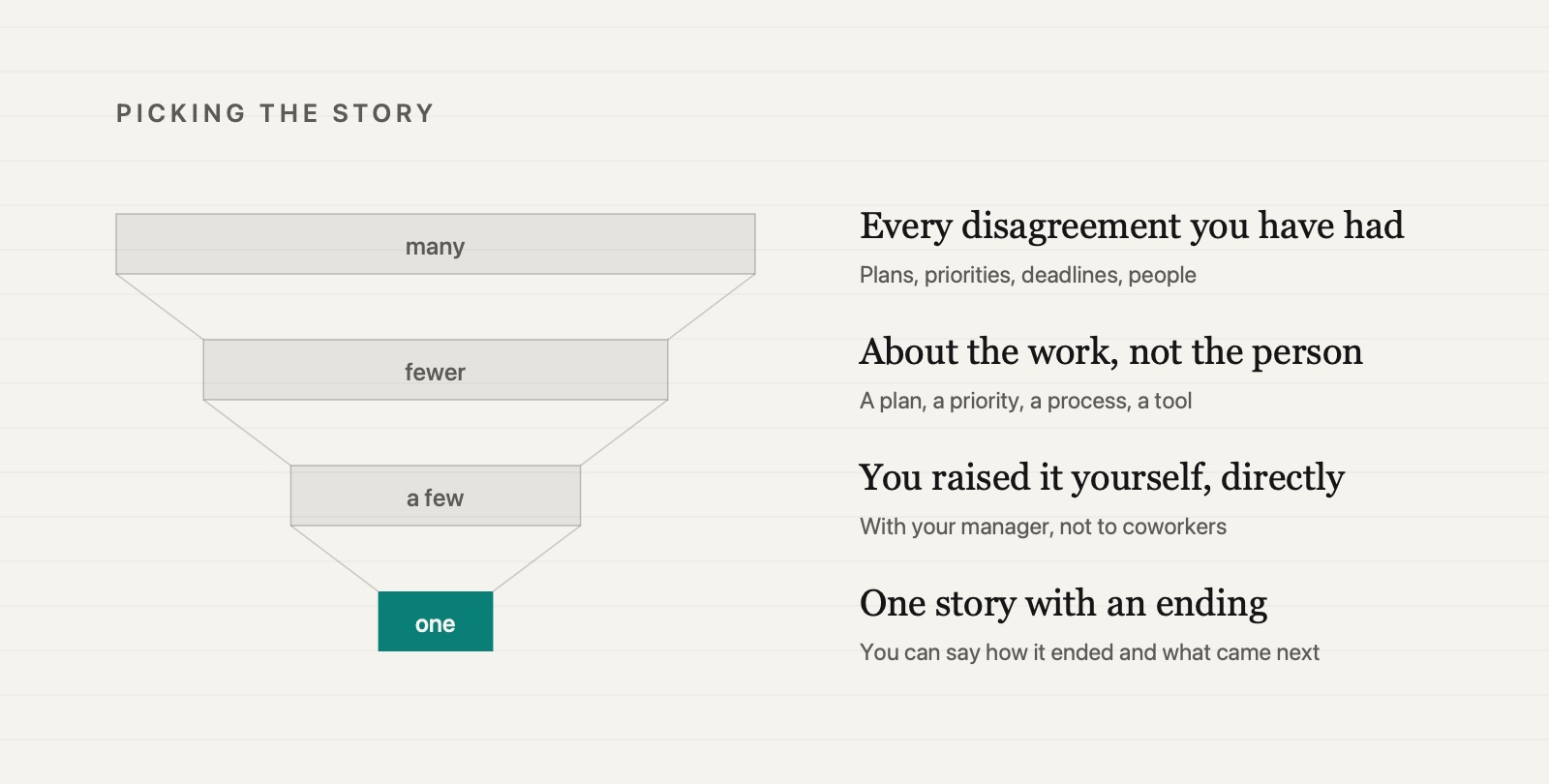
Most people have more disagreements to choose from than they think. Narrow them with three filters.
First, it should be about the work: a plan, a priority, a process, a deadline, a tool. Not about your manager's personality or how they treated you. Second, you raised it yourself, directly, with your manager. Complaining to coworkers shows the opposite of what they want to hear. Third, you can say how it ended.
Skip stories where the relationship broke down. They make the interview about your old manager instead of you. If you are new to work, a team lead, shift supervisor or professor counts.
Step 2: Say what you disagreed about in your first sentence
This is where most answers go wrong. People start with the company, the team and the project, and the interviewer waits forty seconds to learn what the story is about.
Put the disagreement in the first sentence instead. Here is the example we will build through the rest of this post:
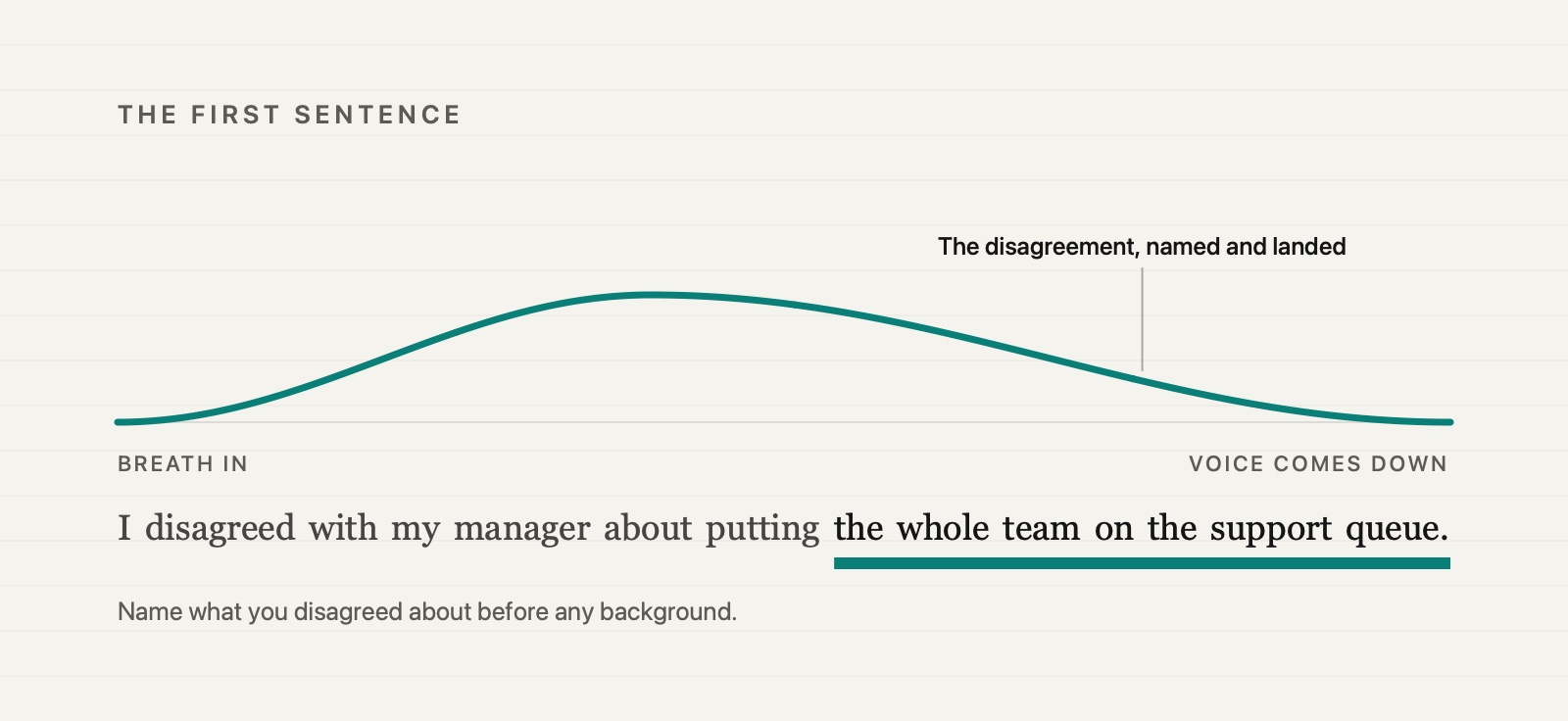
"I disagreed with my manager about putting the whole team on the support queue."
That sentence tells the interviewer what the story is and that it was about the work. Everything after it is heard as support for a point they already have. Add one or two sentences of background next, only what they need: "We were six engineers, and she wanted every customer ticket answered within an hour, so she asked all of us to watch the queue."
Say that first sentence in one breath and let your voice come down at the end. If it rises, it sounds like you are asking whether the story is allowed.
Step 3: Give your manager's view fairly
Before you explain why you disagreed, say why your manager wanted what they wanted. One sentence is enough, and it should be the version they would agree with.
"She was worried that a slow reply to one of our biggest customers would cost us the account, and that was a fair worry."
This sentence shows you understood the other side before you pushed back, and it takes the villain out of the story. Skip it, and even a calm answer can sound like "my manager had a bad idea and I had a good one."
Then give your side, also in about one sentence: "My concern was that with all six of us watching the queue, nobody had a full afternoon for the database migration we were already behind on."
Step 4: Spend most of the answer on how you raised it
This is the part the interviewer actually came for. Most of your ninety seconds should go here. Answer four small questions: where did you raise it, what did you bring, what did you suggest instead, and how did you say it.
In the example: "I asked for fifteen minutes in our one-on-one rather than raising it in the team meeting. I brought two weeks of ticket times, which showed most tickets arrived before eleven in the morning. I suggested a rotation: one person on the queue each day, and anyone could be pulled in for our top customers. And I opened by saying her goal was right, and I only wanted to change how we got there."
Notice what is not in there: no "it was obviously a mistake," no "everyone agreed with me." The details show judgment: the right setting, real evidence, a concrete alternative, and respect for the goal.
If you want more on the live skill of disagreeing well, our post on how to disagree in a meeting covers the live version. In an interview, you are telling the story of having done it.
Step 5: Say how it ended, even if you did not win
The ending has two parts: what happened, and what you did next.
"She agreed to try the rotation for two weeks. Replies to our top customers stayed under an hour, the rest of the team got their afternoons back, and we kept the rotation after the trial."
Your story does not need to end with your manager agreeing. "She heard me out, kept her plan, and I put my full effort into it" shows the second half of disagree and commit, the half people forget. A lost argument can still end on a positive note: what you learned, or what went well because you committed.
Avoid the ending where you were proven right and everyone realized it. Even when true, it sounds like you are keeping score.
Close with one short sentence about what you would do the same way again: "What I would repeat is bringing the data and her concern into the same conversation."
The whole answer, start to finish
Put together, here is a full answer to "tell me about a time you disagreed with your manager," as it sounds out loud:
"I disagreed with my manager about putting the whole team on the support queue. We were six engineers, and she wanted every customer ticket answered within an hour. She was worried that a slow reply to one of our biggest customers would cost us the account, and that was a fair worry. My concern was that nobody had a full afternoon for the migration we were already behind on. So I asked for fifteen minutes in our one-on-one, brought two weeks of ticket times showing most tickets arrived before eleven, and suggested a daily rotation, with anyone pulled in for our top customers. She agreed to try it for two weeks. Replies to top customers stayed under an hour, the team got their afternoons back, and we kept the rotation. What I would repeat is bringing the data and her concern into the same conversation."
That runs about a minute at a normal pace, which leaves room for follow-up questions. For the usual range on behavioral stories, see how long an interview answer should be.
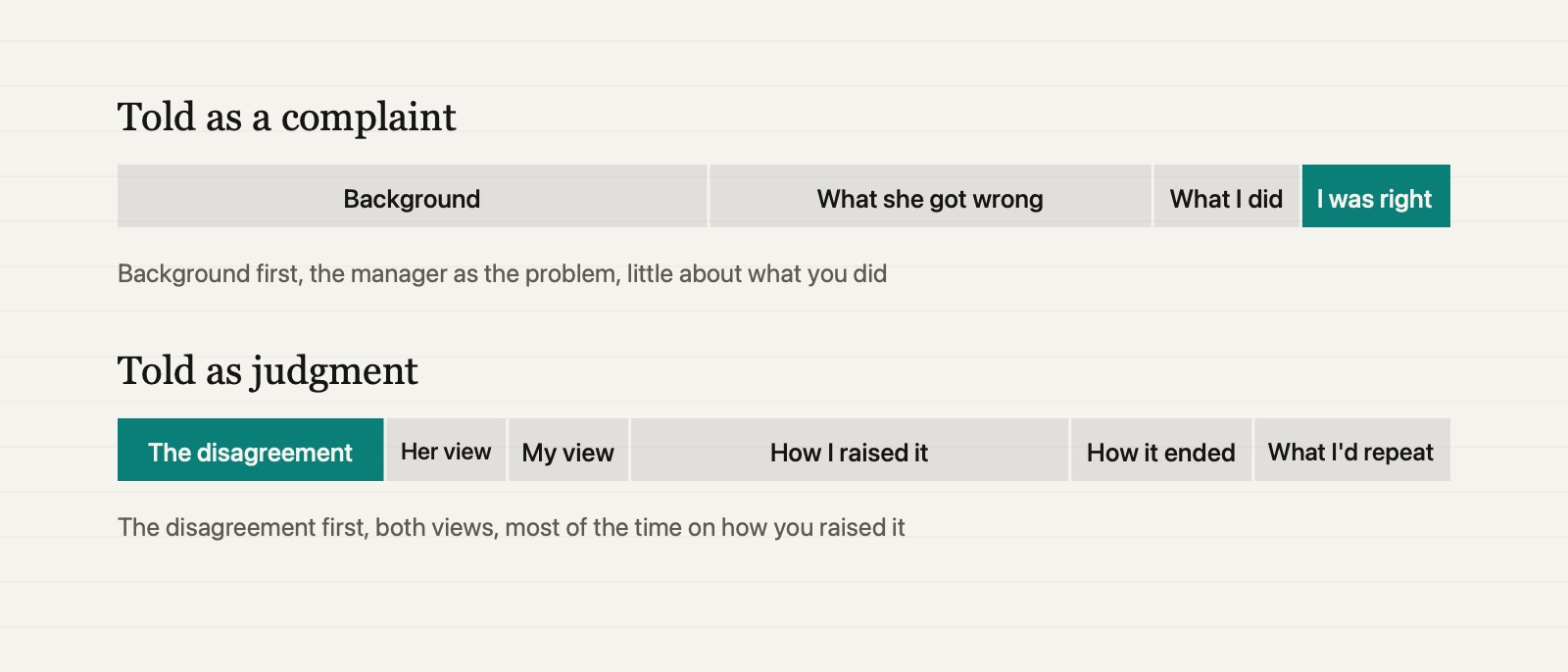
The usual version of this story spends most of its time on background and on what the manager got wrong. The rebuilt version names the disagreement first and spends most of its time on what you did.
What to leave out
- "I don't really disagree with my managers." It tells the interviewer you either do not speak up or missed the question. Pick a small, real example.
- Your current manager, by name, with an edge. Keep it calm and about the work. The interviewer will imagine you telling a story about them someday.
- The long backstory. If the disagreement is not in your first two sentences, cut until it is.
- Proving you were right. Say what happened and let the interviewer judge.
Try it now: a five-minute practice round
You can do this with your phone's voice recorder and a timer.
- Pick one real disagreement using the three filters in Step 1. Write only its first sentence: "I disagreed with my manager about ___."
- Start the timer and the recorder. Ask yourself "tell me about a time you disagreed with your manager" and answer out loud, all the way through, without notes. Stop the recording when you finish.
- Play it back. How many seconds before you named the disagreement? Would your manager agree with how you described their view? How much of the answer was about what you did?
- Make one change only. Move the disagreement to the first sentence, rewrite your manager's view, or cut background to one sentence.
- Record it again and listen once more.
The second take is usually shorter and clearer. The disagreement often arrives later than you expect, because it never feels late while you are talking.
If you can see the fix when you listen back but it slips away the moment you start talking, that is a practice problem, and short daily practice is what helps. Sayforth is a 30-day iPhone program built on that idea: one short coached spoken answer a day, drawn as a single speaking line so you can see where your point landed, with one change to carry into tomorrow. It is coming soon, and you can see how the daily practice works now.
Be first to know when Sayforth is live.
Get launch updatesFrequently Asked Questions
What if I have never disagreed with my manager?
Think smaller. A disagreement can be about the order of two tasks, a deadline, how a report was laid out, or which tool to use. If you truly have none, use a team lead, a supervisor at a part-time job, or a professor on a project, and say so plainly at the start.
Can I tell a story where my manager turned out to be right?
Yes, and it can be one of the strongest versions. Say what you disagreed about, how you raised it, and what you learned when their call worked out. It shows you can speak up and also change your mind, which is exactly what the question is testing.
How long should my answer be?
Aim for about one to two minutes. Name the disagreement in the first sentence, keep background to one or two sentences, and spend most of the time on how you raised it. Then stop and let the interviewer ask follow-up questions.
Should I use the STAR method for this question?
You can. Situation, task, action and result still fit. The change is to name the disagreement in your first sentence instead of building up to it, and to give your manager's view fairly before you explain yours.