The short version of how to disagree in a meeting: name the one thing you disagree with in your first sentence, give your strongest reason, say what you would do instead, and then hand it back with a real question. Four sentences, said plainly, in about twenty seconds. The warmth comes from your tone and your question. The clarity comes from the order.
Most people who struggle with how to disagree in a meeting get one of those two right and lose the other. Some wrap the point in so much padding that nobody notices a disagreement happened. Others say it so flatly that the room hears a verdict on a colleague instead of a view about a plan. Neither one changes the decision, and changing the decision is the whole reason you spoke.
Why disagreement comes out too soft or too hard
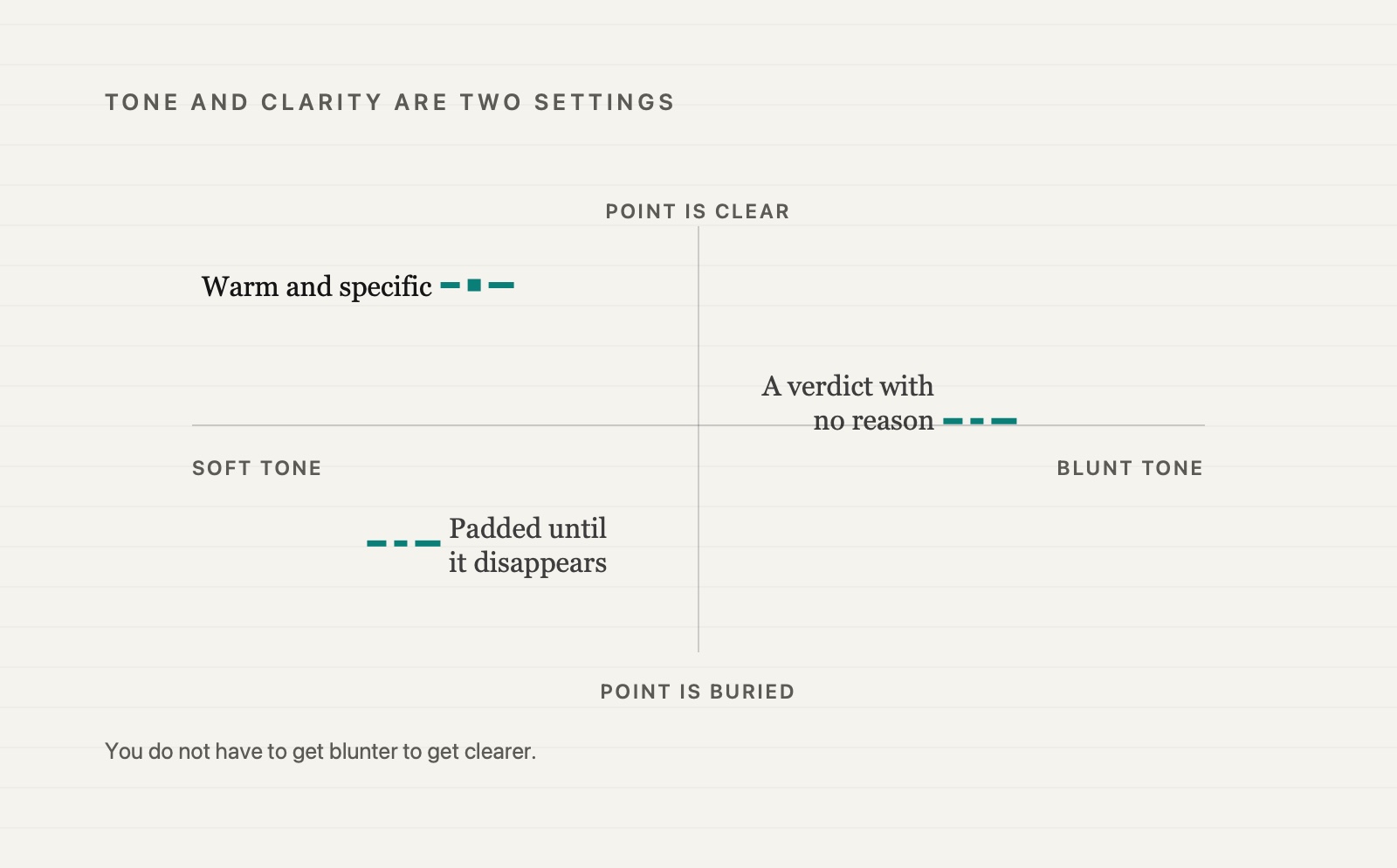
The soft version sounds like this: "I might be missing something, and I know a lot of work went into this, so this is probably a small thing, but I just wonder if the date is maybe a little tight?" By the time the actual concern arrives, it has been apologized for three times. People hear the apologies and file the concern as minor.
The hard version sounds like this: "That date is not going to work." It is clear, but it gives nobody a reason, it offers nothing else, and it can land as a judgment on whoever picked the date. The person who owns the plan now has to defend it, and a defended plan rarely moves.
Here is the useful thing to notice. Softness and clarity are two separate settings, not one slider. You do not have to become blunt to be clear. You can be friendly and completely specific at the same time, and that combination is the one that actually gets a plan changed.
It is also worth knowing why your disagreement matters to the room, even when it feels awkward to raise. Decades of research on group decisions have found that groups spend a disproportionate share of discussion on information everyone already has, and often miss a better option that only one member's information points to (Lightle, Kagel and Arkes, Ohio State University). If you are the one who sees the problem, you may be holding exactly the piece the group is missing. Saying it clearly is not being difficult.
Step 1: Name the exact thing you disagree with
Before you speak, finish this sentence in your head: "I disagree with ___." The blank should be small and concrete. Not "the plan." Not "some of this." One decision, one date, one number.
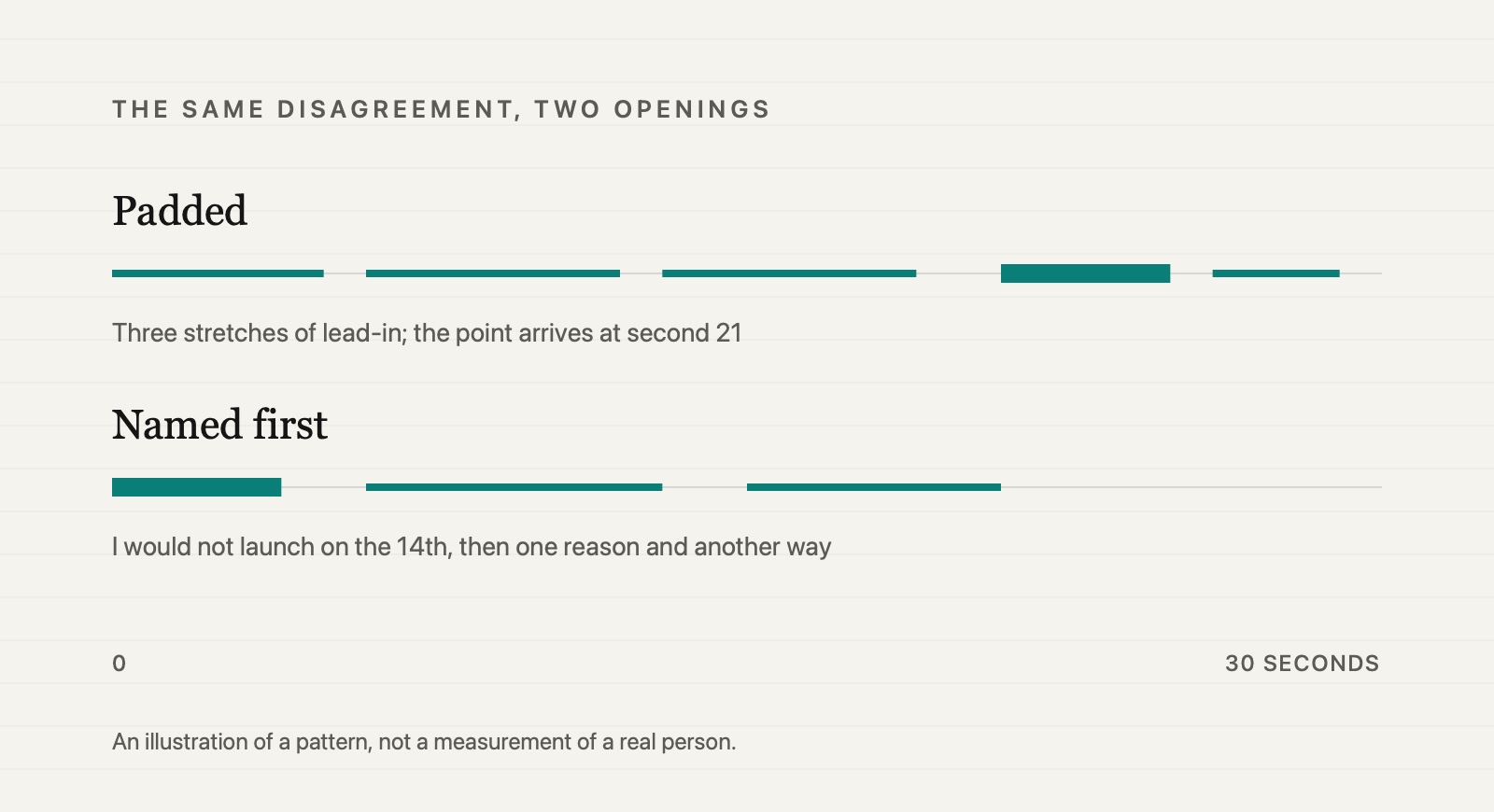
Say you are in a planning meeting and the team has set the new onboarding flow to launch on the 14th. You think the support team will not be ready by then. The narrow version is "I would not launch on the 14th." It is one sentence, it names the decision, and it tells everyone exactly what is being questioned and what is not.
Narrowing it also protects the relationship. Disagreeing with one date quietly says you agree with the rest, so the person who built the plan hears an adjustment, not a rejection. You can say so out loud if it is true: "The flow looks right to me. I would not launch it on the 14th." Keep the praise to one short sentence, and only say it if you mean it.
Then put that sentence first. If you open with the lead-in, the room spends your first fifteen seconds waiting to find out whether this is a question, a joke or a problem. If you open with the point, everything after it gets heard as support for a position they already understand.
Step 2: Give your strongest reason, and only that one
It is tempting to bring every reason you have, as if five reasons are harder to argue with than one. When you disagree in a meeting, it works the other way. The room remembers the weakest reason, because that is the one someone can answer, and once it is answered your whole case feels answered.
So pick one. For the launch date, the strongest reason might be: "Support has not been trained on the new flow yet, and their training is booked for the week after." That is a fact the room can check, and it points straight at the problem.
A good test is whether the reason is about the work, not a person. "Support has not been trained yet" is about the work. "Nobody talked to support" is about someone's mistake, even if it is true, and it will turn the next five minutes into a defense. If you are holding more reasons, keep them. If someone pushes back, you can bring out the second one then.
Step 3: Say what you would do instead
A disagreement with no alternative leaves the room with a problem and nowhere to go. A disagreement with an alternative gives them a decision to make. That is a much easier thing to say yes to.
The alternative does not have to be perfect or final. It only has to be concrete: "I would launch on the 21st, right after the training." Or, if a date is truly fixed: "If the 14th has to stay, I would launch to a small group first and open it to everyone once support is trained."
This sentence also changes how your disagreement sounds. Without it, you are the person who said no. With it, you are the person who found a way to make the plan work.
Step 4: Hand it back with a real question, then stop
The last sentence gives the room a turn. The best version is a question you actually want answered, such as "Is there a reason the 14th cannot move?" or "What am I missing about the date?" A real question tells people you can be persuaded, and it gives the plan's owner an easy way in.
Then stop. This is the hardest part of learning how to disagree in a meeting, because the silence after a disagreement feels enormous. The urge is to fill it: to soften what you said, add a third reason, or take half of it back. Do not. The pause is the room thinking about your point. Anything you add now pulls attention back to you and away from the decision.
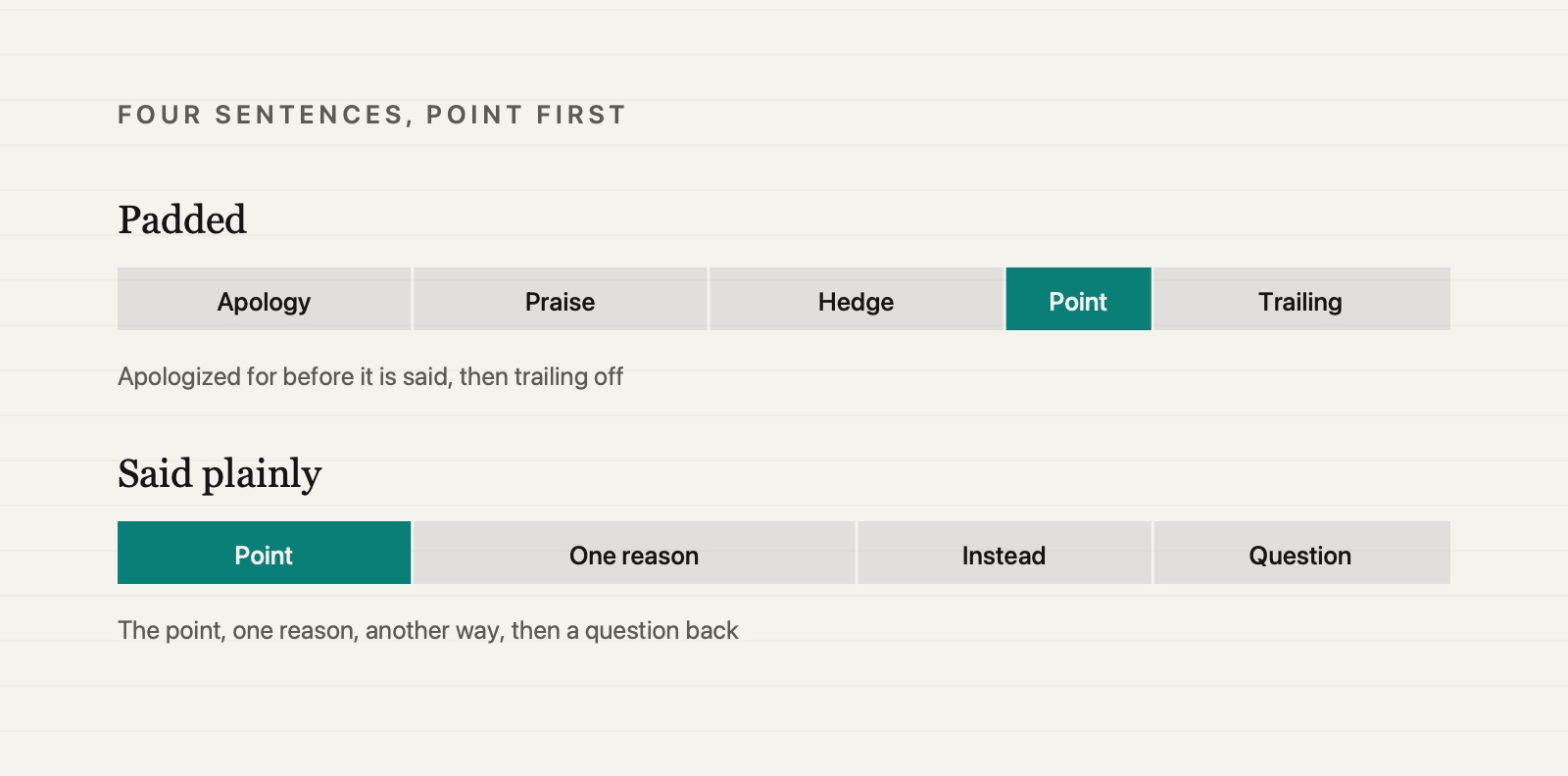
Put together, the whole thing is four short sentences: the point, one reason, what you would do instead, and a question back. Compare that to the padded version from the start of this post and the difference is not politeness. Both can be polite. The difference is that one of them has the disagreement in it.
Step 5: Choose the moment and the room
Knowing how to disagree in a meeting is partly knowing when. Disagree while the decision is still open, not after it has been made and everyone has moved on. A concern raised during the discussion is input. The same concern raised after the decision sounds like reopening it.
Some disagreements belong in the room and some do not. If your point is about the plan, the room is the right place, because the room is deciding. If your point touches someone's judgment or standing, or it would embarrass your manager in front of their own manager, say it one-on-one first. You can make exactly the same point with less pressure on the other person to defend themselves.
If the other person has more power than you, it helps to weigh the risk of speaking up against the risk of staying quiet, and to ask whether they want to hear a different view before you give it. Harvard Business Review's guide to disagreeing with someone more powerful than you walks through both.
Try it now: how to disagree in a meeting in five minutes
You can practice this today with a phone and a timer. Pick a real decision at work, or anywhere, that you think is wrong. It works better if it is a small one.
- Write the four sentences. The point ("I disagree with ___"), one reason, what you would do instead, and one real question. Keep each one short enough to say in a single breath.
- Set a timer and say them out loud, recording on your phone. Aim for under twenty-five seconds.
- Listen back once, and only listen for one thing: how many words came before your first sentence. Every "I might be wrong" or "this is probably nothing" counts.
- Say it again, starting on the point with nothing in front of it. Then stop and count three seconds of silence before you reach for the timer.
The second take is usually shorter and clearer, and often sounds friendlier too, because your tone is left to do the warm part on its own.
If you know what you think in the meeting but it keeps coming out wrapped in apologies, that is a practice problem, not a courage problem. Sayforth is a 30-day iPhone program for exactly this: one short coached spoken answer a day, drawn as a single speaking line so you can see where your point actually landed, and one change to carry into tomorrow. It is coming soon.
Be first to know when Sayforth is live.
Get launch updatesTwo related posts cover the pieces around this one. If you also struggle to be brief when it is simply your turn to report, read how to give a status update in a meeting. If the point tends to arrive late in everything you say, how to stop rambling when you answer a question goes deeper on putting it first. You can also see how the daily practice works.
Frequently Asked Questions
How do you disagree with your boss in a meeting?
Keep it about the plan, not about their judgment, and keep it narrow: one decision, one reason, one alternative. If the point could make them look wrong in front of their own manager, raise it with them privately first. Asking "Can I offer a different view on the date?" before you give it also makes it easier for them to hear.
How do you disagree politely in a meeting without sounding rude?
Politeness comes from your tone, a brief and honest note of what you agree with, and a real question at the end. It does not come from hedging the point itself. "The flow looks right to me. I would not launch it on the 14th, because support is not trained yet" is both polite and clear.
Is it better to disagree in the meeting or after it?
If the disagreement is about the plan and the decision is still open, say it in the meeting, because that is where the decision is being made. If it is about a person, or it would put someone on the spot in front of senior people, say it privately first. Raising a concern after a decision is final usually lands as reopening it.
What if I disagree and the decision goes the other way?
Say once that you understand the decision, and then support it properly. You were heard, which is what the meeting owed you. If what you worried about does happen later, raise it as a fact about the work, not as a reminder that you were right.