
Here is how to give a farewell speech for a coworker: tell one short story the whole room can follow, say one specific thank-you that names what they did and what it changed, and end on that thank-you. Then raise your glass and stop. Two minutes is plenty. The thank-you is the point of the speech, so decide it first and build everything else around it.
That is the whole shape. Most goodbye speeches go wrong by trying to cover everything the person ever did, and the room stops listening halfway through the list. A short speech still deserves a rehearsal, and the method in how to practice a presentation by yourself works just as well for two minutes of goodbye.
Why most farewell speeches fall flat
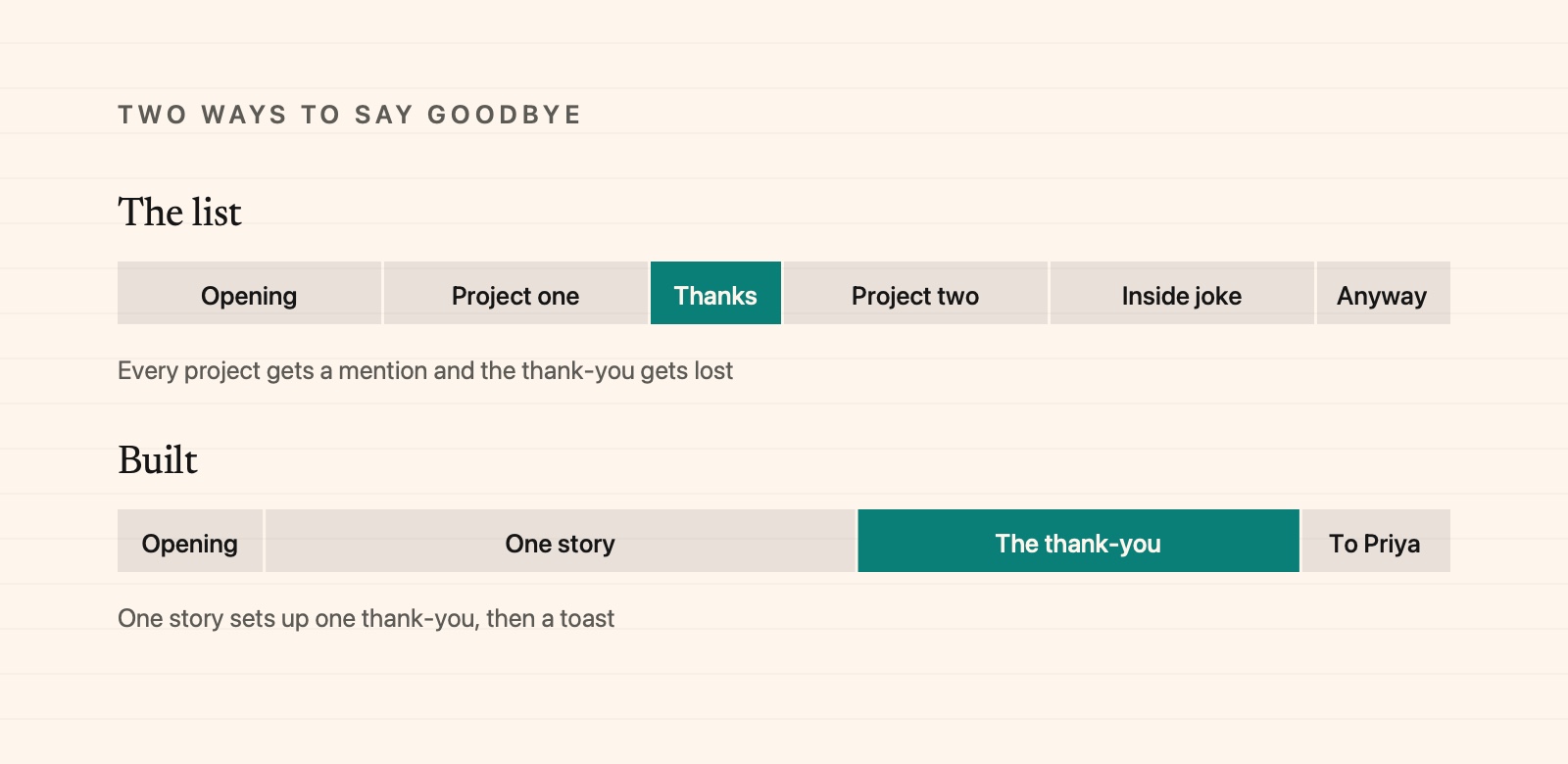
The usual problem is not nerves. It is the list. The speaker wants to be fair to every year, so they walk through every project, every team change and every office move. Nothing stands out, because everything got the same weight.
The second problem is the inside joke. "And of course, nobody will ever forget the stapler." Four people laugh. Thirty people smile politely and wonder what happened with the stapler. A farewell is said to a room, and the joke only reaches a corner of it. Toastmasters' own advice on toasts is to use humor only when it is appropriate rather than cringeworthy, and a joke most of the room cannot follow is the quiet kind of cringeworthy.
The third problem with most farewell speeches for a coworker is the ending. The speaker runs out of things to say, says "so, yeah, anyway," and the room is not sure whether to clap. A good goodbye ends on purpose, on a line that sounds like an ending.
Step 1: Decide the thank-you sentence first
The easiest way to write a farewell speech for a coworker is backward. Before you think about stories or jokes, write one sentence that finishes this thought: "The thing they did that I will keep is..."
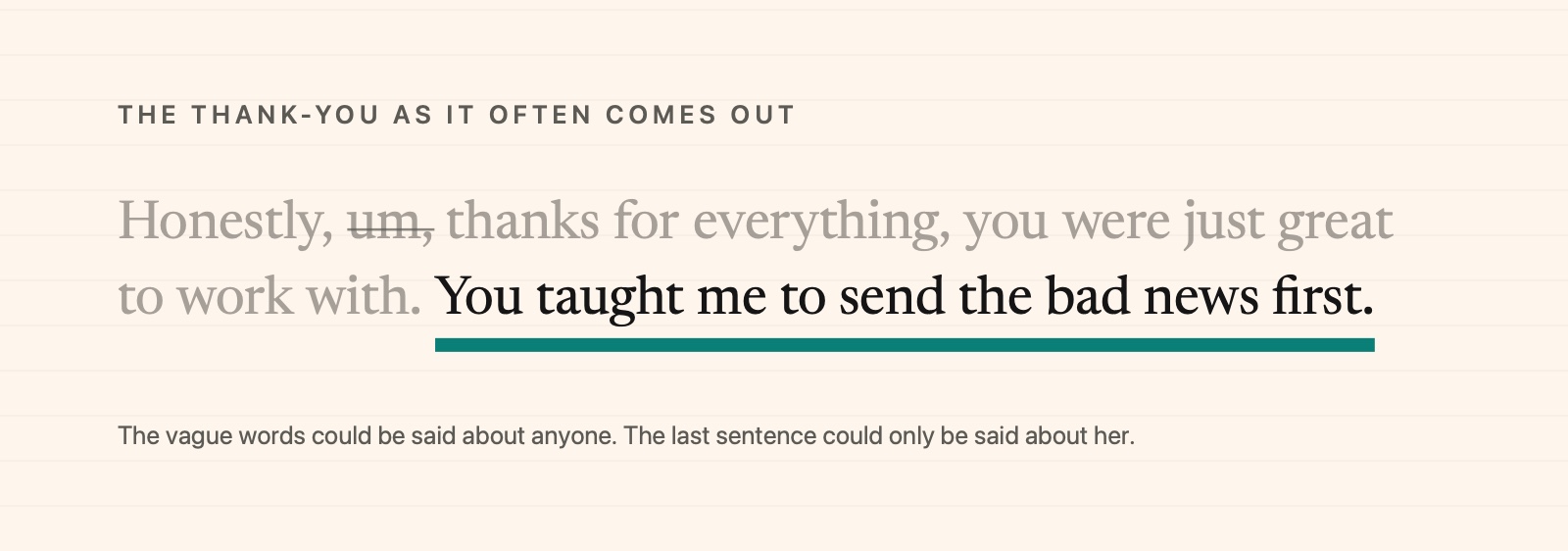
Make it specific. "Thanks for everything" is kind, but it could be said about anyone. A specific thank-you names an action and what it changed. Say your coworker Priya is leaving after nine years running customer operations. A vague line is "Priya was always there for us." A specific one is "You taught me to send the bad news first, and that is the reason the Halvorsen account is still ours."
The specific version does two jobs. It tells Priya that you noticed something real, and it tells the room who she was at work, without a list.
This is the sentence the rest of the speech leads to. Once you have it, you know what story to tell, because the story should set it up.
Step 2: Pick one story the whole room can follow
One story, not five. Choose a moment that shows the same quality as your thank-you, and that someone who joined last month could follow.
A quick test for every story and joke: would the newest person in the room understand it without an explanation? If not, cut it, or add the one sentence of background that lets everyone in. "In my first week, I wrote a customer an email that buried a two-week delay in the fourth paragraph" lets everyone in. "Remember the Tuesday thing?" does not.
The story should be short. Set the scene in a sentence, say what they did, and say what happened next. For Priya: "In my first week, I wrote a customer an email that buried a two-week delay in the fourth paragraph. Priya read it, moved the delay to the first line, and said, 'They will forgive the news. They won't forgive finding it.' The customer called to thank us for being straight with them."
Under a minute, and the room now knows something true about Priya that a list of projects would never have shown.
Step 3: Make the thanks specific, and say it plainly
People worry that a direct thank-you will sound awkward or that they will not find the right words. Research on thank-you letters suggests that worry is misplaced. In experiments by Amit Kumar and Nicholas Epley, people wrote letters of gratitude and predicted how the person reading them would feel. Writers underestimated how positive the recipients would feel and overestimated how awkward it would be. Writers also fretted over expressing themselves skillfully, while recipients mostly responded to the warmth.
The finding that matters most for a farewell speech: writers underestimated how surprised recipients would be about why they were thanked. People often do not know which of their habits mattered to someone else. Telling them is the gift.
So say it plainly. No windup, no "I just want to say, honestly, that..." Strip the throat clearing and say the sentence that is the point.
Step 4: Keep it to two or three minutes
A farewell speech for a coworker is not a keynote. The Toastmasters guide to social speeches says two to three minutes is about right for most toasts, and a goodbye at a team lunch or a last-day call is the same kind of moment. People are standing, holding drinks or plates, and waiting for the person leaving to get the last word.
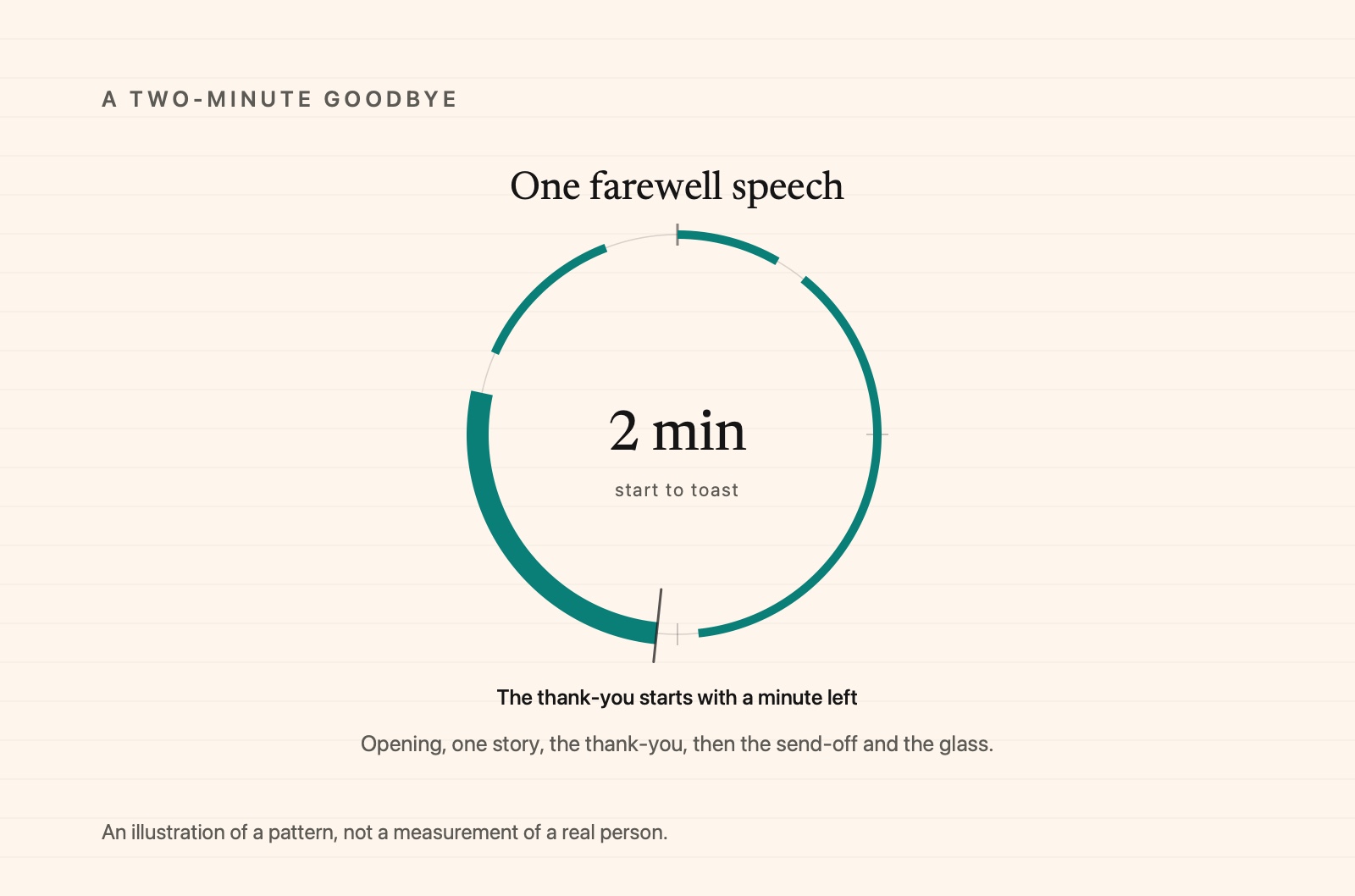
Two minutes is roughly this:
- About 10 seconds to open: who they were to the team, in one sentence.
- About 45 seconds for the one story.
- About 30 seconds for the thank-you and what it changed.
- About 15 seconds to send them off and raise a glass.
That leaves room to breathe between parts. If your draft runs past three minutes, the fix is almost never to talk faster. It is to cut the second story. If speed is your habit under pressure, how to stop talking too fast shows how to slow down just the sentences that matter.
Step 5: End on the thank-you, then stop
The last thing you say is the thing people remember, so do not let the speech trail off. Say the thank-you, add the send-off, and raise your glass. "Priya, you taught me to send the bad news first, and that is the reason the Halvorsen account is still ours. We are going to miss you. To Priya."
Then stop talking. Do not add "anyway" or "that's all I've got." Hold the glass up for a second and let the room answer. The pause is part of the ending. The same idea runs through how to end a presentation: the last line is decided in advance, and silence after it is a feature, not a mistake.
If your voice catches near the end, that is normal at a goodbye. Pause, take one breath, and say the line. Nobody in the room will hold it against you. If you lose your place entirely, go back to the thank-you sentence, since it is the one line you prepared most. How to recover when you lose your train of thought covers that moment in more detail.
How to give a farewell speech for a coworker in two minutes
Here is the full speech for Priya, put together from the steps above. Read it out loud and it runs about a minute and a half, which leaves room for laughter and pauses.
"For nine years, Priya has been the person we go to when a customer is upset. In my first week, I wrote a customer an email that buried a two-week delay in the fourth paragraph. Priya read it, moved the delay to the first line, and said, 'They will forgive the news. They won't forgive finding it.' The customer called to thank us for being straight with them. I have written every hard email that way since.
"Priya, you taught me to send the bad news first, and that is the reason the Halvorsen account is still ours. We are going to miss you. To Priya."
Notice what is not in it. No list of her projects. No inside joke. No "I don't really know how to say this." One opening line, one story, one thank-you, one toast. Everything in it points at the same quality: she tells the truth early.
If you are the one leaving
The same shape works when the farewell speech is yours. Thank the group in a sentence, then single out one or two people and say what each one did that you will take with you. One short story is still enough. End on what you will miss, not on a list of what you worked on.
Keep it shorter than you think. The room is there for you, but they are standing, and a short speech from the person leaving usually lands better than a long one.
A five-minute exercise to practice it today
You do not need an audience to rehearse a farewell speech for a coworker. You need your voice and a timer.
- Write the thank-you sentence. One line, naming an action and what it changed. Two minutes at most.
- Say the story out loud once, with the timer running. No notes. Stop the timer when you finish.
- Check the time. If the story ran over a minute, say it again and cut the background to one sentence.
- Say the whole speech, start to finish, and end on the thank-you. Hold a pause after the last line, as if the room is about to answer.
- Record the last run on your phone and play it back once. Listen for one thing only: did the speech end on purpose, or did it trail off?
If it trailed off, say the last line one more time, alone. That line is the one worth getting right.
Many people only practice speaking out loud when something is on the line, which is why a two-minute goodbye can feel harder than it should. Sayforth is a daily practice app for iPhone, coming soon, that gives you one question a day to answer out loud and shows your answer as a single speaking line afterward, so you can see whether you landed on your point or trailed off, with one change to try tomorrow. You can see how a full day of practice works first.
Be first to know when Sayforth is live.
Notify meFrequently Asked Questions
How long should a farewell speech for a coworker be?
Two to three minutes is right for most farewells. That leaves time for one story, one specific thank-you and a send-off. If you are giving a formal speech at a retirement dinner, a little longer is fine, but a short speech is rarely the one people complain about.
Should a farewell speech be funny?
A little humor helps if the whole room can share it. Skip inside jokes that only a few people understand, and never make the person leaving the target of a joke they would not tell about themselves. Warmth matters more than laughs.
What do you say in a farewell speech if you did not know the coworker well?
Ask two or three people who worked closely with them for one moment that shows who they were at work. Tell that story and credit the person who told it to you. Then thank them on behalf of the team for the thing those people named.
How do you end a farewell speech?
End on your specific thank-you, then a short send-off such as "We are going to miss you," and raise a glass if there is one. Then stop talking and let the room respond. Avoid closing with "anyway" or "that's all I've got," which tells the room the speech ran out instead of ending.