
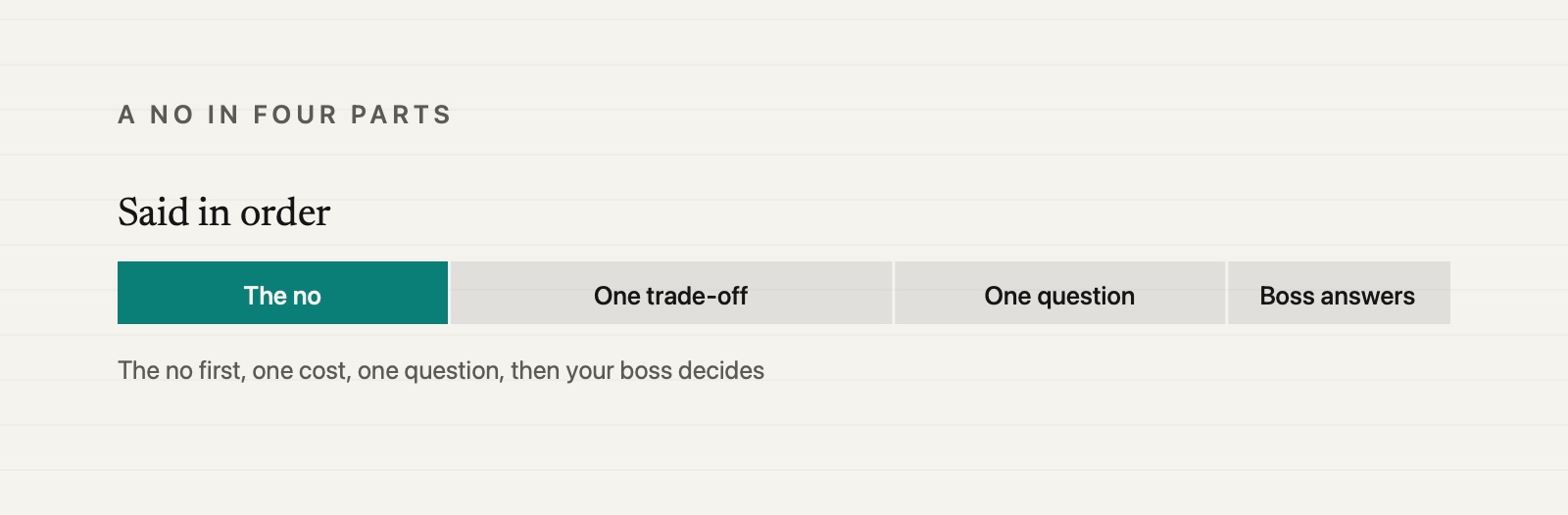
Here is how to say no to your boss without rambling. Put the no in your first sentence. Name what saying yes would cost, in one plain line. Ask one question about which work comes first. Then stop talking and let your boss decide. Three short sentences, about twenty seconds, said calmly.
Most people know they are allowed to decline. The trouble is the moment itself. Your boss asks, you feel the pause, and what comes out is a minute of reasons with a soft "I mean, I could try" at the end. That is a yes with extra steps. This post shows how to build the twenty-second version and rehearse it out loud before you need it.
Why a no turns into a ramble, or a yes
A no to a peer is a small thing. A no to the person who writes your review feels much bigger, so you pad it. You start with how busy you are. You list every project. You apologize. You add "but if it's urgent." Each sentence feels like it is making the no safer.
It is doing the opposite. While you talk around the no, your boss hears a person who has not decided yet, and an undecided person often ends up saying yes. Worse, the real information gets lost. Your boss needed one fact: this new task will push something else back. Instead they got a tour of your calendar.
So the first rule of how to say no to your boss is about order. The no comes first. The reason comes second, in one line. Everything else is optional.
Step 1: Take a minute if you need one
You do not have to answer on the spot. If a request lands in a meeting or a hallway and you are not sure what it would cost, say so in one sentence and give a time.
"Let me check what this would move, and I'll come back to you by three."
That is not dodging. It is a short, specific promise, and it gives you room to answer clearly instead of reflexively. The key is the time. "Let me think about it" with no time attached sounds like a quiet no, and your boss will chase it. "By three" sounds like someone who is handling it.
If you already know the answer, skip this step. A no you already know is easier to hear today than tomorrow.
Step 2: Put the no in your first sentence
Decide on one sentence that says what you will not do, or not do yet. Use plain words. You do not need the word "no" itself, but the meaning has to be clear the first time someone hears it.
Here is a common example. Your boss asks you to take over the client onboarding guide this week, and you are already finishing the pricing report due Friday. This is what usually comes out:
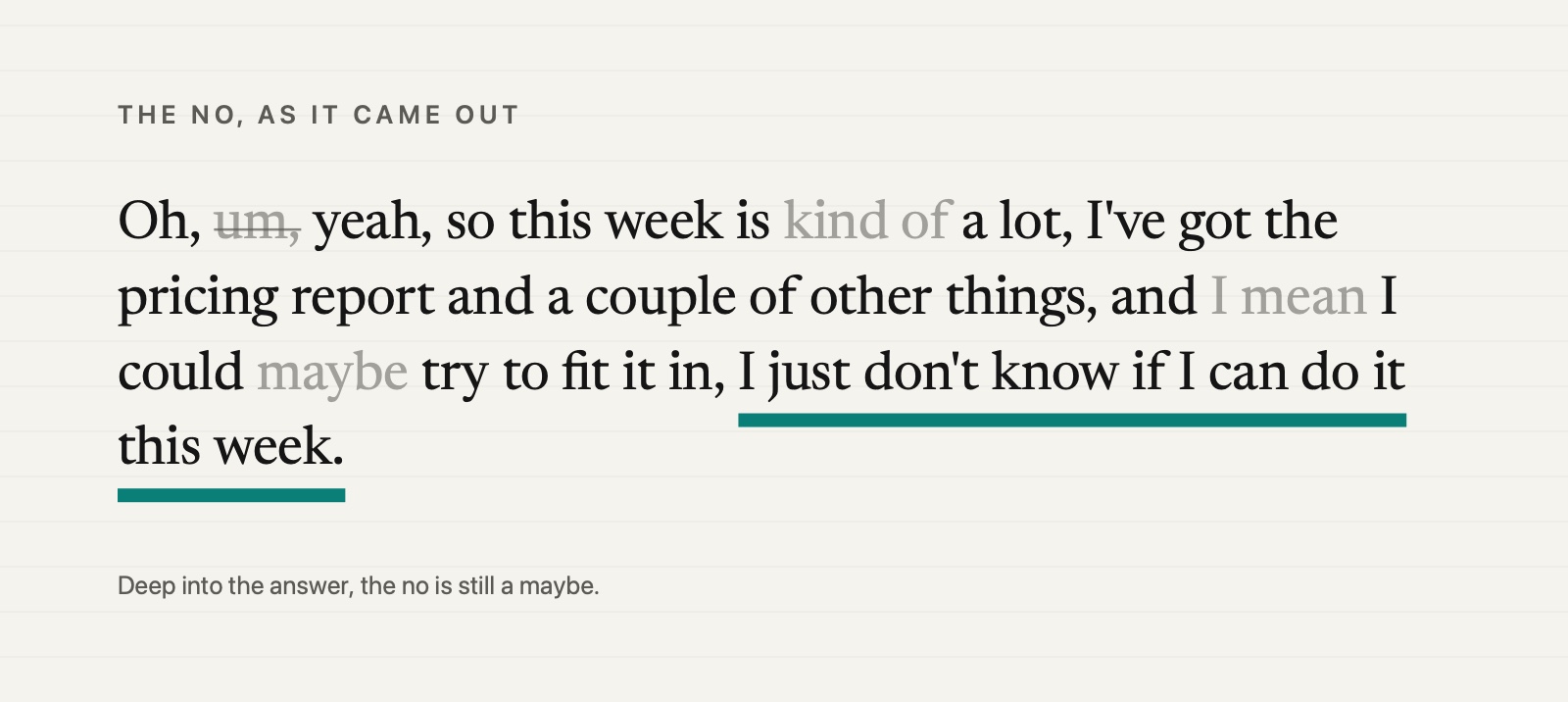
"Oh, um, yeah, so this week is kind of a lot, I've got the pricing report and a couple of other things, and I mean I could maybe try to fit it in, I just don't know if I can do it this week."
And this is the same answer said first:
"I can't take the onboarding guide this week."
Eight words. Your boss now knows where you stand. Notice what dropped out with the padding: "kind of," "I mean," "maybe," "I just don't know." Hedges like these turn a clear answer into an open question, and an open question invites your boss to push until it becomes a yes.
Step 3: Name the trade-off, not your feelings
Your second sentence gives the reason, and the best reason is the trade-off. Not "I'm swamped" or "I'm stressed," which describe how you feel. Say what saying yes would move.
"The pricing report is due Friday, and taking the guide on would push it to next week."
That sentence does two things. It shows you are not refusing the work because you do not want it. You are refusing it because something your boss already cares about would slip. And it turns your no into a decision your boss can actually make, with the real cost in front of them.
Keep it to one reason. If you list four, your boss will argue with the weakest one. One concrete trade-off, with a date or a deliverable in it, is hard to argue with.
Step 4: Ask one question, then stop
The third sentence hands the decision back. Ask which work comes first.
"Which would you rather I finish first?"
This is the heart of how to say no to your boss without it sounding like a refusal. You are not saying "that's not my problem." You are saying "I can do one of these this week, and you get to pick." Your boss may say the report can wait. They may say the guide can wait. They may find someone else for the guide. All three are fine, because now the choice is theirs and it is made with real information.
Then stop. This is the step people skip. The silence after your question feels long, so you fill it: "but I mean, if it's really urgent, I can try." That one sentence undoes the whole answer. Let the pause sit. Your boss is thinking about what to say, and that pause is their turn, not yours.
Step 5: Offer a smaller yes, only if it is real
Sometimes there is a part of the request you can do. If so, offer it after the question, not instead of the no.
"If it helps, I can send you my notes from last year's guide today."
A smaller yes works when it is genuinely small and genuinely doable. It shows you want the work to succeed even if you cannot own it. It stops working when it is a hidden full yes: "I can't take the guide, but I could do a first draft." That is the guide. If you offer it, plan to do it.
When the answer is not yours to give
Some requests are not really questions. A reorganization, a new tool, a deadline set above your boss's head. You can still speak up once, the same way: your concern first, one reason, one question.
"I'm worried this deadline doesn't leave time for testing. Is there any room on the date?"
If the answer is still yes, say so plainly and commit. "Okay. I'll plan around Friday." Saying no to your boss is about giving them the cost before they decide. It is not about winning every time. Once the decision is made, a clear yes keeps your earlier no worth listening to.
What not to say when you tell your boss no
A few phrases make the conversation harder. Learn to hear yourself reach for them.
- "I'm just so busy right now." Everyone is busy. Without a named trade-off, this sounds like a complaint, and it invites "we all are."
- "I'll try." This is a yes that hides a no. Your boss hears yes, and you will be blamed when it slips.
- "That's not really my job." Even when it is true, leading with it sounds like a refusal to help. Lead with the trade-off instead.
- "Sorry, sorry, I know this is bad timing." One short apology is fine. Three make a reasonable no sound like a confession.
Why the no feels worse than it is
Part of what makes saying no hard is the reaction you imagine. There is some evidence that people tend to expect more fallout than they get. A 2023 set of experiments by Julian Givi and Colleen Kirk, with more than 2,000 participants, looked at people turning down social invitations. The people declining expected the person who invited them to be more upset than the people being declined said they would be (American Psychological Association, via ScienceDaily).
That research was about social invitations, not work requests, so treat it as a hint and not a promise. Your boss is not your friend inviting you to dinner, and a no at work has real stakes. But the pattern is worth knowing. The version of the conversation in your head can be harsher than the one you actually have, especially when your no comes with a clear reason and a question.
Try it now: practice how to say no to your boss
You will say no to your boss more clearly if you have said it out loud once before the real moment. This takes five minutes and needs only your voice and a timer.
- Pick a real request you said yes to recently and wish you had not. Set a timer for sixty seconds and answer it out loud the way you naturally would. Do not plan it.
- Notice where the no showed up. Most people find it near the end, softened, or missing entirely.
- Write three short lines: the no, the one trade-off, and the question about which work comes first.
- Set the timer again and say those three lines out loud, in that order. It will probably take fifteen to twenty seconds.
- Say them once more, and this time stay silent for three full seconds after your question. That silence is the part you are practicing.
Nothing about your workload changed between the first try and the last. You moved the no to the front and learned to stop after the question.
If the no keeps sliding to the end however you plan it, that is a habit you only hear by speaking. Sayforth is a 30-day iPhone program for practicing exactly that: one question a day, answered out loud, shown afterward as a single speaking line so you can see where your point landed, with one change to carry into tomorrow. It is coming soon.
Be first to know when Sayforth is live.
Get launch updatesTwo related posts go further on the same skill. If the no is about a plan rather than a request, how to disagree in a meeting uses the same order in front of a group. And if the hard news is about your own work, how to tell your boss you made a mistake puts the fact first in the same way. You can also see how the daily practice works.
Frequently Asked Questions
Is it okay to say no to your boss?
Usually, yes, when the reason is about the work. Many managers would rather hear what a new task will push back than find out on the due date. Say the no early, name the trade-off, and let your boss choose what comes first.
How do you say no to your boss politely?
Politeness comes from your tone and your question, not from extra words. Say the no in one plain sentence, give one concrete reason, and ask which work your boss wants first. One short "sorry" is enough if you want it.
What do you say when your boss gives you too much work?
Name the trade-off instead of the feeling. "If I take this on, the report moves to next week. Which should I finish first?" That turns too much work into a choice your boss can make with real information.
Should I say no to my boss in person or in a message?
A quick call or a one-on-one is usually better, because your tone carries part of the message and you can answer questions right away. If you write it, keep the same order: the no in the first line, the trade-off, then the question.