
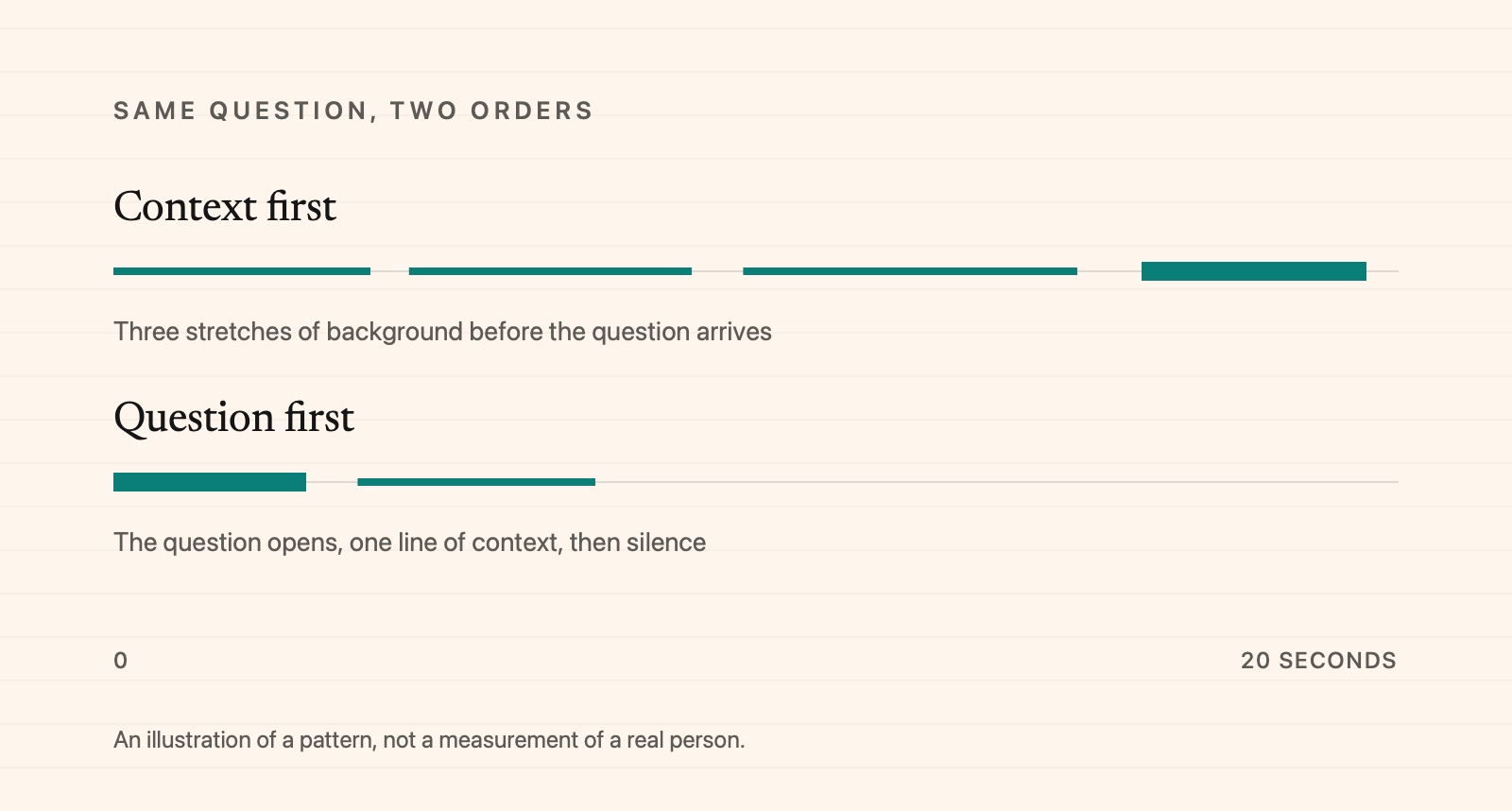
The short version of how to ask a good question in a meeting: decide the one thing you want to know, say it as a question in your first sentence, add one line of context only if it helps, and then stop talking. One question, about ten seconds. Most meeting questions go wrong in the other order, with a minute of background first and the actual question arriving last, if it arrives at all.
You have probably heard the long version, and you may have given it. "So, I was looking at the numbers from last quarter, and I know we talked about this a bit in the planning session, and I'm not sure if this is the right meeting for it, but I guess my question is, are we still planning to hire for the second team?" By the time the question shows up, half the room is waiting for it to end, and the other half has already started guessing what you meant.
Why good questions get lost in meetings
The background comes first for an understandable reason. You want the room to see why you are asking, so you walk them to the question the same way you walked yourself there. You are also protecting yourself. Context in front of a question feels like proof that the question is reasonable and that you were paying attention.
That instinct is common. Researchers Alison Wood Brooks and Leslie K. John, writing in Harvard Business Review, note that few executives treat questioning as a skill they can improve. The long lead-in may be a symptom of that: you still ask, but you bury the question so deep that it feels safer.
The trouble is that listeners cannot hold your context in their heads while they wait to learn what it is for. Until they hear the question, they do not know which parts of the background matter. So they either try to remember all of it, or they stop listening and wait. Both lead to the same reply: "Sorry, what was the question?"
Step 1: Decide what you actually want to know
Before you unmute or raise your hand, finish this sentence in your head: "I want to know ___." The blank should be one thing. Not "more about the plan." One fact, one decision, or one reason.
Most meeting questions fall into one of three kinds, and naming yours makes it much easier to ask:
- A fact: "When does the vendor contract end?"
- A decision: "Are we still hiring for the second team this quarter?"
- A reason: "Why did we move the launch to March?"
If you cannot fill in the blank, you are not ready to ask yet. That is useful to know. It often means you have a feeling ("something about this timeline seems off") rather than a question. You can still speak, but say it as what it is: "I'm not sure the timeline works, and I want to understand it better. What is the launch date tied to?"
Step 2: Ask the question first, then add one line of context
This is the step that changes how a question lands, and most of learning how to ask a good question in a meeting comes down to it. Say the question in your first sentence, with nothing in front of it. Then, if the room needs to know why you are asking, give one short line of context after it.
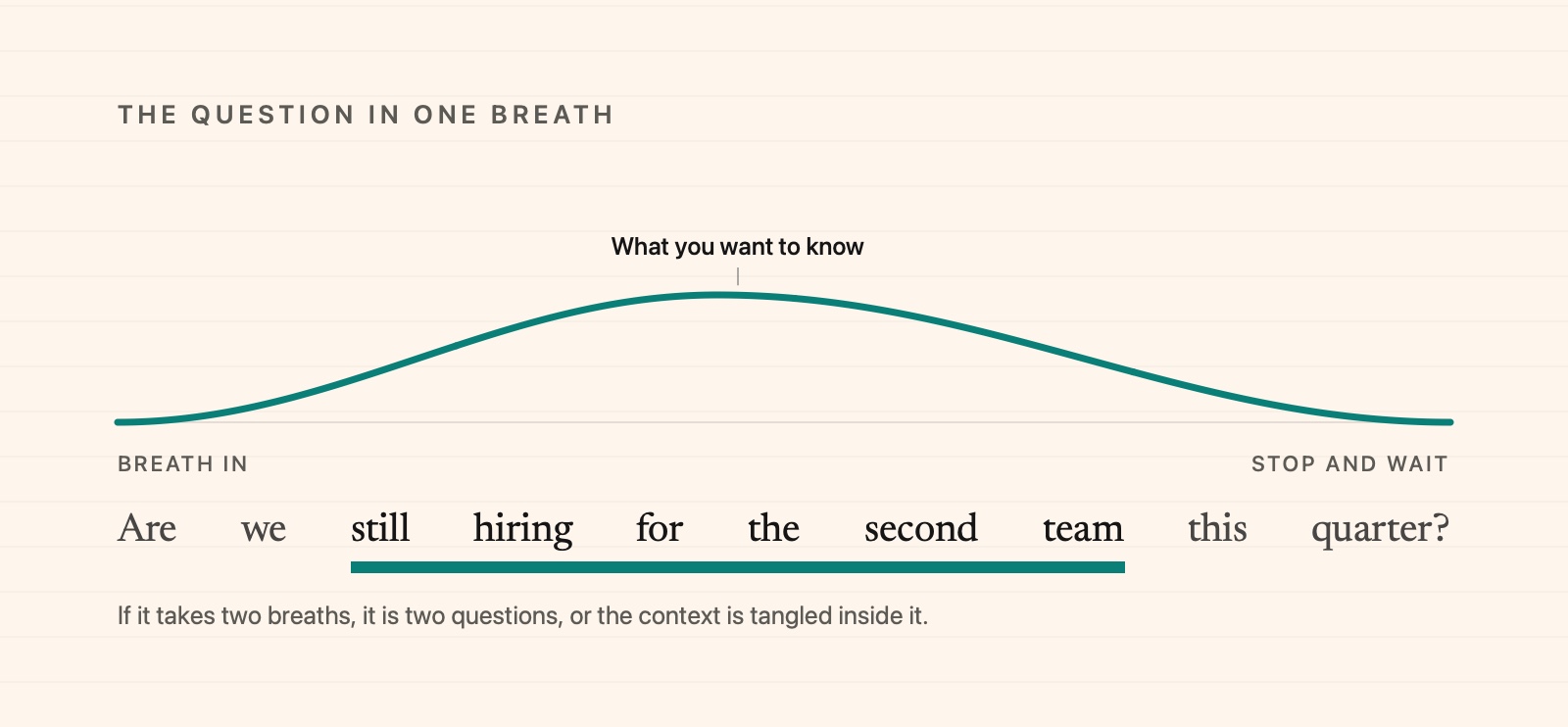
Here is the hiring question from the opening, rebuilt: "Are we still hiring for the second team this quarter? I ask because the budget numbers I saw last week looked lower." The question takes about three seconds. The context takes about four. Everyone in the room knows what you are asking from the first word, and the context now does a clear job: it explains the question instead of hiding it.
A good test is whether you can say the question in a single breath. If it takes two breaths, it is probably two questions, or it has context tangled up inside it. Pull the context out and put it after.
Step 3: Ask one question at a time
When you have been waiting to speak, it is tempting to bring everything at once. "Are we still hiring, and if so, is it one role or two, and who is running the interviews?" It feels efficient. It almost never is.
Stacked questions give the person answering a choice, and people tend to answer the easiest one. The others quietly disappear. You end up asking the hard one again later, now with less of the room's attention.
Ask the most important question first. Wait for the answer. If the answer does not cover your second question, ask it next. Two short exchanges take less time than one long question followed by "and what about the other thing I asked?"
Step 4: Make it easy to answer
A good question in a meeting is one the right person can answer quickly. Three small choices help.
Say who you are asking. "Dana, are we still hiring for the second team?" is easier to answer than the same question tossed to the whole room, where everyone waits for someone else to speak. If you do not know who owns the answer, say that: "Who would know whether we are still hiring for the second team?"
Match the shape to what you need. If you need a yes or a no, ask for one. If you need someone's thinking, ask an open question that starts with "what" or "how," such as "What would have to be true for us to hire this quarter?" Avoid open questions when you really want a fact, because they invite a speech.
Drop the apology. "Sorry, this is probably a dumb question" adds words before the question and asks the room to reassure you before it can answer you. Just ask it.
Step 5: Stop talking and wait
Once the question is out, stop. This is the part of how to ask a good question in a meeting that people skip, because it is harder than it sounds. A few seconds of silence after a question feels long when you are the one who asked it, and the urge is to fill it.
Filling it usually takes one of three forms. You rephrase the question in different words, so now there are two versions. You turn it into multiple choice ("Like, is it on hold, or are we waiting for budget, or...?"), which narrows the answer to options you made up. Or you answer it yourself, which makes the question disappear entirely.
The silence is the other person thinking. Let them use it. If nobody answers after a real pause, ask again with the same words, or name a person. Do not add more context in the hope that it helps. It rarely does.
Step 6: Ask one follow-up that shows you listened
The answer is not the end of a good question. A short follow-up turns it from a one-off into an exchange, and it shows the person you were actually listening.
There is research behind this. In a study described by the Association for Psychological Science, Harvard researchers found that people who asked more questions in one-on-one text chats were liked more by their conversation partners, and that follow-up questions were especially likely to have that effect. People who read the chats afterward did not show the same effect. A meeting is not a one-on-one chat, so treat that as a reason to try it, not a promise. But the logic carries over: a follow-up proves you heard the answer.
Keep the follow-up as short as the first question. "So the role is on hold until January?" or "What would change that?" Then let the meeting move on. One question and one follow-up is a contribution. Five follow-ups is taking over the meeting.
The ten seconds before you unmute
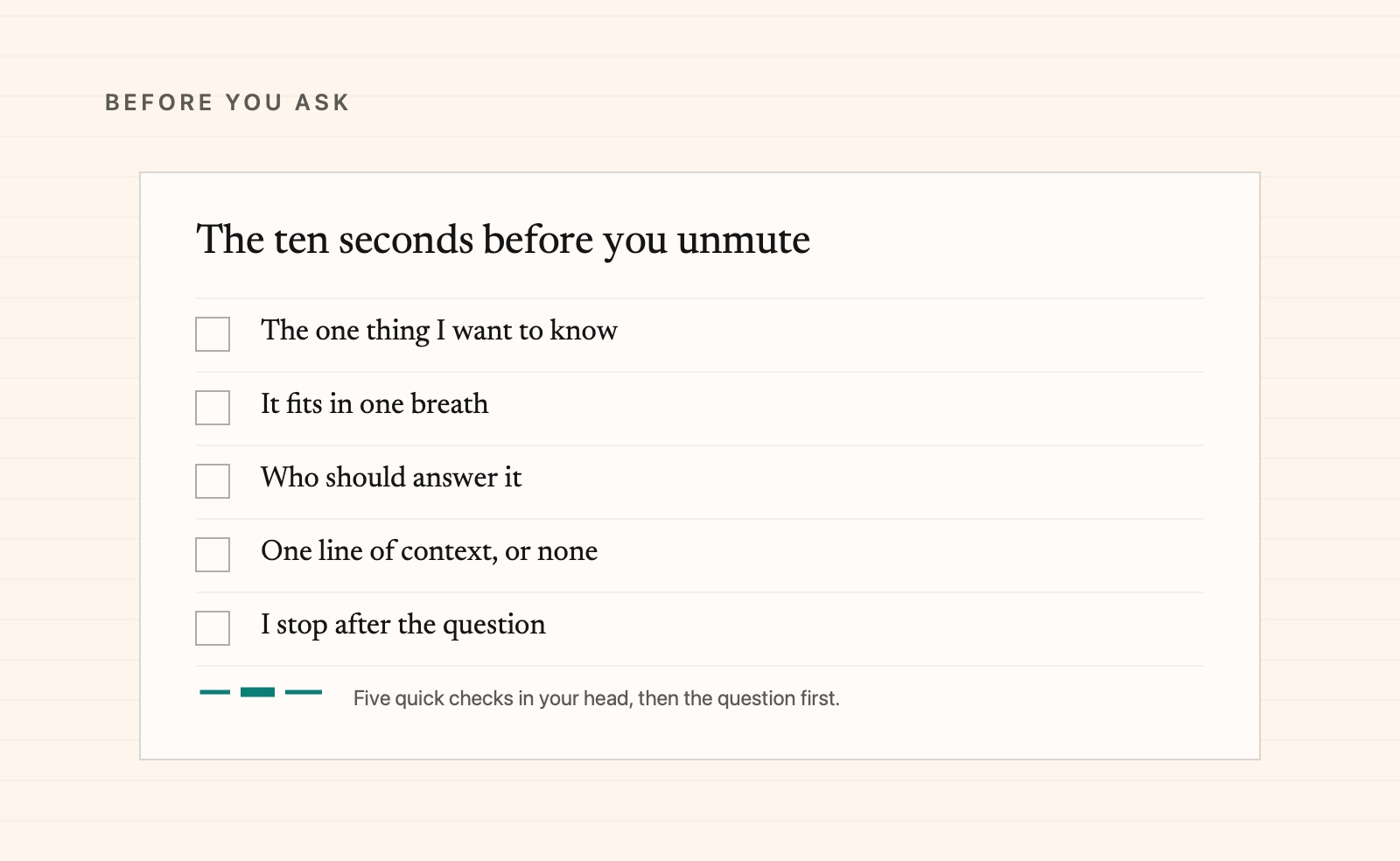
Put together, how to ask a good question in a meeting is a routine that fits in the few seconds before you speak. You do not need notes. You only need to run through five quick checks in your head, in order, and then open your mouth with the question first.
Try it now: how to ask a good question in a meeting in five minutes
You can practice this today with a phone and a timer. It works best with a real question you are holding about your work.
- Write down a question you have been meaning to ask in a meeting. Write it the way you would naturally say it, background and all.
- Find the one thing you want to know and rewrite it as a single question. Then write one line of context to go after it, or none.
- Set a timer and say the rebuilt version out loud while recording on your phone. Aim for under ten seconds.
- Listen back and check one thing: is the first sentence the question? If any word of background comes before it, say it again, starting on the question.
- After the last word, count three seconds of silence before you stop the recording. That pause is the part you will want to fill in a real meeting.
Most people find the second take is not only shorter but sounds more confident, because it no longer sounds like the question is apologizing for itself.
If you know what you want to ask but it keeps coming out wrapped in background, that is a practice problem, and it shows up in every kind of answer you give. Sayforth is a 30-day iPhone program, coming soon, built for exactly this: one question a day, answered out loud, then shown back as a single speaking line so you can see whether your point came first, with one change to carry into tomorrow.
Be first to know when Sayforth is live.
Notify meIf your questions tend to turn into objections, how to disagree in a meeting covers saying the disagreement plainly. When it is your turn to report rather than ask, how to give a status update in a meeting uses the same point-first order. And if the point arrives late in everything you say, how to stop rambling when you answer goes deeper. You can also see how the daily practice works.
Frequently Asked Questions
How do you ask a question in a meeting without sounding stupid?
Say the question first, plainly, without apologizing for it. Questions sound unsure mostly because of what comes before them: the hedges, the "this is probably obvious" and the long lead-in. A clear, short question sounds like someone who knows what they need.
When is the best time to ask a question in a meeting?
Ask while the topic is still being discussed, not after the meeting has moved on. If the question only matters to you, or it would take more than a minute to answer, ask the person afterward instead. If the meeting has a set time for questions, save it for then.
How do you ask a question to your boss in a meeting?
Use the same order as any other question: the question first, one line of context, then stop. If the question could put your manager on the spot in front of others, such as one about a decision they made, ask it privately first. Most questions are fine to ask in the room.
How many questions should you ask in a meeting?
There is no fixed number, but one well-asked question and one follow-up is usually a strong contribution. If you have several, ask the most important one first and see whether the answer covers the rest. Save the remaining ones for after the meeting or a message to the right person.