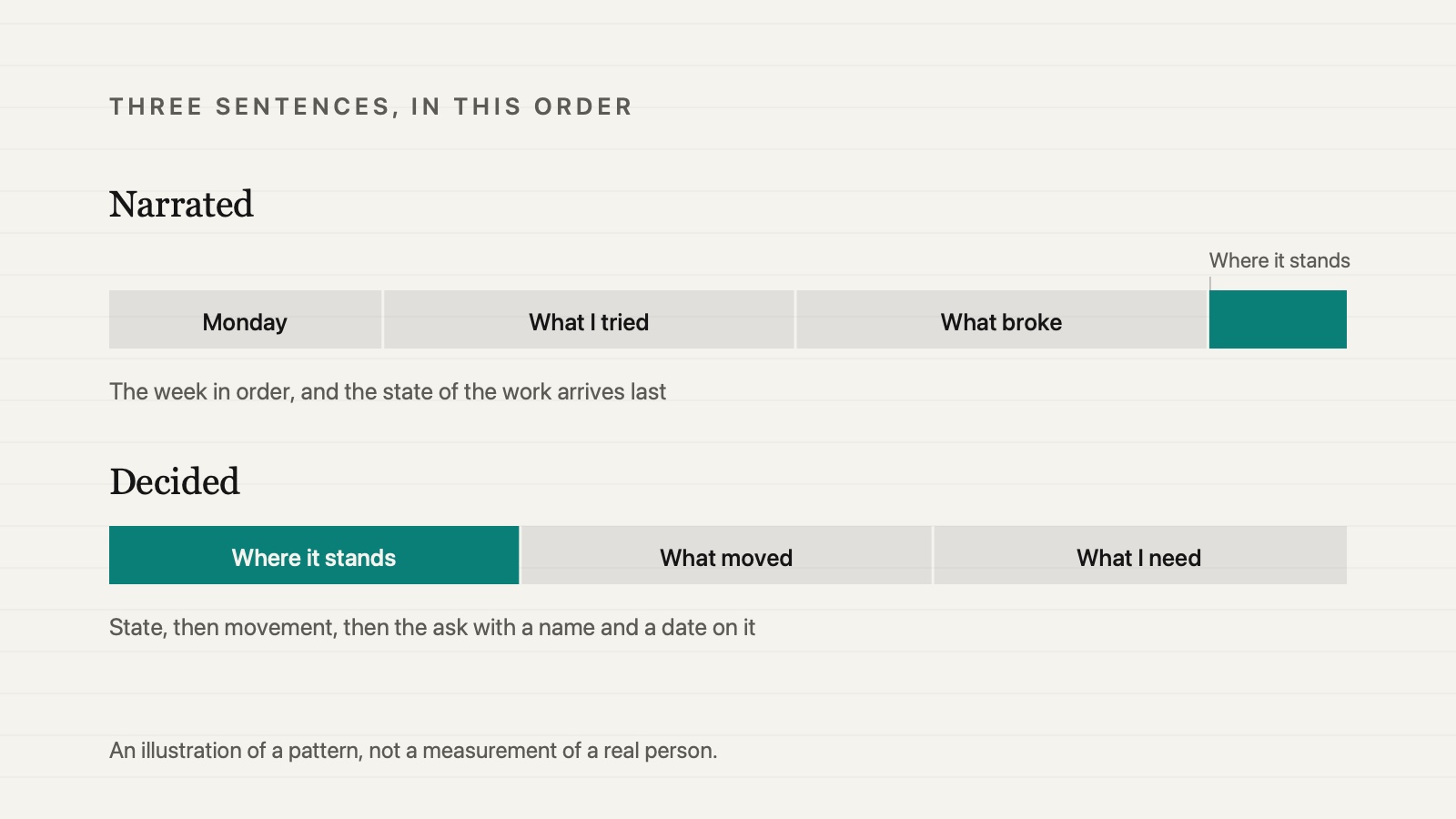
The short version of how to give a status update in a meeting: say where the work stands, then say what moved, then say what you need. Three sentences, about thirty seconds. Most updates go wrong because they run in the opposite order, starting with everything that happened and arriving at the state of the work last, if at all.
That order feels wrong when you are the one speaking. You did the work, so you want to walk through it. But your team is not listening for the walkthrough. They are listening for one thing: is this on track, and does anyone need to do anything about it. Give them that first and the rest of your update gets heard properly, because nobody is still waiting to find out how worried to be.
Why most updates come out as narration
Watch a few people take their turn in a status meeting and you will hear the same shape again and again. It starts on Monday. It moves through the week in order. It includes the part where something was almost fixed, the part where it broke again, and the name of the person who helped. Somewhere near the end, if the meeting has not moved on, it reaches the point.
This happens because you are retrieving the week from memory, and memory hands things back in the order they happened. Narration is the path of least resistance. It is also the reason updates stretch: there is no natural place to stop, so you keep going until someone interrupts or you run out of week.
The fix is not talking faster or preparing more. Learning how to give a status update in a meeting is mostly learning to decide, before you speak, which single sentence is the update, and to say that sentence first.
Step 1: Decide the one sentence that says where it stands
Before the meeting, finish this sentence in your head: "Right now, X is ___." The blank is a state, not an activity. On track. Blocked. Done and waiting on review. Two days behind. Shipped Thursday.
The test for a good first sentence is whether someone could act on it without hearing anything else. "I have been working on the migration" is an activity, and nobody can do anything with it. "The migration is done except for the last table, which lands tomorrow" is a state, and a manager can immediately decide whether to worry.
Write that sentence down, or at least say it out loud once before the meeting. A sentence you have already said once comes out cleanly. A sentence you are composing live comes out with three false starts in front of it.
This is the same instinct behind a practice the US Army made a written rule. Its correspondence regulation names two essential requirements for Army writing, and the first is putting the main point at the beginning, which it calls the bottom line up front. The standard it sets is that the writing be understood in a single rapid reading (Army Regulation 25-50). A spoken update gets one rapid hearing, which is a harder version of the same problem.
Step 2: Put the state before the story
Once the first sentence is decided, everything else in your update becomes optional detail, which is exactly what it should be. The story of how you got there is the second sentence, not the first, and it can be short.
Compare two versions of the same turn. The first is how it usually comes out:
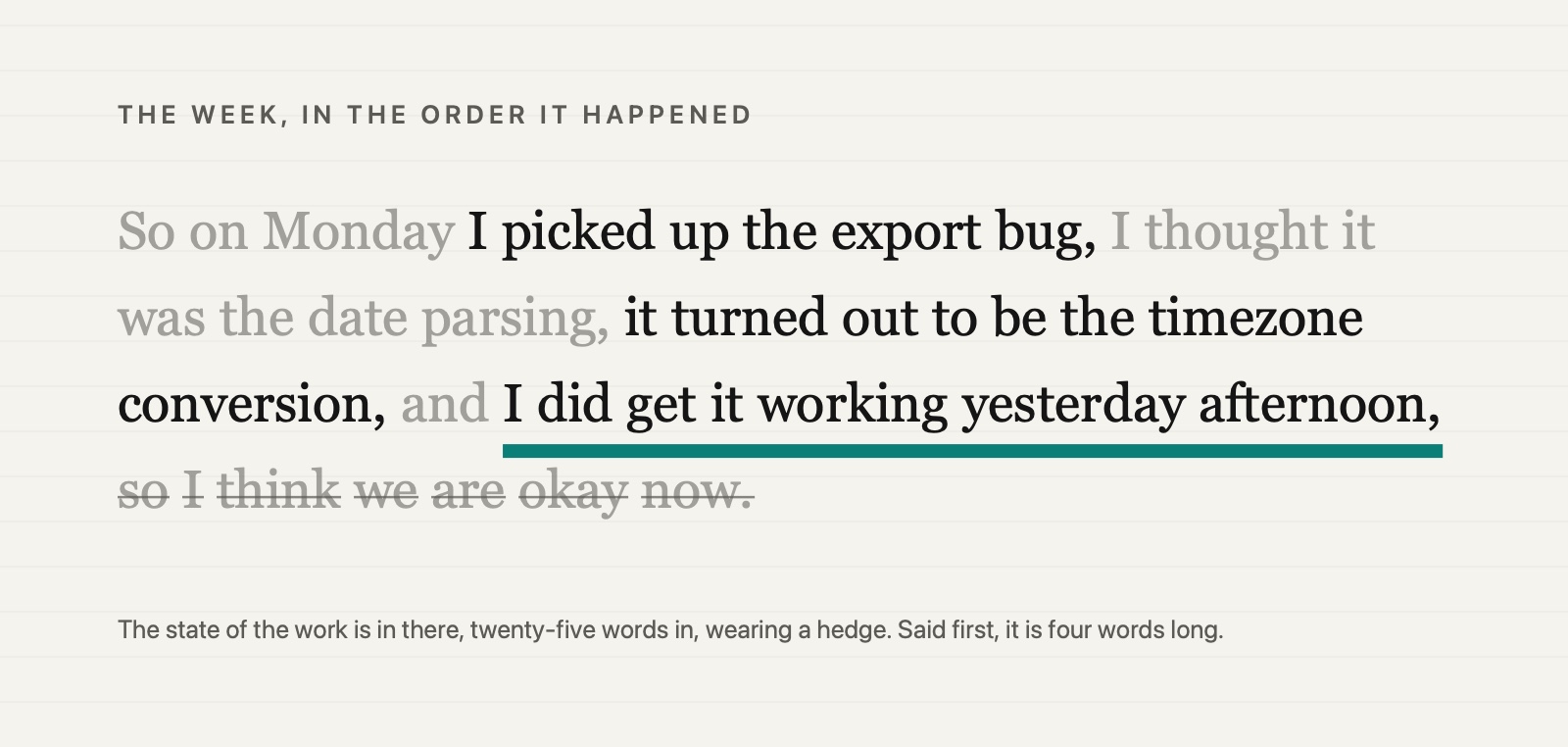
"So on Monday I picked up the export bug, and I thought it was the date parsing, so I spent a while there, and it turned out it was actually the timezone conversion, which took some digging because the logs were not helpful, and I did get it working yesterday afternoon, so I think we are okay now."
The second is the same information, reordered:
"The export bug is fixed and deployed. It was a timezone conversion issue, not date parsing like we thought. No further action needed."
Same facts. The second version is thirty-five words shorter and puts the state in the first four words. Nobody in the room had to hold an unfinished thought for forty seconds waiting to learn whether the bug was fixed.
Notice what got cut. The hedges went ("I think we are okay now" became a statement). The chronology went. The dead ends went, except for the one that is genuinely useful to the team, which is that the obvious diagnosis was wrong.
Step 3: Say the ask as a request, not a complaint
The third sentence is what you need, if you need anything. This is the part people soften until it disappears, because saying you are blocked can feel like admitting you failed.
An ask that gets acted on has three parts: what you need, who you need it from, and by when. "I am blocked on the API keys" is a complaint about the universe. "I need the staging API keys from someone on platform by Wednesday or the integration slips a week" is a request, and it has a name and a date attached to it, so it can actually be picked up in the room.
If nothing is blocking you, say so explicitly and stop. "Nothing blocked, nothing needed" is a complete third sentence, and it is better than trailing off, because it tells the room your turn is over.
That three-part shape, state and then movement and then ask, is what a status update actually is. Everything else is elaboration you can offer if somebody wants it.
Step 4: Decide your last sentence before you start
Most status updates do not end. They thin out. The speaker gets to the end of what they prepared, keeps talking at lower confidence, adds a qualifier, and eventually stops on something like "so, yeah, that is basically where we are with that."
The cure is to decide your closing sentence at the same time you decide your opening one. Usually it is the ask, or it is "nothing blocked, nothing needed." Either way you know in advance which sentence you are going to stop on, so the stop is a decision instead of an accident.
Then stop. The silence after a short update feels much longer to you than it does to anyone else, and the room reads it as confidence rather than as a gap you failed to fill. If someone wants the detail, they will ask, and answering a question is a much easier speaking task than guessing what detail to volunteer.
Daily standups have the same problem. One of the best known write-ups on how teams run them describes a common failure where people address their update to the manager rather than to each other, turning coordination into status reporting (Martin Fowler on daily standup patterns). That distinction is worth holding onto when you decide your closing sentence. An update aimed at proving diligence to one person has no natural end. An update aimed at the people who might need to act has an obvious one: it stops when they know what they need to know.
Try it now: how to give a status update in a meeting in five minutes
This takes five minutes and needs only your voice and a timer. Do it before your next status meeting.
- Pick the piece of work you will report on. Set a timer for sixty seconds.
- Say your update out loud, once, without planning it. Let it be as rambling as it wants to be. Notice where you stopped.
- Now write down three things: the state ("X is ___"), the movement (one sentence), the ask (or "nothing blocked, nothing needed").
- Set the timer again and say those three sentences out loud in that order. It will probably take twenty to thirty seconds.
- Say them a second time. The second pass is the one that sounds like you rather than like a list being read.
The gap between attempt one and attempt four is the whole skill. You are not learning new information about your own work. You are practicing putting the part that matters at the front, out loud, where you can hear whether it actually lands. Nobody works out how to give a status update in a meeting by thinking about it silently, because the problem only shows up in the speaking.
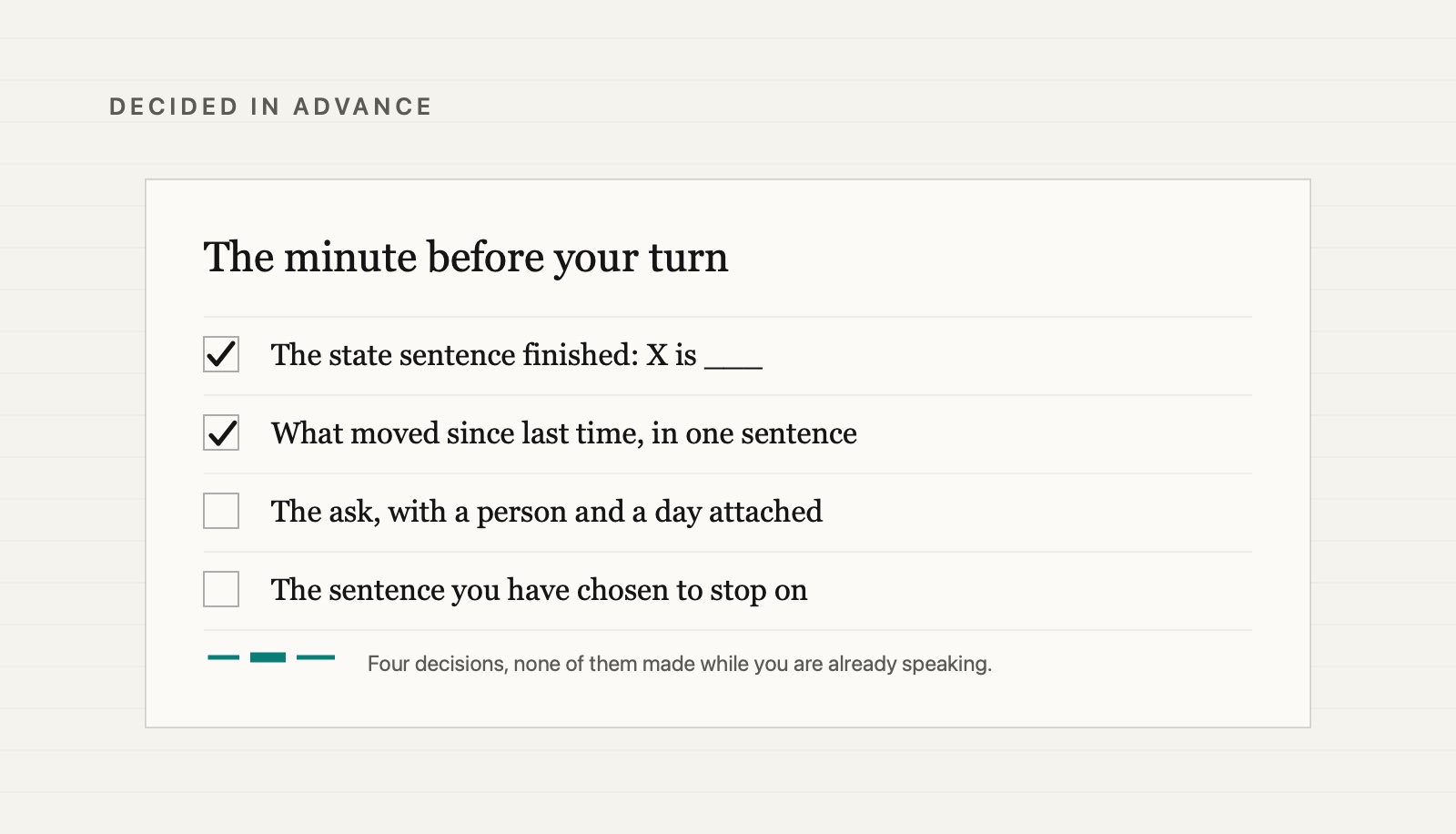
Run through this list in the minute before your turn and the update mostly gives itself.
If your updates keep coming out as narration and you can hear it happening but cannot catch it in the moment, that is a practice problem rather than a knowledge problem. Sayforth is a 30-day iPhone program built on exactly this: one short spoken answer a day, drawn as a single line so you can see where your point actually landed, and one change to carry into tomorrow. It is coming soon.
Be first to know when Sayforth is live.
Get launch updatesTwo related posts go deeper on the pieces this one touches. If your problem is that the point arrives late in everything you say, not only in status meetings, read how to stop rambling when you answer a question. If you want to practice out loud on your own before the meeting, how to practice for an interview alone covers the recording routine, and it works the same way for a status update. You can also see how the daily practice works if you want the mechanics.
Frequently Asked Questions
How long should a status update in a meeting be?
Thirty seconds is a good target, and under two minutes even when something has gone badly wrong. Most advice on how to give a status update in a meeting focuses on what to include, but length is mostly decided by order: an update that starts with the state can stop early, and one that starts with the story cannot. If it is running longer than that, the update has usually turned into a walkthrough of the work, and the people listening stopped tracking it a while ago. Say the state, the movement and the ask, then let questions pull out the rest.
What do you say in a status update when you have made no progress?
Say that plainly in the first sentence, then say why in the second, then say what would change it. "No movement on the reporting work this week. I was pulled onto the outage Tuesday and Wednesday. It restarts Monday unless something else lands first." No progress is a legitimate state, and stating it directly takes far less time than building a case for it.
How do I give a status update without sounding negative?
Say the state as a fact rather than as an apology, and attach a next step to anything that is going badly. "Two days behind, back on track by Thursday" is the same news as "sorry, I am really behind on this," but the first one sounds like someone managing the work and the second sounds like someone worried about being judged for it.
Should I write my status update down before the meeting?
Write down the three sentences, not a script. A script read aloud sounds read, and it removes your ability to adjust when the meeting takes a different turn. Three short prompts, the state and the movement and the ask, give you the structure while leaving the actual wording to happen live, which is what makes it sound like you.