
Here is how to answer "what is your greatest strength." Name one strength in your first sentence. Prove it with one short example from real work. Close with one sentence that ties it to this job. Said out loud, the whole answer takes about twenty seconds, and the example is the part the interviewer remembers.
Most people answer with a list instead. Three or four good qualities, no example, and a line at the end about being a hard worker. It is the most rehearsed-sounding answer in the interview, and the interviewer has heard a version of it from almost everyone. This post is about the spoken answer: the four sentences, how to pick the one strength, what the list sounds like next to a proved claim, and what to do with the follow-up. It ends with a five-minute exercise.
What the interviewer is really asking
"What is your greatest strength?" sounds like an invitation to say nice things about yourself. It is not. The interviewer has a job description open and is asking two quieter questions. Does your strongest ability match something this role needs? And can you prove it, or only claim it?
The second question is where answers fall apart. The Muse's advice on this question is to answer it directly and then move into a story that shows the skill, with enough context to follow and a clear result (The Muse). Robert Half says every strength you plan to mention needs a real-world example behind it, and warns that interviewers spot rehearsed answers quickly (Robert Half). Both describe the same thing from different sides. A claim without an example is an adjective, and an interviewer cannot do much with an adjective.
So how to answer what is your greatest strength is not a list of your qualities. It is one quality and the ten seconds of evidence that make it true.
How to answer what is your greatest strength in four sentences
The answer has three parts, spread over four short sentences.
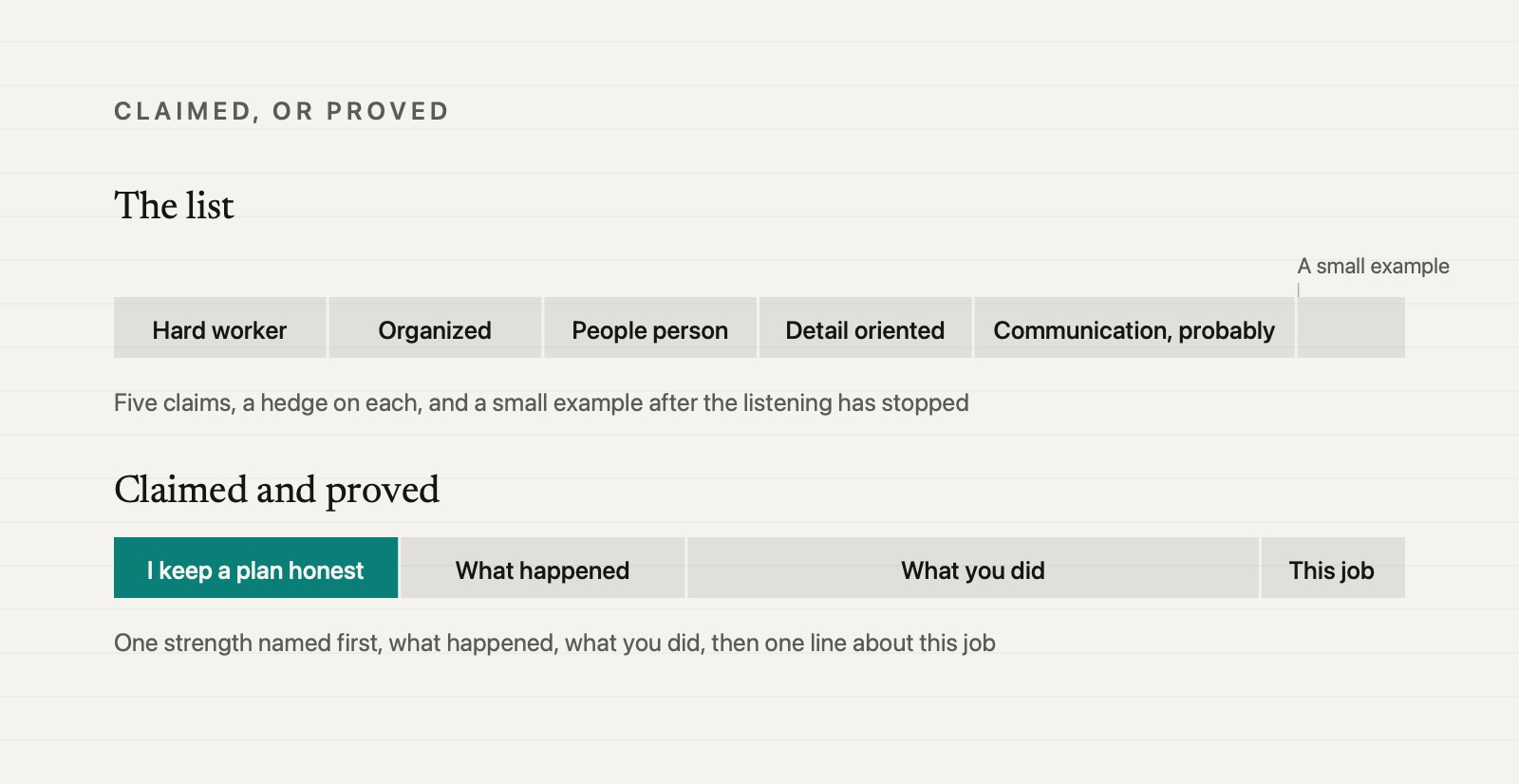
Sentence one names the strength. Plain words, no preface. Not "I guess I'd say," not "people tell me." Just the strength, in a form specific enough that nobody else in the waiting room would say it the same way. "I keep a plan honest." "I can explain a technical problem to someone who does not want to hear about it." "I finish the boring part."
Sentences two and three are the example. One real moment from the last couple of years, told as what happened and what you did. Keep the setup to a few words, spend the words on your decision, and end on the result in plain terms.
Sentence four ties it to this job. One short line, not a pitch. "That is the part of this job I would lean on most."
Here is the example for the rest of this post. Priya is interviewing for an operations coordinator role. Asked for her greatest strength, her whole answer is:
"My greatest strength is that I keep a plan honest. Last spring our warehouse move slipped by two weeks. I said so in the first week, not the third, and we moved the go-live date before anyone had promised it to a customer. That is the part of this job I would lean on most."
Four sentences, about twenty seconds, then silence. Nothing in it is a boast. The strength is a plain fact, the example is specific enough to be checked, and the close points at the job.
What the list answer sounds like
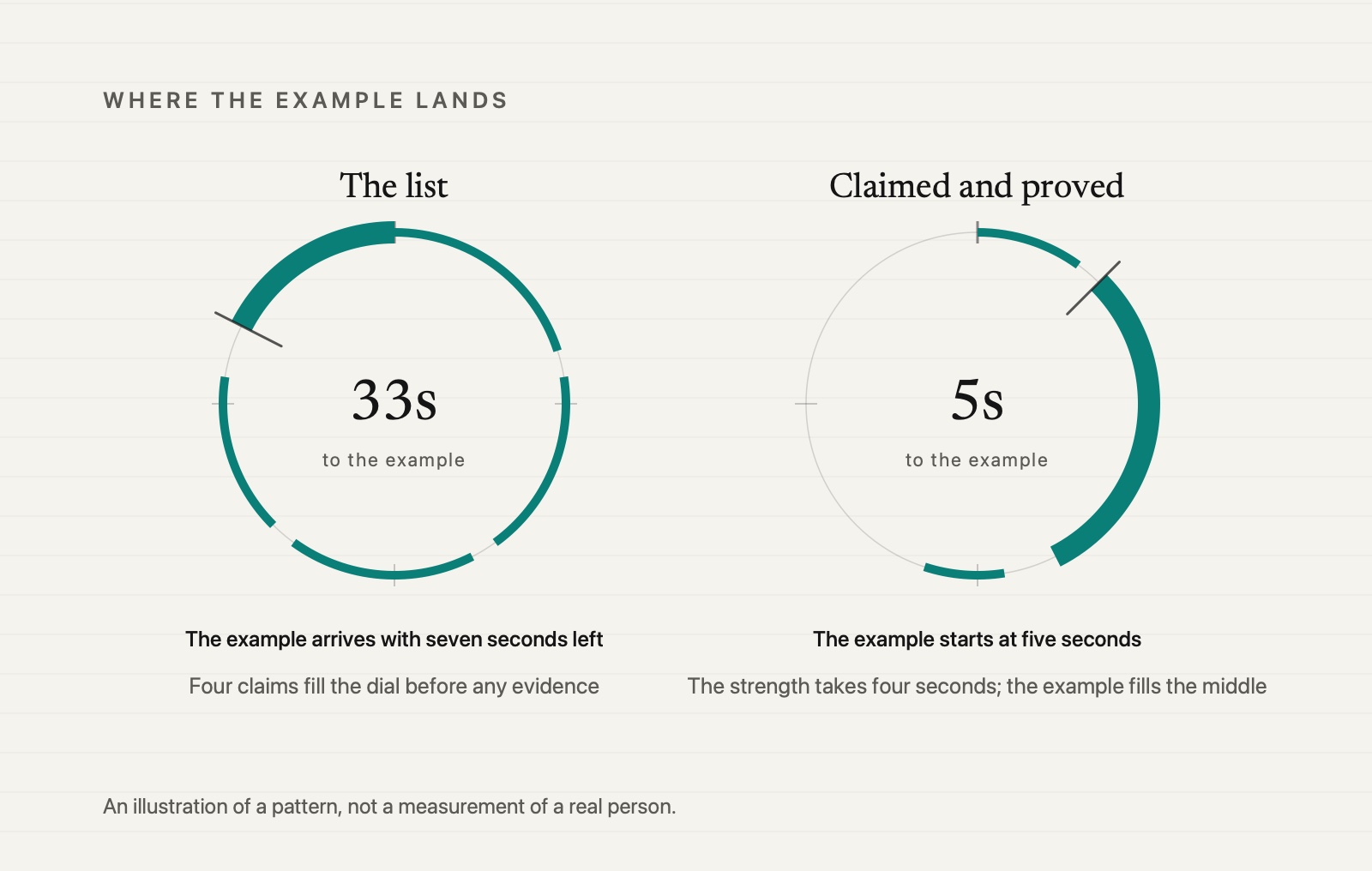
Here is what most people say instead. "I'd say I'm a hard worker, I'm really organized, I'm a people person, and I'm pretty detail oriented. I think my biggest strength is probably my communication skills, because I'm good at working with all kinds of people." Forty seconds, five claims, no evidence, and a hedge on nearly every one.
The list fails for a simple reason. Every item on it is a word the interviewer has heard from every other candidate, so none of them separates you. The Muse makes the same point: limit yourself to one to three attributes and skip the string of generic adjectives. A guide republished by the career center at California State University, Northridge goes further: review the posting, find three skills that match your experience, and focus the answer on one of them (CSUN Nazarian Career Center).
There is a second problem that only shows up when you hear the list out loud. Because the list has no example, people feel the answer getting thin and add a small story at the very end, after the interviewer has stopped listening for one. The proof arrives with a few seconds left. In the built answer the strength arrives at once and the example fills the middle, which is the part of any answer a listener holds onto.
Pick the strength this job would use
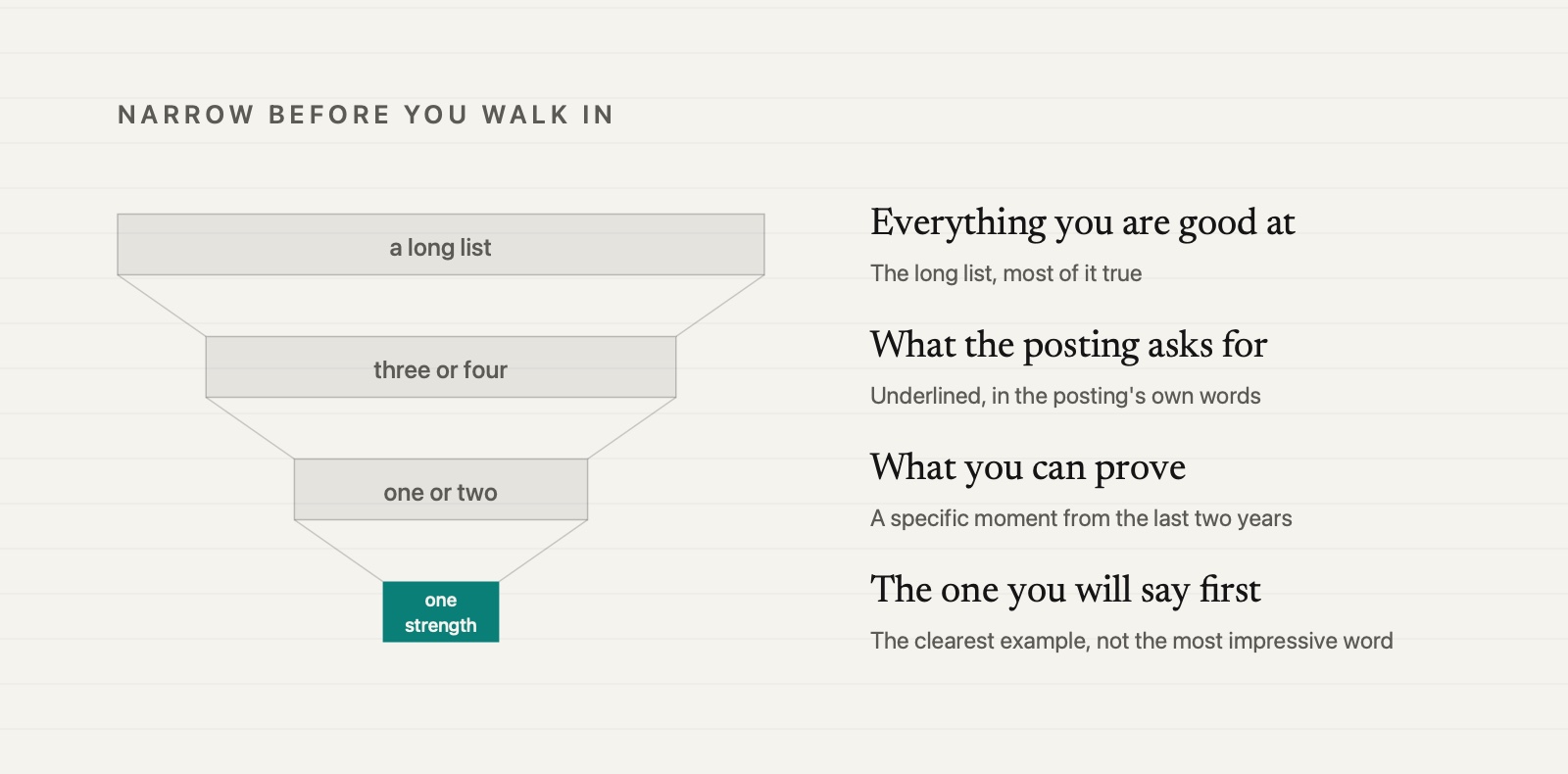
The hardest part of how to answer what is your greatest strength is not the wording. It is choosing. Most people have a long list of things they are good at, and the instinct is to say several of them so nothing is wasted. The better move is to narrow before you walk in.
Start with the posting. Underline the three or four things it asks for most often, in its own words. Then cross out any you cannot back with a specific moment from the last two years. What is left is usually one or two. Pick the one with the clearest example, not the one that sounds most impressive. "I keep a plan honest" beats "strategic thinker" every time, because one of them comes with a warehouse move attached.
Relevance matters more than people expect. The CSUN guide notes that strengths which are too general are unlikely to make much of an impression, and the Muse suggests choosing a strength you have not had a chance to show elsewhere in the interview. If the posting is about keeping ten projects moving and your example is about a single late night, the strength may be real and still the wrong one for this room.
If two strengths survive, keep the second one for the follow-up. You will often get to use it.
Say it like a fact, not a confession
Even a well-chosen strength can go soft in the mouth. The sentence that names it is the one people hedge most, because saying "I am good at this" out loud feels like bragging. So it comes out as "I guess I'd probably say I'm fairly good at keeping things on track, I think."
Cut the hedges from that one sentence, and leave them everywhere else if you must. "My greatest strength is that I keep a plan honest." Said plainly, at the same pace as the sentences around it, that does not sound arrogant. It sounds like something you have checked. Robert Half's warning about arrogance is about pointing out colleagues' shortcomings, not about stating a strength directly, and the direct statement is what lets the example that follows land. Our post on how to sound confident in an interview goes through the hedges one by one.
One more thing the ear notices: the close. End on the sentence about the job, let it land, and stop. Do not add "so, yeah," and do not turn the close into a question. The short silence after a plain answer is what makes it read as settled.
When the interviewer asks for more
Sometimes the first answer is the whole exchange. Sometimes there is one more question. Everything about how to answer what is your greatest strength carries over to the follow-up, one strength, one example, then stop, and the common follow-ups are easy if you narrowed properly.
"What else?" or "Any others?" Give the second strength that survived, in the same shape but shorter: one sentence for the strength, one for the example. Do not go back to the list.
"Can you give me another example of that?" Have one. The strength you chose should be true often enough that a second moment exists. If you cannot think of one, you probably picked the wrong strength.
"And what about a weakness?" That is a different question with a different shape, and the worst thing you can do is let the strength answer run into it. Stop, take a breath, and treat it as new. Our post on how long an interview answer should be covers why the stop between answers matters as much as the answers themselves.
Try it now: practice how to answer what is your greatest strength in five minutes
You can do this with your phone's voice recorder and a timer.
- Write the strength sentence, word for word, and cut every hedge: "I guess," "probably," "I think," "fairly."
- Write the example in two sentences, what happened and what you did, then the one-line close that points at the job.
- Start the timer and the recorder. Ask yourself out loud, "What is your greatest strength?" Answer with your four sentences. Count silently to three before you stop the recording.
- Play it back and listen for two things only. Did a list sneak in before the strength? Did the example come out faster than the rest, or get skipped?
- Change one of those and record it again. If you have a minute left, ask the follow-up, "What else?", and answer with the second strength in two sentences.
The second take is almost always shorter, and the example almost always comes out clearer. For a routine built on the same idea across several questions, see our post on how to practice for an interview alone.
If you can write the four sentences but the list comes back the moment someone actually asks, that is a practice problem, not a knowledge problem, and a few minutes a day is what fixes it. Sayforth is a 30-day iPhone program built for that: one short coached spoken answer a day, drawn as a single answer line after you finish so you can see where your main point landed, with one change to carry into tomorrow. It is coming soon, and you can see how the daily practice works now.
Be first to know when Sayforth is live.
Get launch updatesFrequently Asked Questions
How long should my answer to "what is your greatest strength" be?
About twenty to thirty seconds: one sentence for the strength, two for the example, one to tie it to the job, then a stop. If the interviewer wants a second strength, they will ask, and that one gets two sentences.
Should I give one strength or several?
One, with an example. Career guides agree on this: The Muse suggests one to three attributes without a string of adjectives, and the CSUN career center's guide says to focus the answer on one skill from the posting. One proved strength says more than three claimed ones, and the second strength is better saved for the follow-up.
What is a good strength to say in an interview?
The one the posting asks for that you can prove with a specific moment from the last two years. Specific beats impressive. "I keep a plan honest" with a story attached does more than "strategic thinking" without one.
How do I answer without sounding arrogant?
State the strength plainly in one sentence, prove it with what happened rather than with adjectives, and never compare yourself to colleagues. A plain fact with evidence does not sound arrogant. A list of qualities with no evidence is what sounds rehearsed.