
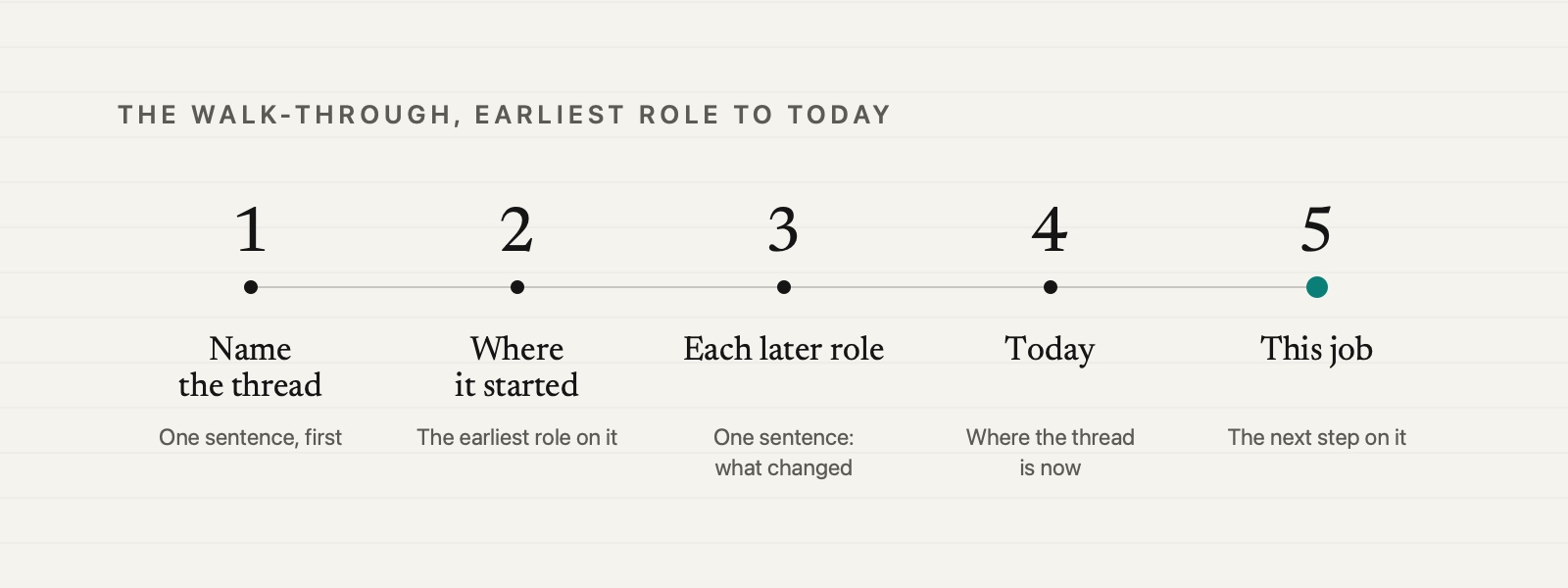
Here is how to answer "walk me through your resume." Pick the one thread that runs through your roles and leads to this job. Say where that thread leads in your first sentence. Then walk the roles in order, one sentence each, as proof. End at today and point at the job in front of you. Aim for sixty to ninety seconds.
The question sounds like a request to read your resume out loud. It is not. The interviewer has the page in front of them. What they do not have is the story that connects the lines, and that is the only thing you can add. This post builds one answer, part by part, and ends with a five-minute exercise you can do with a timer and a voice recorder.
What "walk me through your resume" really asks
Interviewers use this question to open. It gives them a quick map of your experience, so they know what to ask about next, and it shows whether you can sum up your own work without wandering. Career advisers quoted on Duke's career hub make the same point, and their first rule is the one most people break: do not just read through the bullet points. Link each role to a skill or an example that matters for this job (Duke University Career Hub).
It is close to "tell me about yourself," but not the same. "Tell me about yourself" is open, and you can lead with themes. "Walk me through your resume" asks for a walk: the roles in time order, so the interviewer can follow your path and find each role on the page. The trick is to keep that order while still saying something the page cannot.
Northwestern's career office teaches a present, past, future shape for "tell me about yourself": where you are now, two or three experiences that fit, and why you want the role (Northwestern Career Advancement). The steps below borrow from that shape for the resume question. They change what you say first.
Step 1: Pick the thread before you pick the roles
Lay your resume in front of you and ask one question: what is the one thing this job needs that my roles kept teaching me? That is your thread. It might be keeping customers from leaving, shipping things on a deadline, making numbers make sense to people who hate numbers, or running a team through a change.
One thread, not three. If you find three, pick the one the job posting cares about most. A thread that fits the role is worth more than a thread that flatters you.
Here is the example we will build through the rest of this post. Dana is interviewing for a customer success manager role. Her resume runs bank teller, support rep, support team lead, an eight-month gap, then account manager. Read in order, it looks like four jobs. Read along a thread, it is one skill getting sharper: keeping customers from leaving.
Step 2: Say where the thread leads in your first sentence
This is where most answers go wrong. People start at the top of the page, with the first job and its dates, and the interviewer waits a minute to find out why any of it matters.
Say the thread first instead:
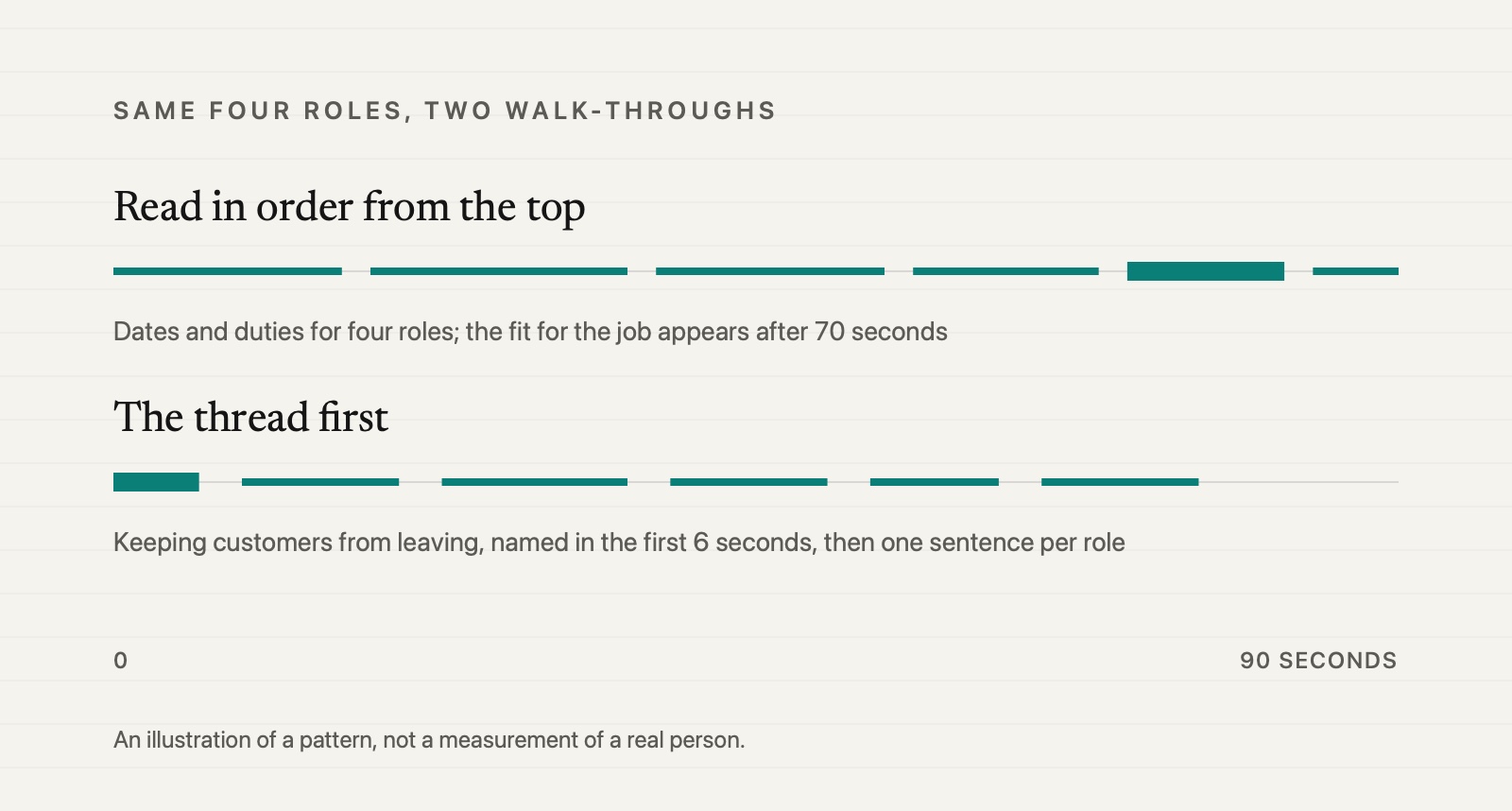
"The thread through my resume is keeping customers from leaving."
Now every role you name is heard as evidence for a point the interviewer already has. The same advisers note that listeners engage most at the beginning and the end of an answer, so the opening is the wrong place to spend on dates. It is the right place for the one sentence you want remembered.
Say that sentence in one breath and let your voice come down at the end. Then pause. The pause tells the interviewer the map is coming.
Step 3: Walk the roles in order, one sentence each
Now walk the page, earliest relevant role to latest. Give each role one sentence, and make that sentence about the thread, not the job description. The pattern is: where you were, and what the thread looked like there.
Dana's version:
"It started at the bank, where I was the teller people came to when they wanted to close an account, and I learned to ask why before I did it. At the software company I moved into support, and after a year I was taking the escalations, the customers who had already decided to cancel. That got me the team lead role, where I built the handoff we used when a ticket turned into a cancel risk."
Three roles, three sentences, and each one says what changed. Notice what is missing: no start dates, no company sizes, no list of duties. The interviewer can read all of that. What they could not read is that the teller job is where the skill started.
Walk the roles in time order, earliest to latest, and keep that direction the whole way. Most resumes list the newest role first, so name each role plainly enough that the interviewer can find it on the page. If you jump around, they stop listening and start searching.
Step 4: Skip what is not on the thread, and give a gap one sentence
Not every line on your resume belongs in the answer. A summer job, a short contract, a role that was a detour: leave them out. If the interviewer wants to know about them, they will ask, and the page is right there. Leaving things out is not hiding them. It is editing.
A gap is different. Say it yourself, in one plain sentence, before anyone has to ask. Dana's resume has eight months between the team lead role and the account manager role:
"I took eight months out to care for my father, and came back as an account manager."
That is the whole treatment. No apology, no extra explanation, no speeding up. Then carry on with the thread. The advisers on Duke's hub warn that skipping over a visible gap makes interviewers wonder what you are hiding, and a sentence like this one removes the wondering.
If a role was a real change of direction, say what carried over in one clause: "a year in sales, which is where I learned to hear a no coming." Then move on.
Step 5: End at today and point at this job
The last twenty seconds have two parts: where the thread is now, and why this job is the next step on it.
"Now I own renewals for forty accounts. This role is the next step on that thread: a book of customers before they get to the point of cancelling, which is the part I have been working toward."
The ending is where the interviewer decides what to ask next, so make it easy. Point at the job, then stop. Do not add "so that is pretty much it" or trail off into a list of hobbies. A clean stop sounds like confidence. For why that is, our post on how to sound confident in an interview covers the pause and the landing.
The whole answer, start to finish
Put together, here is Dana's answer to "walk me through your resume," as it sounds out loud:
"The thread through my resume is keeping customers from leaving. It started at the bank, where I was the teller people came to when they wanted to close an account, and I learned to ask why before I did it. At the software company I moved into support, and after a year I was taking the escalations, the customers who had already decided to cancel. That got me the team lead role, where I built the handoff we used when a ticket turned into a cancel risk. I took eight months out to care for my father, and came back as an account manager, where I own renewals for forty accounts. This role is the next step on that thread: a book of customers before they get to the point of cancelling, which is the part I have been working toward."
That runs a little over a minute at a normal pace, which leaves the interviewer plenty of room to pick a role and go deeper. For the usual ranges, see how long an interview answer should be.
Read the answer once more and notice what it does not do. It never says "then in 2019." It never lists duties. It mentions every role on the page and spends one sentence on each. And the first sentence and the last sentence say the same thing in two ways, which is what makes it feel finished.
What to leave out
- The top of the page, first. If your first sentence is a date or a degree, the thread is already lost. Start with the thread.
- Duties. "I was responsible for" tells the interviewer nothing the page did not. Say what changed in the role.
- Every line. Pick the roles on the thread. The rest is on the page if they want it.
- The long gap story. One sentence, said plainly, then on with the thread.
- A trailing ending. Point at the job and stop.
Try it now: practice how to answer walk me through your resume in five minutes
You can do this with your phone's voice recorder and a timer. Put your resume on the table.
- Write one sentence that starts "The thread through my resume is." Only that sentence.
- Start the timer and the recorder. Ask yourself "walk me through your resume" and answer out loud, all the way through, without notes. Stop the recording when you finish.
- Play it back. How many seconds before the thread arrived? Did any role get more than two sentences? Did you say the gap plainly, or speed through it?
- Make one change only. Move the thread to the first sentence, cut one role down to one sentence, or rewrite the ending so it points at the job.
- Record it again and listen once more.
The second take is usually shorter, and the thread usually arrives earlier. If you want a longer routine, our post on how to practice for an interview alone builds a five-round version.
If you can hear the fix when you listen back but it slips away the moment you start talking, that is a practice problem, and a few minutes a day is what helps. Sayforth is a 30-day iPhone program built on that idea: one short coached spoken answer a day, drawn as a single answer line so you can see where your point landed, with one change to carry into tomorrow. It is coming soon, and you can see how the daily practice works now.
Be first to know when Sayforth is live.
Get launch updatesFrequently Asked Questions
How long should my answer to "walk me through your resume" be?
Aim for sixty to ninety seconds. Name the thread in your first sentence, give each relevant role one sentence, and end by pointing at the job. Then stop and let the interviewer choose where to go deeper.
Should I go in chronological order or start with my current job?
Walk the roles in time order, from the earliest relevant role to today, and keep that direction the whole way. Say the thread first, so the order has a point. Most resumes list the newest role first, so name each role plainly enough that the interviewer can find it on the page.
What is the difference between "walk me through your resume" and "tell me about yourself"?
"Tell me about yourself" is open, and you can lead with themes or a little about who you are. "Walk me through your resume" asks for the roles in order. The thread approach works for both: name it first, then use the order for the resume question and the themes for the open one.
How do I explain a gap when walking through my resume?
Say it yourself, in one plain sentence, at the point in the order where it happened. "I took a year out to care for a parent, and came back as a project lead." No apology and no extra detail, then carry on with the thread. Career advisers warn that skipping a visible gap makes an interviewer wonder what you are not saying, and one plain sentence settles it.