Almost every guide on how to stop saying um opens with a count. Record yourself, tally the ums, watch the number come down. The counting is where most people quit, and there is a good reason for that. The number was never the thing that was wrong.
Researchers who study speech do not treat fillers as mistakes. A survey of the research on fillers in spoken language puts the disfluency rate of ordinary conversation somewhere around 5 to 10 percent, counting fillers, repeats, restarts and self-corrections together (Dinkar, Clavel and Vasilescu, TAL). Perfectly fluent speech is not the normal case. It is the exception.
So zero is not the target. The target is smaller and much more useful: stop filling every gap with sound when silence would do the same job better. That is a change you can actually practice.
Why you say um in the first place
An um is a delay signal. You arrive at a point where the next words are not ready, and the sound holds your place while you decide. Harvard Business Review puts the trigger in plainer terms: when you get rattled, distracted, or stuck on what comes next, reaching for a filler is the easy move (Harvard Business Review).
Listeners read it the same way, and they are not as annoyed by it as you think. In the research summarized above, fillers made listeners recognize the following word faster, which suggests fillers pull attention toward what is coming rather than pushing it away. In another study, speech with fillers was recalled better than the same speech with coughs of equal length spliced in. The extra time was not what helped. The signal was.
That is worth sitting with if you have been told that every um costs you credibility. A handful do not. What does cost you is the habit hiding behind them, which is deciding what to say while you are already saying it. That is also why this problem overlaps with how to stop rambling when you answer: both start at the moment you begin talking before you have picked your point.
Toastmasters International, which assigns someone at every meeting to track these sounds, uses a conservative working baseline of about six vocalized disfluencies per hundred words, close to nine a minute at a normal speaking rate (Toastmasters International). Their stated goal is reduction, not elimination.
With that settled, here is how to stop saying um in four steps, none of which involve keeping a tally.
Step 1: Hear it before you count it
You cannot change a sound you never notice yourself making. Almost nobody hears their own ums in real time, because the part of your attention that would catch them is busy assembling the next sentence.
So the first move is not counting. It is listening. Record yourself answering one question out loud for about a minute, then play it back once. Toastmasters suggests recording in more than one setting and listening to at least five minutes of your own speech a day for at least two weeks, which is a sensible shape for this.
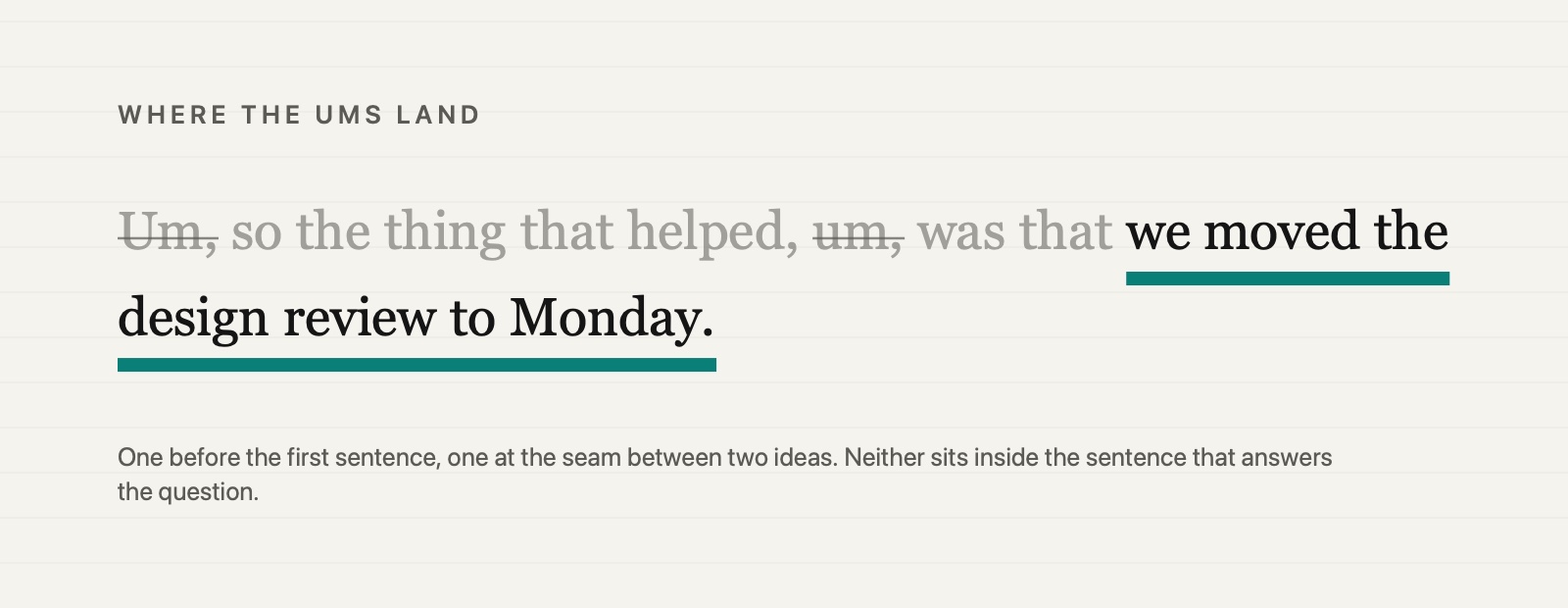
Listen for where the ums land, not how many there are. Nearly all of them turn up in two places: right at the start, before your first real sentence, and at the seam between two ideas. Both are decision points. The sound is marking the spot where you had not decided yet.
Then write down the one sentence that actually answered the question, and look at everything you said before you got to it.
Step 2: Trade the sound for a pause you can feel
If you remember one thing about how to stop saying um, make it this swap, and it is easy to describe. When you reach the place where an um would go, close your mouth and let the gap stay silent.
It is harder than it sounds for one reason. A pause feels far longer to the person making it than to the person hearing it. A single second of silence can feel like five from the inside. From the outside it reads as someone thinking, which is exactly how you want it read.
Give the pause a width so you are not guessing. One beat, roughly a second, at the seam between two sentences. Two beats before the sentence that carries your point. You are not adding dead air. You are moving the thinking out of the sound and into the silence.
One warning. If you hold the silence but keep talking at the same speed afterward, the ums come straight back at the next seam. A pause only holds if what follows it is ready, which is what the next step is for.
Step 3: Say shorter sentences
Long sentences are expensive to build while you are standing up. You are holding a clause open, remembering where it has to land, and choosing the next word, all at the same time. Toastmasters lists shorter sentences as a direct fix for this reason: less to hold in your head means less need to stall.
Compare two versions of the same answer.
The long version: I guess the thing that helped, which we did not really expect at the time, was that we moved the design review, and that meant the backlog, which had been sitting there for about a month, finally cleared.
The short version: We moved the design review to Monday. The backlog cleared in a week. We did not expect that to be the fix.
Same content, and the second one gives you three places to breathe with nothing held open across a clause. You do not need a filler, because you are never caught mid structure when you stop.
Step 4: Give it two weeks, not one evening
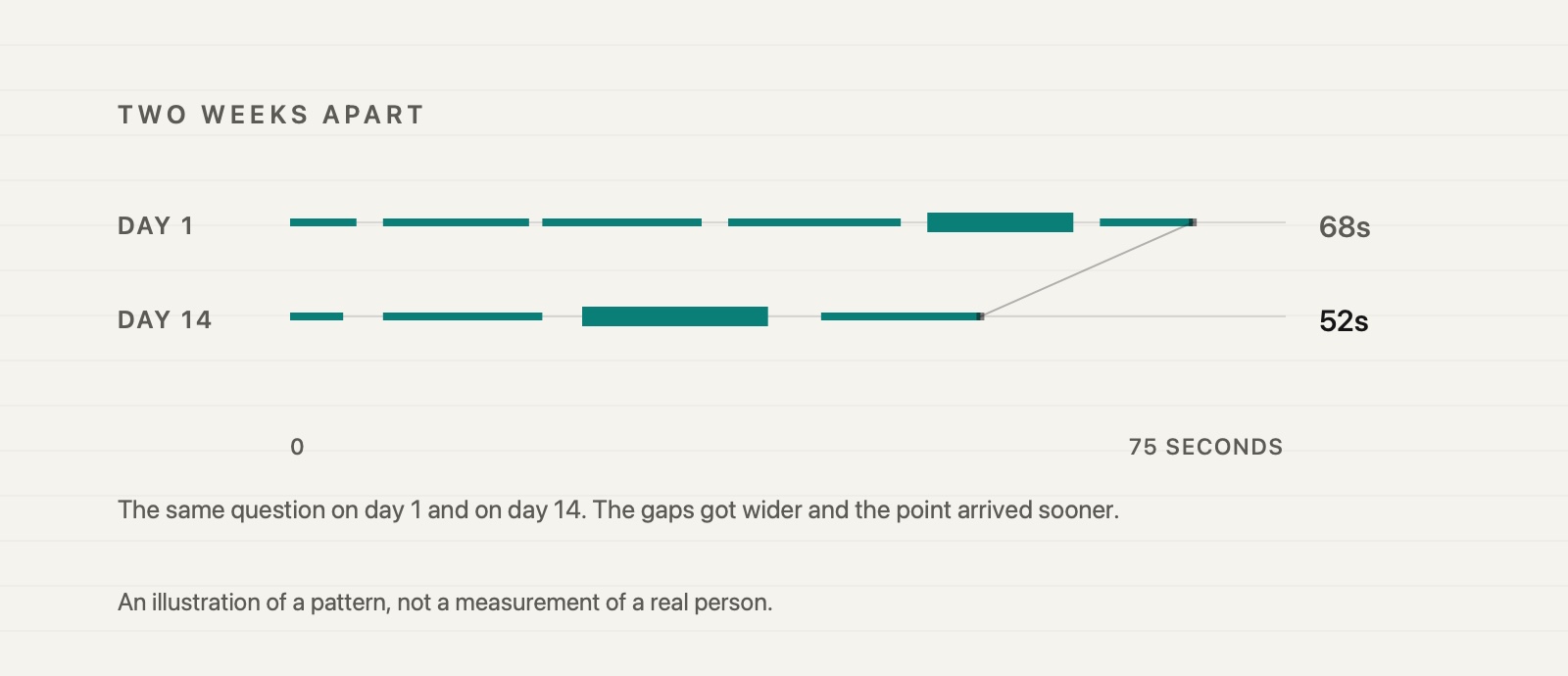
This is a motor habit, not a fact you can learn in an evening. It shifts on the timescale habits shift on, which means short daily practice rather than one long session.
Two weeks of one recorded minute a day is usually enough to hear a difference, and the difference is often not that the ums disappeared. It is that they moved. They stop appearing inside sentences and gather at the start instead, where you have not chosen your opening line yet. That is real progress, and it points straight at the next thing to work on.
Compare yourself against your own first recording rather than against someone fluent on a podcast. Podcast fluency is edited.
Try it now: how to stop saying um in five minutes
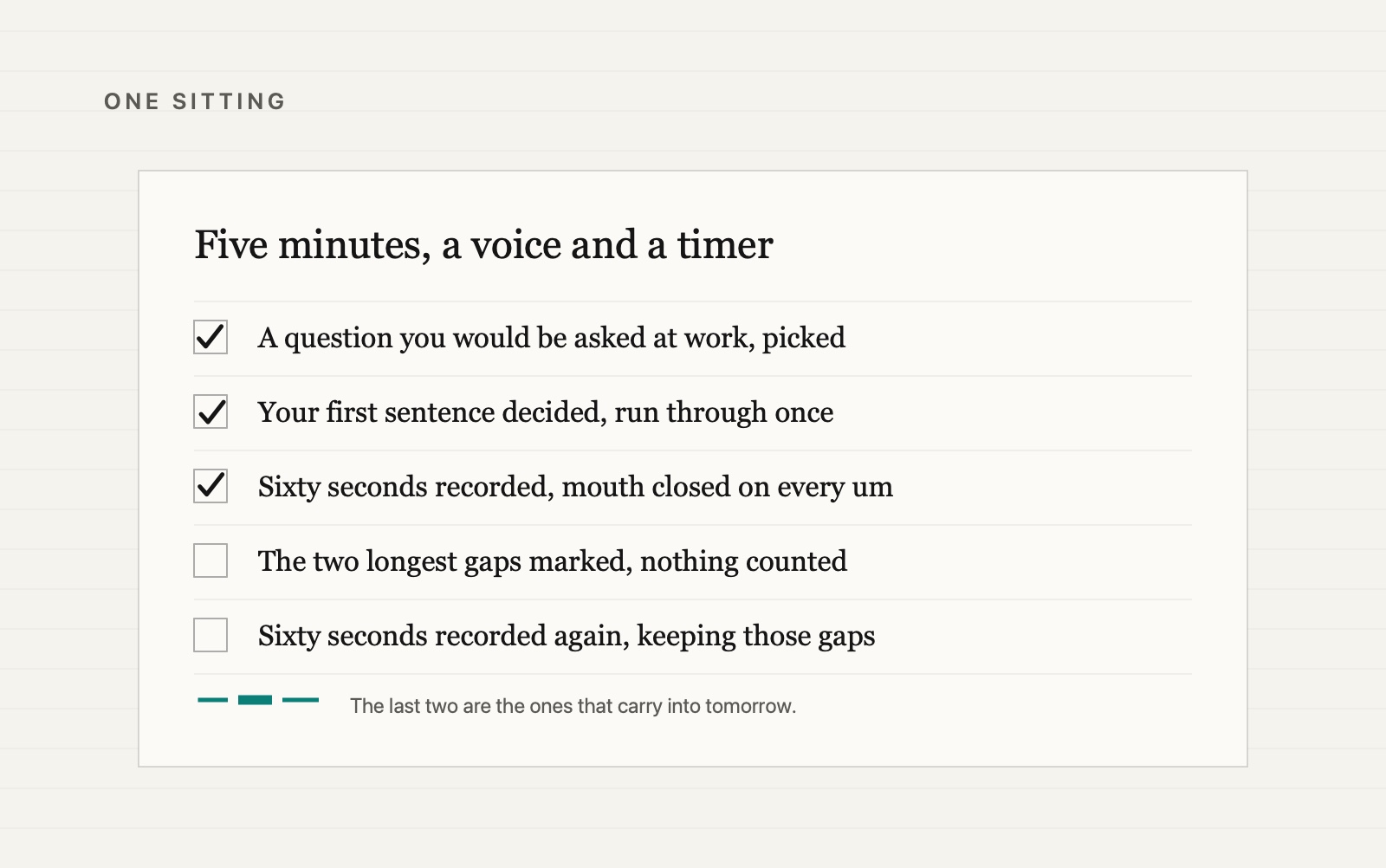
You need a voice recorder and a timer. Five minutes, once.
- Pick a question you would plausibly be asked at work, such as what you worked on last week.
- Before recording, decide your first sentence and run it through your head once. Only the first one.
- Record for sixty seconds. When you feel an um arriving, close your mouth instead and let the gap sit.
- Play it back once. Do not count anything. Mark the two gaps that felt longest to you while speaking.
- Record the answer once more, sixty seconds, keeping those two gaps deliberately.
Most people find the second recording is both shorter and has fewer fillers, without having aimed at either one.
You cannot hear your own ums while you are producing them, and that gap is what Sayforth is built for: a 30-day iPhone program, coming soon, where one short coached answer a day is drawn as a single speaking line with strokes for speech and gaps for your pauses, one change to carry into tomorrow, no scores, and recordings that stay on your phone.
Be first to know when Sayforth is live.
Get launch updatesIf you would rather see the shape of the daily practice before anything else, a full day, step by step, is on the site.
Frequently Asked Questions
Is it bad to say um in an interview?
Not at the rate most people use them. Research on fillers finds that listeners treat them as a signal more is coming, and that speech containing them can be recalled better than speech with a non-speech sound of the same length. What weakens an answer is losing its structure, not the sound itself.
How many filler words is too many?
There is no clean threshold. Toastmasters works from a baseline near six vocalized disfluencies per hundred words, which is a reference point rather than a limit. A more useful personal test: if you can hear a filler in the middle of a sentence on playback, that one was covering a decision you had not made yet.
How long does it take to stop saying um?
Give it about two weeks of short daily practice before you expect to hear a change, and expect the change to be fillers moving rather than vanishing. They tend to migrate to the start of an answer, which is a cue to decide your opening sentence before you begin.
Should I count my filler words?
Count once at the beginning if you want a baseline, then stop. After that first pass, counting quietly becomes the exercise. Listening for where the fillers land teaches you more than a total ever will, because the location tells you which decision you were still making.