
The short version of how to present to senior leadership: say the decision you need in your first sentence, give two reasons it is the right call, keep the rest of your evidence ready for questions, and stop when you have asked. Most people do the opposite. They start with the background, walk through the work, and reach the ask in the last minute, which is often the minute the meeting no longer has.
That order is not a mistake of nerves. It is the order you lived the work in, and it is the order most of us were taught for a report. But a leadership meeting is not a report. The people in that room are deciding many things in a short time, and they are listening for one thing from you: what do you need us to decide, and should we? Answer that first and everything after it is easier to hear.
Why presenting to senior leadership feels so different
Presenting to your own team, you can build up to the point. People know the project, they have time, and they will wait. With senior leaders, three things change at once.
First, time is short and it can shrink without warning. Your twenty minutes becomes eight because the item before yours ran long. Second, they interrupt. A question on your second sentence is normal, and it usually means they are engaged, not that you are failing. Third, they are not grading your effort. They are trying to make a decision well and move on.
All three point the same way. If your ask sits at the end, every one of those pressures pushes it out of the room. If it sits at the front, the pressures stop mattering, because the most important sentence has already been said.
Writers have a name for this. Journalists call it the inverted pyramid, and the military calls it bottom line up front. The Nielsen Norman Group, which studies how people read, describes the idea plainly in its guide to the inverted pyramid: start with the most important information so that someone who only takes in the beginning still gets the main point. A leadership meeting works the same way. Some of the room will only really listen to your first minute, and that is the whole idea behind how to present to senior leadership well.
Step 1: Write the one sentence you need them to hear
Before you open a slide, write one sentence that says what you want the room to decide. Not the topic. The decision. Every other part of how to present to senior leadership hangs on this sentence.
"An update on the payment project" is a topic. "We need approval to delay the launch by two weeks so we can fix the payment errors" is a decision. Leaders can say yes or no to the second one. They can only listen to the first one.
If you cannot write that sentence, you are not ready to present yet, and no amount of slide polish will fix it. Sometimes the honest sentence is not a request at all: "We are on track, and I need nothing from you today." That is fine. It is still a sentence a busy person can act on, even if the action is to move to the next item.
Keep it short enough to say in one breath. If it needs a comma and two "and"s, you have more than one ask. Pick the one that matters most and save the other for later, or for a separate meeting.
Step 2: Build the first minute around the ask
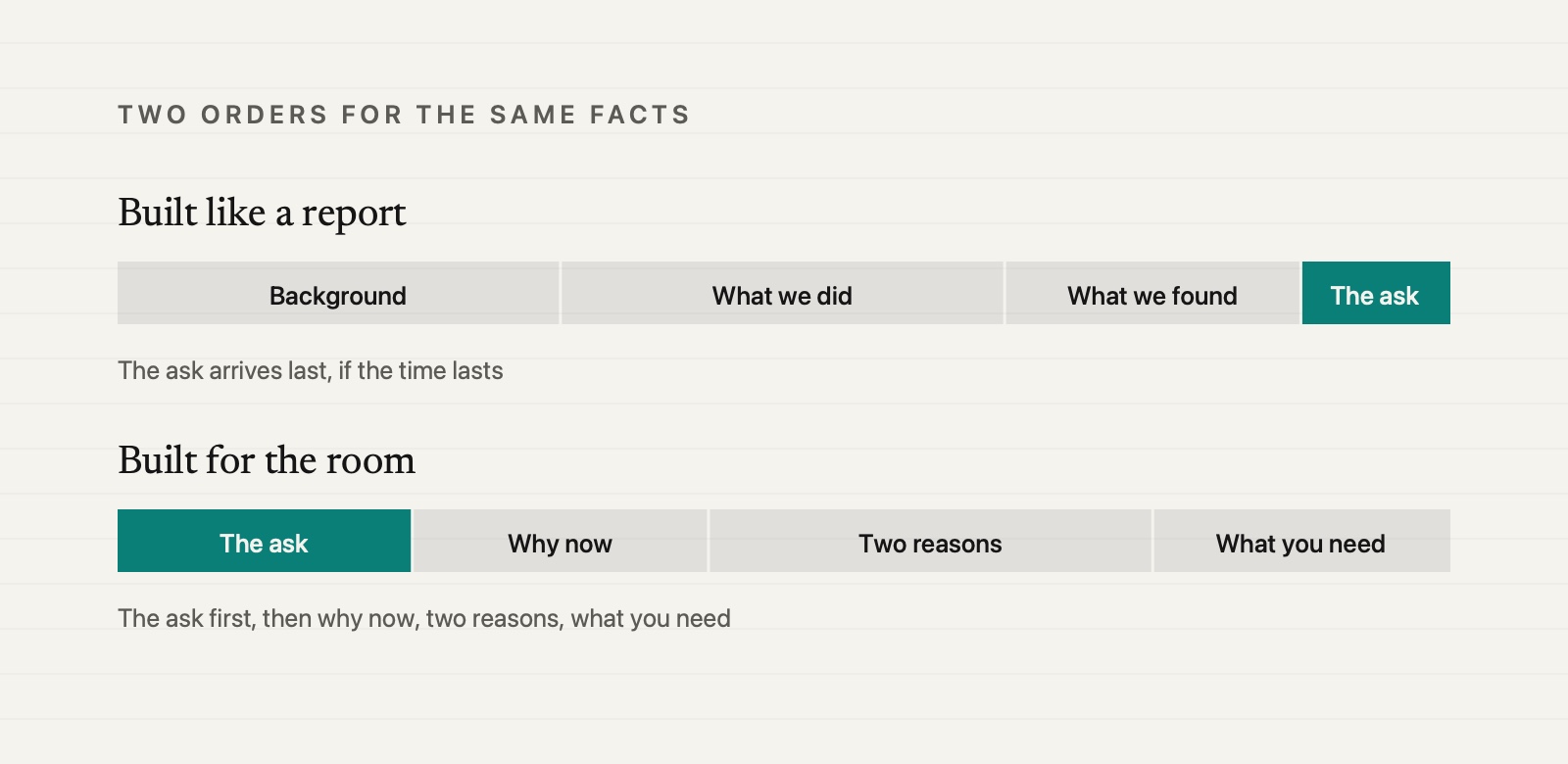
Once you have the sentence, build your opening around it. The shape that works is simple: the ask, why it matters now, two reasons, and what you need from them. Every part of that is about the decision. None of it is history.
Compare it with the shape most of us fall into. Background first, then what the team did, then what you found, then the ask. Same facts, same work, same slides. The only difference is the order, and the order decides whether the ask gets heard.
For the payment example, the opening could sound like this: "We need approval to delay the launch by two weeks so we can fix the payment errors. Right now about one checkout in fifty fails at the last step, and launching with that would hit our busiest month. The fix is already built and testing well. What I need from you today is a yes on the new date." That is four sentences and roughly twenty seconds. Everything else in your deck is support for those four sentences.
Step 3: Say the ask in the first thirty seconds
Knowing the ask goes first and actually saying it first are two different skills. Under pressure, most people slide back into warm-up: thanking everyone for the time, explaining how the project started, describing the team. Each of those feels polite. Together they can eat the first two minutes.
A simple rule helps: your ask comes out before thirty seconds have passed. One short line of greeting is fine. Then the decision. If someone needs context to follow it, they will ask, and now you are answering their question instead of guessing at it.
This is the heart of how to present to senior leadership. It feels abrupt the first few times you do it. To you it sounds rushed and a bit blunt. To the people listening it usually sounds clear and confident, because it tells them right away why this item is on their agenda.
Step 4: Move the detail to the back
You probably did a lot of work to get here. Maybe there are forty slides of analysis behind your recommendation. The temptation is to show all of it, because it proves you were careful.
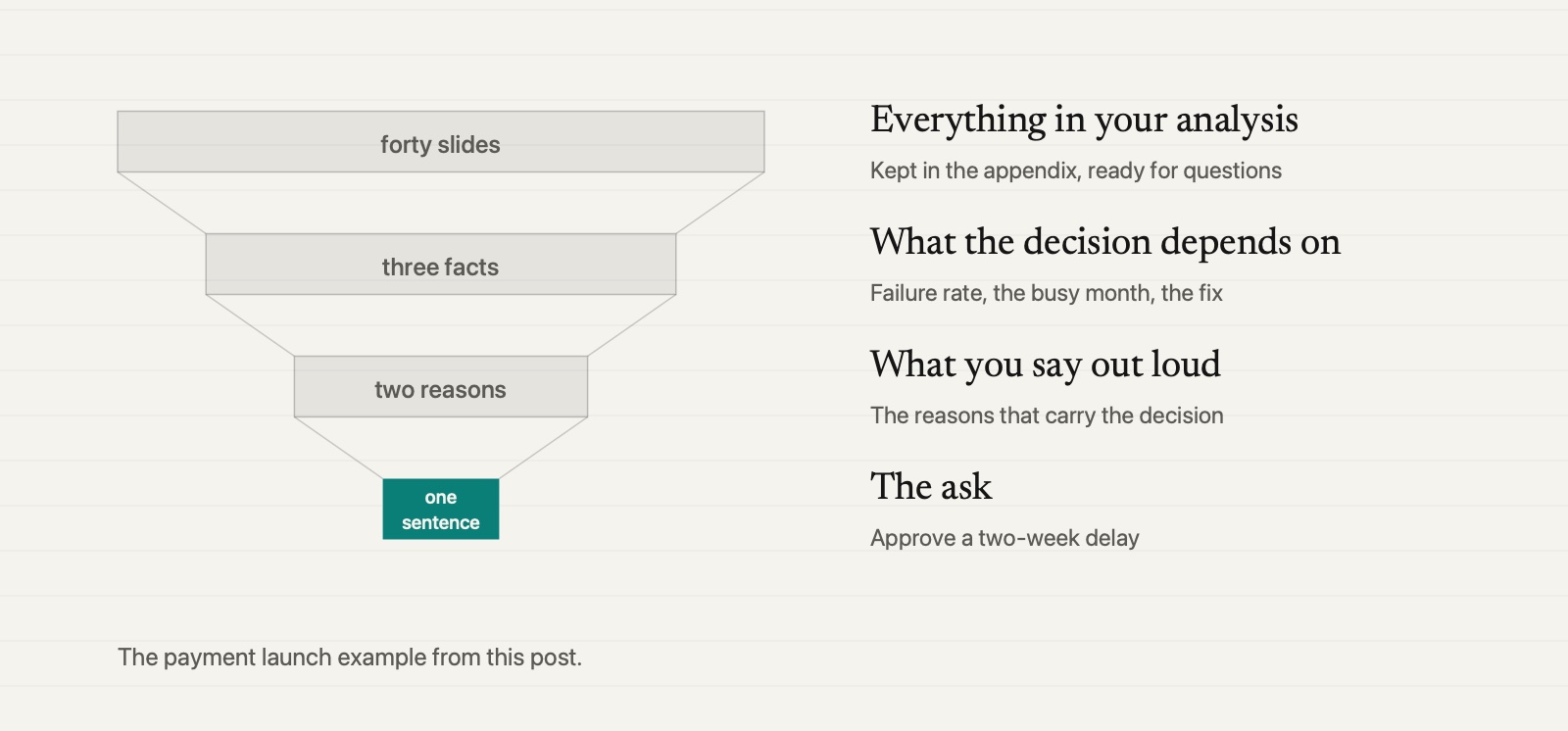
Leaders mostly take the care for granted. A big part of how to present to senior leadership is choosing what not to say out loud. What they want is the few facts the decision depends on. For the payment example, that is three facts: how often checkout fails, when the busy month starts, and whether the fix is ready. Out loud, you only need two reasons from those facts. And at the very front, you need the ask.
So split your material into two piles. The front pile is what you say: the ask and two reasons. The back pile is everything else, kept in an appendix or a document you can open if someone asks. You are not hiding anything. You are letting the room choose how deep to go, which is exactly what they want to do.
Step 5: Treat interruptions as part of the plan
Senior leaders interrupt. Expect it, and plan for it instead of fearing it. A question in your first minute means someone is paying attention to the thing you most want them to think about.
When it happens, answer the question directly and briefly, then come back to the ask. "Good question. The fix was tested on last month's traffic and the failure rate dropped to almost zero. So, back to the date: can we move launch by two weeks?" That last sentence matters. It returns the conversation to the decision without making anyone feel cut off.
If you do not know the answer, say so and say when you will have it. Guessing in front of senior leaders costs more than a plain "I will find out and send it by end of day." If you get questions you cannot answer often, that is useful too: it tells you what to add to the back pile next time.
Step 6: End on the ask, then stop
Your last sentence should repeat the decision, almost word for word. "So the ask is a two-week delay to fix the payment errors." Then stop talking.
The silence afterward is the hardest part. It can feel like a mistake, and the urge is to fill it with one more fact or a softening phrase like "but whatever you think is best." Resist that. A short pause gives the room a moment to decide, and a clean ending sounds far more certain than a trailing one. If it helps, decide your last sentence before you walk in, the same way the post on how to give a status update in a meeting suggests for shorter updates.
Practice how to present to senior leadership in five minutes
You can practice the hardest part today with your voice and a timer. No slides needed.
- Pick a real decision you need from someone above you, or a recent one. Write the one ask sentence from Step 1.
- Set a timer for one minute and say your opening out loud: the ask, why now, two reasons, what you need. Stop when you finish, even if time is left.
- Note when the ask came out. If anything came before it except a short greeting, cut that part.
- Say it again. This time, have the ask out within your first two sentences.
- Now imagine a question right after your first sentence. Answer it in one or two sentences, then say the line that brings it back to the ask.
Five runs of this are enough to feel the difference. The first take usually starts with background. By the third run, many people find the ask comes out first more easily. If your work is technical, the same drill pairs well with the ideas in how to explain technical work to non-technical people, since leadership rooms often hold both kinds of listener.
If you keep hearing yourself warm up for a minute before you reach the ask, that is a habit, and habits change through short spoken practice more than through reading. Sayforth is an iPhone app, coming soon, built for that: a 30-day program with one question a day, answered out loud, shown afterward as a single speaking line so you can see where your main point landed, and one change to carry into tomorrow. You can see how the daily practice works first.
Be first to know when Sayforth is live.
Get launch updatesFrequently Asked Questions
How long should a presentation to senior leadership be?
As short as the decision allows, and shorter than the time you were given. Plan to make your ask and two reasons in the first minute, then leave the rest of the slot for questions. If you were given twenty minutes, a strong plan is five minutes of talking and fifteen of discussion.
What do senior leaders want to hear in a presentation?
They want to know what you need them to decide, why it matters now, and what happens if they say yes or no. They usually trust that you did the work. Lead with the decision and keep the supporting detail ready for when they ask.
How do I handle tough questions from executives?
Answer the question directly in a sentence or two, then bring the conversation back to your ask. If you do not know, say so and give a time you will follow up. A clear "I will find out" lands better than a guess.
Should I send slides before presenting to senior leadership?
Often yes, especially a one-page summary that starts with the ask. Leaders who read it ahead of time tend to arrive with questions instead of needing the background. Keep the full analysis as an appendix rather than the main deck.