Here is how to introduce yourself in a meeting: say your name and let it land, say your role in words this room uses, then say why you are in this particular meeting. Three sentences, about fifteen seconds. Then stop. The third sentence is the one most people skip, and it is the only one anyone will remember.
Most introductions go wrong in one of two ways. Some are so short they carry nothing: a name, a job title, a nod to the next person. Others turn into a career summary that starts with the first job and works forward. Both miss what the room needs, which is not your history. It is the answer to a quieter question everyone is asking: why is this person here, and what will they care about in the next hour?
Why meeting introductions come out badly
A round of introductions is a strange speaking task. You get one turn, you know it is coming, and you can watch it get closer one person at a time. That last part matters more than it seems.
Psychologists call it the next-in-line effect. In Malcolm Brenner's 1973 study, people taking turns reading aloud around a table remembered less of what was said just before their own turn. A team at the University of Waterloo, building on that work, opens their paper with a familiar example: co-workers taking turns introducing themselves often struggle to recall the names said just before their own (Forrin and colleagues, Journal of Memory and Language, 2019). Their explanation is that anticipating your own turn pulls attention away from what you are hearing.
So while the person two seats away is talking, you are not listening. You are drafting. And a sentence drafted in a hurry, under the pressure of a turn that is about to arrive, tends to come out as either too little or far too much.
The fix is to decide your three sentences before the round starts, so there is nothing left to draft. Then you can actually listen to everyone else.
Step 1: Say your name slowly, and rest after it
Your name is the one word you have said thousands of times, so it is the word you say fastest. To you it is obvious. To a room of people hearing it for the first time, it is a new word, and new words need a moment to stick.
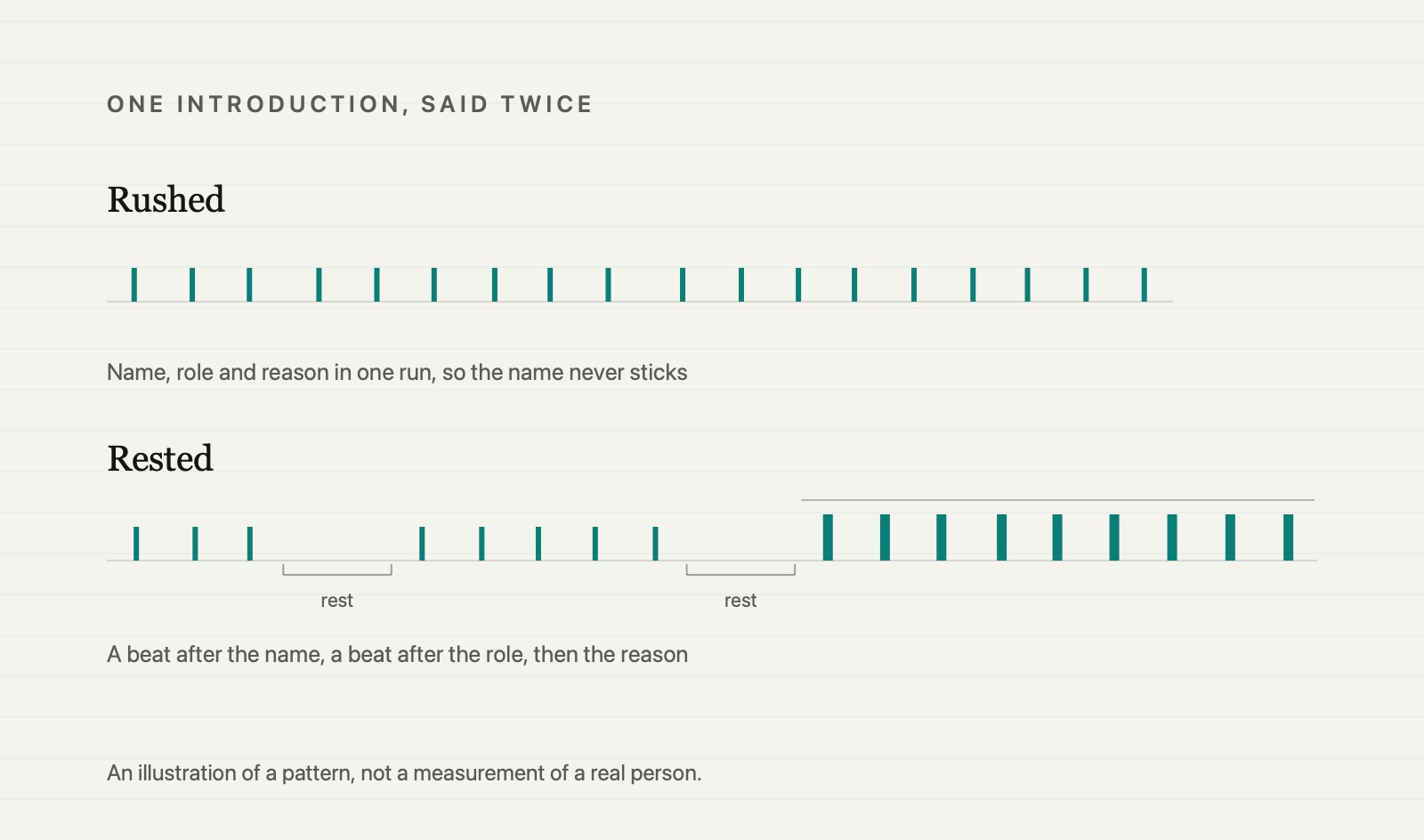
Say your name a little slower than feels natural, then take a short rest before the next sentence. A beat of about one second is enough. That small rest is where the listener files the name away. Without it, the name runs straight into your job title and both get lost in one quick blur.
Compare two versions of the same opening. The rushed one sounds like "HiI'mSamReyesI'monthesupportteam." The rested one sounds like "Hi, I'm Sam Reyes." A rest. "I run onboarding on the support team." A rest. Same words, same speed for the parts that are not your name, but the name now has room around it.
The rest will feel long to you. It is not. A one-second gap stretches in your own head while you are standing in it. To the people listening, a short rest after a name reads as calm, not as a lapse.
Step 2: Say your role in words this room uses
Job titles are often written for an org chart, not for a conversation. "Senior Associate, Customer Lifecycle Operations" tells a room almost nothing. It is also hard to say out loud without stumbling.
Instead of your title, say what you do in plain words, and pick the version that matters to the people in front of you. "I run onboarding on the support team" is clearer than the title it replaces. If you are meeting engineers, maybe it is "I handle the tickets that come in during a customer's first month." If you are meeting finance, maybe it is "I look after the team that new accounts talk to first."
One sentence. You are giving people a label so they know what to ask you about later.
Step 3: Say why you are in this meeting
This is the sentence that makes an introduction worth hearing, and it is the one most templates leave out. It connects you to the reason everyone is gathered.
"I'm here because the new returns flow lands on my team first, so I want to hear where it is headed."
"I'm here because we'll be the ones testing this, and I'd like to know what changes before we start."
"I'm joining from the design side, since a lot of this will touch the screens we own."
Notice that each of these is specific to one meeting. You cannot reuse it next week in a different room, and that is the point. A reason tied to this meeting tells people what you care about, what you can help with and why they might want to talk to you afterwards. A job history tells them none of that.
Here is how this goes wrong in practice. Someone is asked to introduce themselves and does this:
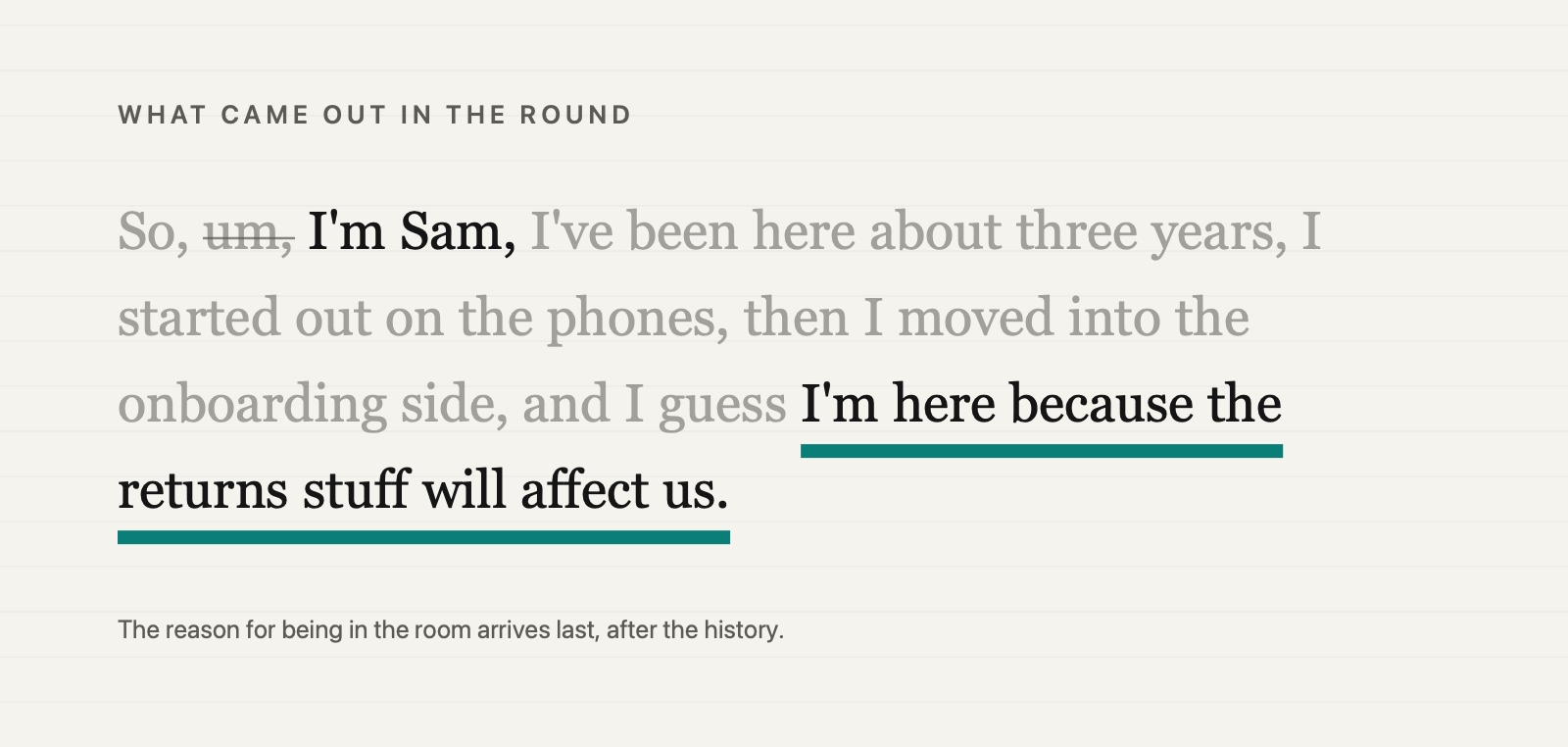
"So, um, I'm Sam, I've been here about three years, I started out on the phones, then I moved into the onboarding side, and I guess I'm here because the returns stuff will affect us."
Everything useful is in the last nine words. The rest is history in the order it happened, which is how memory hands it back to you when you have not decided in advance. Learning how to introduce yourself in a meeting is mostly learning to lead with that last clause instead of arriving at it.
Step 4: Stop on purpose
Your last sentence is the reason you are there. Say it and stop. Do not add "so yeah," do not add "that's about it," do not add a joke to fill the gap. The person after you is waiting, and a clean stop makes room for them.
Stopping feels abrupt from the inside. But the room reads a clean stop as someone who knew what they wanted to say, and a trailing ending as someone who was not sure.
If you want one more thing in your introduction, make it an offer, not more history. "If anything here touches onboarding, I'm the person to ask" is useful. It gives people a reason to find you after the meeting. Keep it to one sentence and let it be your stopping point.
What changes on a video call
The same three sentences work on Zoom or Teams, with a few small changes. Your name is probably already on screen, and audio lag can make a long rest sound like a dropped connection, so keep the rest after your name to about one beat. Unmute a moment before your turn so your first word is not clipped, and look at the camera, not your own tile, while you say the reason sentence.
How first impressions form in a few seconds
People form impressions quickly, and that is not just a saying. In research described by the American Psychological Association, strangers watched silent video clips of teachers, some as short as six seconds. Their ratings of qualities such as confidence lined up closely with ratings from students who had spent a whole semester in those classes (APA Monitor on Psychology, "Thin slices of life").
That is not a reason to panic about your fifteen seconds. It is a reason to spend them well: a name the room can keep, a role it can understand and a reason to remember you. A clear introduction does that whether or not you feel calm while giving it.
Try it now: practice how to introduce yourself in a meeting in five minutes
You need your voice and a timer. Pick a real meeting you have coming up this week.
- Set the timer for thirty seconds. Introduce yourself out loud the way you normally would, without planning. Notice how long it ran and where you stopped.
- Write down three lines: your name, your role in plain words, and one sentence that starts "I'm here because."
- Say the three lines out loud. Rest for one beat after your name and one beat after your role.
- Say them again. This time end on the reason sentence and stay silent for two full seconds afterwards.
- Say them a third time without looking at your notes.
The first take is usually longer and ends on a trailing phrase. The third usually sounds like you, only clearer. You have not memorized a script. You have practiced an order, and the order is what carries into the room.
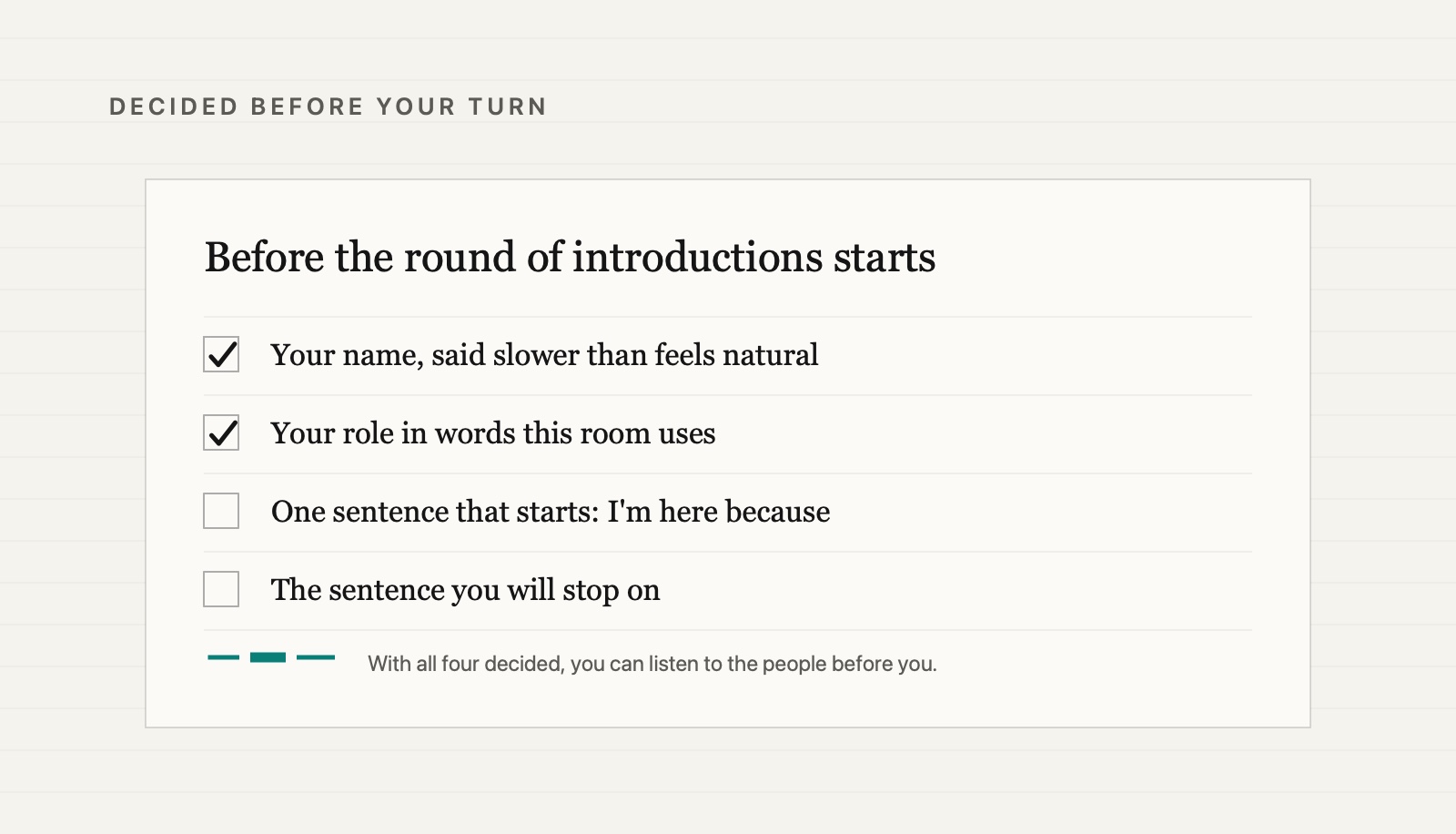
Run through this list in the minute before the round of introductions starts. Then put it away and listen to everyone else.
If you know what you want to say but it keeps coming out as history in the order it happened, that is something you can practice rather than just understand. Sayforth is a 30-day iPhone program built for exactly that: one short spoken answer a day, drawn as a single line so you can see where your point landed, and one change to try tomorrow. It is coming soon.
Be first to know when Sayforth is live.
Get launch updatesIf introductions are only one of the turns you dread in meetings, two other posts cover the rest. How to give a status update in a meeting uses the same decide-first approach for the turn you take every week. How to stop rambling when you answer a question goes deeper on why the point arrives late and how to move it forward. You can also see how the daily practice works.
Frequently Asked Questions
What should I say when introducing myself in a meeting?
Say three things: your name, your role in plain words and why you are in this meeting. For example, "I'm Sam Reyes. I run onboarding on the support team. I'm here because the new returns flow lands on my team first." Leave out your career history unless someone asks for it.
How long should a self-introduction in a meeting be?
About fifteen seconds for a round of introductions, and rarely more than thirty. If the meeting is small and the host asks you to say a bit more, add one sentence about what you can help with, not more background. When you know how to introduce yourself in a meeting in three sentences, it is easy to stretch to four and still stop cleanly.
How do I introduce myself in a meeting as a new employee?
Use the same three sentences, and make the third one about what you are learning. "I joined the data team two weeks ago, and I'm here to understand how reporting works before I start on it." People are usually glad to help someone new, and a clear reason tells them how.
How do I introduce myself in a virtual meeting?
Unmute a moment before your turn, look at the camera rather than your own video, and keep the rest after your name short so it does not sound like the connection dropped. The three sentences stay the same. Your name is likely already on screen, so the reason sentence carries even more of the introduction.