Here is how to stop saying I think at work: do not ban it. Keep it where you are honestly unsure, cut it from the one sentence your recommendation rests on, and put the reason where the hedge used to be. "I think we should" becomes "We should, because." That small swap does more than any list of stronger phrases.
Most advice hands you a list of substitutes: "I recommend" instead of "I think." Those lists treat the words as the problem. The real habit is putting a cushion in front of the sentence you are most afraid to get wrong, and a cushion with a firmer name is still a cushion.
Why you say I think at work
"I think" is a hedge: words that soften a claim, like "kind of," "maybe" and "just." It is a close cousin of the um. An um holds your place while you find the next word. An "I think" holds your place while you decide whether you are allowed to say the next word. If you have worked on how to stop saying um, you will recognize the pattern: the sound shows up exactly where a decision has not been made yet.
At work, the trigger is usually social, not grammatical. You are about to disagree with someone senior, commit the team to something, or say a number out loud. So you reach for protection: if I say "I think" first, and I turn out to be wrong, I only thought it.
The trouble is that the protection mostly does not work. Researchers Peter Collins and Ulrike Hahn tested whether hedging protects a speaker's reputation when a claim turns out to be false. Hedging did not change how listeners updated their view of the speaker, and the researchers found no clear evidence of a protective effect (Collins and Hahn, Journal of Experimental Psychology: Learning, Memory, and Cognition). So the cushion buys you little protection.
There is a second cost. When "I think" opens every sentence, it pushes your actual point later. That is the same buried-point problem covered in how to stop rambling when you answer, just made of smaller pieces.
When I think is the right thing to say
Before cutting anything, know what to keep. Sometimes "I think" is simply true.
A team including Wharton marketing professor Jonah Berger studied how different hedges change how persuasive a message is. They found that not all hedges hurt. Hedges that mark something as your own view, like "in my opinion," came across as more confident than general ones like "probably," and hedges that signal a high likelihood ("likely," "should") did better than weak ones ("might," "could"). They also cautioned against hedging out of habit or simply because it is convenient (Knowledge at Wharton).
So there are honest uses of "I think" at work:
- Someone asked for your opinion. "What do you think of the new layout?" "I think the second option reads faster." That is an answer, not a dodge.
- You genuinely do not know. "I think the contract renews in March, but let me check." Here the hedge is information.
- You are offering one view among several. In a brainstorm, "I think" signals that your idea is on the table, not the decision.
The goal is not zero. It is that no "I think" sits in front of a recommendation you actually believe. For the interview version of this habit, see how to sound confident in an interview.
Step 1: Hear where your I think lands
Most people do not hear their own hedges in real time, because their attention is busy building the next sentence. So record yourself. Pick one real recommendation you need to make this week, set a timer for one minute, and say it out loud the way you would in the meeting. Then play it back once and listen only for "I think" and its relatives: "I feel like," "maybe," "probably," "kind of," "just."
Do not count them. Notice where they land. They often cluster in two places: the very first sentence, and the sentence that carries the actual ask. Both are moments of commitment, which is why the cushion shows up there.
Step 2: Sort each I think by two questions
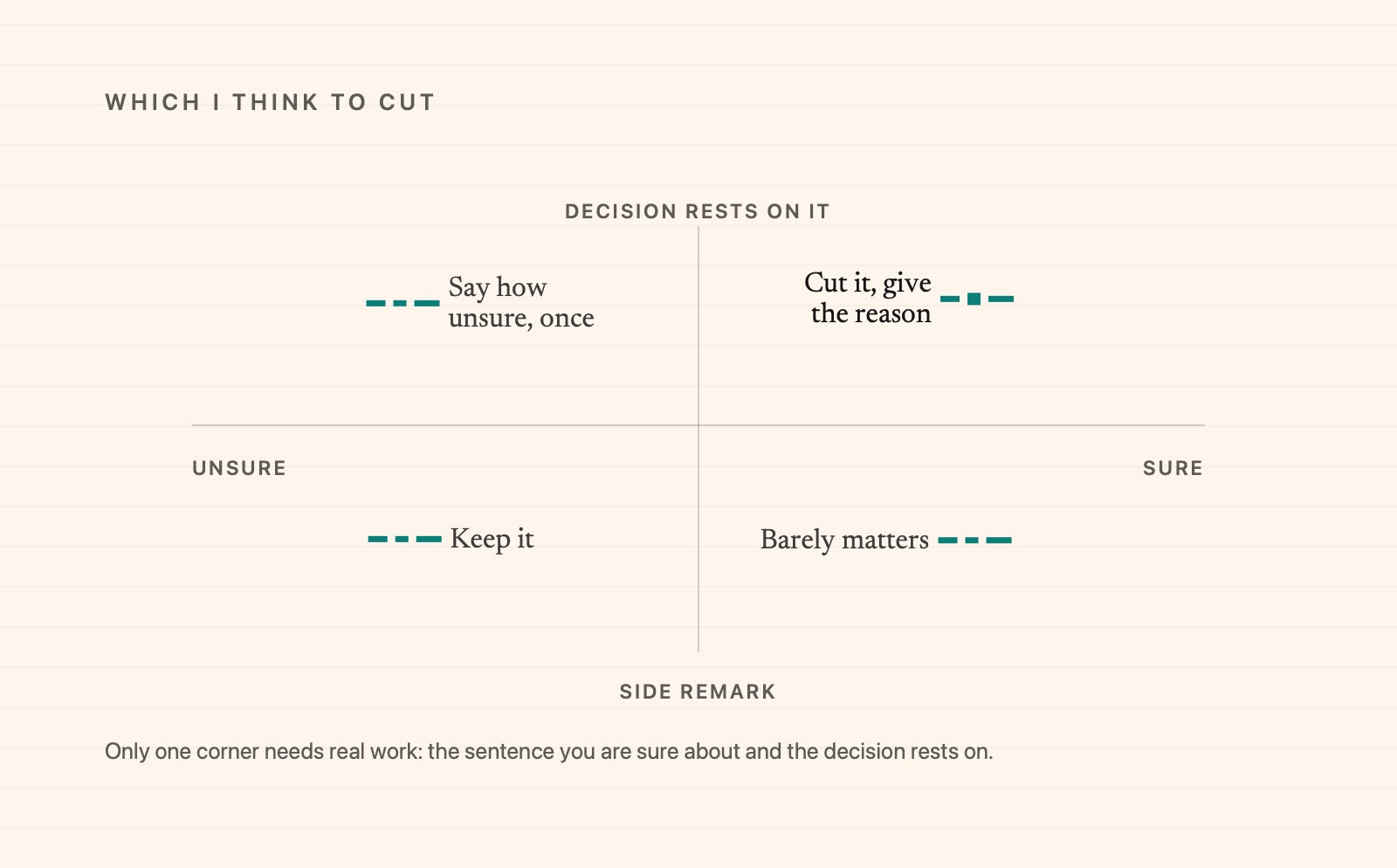
For each hedge you heard, ask two questions. How sure am I, really? And is this the sentence the decision rests on, or a side remark?
- Unsure, side remark. Keep it. "I think the vendor is based in Denver" is fine. Nobody is deciding anything on it.
- Sure, side remark. Cut it if you like, but do not spend energy here. These cost little.
- Unsure, key sentence. Do not hide it behind a vague "I think." Say how unsure you are and why, in plain words. More on that in Step 5.
- Sure, key sentence. This is the one that matters. Cut the hedge, and give the reason instead.
Step 3: Cut it from the sentence that carries the decision
Write the key sentence down exactly as it came out. Here is one from a weekly team meeting, where someone is asked whether the renewal survey should move from email into the app:
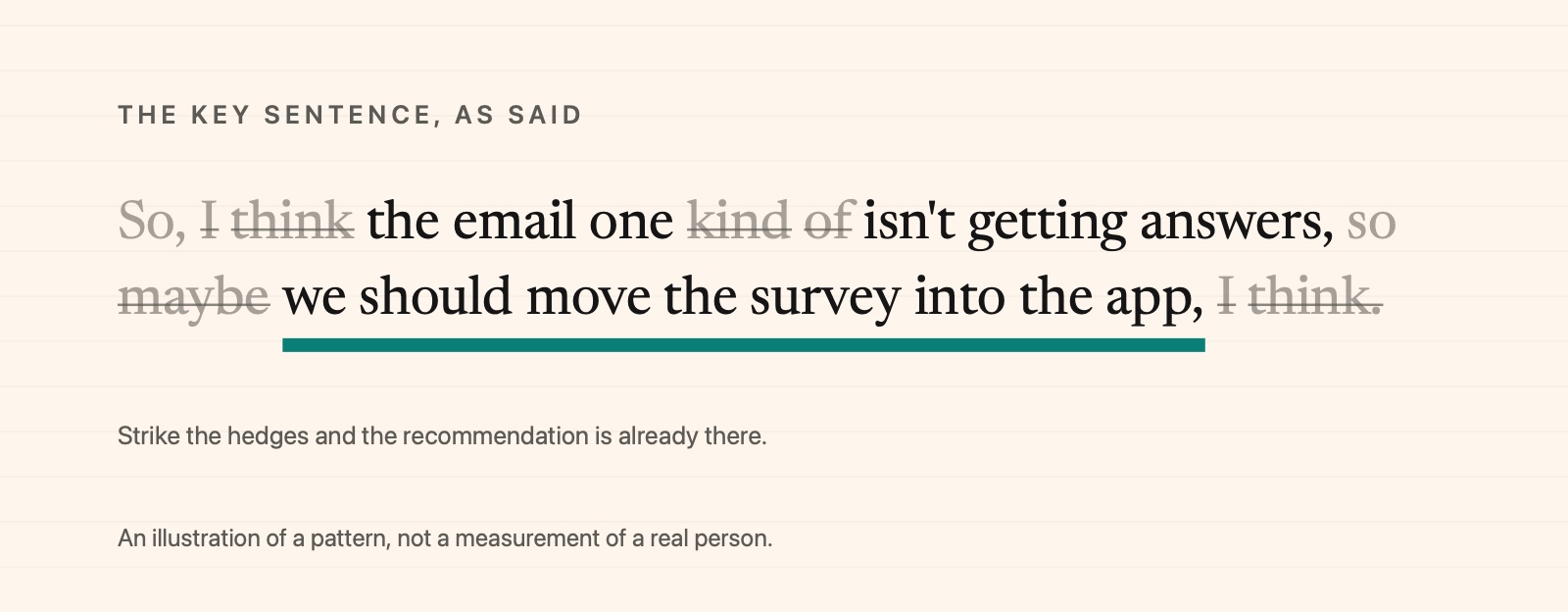
"So, I think the email one kind of isn't getting answers, so maybe we should move the survey into the app, I think."
Now cross out every hedge and read what is left: "The email one isn't getting answers, so we should move the survey into the app." Nothing was added. The clear sentence was inside the hedged one the whole time.
Notice that this sentence had two "I think"s, one at each end. The first one asks for permission to speak, and the second takes the claim halfway back. Cutting both changes how the whole answer sounds.
Step 4: Replace the hedge with the reason, not a softer word
This is the step most swap lists skip. When you remove "I think," the sentence can feel bare, and the instinct is to fill the gap with another phrase, like "I'd suggest." Often the gap is better filled with the thing the hedge was hiding: your reason, said right after the recommendation.
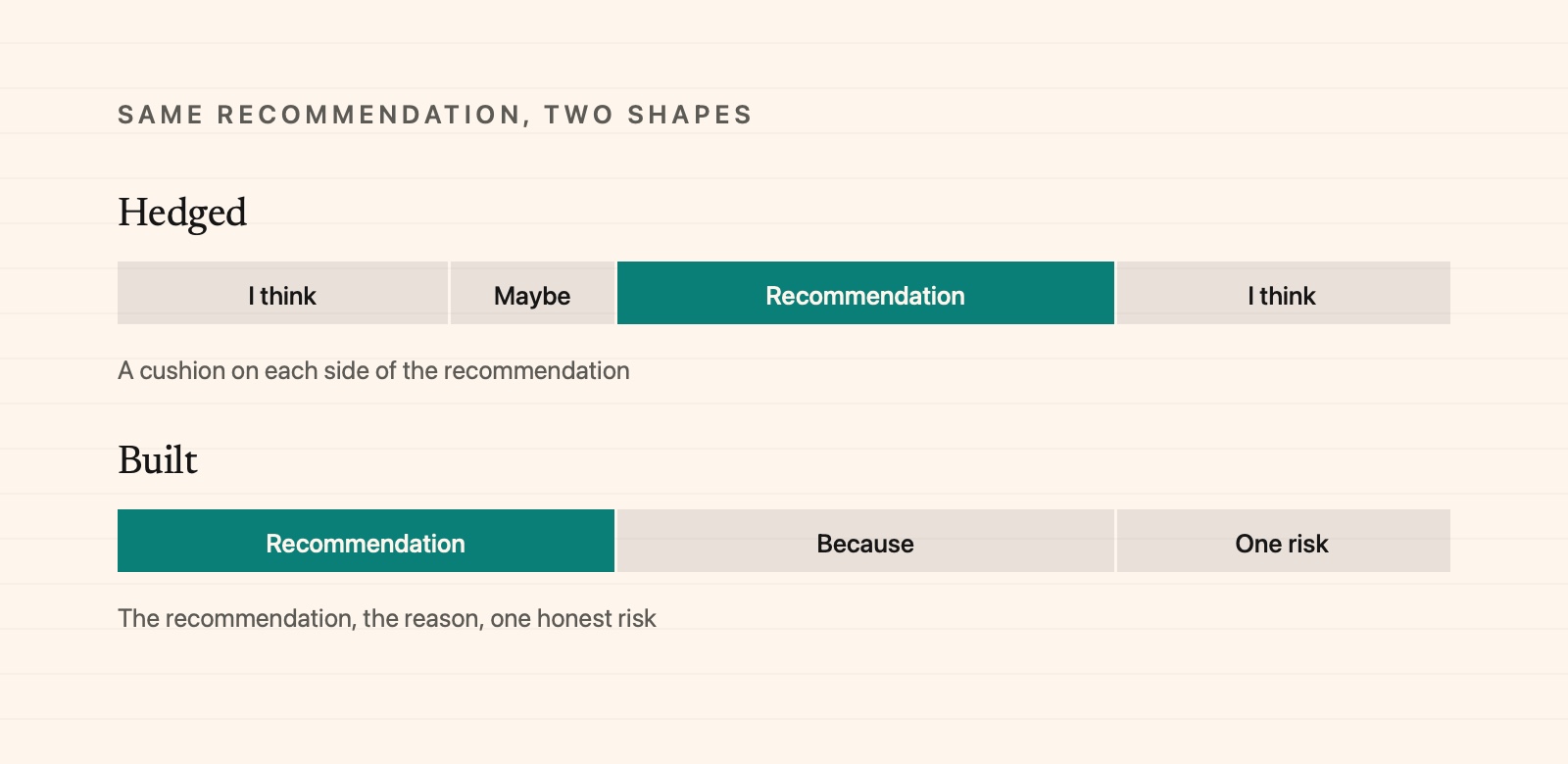
A recommendation with a reason does not need a cushion, because the listener can see why you believe it. "We should move the survey into the app, because the email version isn't getting answers" is not louder or more aggressive than "I think." It is more useful. It gives the room something to agree or disagree with, which is what a recommendation is for.
A simple shape that works for most recommendations at work is three parts: the recommendation, one reason, and one honest risk if there is one. Said out loud, that takes about fifteen seconds.
Step 5: When you are unsure, say how unsure, once
Sometimes the key sentence is one you are not sure about, and you still have to say it. Do not bury it under a few "I think"s. Name the uncertainty once, plainly, and move on.
"I think it might work" tells the listener almost nothing. These tell them a lot:
- "We should move the survey into the app. The one thing I'm not sure about is whether people will answer it on a phone."
- "My best guess is March. I'll know for sure after Thursday's call."
- "This should work if engineering can give us two days. If not, we keep the email version."
Each one puts the recommendation first and states the doubt as a specific condition. That fits the Wharton advice above: state your uncertainty clearly instead of spreading it across every sentence. People also know exactly what would change your mind.
For meetings where you were not ready at all, what to say when you are called on unprepared covers how to give the part you know and name when you will have the rest.
Step 6: Stop after the claim
To stop saying I think at work for good, watch the last place it sneaks in: after the recommendation. You say the clean sentence, then feel the silence, and fill it: "...but yeah, I think, I don't know, that's just my take."
That tail undoes everything before it. When you have said the recommendation and the reason, stop. Let the pause sit for a second. It will likely feel longer to you than it does to the room. If someone wants more, they will ask, and now you are answering a real question instead of apologizing for the last one.
How to stop saying I think at work: a five-minute exercise
You need your phone, a timer, and one real recommendation.
- Record one minute. Make the recommendation out loud as if your manager just asked for it.
- Listen once. Mark each "I think," "maybe," "kind of" and "just" you hear. Note where each one landed, not how many there were.
- Find the key sentence. Which sentence does the decision rest on? Write it down exactly as you said it.
- Cut and sort. Strike every hedge from that sentence. If you were truly unsure about something, write one plain sentence that says what you are unsure of.
- Add the reason. After the recommendation, add "because" and one reason.
- Record again. Say the new version once, and stop when the reason is done.
Play both versions back to back. The second one just commits. Repeat it with a different recommendation tomorrow. With practice, you start to catch the "I think" just before it leaves your mouth, which is when it becomes easy to drop.
Hearing your own hedges is the hard part. Sayforth is an iPhone app, coming soon, built for that moment: you answer one question out loud each day, and afterward your answer is drawn as a single line where each softener word like "I think" shows up as a small notch, so you can see exactly where you cushioned the point. You can read how Sayforth coaching works to see how a coached answer quotes your own words and rewrites the sentence with the point first.
Be first to know when Sayforth is live.
Notify meFrequently Asked Questions
Is it unprofessional to say I think at work?
No. "I think" is fine when someone asks for your opinion or when you genuinely are not sure. It becomes a problem when it sits in front of a recommendation you actually believe, because it makes the listener wonder whether you stand behind it.
What can I say instead of I think?
Often nothing. To stop saying I think at work, delete it and see if the sentence still works, which it usually does. If it feels too bare, add your reason with "because" rather than a new phrase like "I would suggest," which often just replaces one cushion with another.
Why do I say I think so much?
Usually because you are deciding whether you are allowed to say the next part while you are already saying it, often right before you disagree or commit to something. Recording yourself and noticing where it lands is the fastest way to see your own pattern.
Does hedging make you sound less confident?
It depends on the hedge and where it goes. Research on hedges suggests the type matters: weak, vague ones like "might" tend to make a speaker seem less sure, while ones that sound likely or clearly personal can still come across as confident. One plain sentence about what you are unsure of works better than many small hedges spread across your answer.