
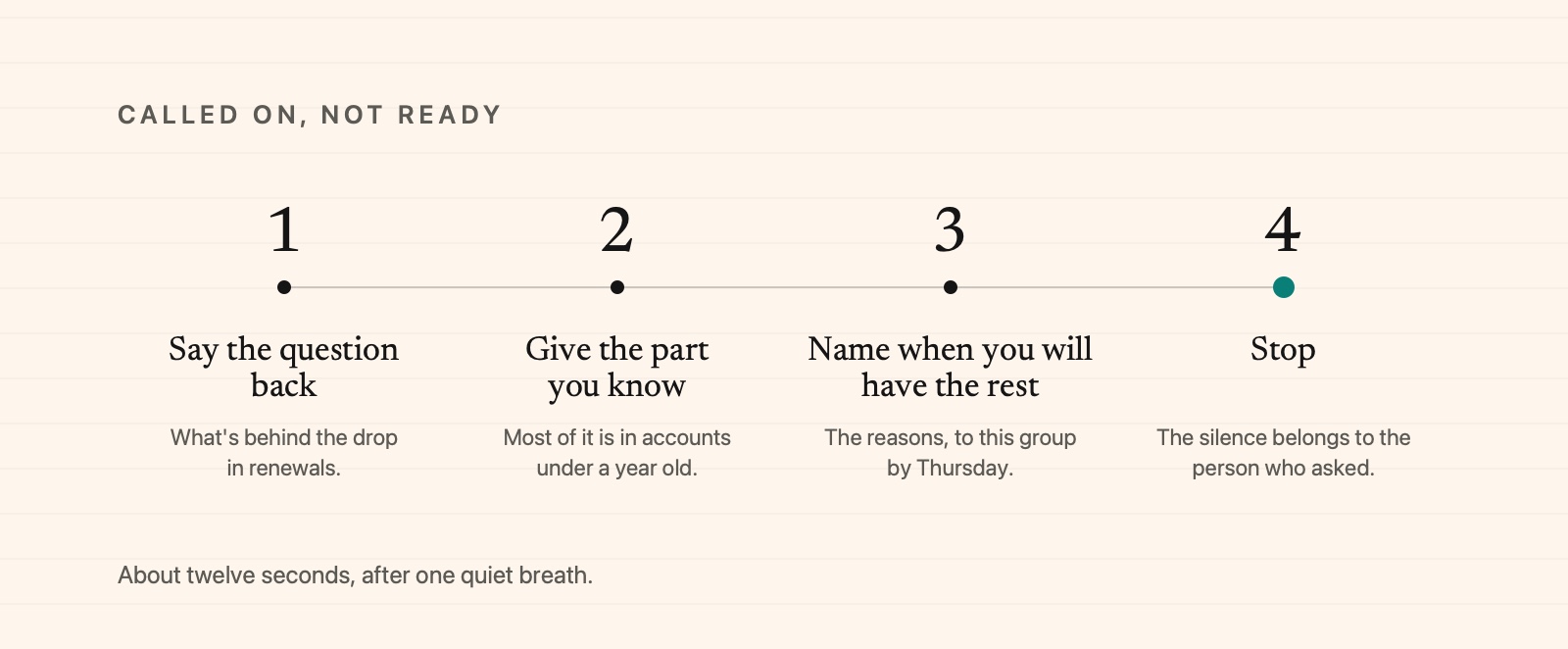
Here is what to say when you are called on unprepared in a meeting: say the question back in a few words, give the part you know, name the day you will have the rest, and stop. Four short moves, about fifteen seconds. You do not need the full answer to give a good reply. You need a clear one.
Most people do the opposite. A manager turns and says, "Jordan, what do you think is behind the drop in renewals?" and the answer starts before the thinking does. "Um, yeah, so, good question, I mean, there are a few things, I was actually looking at this a while ago, and..." A minute later the room still does not know what Jordan thinks. That is the same habit covered in how to stop rambling when you answer, set off by surprise.
Why being called on feels like an emergency
When you are called on without warning, two things land at once. There is the question, and there is the room looking at you. The second one is louder. So you start talking to end the silence, not to answer the question.
There is also a quiet belief that the reply has to be impressive. Matt Abrahams, who teaches communication at Stanford Graduate School of Business, argues that this belief is the thing that trips people up. His advice for speaking on the spot is to lower the bar: "Rather than striving for greatness, challenge yourself to just accomplish the task at hand" (Stanford Graduate School of Business).
The task at hand is small. Someone asked a question. They want to know what you know, what you do not know, and what happens next.
First: take one breath before you answer
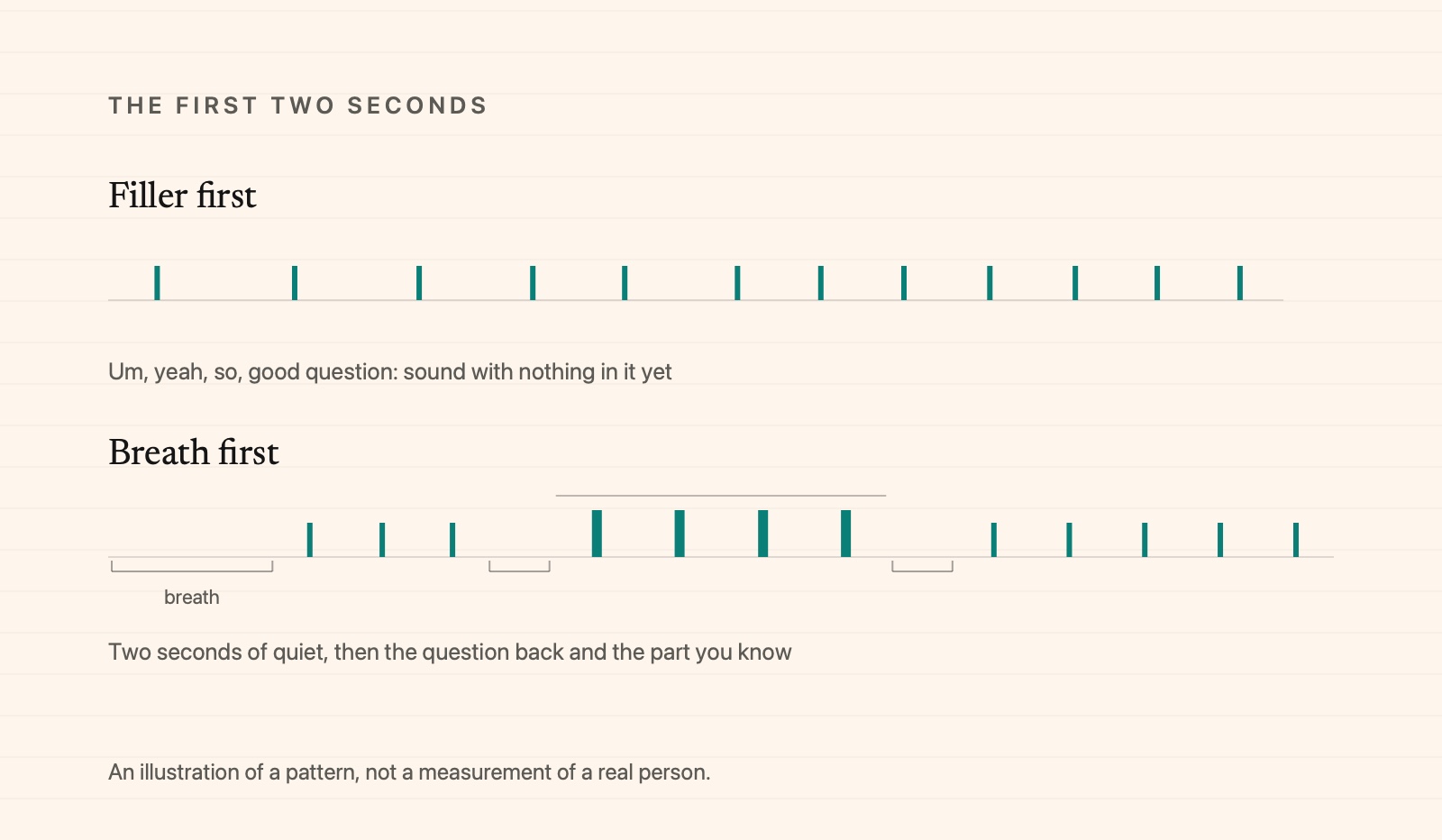
Before any words, take one quiet breath. It lasts about two seconds. It will feel much longer to you than it does to the room.
That breath does two jobs. It stops the filler that would have come out first, the "um, yeah, so" that tells everyone you are scrambling. And it gives you a moment to hear the question again in your head, which matters for the next step.
People skip the breath because they think a fast start looks prepared. It does not. A fast start made of filler sounds like a scramble. Two seconds of quiet followed by a clear sentence sounds like someone who is thinking. If you want the detail on how long a pause can run before it feels odd, how long you should pause when you speak covers it.
Step 1: Say the question back
Start with the question itself, in a few of your own words. "What's behind the drop in renewals." Say it flat, as a statement, not as a stall.
This is the most useful sentence you have when you are called on unprepared, because you can always say it. It needs no knowledge. It also does real work. It shows the room you heard the question, it makes sure you answer the right one, and it gives your mind three more seconds to find the part you know.
If the question was unclear, turn the echo into a check: "Do you mean the drop this quarter, or since the price change?" That is not dodging. A piece on being put on the spot in FM, the magazine published by the accounting bodies AICPA and CIMA, suggests the same thing: "You might also ask the person a question to clarify what they are after" (FM). Ask once, then answer.
Step 2: Give the part you know
Almost no question finds you with nothing. You usually have a piece: one fact, one number from last week, one thing you saw. Say that piece in one sentence, and label it as a piece.
"The part I know: most of the drop is in accounts under a year old."
Labeling matters. "The part I know" tells the room where your knowledge ends, so nobody takes one fact for the whole story. It also keeps you honest. The same FM piece puts it plainly: "there is no point in trying to bluff and pretend you know it all. Just tell them what you do know and what you don't."
The trap here is making the known part long to cover the unknown part. One sentence is enough. Two at most.
Step 3: Name when you will have the rest
Now say what you do not know, and attach a day to it. "I don't know why yet. I can pull the cancellation reasons and send them to this group by Thursday."
This turns a gap into a plan. "I don't know" alone leaves the room with nothing to do. "I don't know yet, and you will have it Thursday" gives them a date, and it shows you know how to find the answer, which is often what your manager was checking.
Be exact. "I'll look into it" is a soft promise that everyone forgets, including you. A day and a place ("by Thursday, in the channel") is a promise people can hold you to. Only name a time you can keep. Then keep it. The follow-up is the second half of the answer, and it is the half that people remember.
Step 4: Stop
After the date, stop talking. Do not add "if that makes sense" or "sorry, I should have had that." Do not circle back to explain why you were not ready.
The FM piece is direct about this: keep the reply short, "and don't be afraid to leave a strategic silence afterwards." A long apology takes more of the meeting's time than the gap in your knowledge ever did. It also changes the subject from the renewals to you.
The silence after your last word is not yours to fill. It belongs to the person who asked. They will say "great, Thursday works," or they will ask a follow-up.
What to say when you are called on unprepared: the whole reply
Put together, the reply to the renewals question sounds like this:
"What's behind the drop in renewals. The part I know: most of it is in accounts under a year old. I don't know why yet. I can pull the cancellation reasons and send them to this group by Thursday."
Read it out loud with a timer. It runs about twelve seconds. It has no filler, no guess and no apology, and it leaves the room with one fact and one date.
Three harder cases
You were not listening. Do not guess at the question from the last few words you caught. Say, "I missed the last part. Could you say the question again?" It costs you three seconds. A confident answer to the wrong question costs a lot more.
You have nothing at all. If the question is outside your work, say so and point to where the answer is. "I don't have that. Dana's team owns the numbers. I can ask her and bring it back tomorrow." You still gave the room a next step.
You are asked what you think, not what you know. Here there is no fact to look up. Give a first thought and call it that: "First thought, not a final one: I'd look at onboarding before pricing, because the drop is in new accounts." Abrahams suggests a simple order for moments like this: what it is, why it matters to the listener, and what comes next. One sentence for each is plenty.
If your mind goes blank halfway through any of these, the fix is a different one, and how to recover when you lose your train of thought walks through it.
What not to say
Knowing what to say when you are called on unprepared also means knowing what to leave out. Four openings make things worse, and all four are common.
- The apology. "Sorry, I wasn't ready for that." Now the room is thinking about your prep, not your answer.
- The compliment. "That's a great question." Said once, it is fine. Said every time, people hear it as the stall it is.
- The guess. A number you are not sure of, said in a sure voice, will be repeated in three other meetings by Friday. If you must estimate, label it: "Rough guess, I'll confirm: about a third."
- The history. Starting from the beginning of the project in the hope that the answer shows up on the way. It rarely does.
Try it now: practice being called on in five minutes
You cannot prepare the answers, because you do not know the questions. You can prepare the moves. This takes five minutes, a phone and a timer.
- Write down three questions someone at work could ask you without warning. Make one of them a question you could not fully answer today.
- Start a voice recording. Read the first question out loud, as if a manager asked it.
- Take one breath. Then give the four moves: the question back, the part you know, the day you will have the rest, and stop. Aim for under twenty seconds.
- Do the same for the other two questions, without stopping the recording.
- Listen back to one thing only: your first two seconds after each question. Was it a breath, or was it "um, so, yeah"?
Run it again tomorrow with three new questions. The words change each time. The order does not, and the order is what you will reach for when a real question lands.
Being called on is hard because your first sentence has to arrive before you feel ready, and that is a skill you can practice. Sayforth is a 30-day iPhone program, coming soon, built on one question a day, answered out loud. After you finish, your answer is shown back as a single speaking line, so you can see where your main point landed, with one change to carry into tomorrow. You can read how the daily practice works step by step.
Be first to know when Sayforth is live.
Notify meIf the surprise question comes in an interview and not a meeting, how to answer an interview question you don't know covers that room. And when the question is the weekly "where are we on this," how to give a status update in a meeting gives you the order to use.
Frequently Asked Questions
What do you say when you are put on the spot in a meeting?
Take one breath, then say the question back in a few words. Give the one part you know, say what you do not know yet, name the day you will follow up, and stop. The whole reply should take about fifteen seconds.
Is it okay to say "I don't know" in a meeting?
Yes, as long as you do not stop there. "I don't know" by itself leaves the room with nothing. "I don't know yet, and I will send it by Thursday" gives people a date and shows you know how to find the answer.
How do you buy time when you are asked a question you did not expect?
Use a quiet breath and then repeat the question in your own words. Together those give you about five seconds to think, and neither one sounds like a stall. If the question is unclear, ask one short question to check what the person needs.
How do you stop freezing when your boss calls on you?
Practice the order, not the answers. Record yourself answering three surprise questions a day with the same four moves: the question back, the part you know, when you will have the rest, and stop. When the order is a habit, you have a first sentence ready for any question.