
Here is how to answer "how do you handle stress and pressure?" Say the first thing you do when pressure hits, in one plain sentence. Then prove it with one real moment: what was going on, what you did, and how it turned out. Say once, briefly, that it was stressful. Aim for about a minute, then stop.
The question sounds like it wants a description of your personality. It does not. It wants evidence. This post shows why most answers turn into a list of coping habits, builds one example answer part by part, and ends with a five-minute exercise you can do today with your phone.
What "how do you handle stress and pressure" is really asking
Career centers list this question in two forms. Kennesaw State University's interview guide puts "How do you handle pressure?" under work style questions, and then, under behavioral questions, asks you to "describe a stressful situation and how you handled it" (Kennesaw State University Career Planning and Development).
The first form invites a general answer. The second asks for a story. The best answer to the first form is quietly the second one: a habit, backed by a story. That way you answer the question they asked and the one they meant.
Underneath both, the interviewer is listening for three things. Do you notice pressure building, or does it surprise you? When it hits, do you still make clear calls? And do you tell people what is happening, or do you go quiet and hope it works out?
Notice what is not on that list. Whether you feel stress at all. Everyone does, and the interviewer knows it. Claiming you never feel it is a risky answer, because it is hard to believe.
Why most answers turn into a list of coping habits
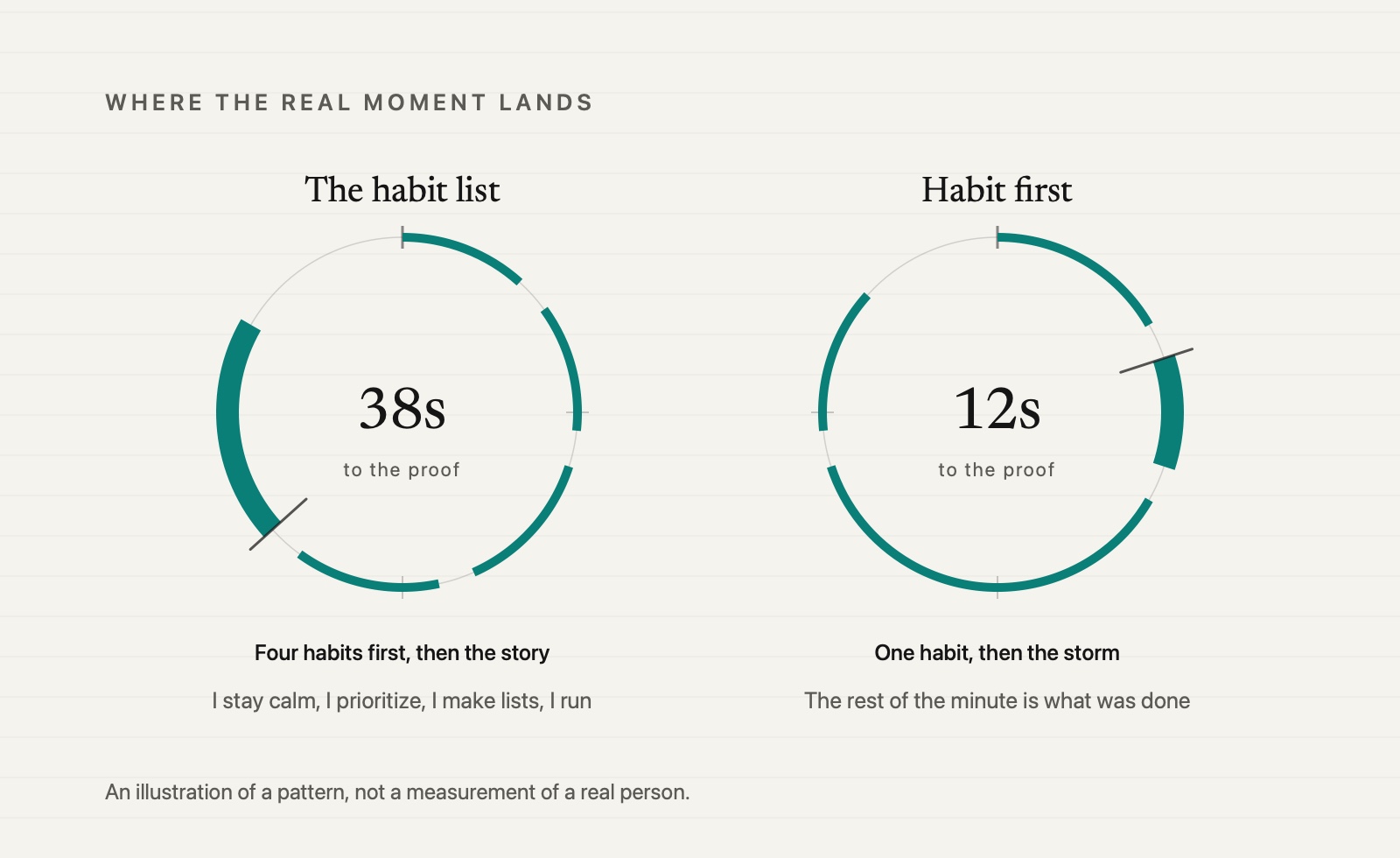
Ask ten people how they handle stress and pressure, and most will start with a list. "I stay calm. I prioritize. I make lists. I go for a run after work." Each item is true. Together they sound like every other candidate's answer, because they are every other candidate's answer.
A list has a second problem when it is spoken. It has no end. Each habit invites another one, so the answer keeps going until the speaker runs out, and then a real example shows up near the end, if it shows up at all. By then the interviewer has heard four claims and no proof.
The fix is to swap the order. Lead with the one habit you most rely on, and spend the rest of the minute showing it in action. One habit with a story beats four habits without one.
How to answer how do you handle stress and pressure in four parts
The answer has four parts, and the order does most of the work.
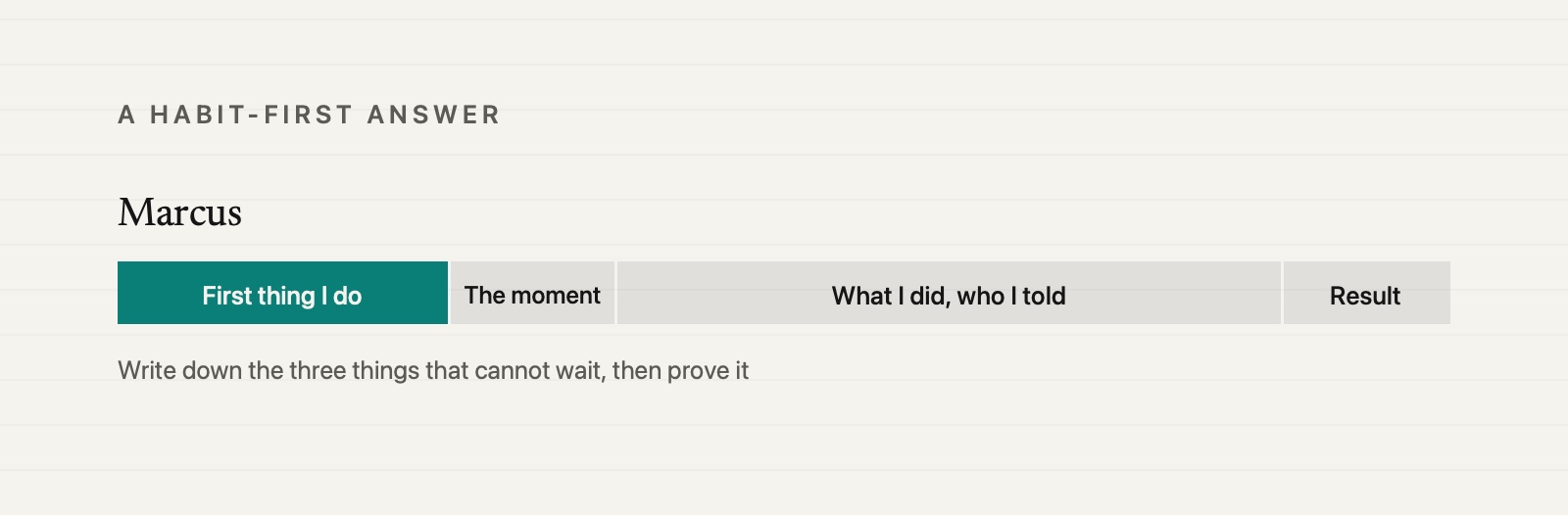
Part one, your habit, in your first sentence. The first thing you actually do when pressure hits. "When things pile up, the first thing I do is write down the three things that cannot wait." It must be an action someone could see, not a feeling.
Part two, the moment, in one sentence. What was happening and why it was hard. One sentence. The pressure itself is background, so it gets the least room.
Part three, what you did, in three or four sentences. This is most of the answer, and it must show the habit from part one. Who you told, what you handled yourself, what you handed off or left for later.
Part four, the result, in one sentence. Something a person could have seen. Then stop.
Here is the example for the rest of this post. Marcus is a dispatcher for a regional delivery company, interviewing for a logistics coordinator role. Asked how he handles stress and pressure, he says:
"When things pile up, the first thing I do is write down the three things that cannot wait, and I work from that list out loud. Last winter a snowstorm closed the highway at noon, with fourteen of our drivers on that road and every phone in the office ringing. My list was the drivers on the closed road, the two customers with same-day orders, and telling the warehouse which trucks would be late. I routed the drivers first, one call each, and asked my coworker to take every call that was not on the list. Then I told the warehouse manager which trucks would be late, before any customer called to ask. Every driver was off that road within the hour, and both same-day orders arrived that evening."
About a minute. The habit is in the first sentence, and the story proves it twice: the list, and the call to the warehouse manager before customers asked. The storm gets one sentence.
Choose a habit you can prove
The habit you lead with matters more than how you phrase it. A good one passes three tests.
It is an action, not a mood. "I stay calm" is a mood, and the interviewer cannot check it. "I write down the three things that cannot wait" is an action. So is "I tell my manager what is at risk before I start fixing it" or "I pick the one task that unblocks the most people and do that first."
It shows up in your story. If your habit is making a list, the story should have a list in it. If your habit is telling people early, the story should name who you told and when. A habit that never appears in the example is just another claim.
It fits the job. A support role rewards a habit about keeping people informed. An analyst role rewards one about checking the numbers before reacting. You likely have more than one real habit, so lead with the one this job needs most.
Then pick the story. You do not need a dramatic crisis. A busy Monday where three people needed you at once will do, as long as you made a clear call in it. If your best pressure story is about one hard deadline and what you cut to meet it, that is a slightly different question with its own shape, and our post on answering the tight deadline question covers it.
Say it was stressful once, then move on
Many people try to sound unbothered. That backfires, because the interviewer knows the moment you are describing was hard. One honest sentence is enough: "It was a lot at once." It makes the rest of the answer believable. Then go straight back to what you did.
The opposite mistake is reliving it. Three sentences about how chaotic the office was, how loud the phones were, how tired you felt. Each one pushes the habit further back. Feelings belong in one short sentence. Actions get the rest.
Out loud, watch the habit sentence itself. It is the sentence most people rush, because it feels like a claim about themselves. Say it at the same pace as the rest, and let it land at the end with your voice coming down. Our post on how to sound confident in an interview covers the small hedges that creep into a sentence like this one.
And if the question makes you nervous in the room, that is normal too. Research by Alison Wood Brooks, described by the American Psychological Association, found that people who said "I am excited" before giving a speech gave longer speeches and were rated as more persuasive, competent and relaxed than people who said "I am calm" (American Psychological Association). You do not have to feel calm to answer this question well. You only have to give the answer in the right order.
When the interviewer pushes
Short follow-ups are common here, and the four-part shape handles them.
"What stresses you out?" Name one real, ordinary thing, then what you do about it. "Too many open requests and no clear order. That is why I make the list." The answer ties back to your habit, which is why the habit came first.
"How do you unwind outside work?" One honest sentence, such as a walk after work or a weekend hobby, and stop.
"What if everything is urgent?" Use your habit again. "Then the list is about what breaks first if I wait, and I check that order with my manager." Asking whose call it is shows judgment, not weakness.
"Can you give me another example?" Have a second story in the same shape, shorter: the moment in one sentence, what you did in two, the result in one.
Try it now: practice in five minutes
You need your phone's voice recorder and a timer.
- Write your habit in one sentence, starting with "When things pile up, the first thing I do is." Make it an action someone could see.
- Write the moment in one sentence, what you did in three, and the result in one. Read it silently. Cross out every sentence about how you felt except one.
- Start the timer and the recorder. Ask yourself out loud, "How do you handle stress and pressure?" Answer from your notes, and count silently to three before you stop the recording.
- Play it back and listen for two things only. How many seconds went by before your habit? Does the story actually show the habit, or just mention it?
- Change one of those and record it again. If you have a minute left, ask yourself "What stresses you out?" and answer in two sentences.
The second take is almost always shorter, and the habit moves to the front.
If the list comes back the moment someone actually asks, even though your habit-first answer is clear on paper, that is a practice problem, not a knowledge problem. A few minutes a day is what fixes it. Sayforth is a 30-day iPhone program built for that: one question a day, answered out loud, drawn as a single answer line after you finish so you can see how far into the answer your point arrived, plus one change to try tomorrow. It is coming soon, and you can see how the daily practice works now.
Be first to know when Sayforth is live.
Get launch updatesFrequently Asked Questions
How do you answer "how do you handle stress and pressure" in an interview?
Say the first thing you actually do when pressure hits, in one sentence. Then give one real moment that shows it: what was happening, what you did and who you told, and how it turned out. Keep it to about a minute.
What is a good example of handling stress at work?
One where you made a clear call under pressure, such as choosing what to do first, handing something off, or telling someone early about a risk, and where you can name the result. It does not need to be a crisis. A busy day with too many requests works if you show what you did about it.
Is it okay to admit you get stressed in an interview answer?
Yes, in one short sentence. Saying you never feel stress is hard to believe, and it skips the part the interviewer cares about, which is what you do next. Admit it plainly, then spend the rest of the answer on your actions.
Should I mention exercise or hobbies when asked how I handle stress?
Only briefly, and not first. Habits outside work are fine to mention in one sentence, but the question is mostly about how you stay useful during the workday. Lead with a habit you use at work and a moment that proves it.