
Here is how to answer "what motivates you" in an interview. Name one thing that drives you, in one plain sentence. Prove it with one real moment when it showed. Close with one sentence that points at this job. Said out loud, that is about twenty-five seconds, and the moment is the part the interviewer remembers.
Most people answer with a list instead. Learning, challenges, helping people, working with a great team. Every item is true and none of them is proved, so the answer sounds like everyone else's. This post is about the spoken answer: what the question is really asking, how to pick the one motivator, what the list sounds like next to a proved answer, the tricky cases like money, and a five-minute exercise to try today.
What the interviewer is really asking
"What motivates you?" sounds like a personality question. It is a fit question. The interviewer wants to know whether you will care about the actual work in this role, on an ordinary Tuesday, after the newness wears off.
Career guides agree on the shape of a good answer. The Muse's advice is to pick a single motivation that fits the position, be honest about it, and support it with a short story, which does not need a dramatic result (The Muse). A guide reposted by St. Mary's University's career center adds that employers use the answer to see whether your motivation matches the role's duties, and warns against saying what you think the interviewer wants to hear (St. Mary's University career center).
Put those together and the question has two quieter parts. Is the thing that drives you present in this job? And is it real, or did you pick it from a list on the way in? A motivator with no moment behind it cannot answer the second part.
How to answer what motivates you in three sentences
The whole answer is three short sentences. Each one has a single job.
Sentence one names the motivator. Plain words, no warm-up, and specific enough that it sounds like you. "What motivates me is taking a messy process and making it simple enough to hand to someone else." Not "I'm motivated by a lot of things," and not a single abstract word like "growth."
Sentence two is the moment. One real time, from the last couple of years, when that motivator showed in what you actually did. Keep the setup to a few words and spend the rest on what you did and how it ended.
Sentence three points at this job. One line, not a speech. Name the part of the role where you would feel the same pull.
Here is the example for the rest of this post. Dana is interviewing for an operations analyst role. Asked what motivates her, her whole answer is:
"What motivates me is taking a messy process and making it simple enough to hand to someone else. Last year our refund process ran through eleven steps in three different tools, so I mapped it, cut it to four, and wrote a one-page guide that new hires now use in their first week. Your posting mentions cleaning up onboarding, and that is the work I would want to start on."
Three sentences, then silence. There is no list in it and no adjective doing the work. The motivator is specific, the moment proves it, and the last line tells the interviewer where it would show up on their team. The same pattern works for the strength question, and our post on how to answer "what is your greatest strength" walks through that version.
How to pick the one motivator
Most people have several honest answers to this question, which is exactly why the list happens. The fix is to choose before the interview, not while you are talking.
Write down four or five things that have kept you going at work or school. Then test each one with two questions.
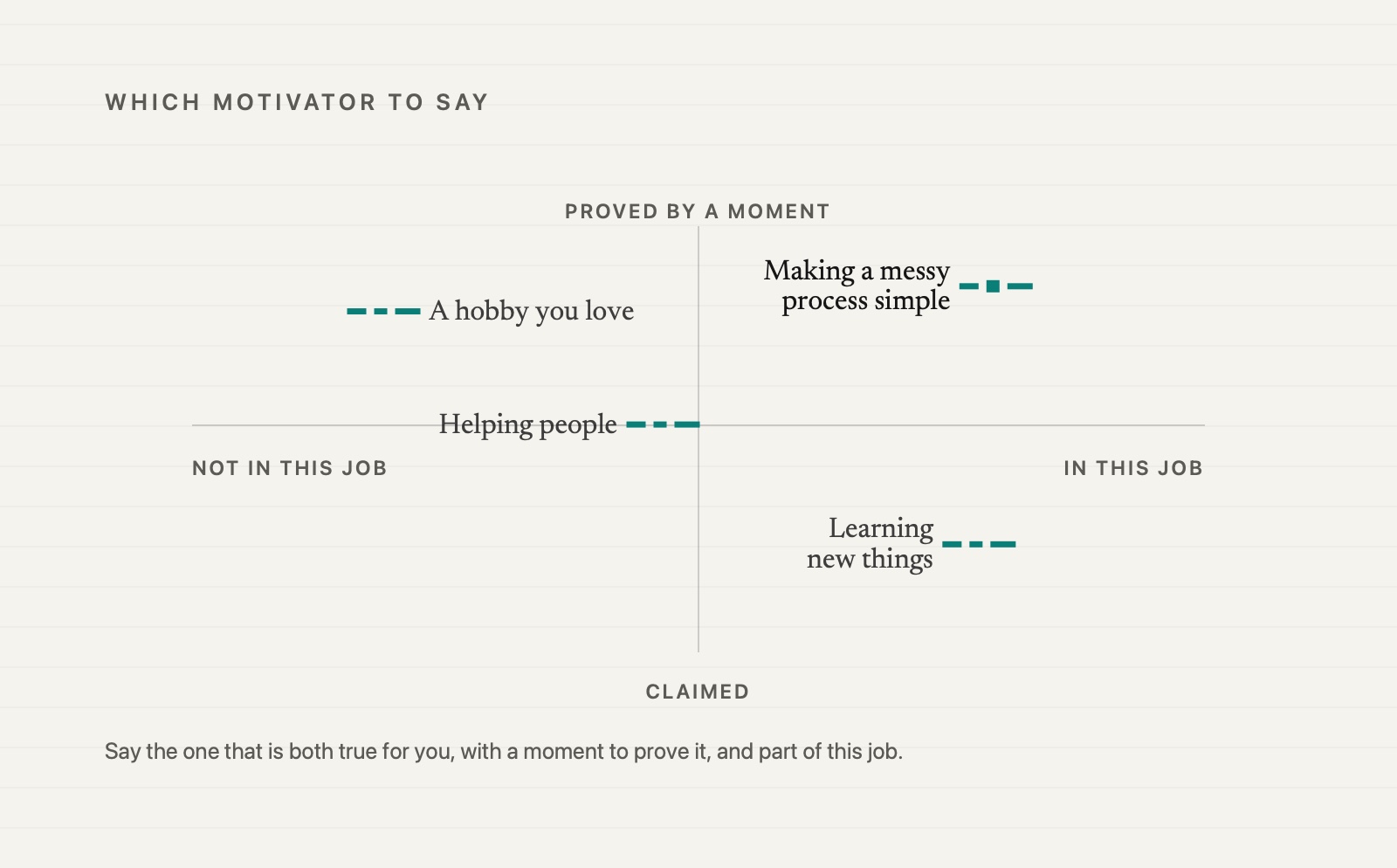
Is it true for you? Can you name a specific moment, with a place and a week, when it actually drove what you did? If you cannot, it is a motivator you admire, not one you have. Cross it out.
Is it in this job? Read the posting again. Does this role contain that kind of work, often enough to matter? A real motivator that the job never touches leaves the interviewer wondering whether you will be bored by spring.
The motivator you want sits where both answers are yes. "Helping people" is often true but too broad to point at a job. "Learning new things" is in almost every posting but rarely comes with a moment. A hobby you love may come with a great moment, but if the job never touches it, it answers a different question. "Making a messy process simple enough to hand off" was true for Dana, came with the refund story, and showed up in the posting's line about onboarding. That is the one she says first.
What a list of motivators sounds like
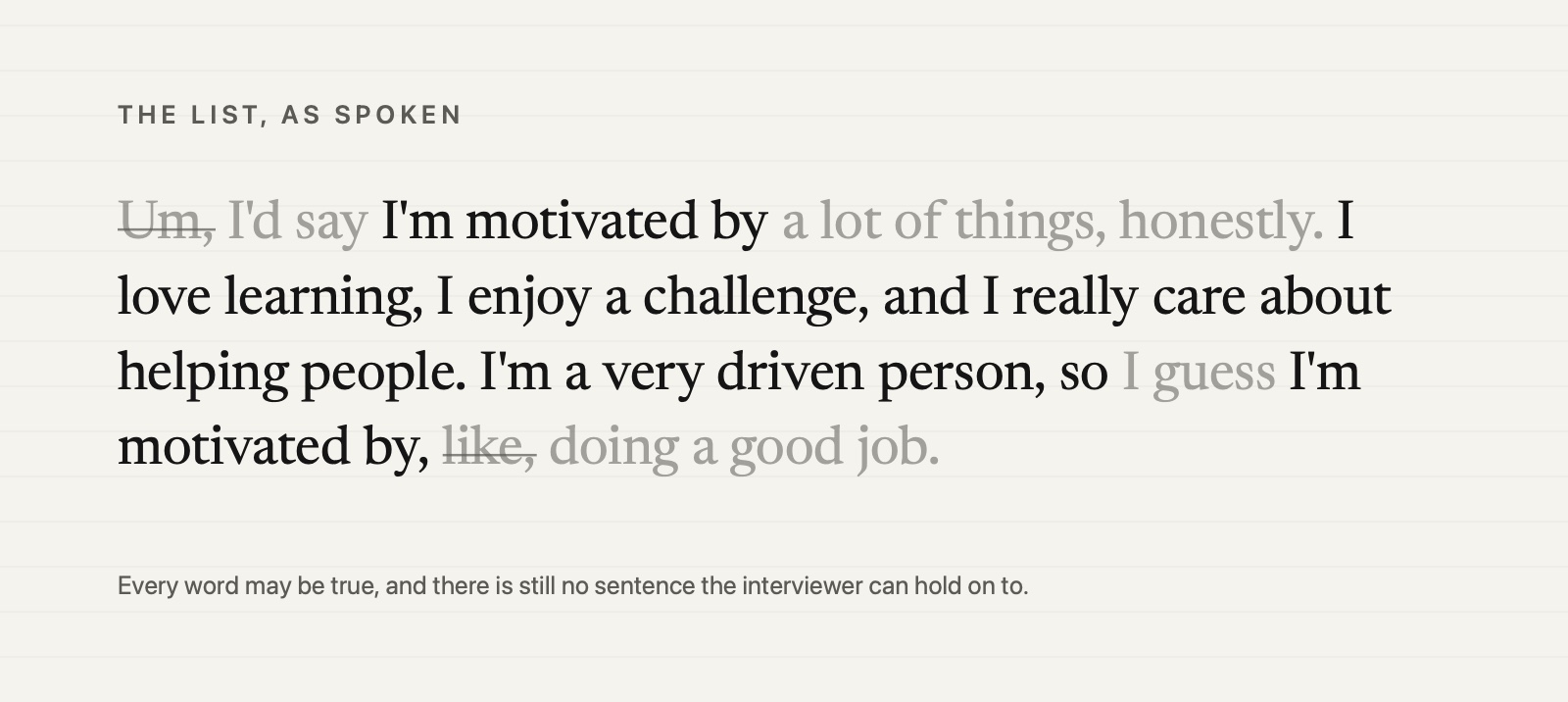
Here is the answer most people give. "Um, I'd say I'm motivated by a lot of things, honestly. I love learning, I enjoy a challenge, and I really care about helping people. I'm a very driven person, so I guess I'm motivated by, like, doing a good job."
Every word of that may be true. Out loud, though, it has three problems. The first sentence is a hedge, so the interviewer waits through it for the real answer. The middle is a list, so nothing in it can be remembered. And the end circles back to "doing a good job," which describes nearly every candidate the interviewer will see that week.
The proved answer has the same honest feeling behind it. It simply chooses one item, attaches a moment, and drops the warm-up. Listen for the moment where your answer actually starts. In the list version, it never quite does. In Dana's version, it starts on the first word.
Money, mission, and the tricky answers
Some honest answers feel risky to say out loud. Here is how to handle the common ones.
Money. Pay matters to everyone, and pretending otherwise sounds strange. But both guides above suggest that pay alone is a weak answer to this question, because it says nothing about the work itself. If money is genuinely part of it, put it inside a work motivator: "I like work where the results are visible and measurable, including in what I earn." Then go straight to the moment.
The company's mission. This can be a strong answer, but only with proof that predates the interview. "I believe in your mission" with no moment behind it sounds like it was read off the About page. "I spent two years volunteering on exactly this problem" is a moment.
Pressure and deadlines. "I work best under pressure" can sound like "I wait until the last minute." If deadlines really drive you, describe what you do with them: "I like a clear finish line. On the vendor switch, I set the date first and planned backward from it."
You are early in your career. Moments from school, a group project, a part-time job, or volunteer work all count. The moment needs to be real and specific, not impressive.
Say it out loud: where the pauses go
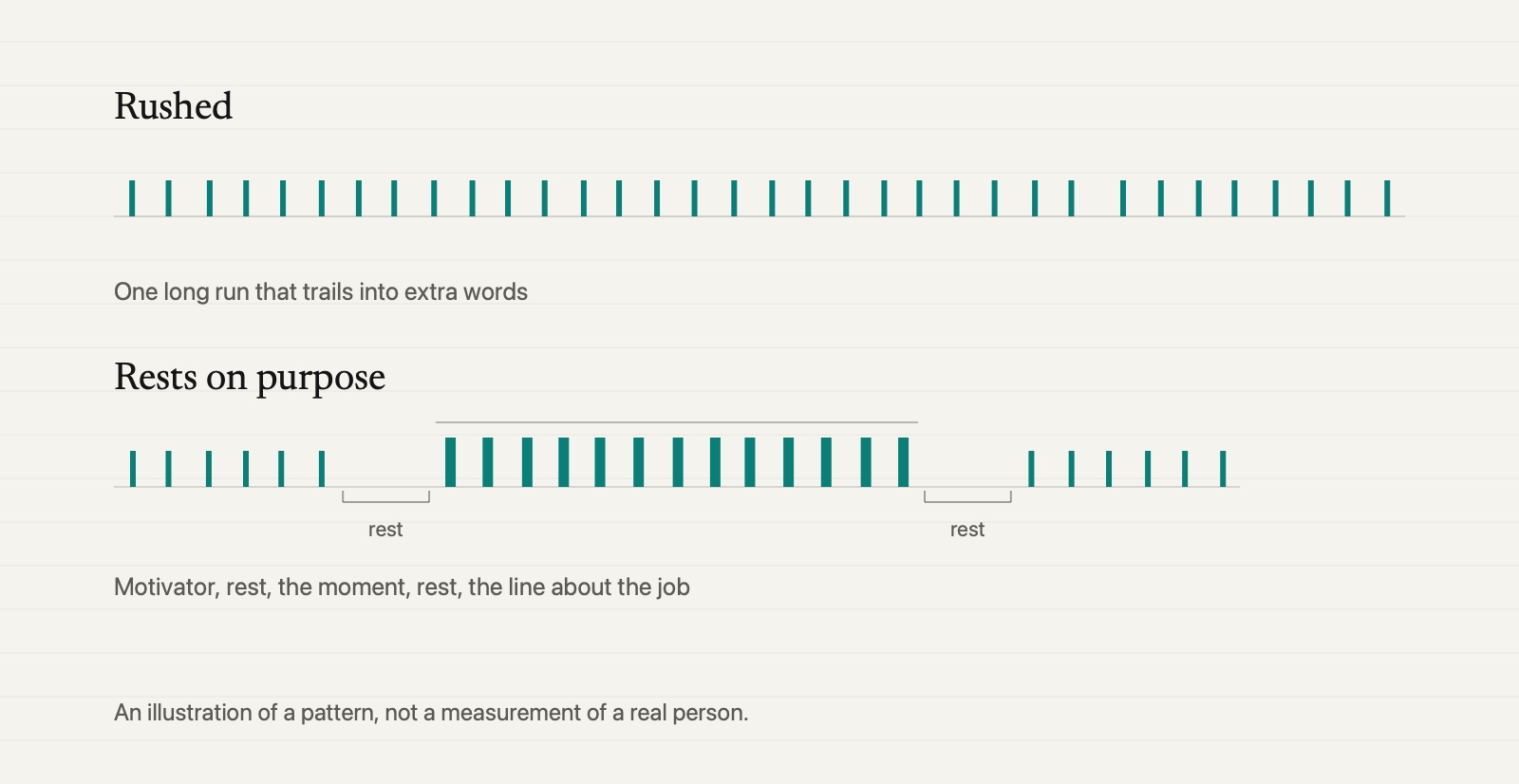
A good answer can still be lost in the delivery. The most common version is speed. People rush the motivator sentence because it feels exposed, then rush the moment because it feels like bragging, and then keep talking because the silence at the end feels too long.
Give each sentence its own space. Say the motivator, then rest for about a breath. Tell the moment at an ordinary pace, then rest again. Say the line about the job, then stop. Those two short rests do most of the work. They let the interviewer hear that the motivator is a choice, and they make the stop at the end sound settled instead of abrupt.
How long the whole thing should run is a fair question. Our post on how long an interview answer should be covers the timing in detail. For this question, under a minute is plenty, and around half a minute is usually better.
When the interviewer asks for more
Often the first answer is the whole exchange. When there is a follow-up, the same rule applies: one thing, one moment, then stop.
"Anything else?" Give your second motivator in two sentences, the motivator and its moment. Do not go back to the list.
"What demotivates you?" Answer it as a new question. Name one condition that slows you down, then say what you do about it. "Unclear ownership. When I see it, I ask who owns the decision before I start the work."
"How does that fit this role?" You already answered this in sentence three, so expand on it. Name one specific task from the posting and say what you would do first.
Try it now: a five-minute exercise
You need your phone's voice recorder and a timer.
- Write four or five motivators on paper. Cross out any that have no moment behind them, and any the job never touches.
- For the one that survives, write the three sentences: the motivator, the moment, the line about this job.
- Start the recorder. Ask yourself out loud, "What motivates you?" Answer with your three sentences, resting for a breath after the first and after the second. Count silently to three before you stop the recording.
- Play it back and listen for two things only. Did a list or a hedge come before the motivator? Did the moment come out faster than the rest?
- Change one of those and record it again.
The second take is almost always shorter and clearer, because you stop warming up and start on the answer.
If you can write the three sentences but the list comes back the moment someone actually asks, that is a practice problem, not a knowledge problem. Sayforth is a 30-day iPhone program built for exactly that: one spoken answer a day, drawn as a single answer line after you finish so you can see where your main point landed, with one change to carry into tomorrow. It is coming soon, and you can see how the daily practice works now.
Be first to know when Sayforth is live.
Get launch updatesFrequently Asked Questions
What is a good answer to "what motivates you" in an interview?
One specific motivator that is true for you and present in the job, proved with one real moment. For example: "What motivates me is making a messy process simple enough to hand to someone else," followed by the time you did it and one line tying it to the role.
How long should my answer be?
About twenty to forty seconds: one sentence for the motivator, one or two for the moment, and one for the job, then a stop. If the interviewer wants more, they will ask.
Can I say money motivates me?
You can be honest that pay matters, but money alone is a weak answer because it says nothing about the work. Put it inside a motivator about the work itself, then give the moment that proves it.
Should I name more than one motivator?
Lead with one. A single motivator with a real moment is easier to remember than three without one. Save a second motivator for the follow-up if the interviewer asks for more.