
Here is how to answer "tell me about a goal you set and achieved." Say the result in your first sentence. Give the goal and why you set it in one sentence. Spend most of the answer on the two decisions that got you there. End with one sentence on what you still do because of it. Aim for about a minute, then stop.
The trouble with this question is not finding a goal. Most people have one. The trouble is that the goal is easy to describe and the achieving is a blur, so the answer spends forty seconds on the setup and squeezes the actual work into one rushed clause at the end. This post builds one example answer, shows how to find the two decisions worth naming, and ends with a five-minute exercise you can do today.
What the interviewer is really listening for
This question comes in many versions. The behavioral interview question list from UMass Amherst Human Resources groups several of them under goal setting, including "Can you talk about a career goal you made?" with the follow-ups "Did you reach it? What obstacles did you encounter?" (UMass Amherst Human Resources). Whichever wording you hear, the interviewer is checking the same three things.
Did you pick a goal that was specific enough to know when you hit it? Did you do something on purpose to get there, beyond working hard? And did it work?
Notice what is not on that list. How long the goal took. How many setbacks there were. How proud you felt. Those parts are easy to remember, so they are the parts most people say first. They are not what the question is asking.
Why the goal eats the answer
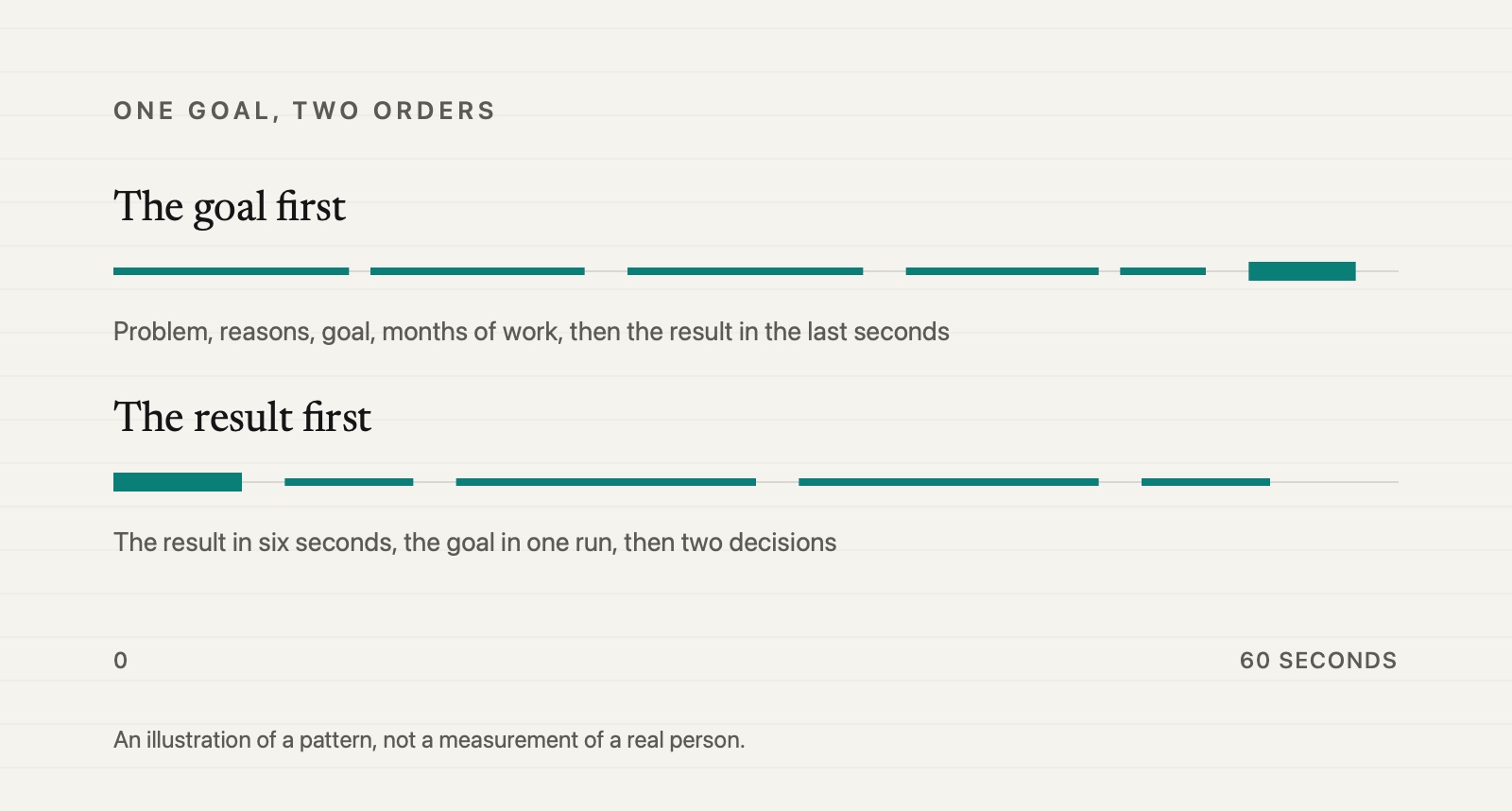
A goal story has a natural order. First the problem, then why it mattered, then the goal you set, then the months of work, then the result. Each step is true. Said in that order, the setup takes most of the minute, because the setup is the part you can describe clearly. The months of work are harder to put into words, so they shrink to "and so I worked on it and we got there."
That is backward. The interviewer can guess the setup. What they cannot guess is what you decided to do, and that is the part that tells them how you would work for them.
There is a simple fix. Say the result first. Once the interviewer knows you got there, the goal needs only one sentence of context, and every sentence after it can go to how.
How to answer tell me about a goal you set and achieved in four parts
The answer has four parts. The order does most of the work. Here is one example, built around a goal many people have had in some form: getting replies out faster.
Part one, the result, in your first sentence. "By the end of the quarter, every customer email got a reply within one working day, down from about three." This is the sentence an interviewer is most likely to remember, so it goes where it cannot get lost.
Part two, the goal and why, in one sentence. "I set that goal myself in January, because slow replies were the most common complaint we got." One sentence. If someone else handed you the target, say so, and say what you added to it.
Part three, the two decisions, in three or four sentences. "The first thing I did was track the oldest unanswered email every morning, so I always knew how far behind we were. The second was to stop answering in the order emails arrived and clear the quick ones in the first hour, which freed the afternoon for the hard ones." This is most of the answer. Use "I" for the calls you made and "we" for work the team did.
Part four, what you still do, in one sentence. "I still check the oldest unanswered message before anything else each morning." This closes the story and shows the habit outlasted the goal.
That is about a minute out loud. If you want to check how long an answer like this should run, our post on how long an interview answer should be covers the timing.
Pick a goal you chose, not one you were handed
The question says "a goal you set," and that word matters. A sales quota your manager gave you, or a deadline a client set, is a different story. If that is the only story you have, it can still work, but say what part of it you chose: the way you broke it down, a stretch target you added, the order you tackled it in. Our post on answering "tell me about a time you met a tight deadline" covers stories where someone else set the clock.
Pick a goal with a clear finish line. Research on goal setting backs this up. In their review of 35 years of studies, Edwin Locke and Gary Latham report that specific, difficult goals consistently led to higher performance than urging people to "do their best" (Locke and Latham, American Psychologist, 2002). In an interview, a specific goal also does a second job. "Replies within one working day" lets the interviewer picture the finish line. "Improve customer service" does not.
Size matters less than people think. A goal from a part-time job, a class, or a side project works if it has a clear finish line and you made real decisions along the way. A personal goal can work too, as long as the decisions you describe are the kind the job would use.
Find the two decisions
This is the part most people skip, because it takes a few minutes of thinking before the interview. It is also the part that makes the answer worth hearing.
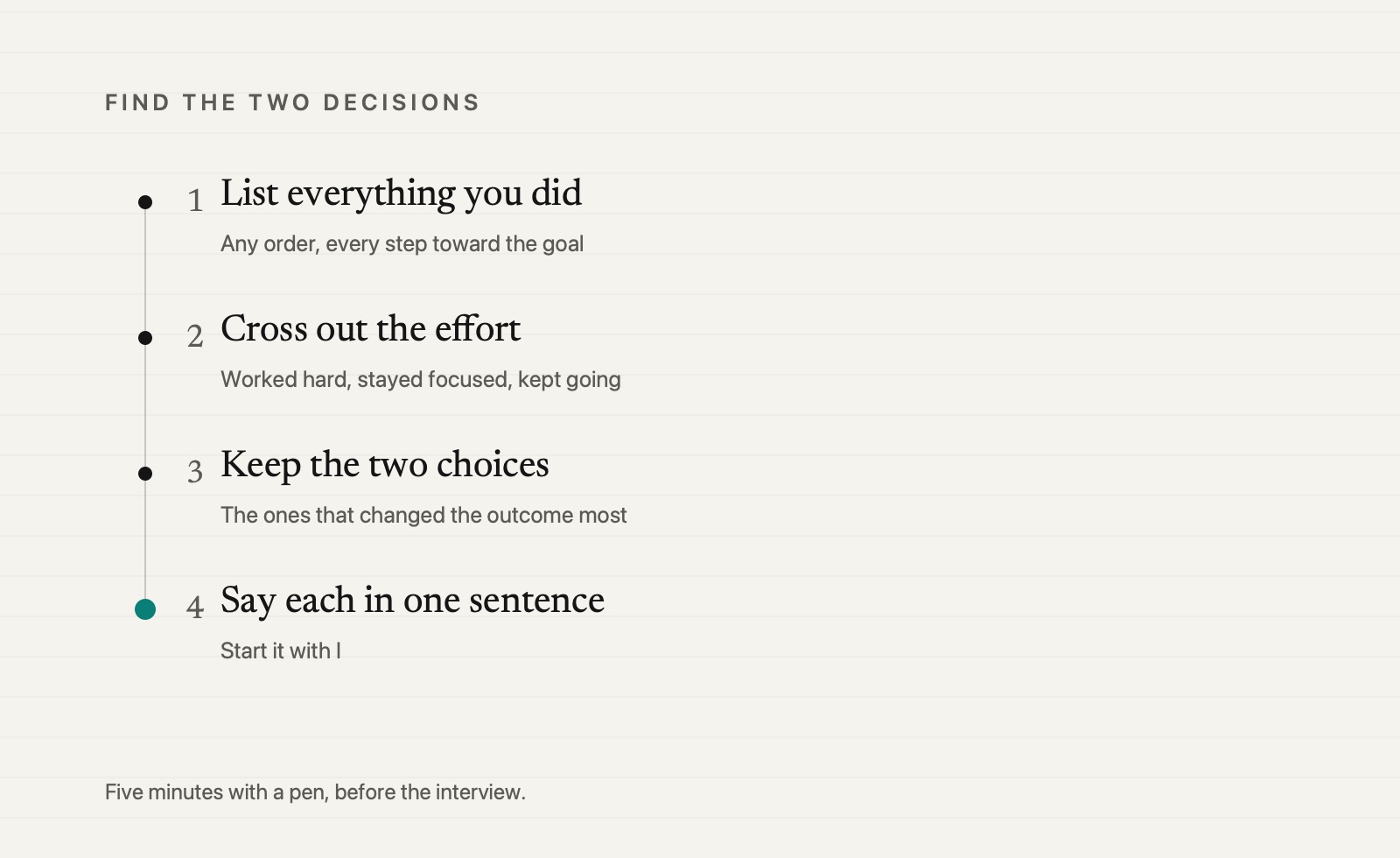
Start by listing everything you did toward the goal, in any order. Most of the list will be effort: you worked on it, you stayed focused, you kept going. Cross those out. Effort is real, but it does not tell the interviewer anything about how you think.
What is left are choices. You decided to measure something. You changed an order. You asked someone for help early. You dropped something to make room. Pick the two that changed the outcome most, and write each one as one plain sentence that starts with "I."
Why two? One decision can sound like luck. Three or more turns into a list, and lists are hard to follow by ear. Two gives the interviewer a clear picture of how you work and leaves room for a follow-up.
If one of your decisions was about tracking progress, keep it. Locke and Latham found that goals combined with feedback on progress work better than goals alone, because people who do not know how they are doing cannot adjust their effort or their approach (Locke and Latham, 2002). "I checked the oldest unanswered email every morning" is exactly that kind of decision, and it is easy to say.
Say the result in one breath
The first sentence carries the most weight, so it is worth saying well. Two things tend to go wrong.
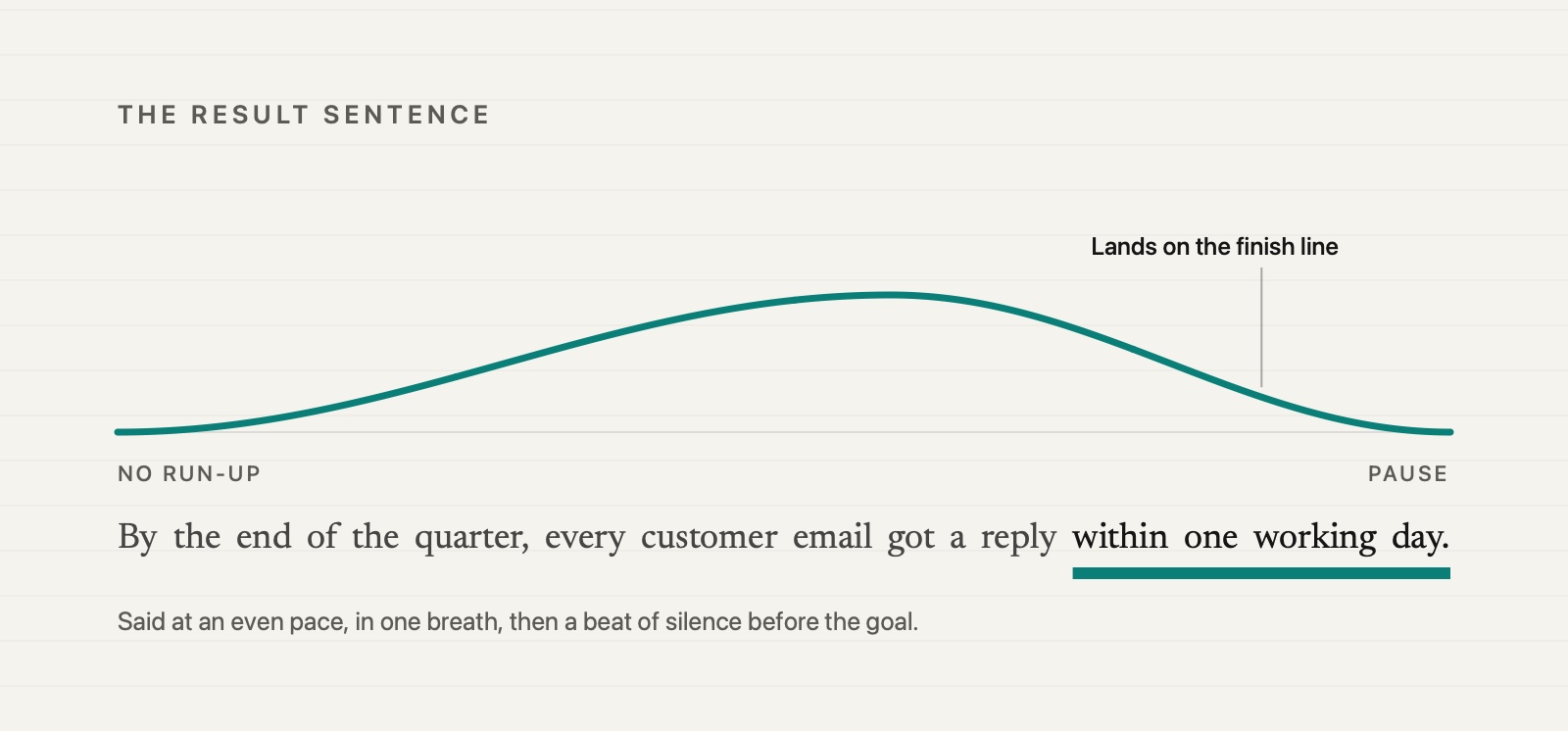
The first is a run-up. "So, I guess one goal that comes to mind would probably be..." spends five seconds before anything happens. Start with the result itself. "By the end of the quarter, every customer email got a reply within one working day."
The second is rushing the number. People often speed up on the part they are proudest of, as if it might sound like bragging. Say the result at the same pace as any other sentence, in one breath, and let it land on the specific part: the number, the date, the finish line. Then pause for a beat before the goal sentence. That small pause tells the listener the main point has been said.
When the interviewer asks for more
Short follow-ups are common with this question, and the four-part shape handles them.
"Did you hit any obstacles?" Name one, in one sentence, and say what you did about it. "Two weeks in, a product launch tripled the volume, so I asked to borrow one person from sales for the first hour of each day." Then stop.
"What would you do differently?" One change, in one sentence. "I would have started tracking on day one instead of week three."
"Tell me about a goal you did not reach." Most people have one. Say what the goal was, how close you got, and what you changed afterward. A plain account of a miss often lands better than a story where everything went to plan.
"What is a goal you are working on now?" Use the same shape in the present tense: the goal in one sentence, why you set it, and the first decision you have already made.
Try it now: practice in five minutes
You need your phone's voice recorder and a timer.
- Write your result in one sentence, with a number, a date, or a clear finish line in it. Then write the goal and why you set it in one more sentence.
- List everything you did toward the goal. Cross out the effort. Circle the two choices that changed the outcome and write each as one sentence that starts with "I."
- Write one closing sentence about what you still do because of it.
- Start the timer and the recorder. Ask yourself out loud, "Tell me about a goal you set and achieved." Answer from your notes. Count silently to three before you stop the recording.
- Play it back and listen for two things only. How many seconds went by before the result? Did the two decisions get more time than the setup?
Change one of those and record it again. The second take is often shorter, and the decisions get more of the minute.
If your result sentence is clear on paper but the long setup comes back the moment someone actually asks, that is a practice problem, not a knowledge problem, and a few minutes a day is what helps. Sayforth is a 30-day iPhone program built for that: one question a day, answered out loud, then drawn as a single answer line after you finish, so you can see how far in your main point arrived, plus one change to try tomorrow. It is coming soon, and you can see how the daily practice works now.
Be first to know when Sayforth is live.
Get launch updatesFrequently Asked Questions
How do you answer "tell me about a goal you set and achieved"?
Say the result in your first sentence, with a number or a clear finish line. Give the goal and why you set it in one sentence, then spend most of the answer on the two decisions that got you there. Close with one sentence on what you still do because of it.
What is a good example of a goal you set and achieved?
One with a clear finish line that you chose yourself, such as cutting a reply time, finishing a certification, or getting a project live by a date you set. The best examples include a decision you made along the way, not just hard work.
Can I use a personal goal in a job interview?
Yes, if the decisions you made to reach it are the kind the job would use, such as planning, tracking progress, or asking for help early. Keep the personal context to one sentence and spend the rest on what you did.
How long should the answer be?
About a minute. One sentence for the result, one for the goal, three or four for the two decisions, and one to close. If the interviewer wants more detail, they will ask a follow-up.