
Here is how to answer "tell me about a time you dealt with a difficult customer." Say your first move in your first sentence: the thing you did that turned the conversation. Give the customer's problem in one fair sentence. Spend most of the answer on what you did next, then end with one sentence on how it turned out. Aim for about a minute.
Almost everyone who has worked with the public has a story for this. The trouble is that the most memorable part of the story is the customer, not you. So the answer comes out as a retelling of the complaint, and your part shows up in the last few seconds. This post builds one example answer, shows why the retelling happens, and ends with a five-minute exercise you can do today.
What the interviewer is really listening for
The question sounds like it is about the customer. It is about you. The University of Utah's human resources office lists customer questions like this under "Customer Focused" in its bank of behavioral interview questions, next to variants such as a time you went the extra mile to meet a customer's needs, or a time you had to stay quiet with a hostile customer (University of Utah Human Resources). Each version asks the same thing in the end: how did you handle it, and what was the result?
The Occupational Information Network, a job database sponsored by the U.S. Department of Labor, describes the work from the other side. Its profile of customer service representatives lists active listening as an essential skill: giving full attention to what people are saying, taking time to understand them, and asking questions. In the same profile, 42 percent of the workers who responded said they deal with unpleasant, angry or discourteous people every day (Occupational Information Network).
So the interviewer is listening for three things. Did you stay steady? Did you find out what the customer actually needed? And did you do something that fixed it, or at least moved it forward?
Notice what is not on that list. Exactly what the customer said. How loud they got. How unfair it felt. Those are the parts you remember best, which is why they take over the answer.
Why the answer turns into the customer's story
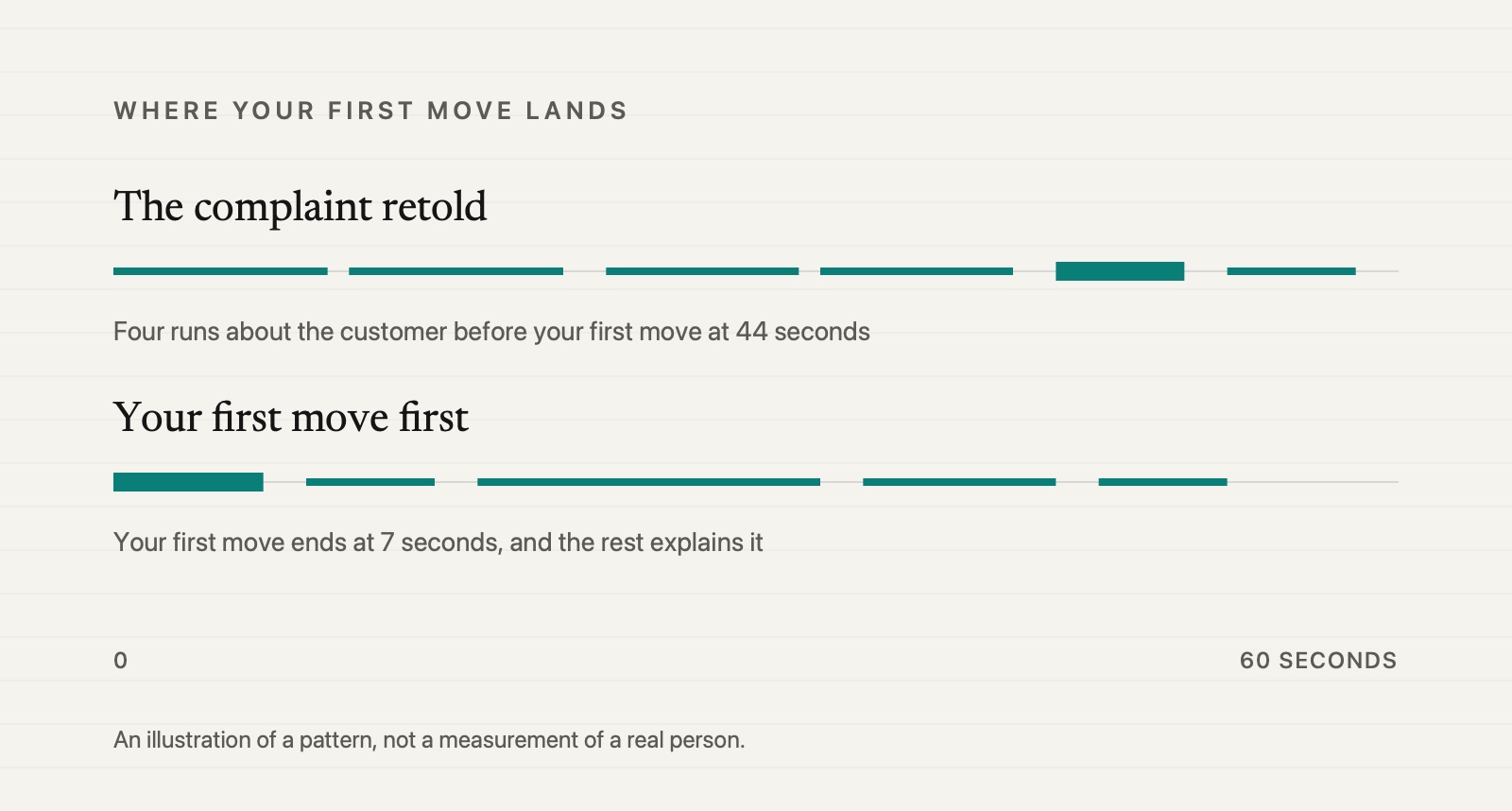
A difficult customer is vivid. You remember their words, their tone, maybe the line forming behind them. When someone asks about that moment, your memory hands you all of it, in the order it happened. First what they bought, then what went wrong, then what they said, then what they said next. By the time you get to what you did, most of the minute is gone.
There is a quieter reason, too. Retelling the complaint feels like proof that the situation really was hard. People add detail to show they are not exaggerating. But the interviewer already believes you. They asked for a difficult customer, so they expect one. Every extra sentence about the customer is a sentence not spent on you.
The result is an answer where you are a supporting character in your own story.
How to answer tell me about a time you dealt with a difficult customer in four parts
The answer has four parts. The order matters more than the wording.
Part one, your first move, in your first sentence. "The first thing I did was stop explaining our policy and ask what he needed by the next morning." This is the sentence the interviewer will write down, so it goes where it cannot get lost.
Part two, the problem, in one sentence. What went wrong for the customer, said fairly. One sentence. Not their exact words, not the volume.
Part three, what you did next, in three or four sentences. This is most of the answer. What you found out, who you called, what you offered, and what you could not offer. Use "I" for what you did.
Part four, the outcome, in one sentence. Something a person could have seen. If it changed how you work, that can be a short second sentence. Then stop.
Here is the example for the rest of this post. Dana worked the returns desk at a home improvement store and is now interviewing for a customer success role. Asked to tell about a time she dealt with a difficult customer, she says:
"The first thing I did was stop explaining our return policy and ask him what he needed by the next morning. He was a contractor whose special-order countertop had arrived cracked for the second time, and his install crew was booked for eight the next day. Once I asked, it turned out he did not need the countertop tomorrow. He needed a date he could trust so he could move his crew. I called our supplier while he waited, got a confirmed delivery for Thursday, and wrote the date and my name on his receipt. He moved his crew to Thursday, and the next time he placed an order he asked for me. Since then I ask what someone needs, and by when, before I explain anything."
That runs about a minute, and her first move is in the first seven seconds. The cracked countertop gets one sentence. What he shouted at the counter is not in it at all, because it was not the point.
Describe the customer fairly, in one sentence
The sentence about the customer is where many answers go wrong in a different way. It is tempting to make the customer sound unreasonable, because then anything you did sounds good. Interviewers notice. A candidate who describes a customer with contempt sounds like someone who will describe the next customer that way too.
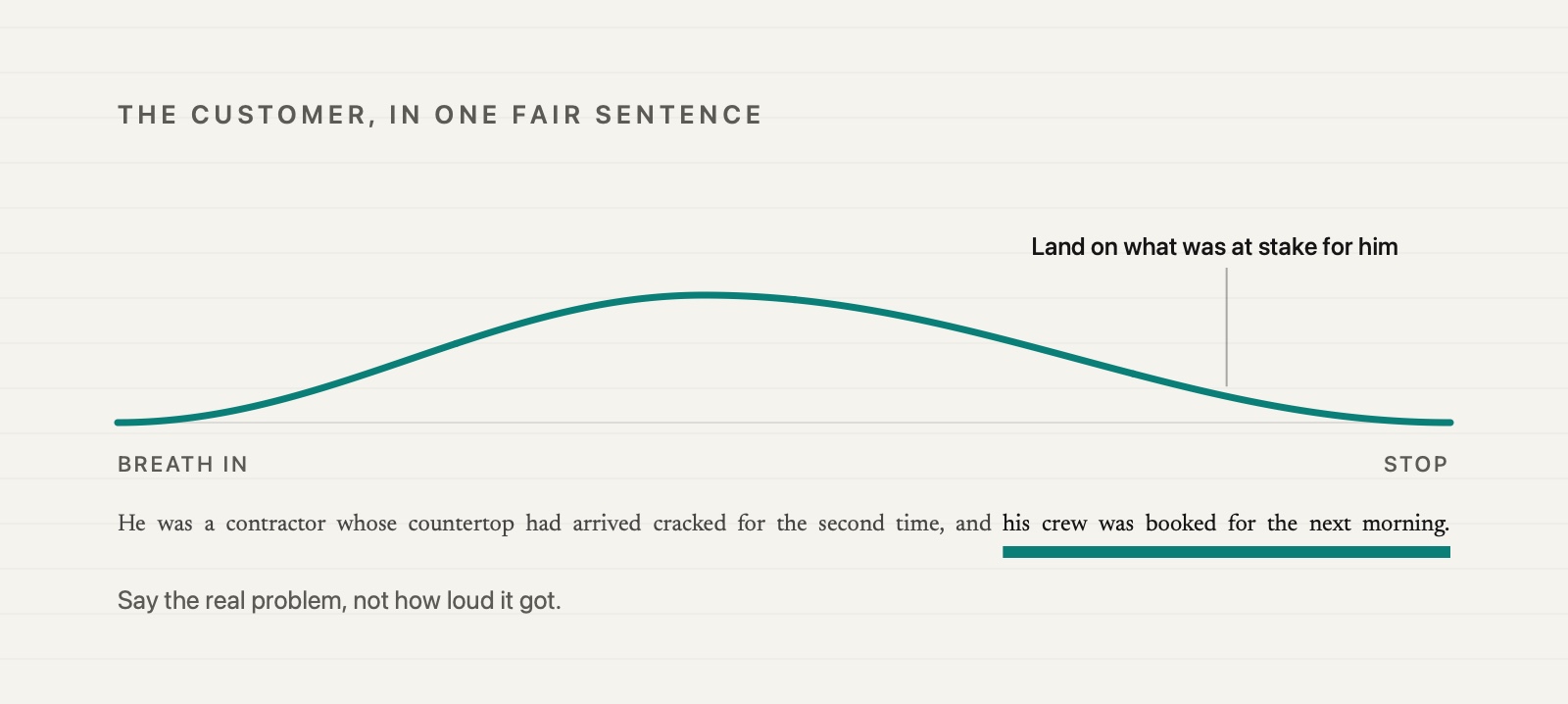
Most difficult customers have a real problem underneath the way they are acting. Say that problem, plainly, in one breath. "He was a contractor whose countertop had arrived cracked for the second time, and his crew was booked for the next morning." That sentence does three jobs. It shows the problem was real, it shows you understood why it mattered to him, and it sets up your first move.
Notice where the sentence lands. It ends on the part that made the situation urgent for the customer, not on how he behaved. If you say only one thing about the customer, make it the thing he needed.
Pick a story where you did something
The story you choose matters more than how you tell it. A good difficult-customer story is not the one with the angriest customer. It is the one where you made the clearest move.
Pick a story with a turn in it. Some moment where the conversation changed because of something you did: a question you asked, a call you made, a thing you offered. "I stayed calm and let him vent" can be part of the answer, but on its own it is not a move. What did you do once he finished?
Difficult does not have to mean angry. A customer who called five times about the same order, or who did not understand the product and kept asking, or who wanted something your store did not sell, all count. These stories are often easier to tell well, because the problem is easier to say fairly.
Pick a story with an outcome you can name. The order arrived, the account stayed open, the customer came back. If the customer left unhappy, that can still work, as long as you say what you did and what you would do differently. It is a harder answer, and it needs a plain, short ending rather than a long defense.
When the interviewer pushes
Short follow-ups are common with this question, and the four-part shape handles them.
"What if the customer was wrong?" Say what was true in their complaint, then what you could and could not do. "He was right that it was late. I could not get him a new countertop by morning, but I could get him a date he could plan around." One or two sentences.
"What if you could not fix it?" Say what you did instead, then who you handed it to and how. "I could not approve that refund, so I wrote up the case and walked it to my manager while he waited." Handing something off well is still a move.
"How did you keep your cool?" One honest sentence, then back to the action. "I was frustrated too, so I asked a question instead of answering him, which gave both of us a second." Do not relive the conversation.
"Can you give me another example?" Have a second story ready in the same shape, but shorter: first move in one sentence, the problem in one, what you did in two. If you are unsure how long each should run, our post on how long an interview answer should be covers the timing.
Try it now: a five-minute practice round
You need your phone's voice recorder and a timer.
- Write your first move in one sentence, starting with "The first thing I did was." Then write the customer's problem in one fair sentence that ends on what was at stake for them.
- Write three sentences on what you did next and one on the outcome. Read it silently and cross out any sentence that quotes the customer.
- Start the timer and the recorder. Ask yourself out loud, "Tell me about a time you dealt with a difficult customer." Answer from your notes. Count silently to three before you stop.
- Play it back and listen for two things only. How many seconds went by before your first move? Did the sentence about the customer come out longer, or faster, than the rest?
- Change one of those and record it again. If you have a minute left, ask yourself, "What if you could not fix it?", and answer in one or two sentences.
The second take is usually shorter, and your part moves to the front. For a routine that runs this across several questions, see our post on how to practice for an interview alone.
If your first move is clear on paper but the whole complaint comes back the moment someone asks, that is a practice problem, not a memory problem, and a few minutes a day is what helps. Sayforth is a 30-day iPhone program built for that: one question a day answered out loud, then your answer drawn as a single speaking line after you finish, so you can see how far in your main point arrived, plus one change to try tomorrow. It is coming soon, and you can see how the daily practice works now.
Be first to know when Sayforth is live.
Get launch updatesFrequently Asked Questions
How do you answer "tell me about a time you dealt with a difficult customer"?
Say your first move in your first sentence, the thing you did that turned the conversation. Give the customer's problem in one fair sentence, spend three or four sentences on what you did next, and end with one sentence on the outcome. About a minute, then stop.
What if I have never worked in customer service?
Use anyone you served or helped as part of your work: a client, a patient, a student's parent, a user who filed a ticket, or another team that depended on you. The shape is the same. Say what you did first, the problem in one sentence, and how it turned out.
Should I use the STAR method for this question?
The parts of STAR are all there, but the order changes. Lead with your action, the first move, and keep the situation to one sentence. The interviewer hears what you did before the background instead of after it.
What if the customer stayed unhappy?
Then say so plainly. Name what you did, what you could not do, and how you handed it on if someone else had to step in. End with one sentence on what you would do differently, and leave it there instead of defending the outcome.