
Here is how to answer "tell me about a time you had to persuade someone." In your first sentence, say who you persuaded, what you wanted them to agree to, and what finally changed their mind. Give their reason for saying no fairly, in one sentence. Spend most of the answer on what you did. End with how it turned out. Aim for about a minute.
That order sounds backward, because the story did not happen that way. Told in the order it happened, though, the answer saves its best part for last. This post shows how to flip it, builds one example answer, and ends with a five-minute exercise you can do today.
What "tell me about a time you had to persuade someone" is really asking
Interviewers ask this in a few forms: "tell me about a time you had to persuade someone," "describe a time you convinced someone to see things your way," or "tell me about a time you influenced a decision." They all ask the same thing. How do you change a mind when you cannot simply tell someone what to do?
That matters because most work runs on agreement, not orders. In a well-known Harvard Business Review article, Jay Conger argues that persuasion at work is less about selling an idea and more about learning from the other person and working out a shared answer with them (Harvard Business Review, The Necessary Art of Persuasion). That is close to what the interviewer is listening for.
So the question is not "were you right?" It is three smaller questions. Did you understand why the other person said no? Did you change anything because of what you heard? And did you get to a yes without damaging the relationship?
This is a behavioral question, so career guides point you to the STAR method: situation, task, action, result (Dartmouth Guarini Career Design). The shape below fits inside STAR. It changes what you say first.
Why persuasion stories bury the point
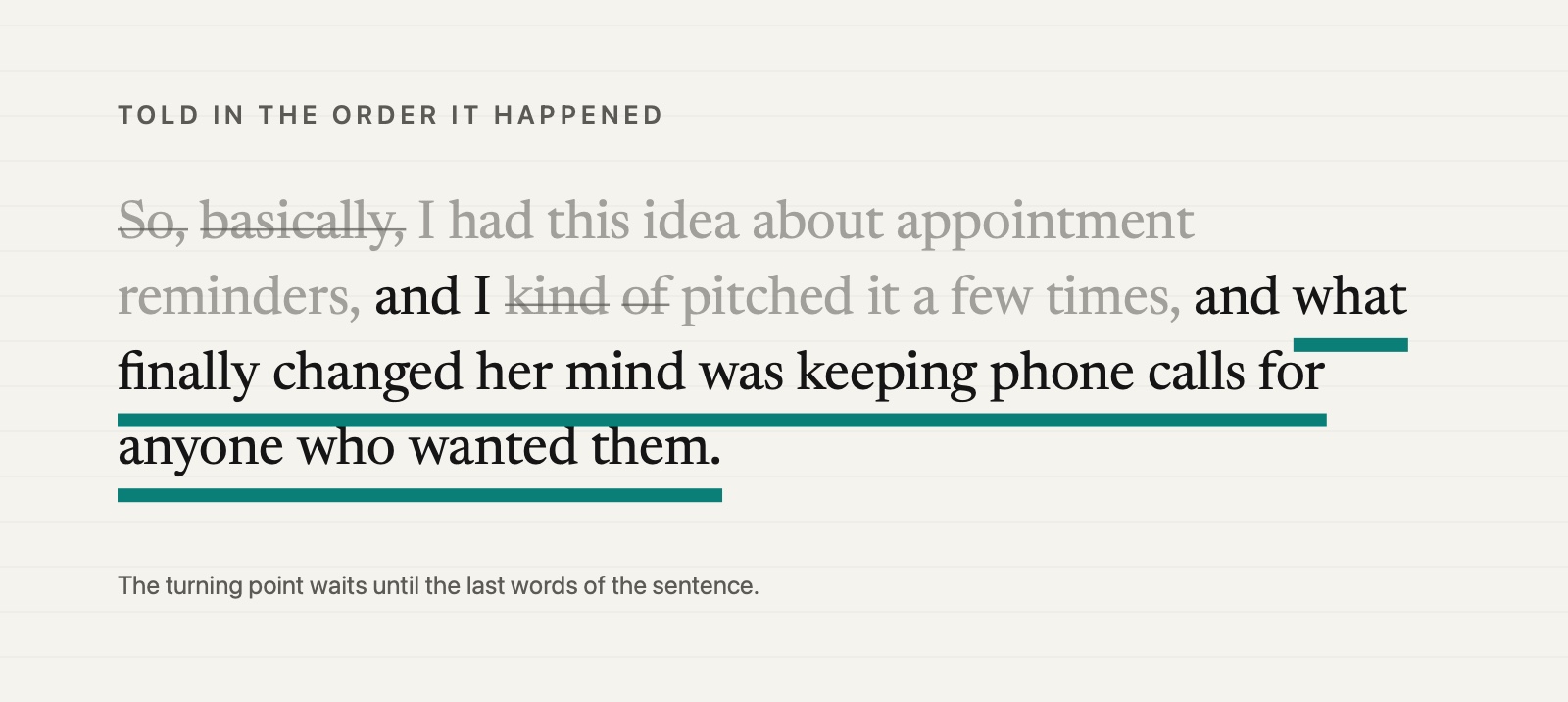
Most people tell a persuasion story in the order it happened. The idea. The first pitch. The pushback. A second try. Some back and forth. Then, finally, the thing that worked.
On paper that reads fine. Out loud it has two problems. First, the interviewer has no idea what the story is about until the end, so they cannot tell which details matter. Second, the most interesting part, the thing that actually changed a mind, gets the least time, because by then you sense you have talked too long and rush to finish.
You can hear it in the opening sentence. It starts with filler, wanders through the setup, and the turning point shows up as an afterthought at the very end.
How to answer a persuasion question in four parts
Here is the shape. It works for a manager, a coworker, a client or a whole team.
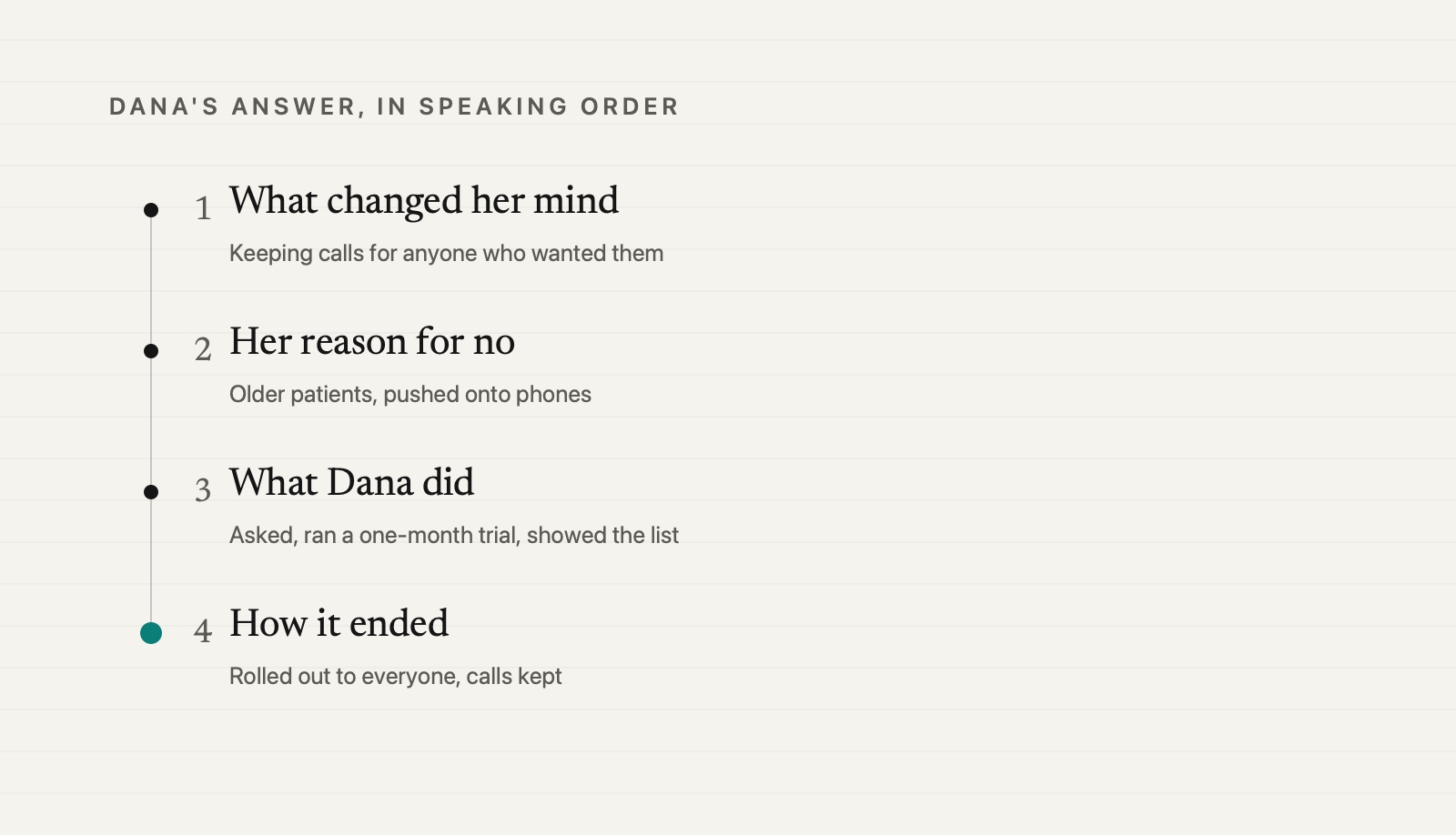
Part one, the turning point, in your first sentence. Who you persuaded, what you wanted, and what changed their mind. "I persuaded our office manager to try text reminders, and what changed her mind was keeping phone calls for anyone who wanted them."
Part two, their reason for saying no, in one sentence. Say it the way they would say it. A fair objection makes you look better, not worse.
Part three, what you did, in three or four sentences. This is most of the answer. What you asked, what you learned, what you changed in your idea, and what evidence you brought.
Part four, how it ended, in one or two sentences. What happened, and one thing you would do the same way again. Then stop.
Here is the example for the rest of this post. Dana works the front desk at a busy dental practice and is interviewing for an operations coordinator role. Asked to tell me about a time you had to persuade someone, she says:
"I persuaded our office manager to try text reminders, and what changed her mind was keeping phone calls for anyone who wanted them. We were missing several appointments a week, and I thought texts would help. Her worry was fair: a lot of our patients are older, and she did not want them to feel pushed onto their phones. So I stopped arguing for texts and asked her which patients she was worried about. Then I suggested a one-month trial with new patients only, with a line on every text saying they could ask for a call instead. I kept a list of missed appointments that month and showed it to her every Friday. At the end of the month she asked me to roll it out to everyone, and the front desk still calls the patients who asked for it. What I would do again is ask about the worry before pitching the fix."
About a minute. The turning point is in the first sentence, so everything after it makes sense as it goes. Her manager's worry gets one fair sentence. Most of the time goes to what Dana did.
Give their reason fairly
The second part is where many answers slip. It is tempting to make the other person sound stubborn, because then your win looks bigger. Interviewers hear it the other way. If the person you persuaded sounds unreasonable, the story is about them, and it hints that you might talk about your next team the same way.
Say their reason the way they would put it. "She did not want older patients to feel pushed onto their phones" is fair. "She was resistant to change" is a label, and it does not explain anything.
A fair reason also sets up the best part of your answer. The Program on Negotiation at Harvard Law School describes the difference between a position, which is what someone asks for, and an interest, which is the need or concern underneath it (Program on Negotiation, Harvard Law School). Dana's manager's position was "no texts." Her interest was "do not leave older patients behind." Once Dana heard the interest, she could change her idea to protect it, and the no went away.
That is the move interviewers want to hear in a persuasion story: you listened for the real worry, and you answered it.
Pick a story where something changed
You may have plenty of persuasion stories. Narrow them with three questions.
Did you change something because of what you heard? The strongest stories are not "I explained it better until they agreed." They are "I learned why they said no, and I adjusted." If nothing about your idea changed, the story shows persistence, which is a weaker thing to show.
Was it about the work? A process, a tool, a schedule, a plan, a priority. Not persuading a friend to pick a restaurant.
Can you say how it ended? A clear yes is easiest. A partial yes or a trial that ran its course also works, as long as you can name what happened.
One thing to keep separate: persuading is not the same as disagreeing. If your best story is about pushing back on a decision your manager had already made, that is a different question with its own shape, and our post on answering the disagreed-with-your-manager question covers it. A persuasion story starts before the decision, when the other person has not said yes yet.
If you are early in your career, a professor, a club, a group project or a shift lead all count. What matters is that you could not simply tell the other person what to do.
Say the first sentence like you mean it
Out loud, the first sentence is the hardest. It feels too direct to open with the ending, so people soften it: "I guess one time I sort of convinced my manager to maybe try something." Every softening word makes the turning point harder to hear.
Say it plainly, at an even pace, and let your voice come down at the end of the sentence, on the thing that changed their mind. Then take a short breath before the second part. That small pause tells the listener the headline is done and the story is starting.
Watch your length, too. Part three is where answers grow, because every meeting and every email feels important. Keep the steps that changed the outcome and drop the rest. If you are not sure how long is too long, our post on how long an interview answer should be explains why about a minute is a good target for a story like this.
When the interviewer pushes
Follow-up questions are common here. The same shape handles them.
"What if they had still said no?" Say what you would have done next, in one or two sentences. "I would have asked whether a smaller trial was worth trying, and if not, I would have dropped it and supported her call."
"Tell me about a time you could not persuade someone." Use the same four parts. The first sentence names what did not change their mind, and part four says what you learned.
"How do you persuade people who are more senior than you?" Point back to your story. "The same way I did with my office manager. I ask what worries them first, then I make the change small enough to try."
Try it now: practice in five minutes
You need your phone's voice recorder and a timer.
- Pick one story where someone said no and later said yes. Write down what changed their mind, in five words or fewer.
- Write your first sentence: "I persuaded [who] to [what], and what changed their mind was [those five words]." Then write their reason for no in one fair sentence.
- Start the recorder and the timer. Ask yourself out loud, "Tell me about a time you had to persuade someone." Answer from your notes, and stop near one minute.
- Play it back and listen for two things only. Was the turning point in your first sentence? Did their reason sound fair, or did it sound like a complaint?
- Fix one of those and record it again. If you have time left, answer "What if they had still said no?" in two sentences.
On the second take, the turning point usually moves to the front, and the answer gets shorter.
If the story still comes out in the order it happened the moment someone asks, even though your notes are clear, that is a practice problem, and it takes a few minutes a day to fix. Sayforth is a 30-day iPhone program built for that: one question a day, answered out loud, then shown as a single answer line after you finish so you can see how far in your main point arrived, with one change to try tomorrow. It is coming soon, and you can see how the daily practice works now.
Be first to know when Sayforth is live.
Get launch updatesFrequently Asked Questions
How do you answer "tell me about a time you had to persuade someone"?
Say who you persuaded, what you wanted, and what changed their mind, all in your first sentence. Give their reason for saying no fairly, then spend most of the answer on what you did and end with how it turned out. Keep it to about a minute.
What is a good example of persuading someone at work?
One where someone said no for a real reason, and you changed something about your idea to answer that reason. Switching a process, trying a new tool, or changing a schedule all work. The stakes can be small as long as you can say how it ended.
Is "tell me about a time you influenced someone" the same question?
Mostly, yes. Influence questions sometimes cover a group or a decision you were not part of, but the same four parts work: the turning point first, their reason, what you did, and how it ended.
What if I have never persuaded a manager?
Use a coworker, a client, a classmate or a team. The interviewer wants to see how you change a mind when you cannot give orders, and that can happen with anyone.