
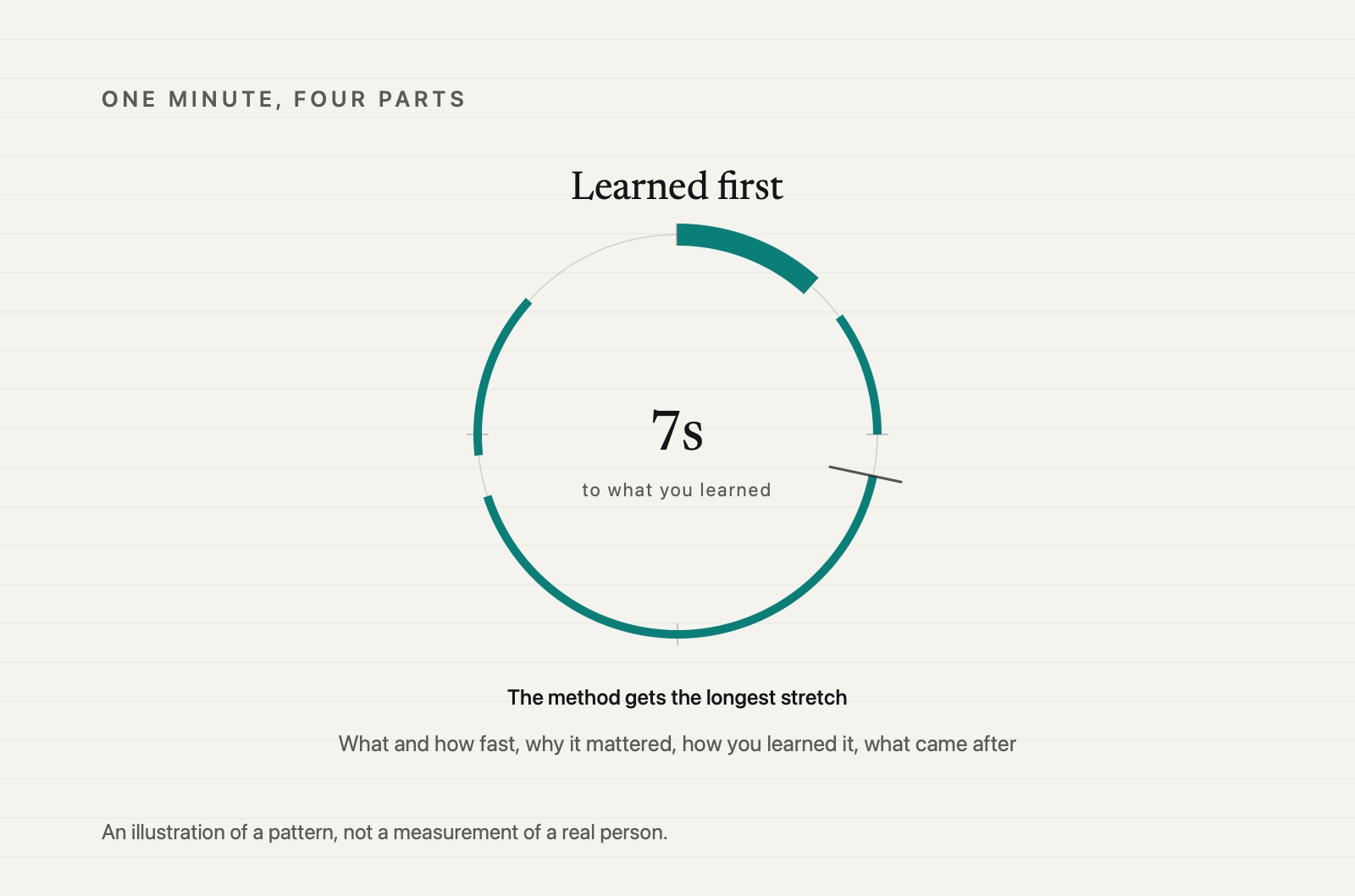
Here is how to answer "tell me about a time you had to learn something quickly." In your first sentence, say what you learned and how much time you had. Next, say why it mattered. Then describe the two or three things you did to learn it, and end on what you could do afterward. Keep it to about a minute.
The question sounds like an invitation to call yourself a fast learner. That is the trap. Saying "I pick things up fast" is a claim, and the interviewer asked for proof. This post shows how to turn one real learning story into a clear answer, how to describe your method without listing every video you watched, and how to practice it out loud in five minutes.
What the interviewer is really asking
Employers ask this question in a few forms. The City of Calgary's hiring guide uses this version: "Tell us about a time when you had to learn something new in a short period of time," followed by what you needed to learn and how you learned it (City of Calgary, interview method). Those two follow-up parts are the real question.
The interviewer is not checking whether you already know their tools. They are checking what happens in your first month on the job, when something is new and the deadline is real. They want to hear three things:
- You knew what to learn. You did not try to learn everything. You found the part that mattered for the deadline.
- You had a method. You can say how you learned it, in a way they could picture.
- It worked. You used what you learned to get something real done.
How hard you worked is not on that list. Late nights and long hours are easy to talk about, but they do not show how you learn. Your method does.
Why "fast learner" answers come out vague
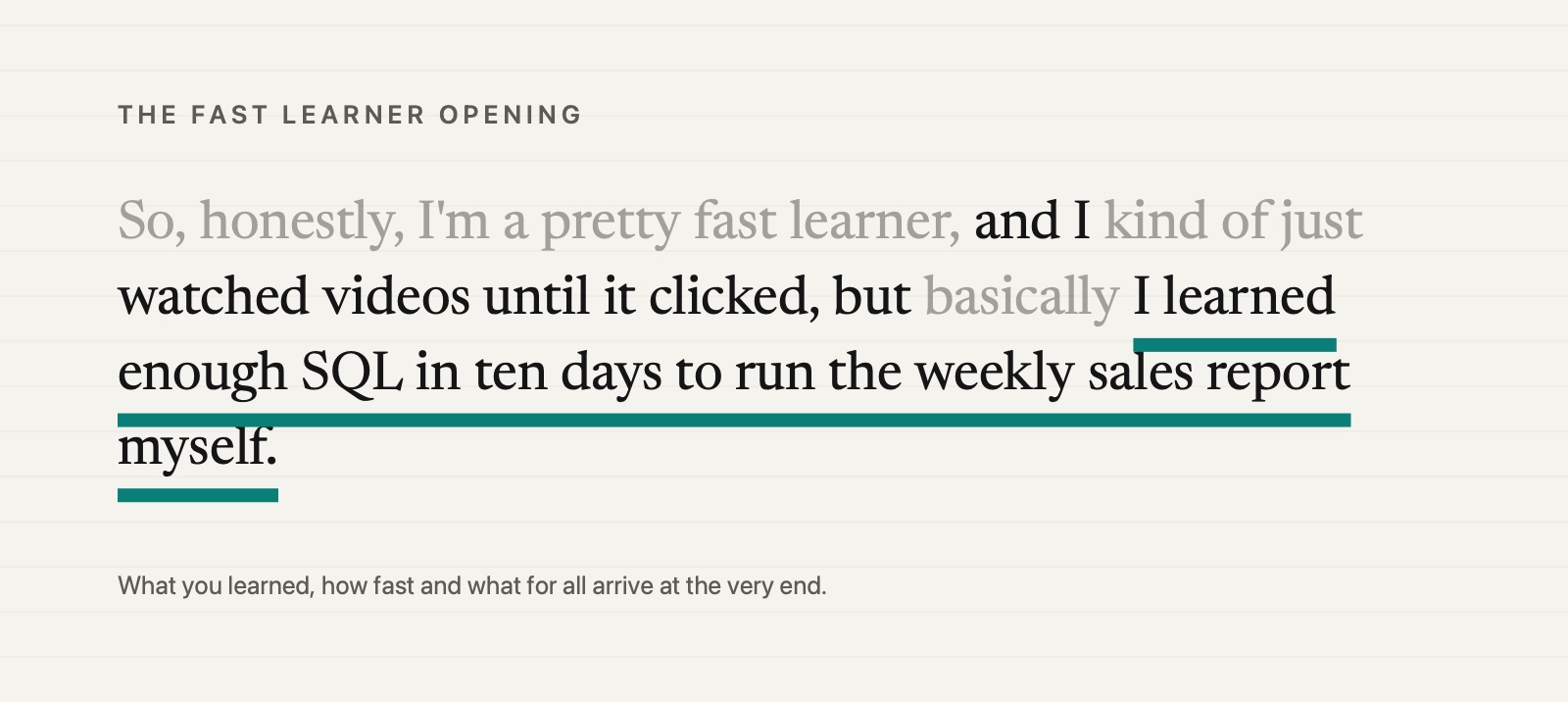
Most weak answers to this question have the same shape. They start with a claim about yourself, add a few soft words, and get to the actual story only at the end. Out loud, it sounds like this: "So, honestly, I'm a pretty fast learner, and I kind of just watched videos until it clicked, but basically I learned enough SQL in ten days to run the weekly sales report myself."
Everything the interviewer needs is in the last part of that sentence. What you learned (SQL), how fast (ten days), and what it was for (the weekly sales report). The rest is filler that makes the story sound smaller than it was. "Kind of just watched videos" even makes the method sound like luck.
The fix is to cut the claim and start with the result. The facts show you learn fast, so you do not have to say it.
How to answer tell me about a time you had to learn something quickly, in four parts
Here is one example, built around something that happens on many teams: the one person who knows how to do a task goes on leave.
Part one, what you learned and how fast, in one sentence. "When our analyst went on leave, I had ten days to learn enough SQL to run the weekly sales report myself." This sentence is the whole story in short. If the interviewer remembers one thing, it should be this.
Part two, why it mattered, in one sentence. "The sales team used that report every Monday to plan their week, and there was nobody else who could run it." Now the deadline is real, and the listener understands the pressure without you having to describe it.
Part three, how you learned it, in two or three moves. "I started from her last month of working queries instead of a course, and changed one line at a time to see what each part did. I kept a one-page cheat sheet of the five commands the report actually used. And before the first report went out, I asked a data engineer for a twenty-minute check." Each move is something the interviewer can picture. Notice what is not there: the name of every tutorial, every hour you put in.
Part four, what you could do afterward, in one sentence. "I ran the report on time every week she was out, and my cheat sheet is now in the team's onboarding folder." End there. A result someone else used is enough. You do not need a big number.
That is about a minute out loud. If you want more on timing, our post on how long an interview answer should be covers it.
Pick a story with a real deadline
The best story for this question has three things: a clear thing you did not know, a real reason it had to happen fast, and a result someone else used. A new tool, a new process, a new customer's product, a set of rules you had to follow, or a topic you had to explain to others all count. It does not have to be technical.
Small and specific beats big and vague. "I learned our new billing system in a week so I could answer customer questions on launch day" is stronger than "I learned a whole new industry when I changed careers," because the interviewer can see the start, the deadline, and the finish.
Stories from outside a full-time job work too. A class where you had to learn a tool in a week for a group project, a part-time job where the register changed overnight, or a volunteer role where you had to learn the rules before an event can all show the same three things.
Avoid two kinds of story. The first is one where you did not really need to learn anything new, such as doing more of a task you already knew. The second is one where you claim to have become an expert in a week. Interviewers will doubt that happened. "Enough to run the report" is believable. "Mastered SQL" is not.
If your story is mostly about acting on a problem nobody asked you to fix, it may be a better fit for tell me about a time you took initiative, which has a different shape.
Say the method in plain words
Part three is where this answer is won or lost, because it is the part that proves you can do it again. Three habits make it easy to follow.
Name moves, not resources. "I started from working examples and changed one line at a time" is a method. "I used a tutorial site, two video channels, and an online course" is a list. The interviewer can reuse a method in their head. A list of sites tells them nothing about you.
Keep it to two or three moves. If you list six things you did, none of them stands out. Pick the two or three that made the biggest difference and say each in one sentence.
Include who you asked. Asking a colleague to check your work is part of learning fast, not a sign of weakness. It also answers a question the interviewer has but will not ask: will this person get stuck and stay quiet?
Then pause for a beat before part four. That small pause tells the listener the method is done and the result is next.
When the interviewer asks for more
Short follow-ups are common after this question. The four-part shape handles each one.
"What would you do differently?" Pick one real thing. "I would have started the cheat sheet on day one instead of day four." A small, honest change sounds more believable than "nothing."
"How do you usually learn something new?" Turn your story into a rule. "I start from a working example, find the few parts that matter, and ask someone to check me before it counts." Then stop. You have already given the proof.
"What if you can't learn it in time?" Say what you would do, plainly. "I would tell the person depending on it early, say what I could deliver by the deadline, and keep learning the rest." Our post on how to answer an interview question you don't know covers how to handle a follow-up you did not prepare for.
"What are you learning right now?" Have one true answer ready, in one sentence, with what it is for.
Try it now: a five-minute practice
You need your phone's voice recorder and a timer.
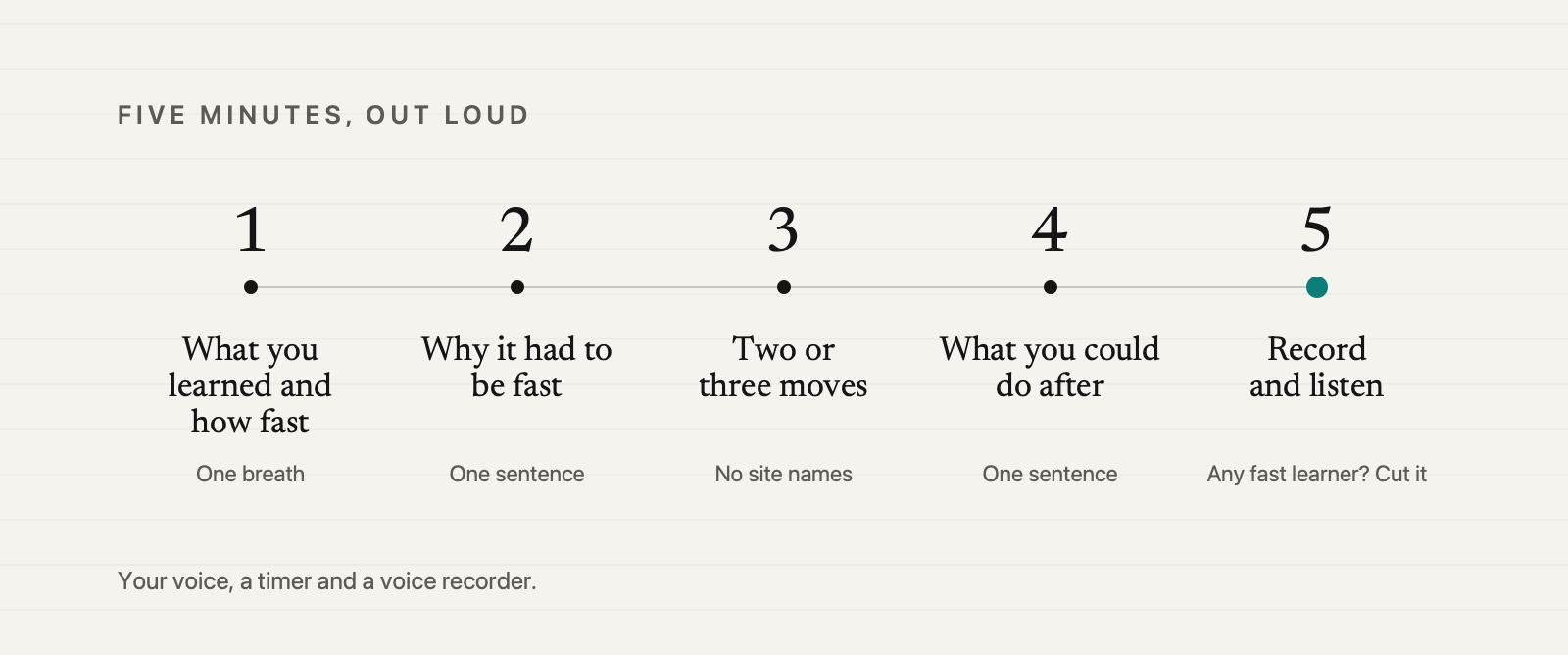
- Write one sentence that says what you learned and how much time you had. Read it out loud. If it needs a second breath, cut words until it does not.
- Write one sentence on why it had to happen that fast.
- Write your two or three learning moves, one short sentence each. Cross out any that are just the name of a website or a course.
- Write one sentence on what you could do afterward.
- Start the timer and the recorder. Ask yourself out loud, "Tell me about a time you had to learn something quickly." Answer from your notes.
- Play it back and listen for one thing: did you say "fast learner," or any word like it, before you said what you learned? If you did, cut it and record again.
On the second take, listen for whether what you learned and how fast now opens the answer.
If the first sentence is clear on paper but the claim about being a fast learner creeps back in the moment someone asks, that is a habit you can only hear by speaking. Sayforth is a 30-day iPhone program built for that: one question a day, answered out loud, then shown after you finish as a single speaking line so you can see where your point landed, with one change to try tomorrow. It is coming soon, and you can see how the daily practice works now.
Be first to know when Sayforth is live.
Get launch updatesFrequently Asked Questions
How do you answer "tell me about a time you had to learn something quickly"?
Start with one sentence that says what you learned and how much time you had. Then say why it mattered, describe two or three things you did to learn it, and end on what you could do afterward. About a minute is enough.
What is a good example of learning something quickly at work?
Any time you had to pick up a new tool, process, or topic to meet a real deadline, and then used it. Learning enough of a new system to answer customer questions on launch day, or learning a report so you could cover for a colleague, are both good examples.
Should I say I am a fast learner?
Not in those words. It is a claim, and the interviewer asked for proof. Say what you learned and how fast, and let the story show it.
What if I have never had to learn something fast at a job?
Use a story from a class, a part-time job, or a volunteer role. The interviewer cares that you found what mattered, had a method, and used what you learned, not where it happened.