

Here is how to answer "tell me about a time you took initiative." In your first sentence, say what you noticed and what you did about it. In the next, say why it was yours to act on and who you told. Then give the two things you actually did, and end on what changed. Keep it to about a minute.
Most people have a good initiative story. The trouble is how it comes out. It turns into a list of tasks: I did this, then I did that, then I set up a meeting. The one moment that makes it initiative, the moment you saw something nobody had asked you to fix, gets buried in the middle. This post shows how to put that moment first, how to pick the right story, and how to practice it out loud in five minutes.
What the interviewer is really listening for
The question comes in several forms. The behavioral interview question bank from UMass Amherst Human Resources lists versions such as "Describe a time when you saw some problem and took the initiative" (UMass Amherst Human Resources). The wording changes. The test stays the same.
Researchers who study this at work describe it in three parts. Michael Frese and Doris Fay define personal initiative as work behavior that is self-starting, proactive, and persistent in getting past the problems that come up (Frese and Fay, Research in Organizational Behavior, 200123005-6)). Those three parts map neatly onto what an interviewer wants to hear:
- Self-starting. Nobody asked you. You saw it yourself.
- Proactive. You acted before it became a bigger problem, not after.
- Persistent. When something got in the way, you kept going.
Notice what is missing. How busy you were. How many hours it took. How many people were in the meeting. Those details are easy to remember, so they are the ones most people say. They are not what the question is asking.
Why initiative stories come out as a task list
An initiative story has a natural time order. First the background, then the team, then the problem, then each thing you did, then the result. Said in that order, the setup and the steps fill most of the minute. The sentence that matters, "I noticed this, and nobody was fixing it," shows up halfway through, often in a quick aside.
The listener cannot tell which part to remember. To them, it sounds like a description of your job. And a description of your job is the opposite of initiative, because initiative is the part that was not your job.
The fix is to move one sentence. Say what you noticed and what you did about it first. Once the interviewer knows you saw a gap and moved on it, every sentence after that has a reason to be there.
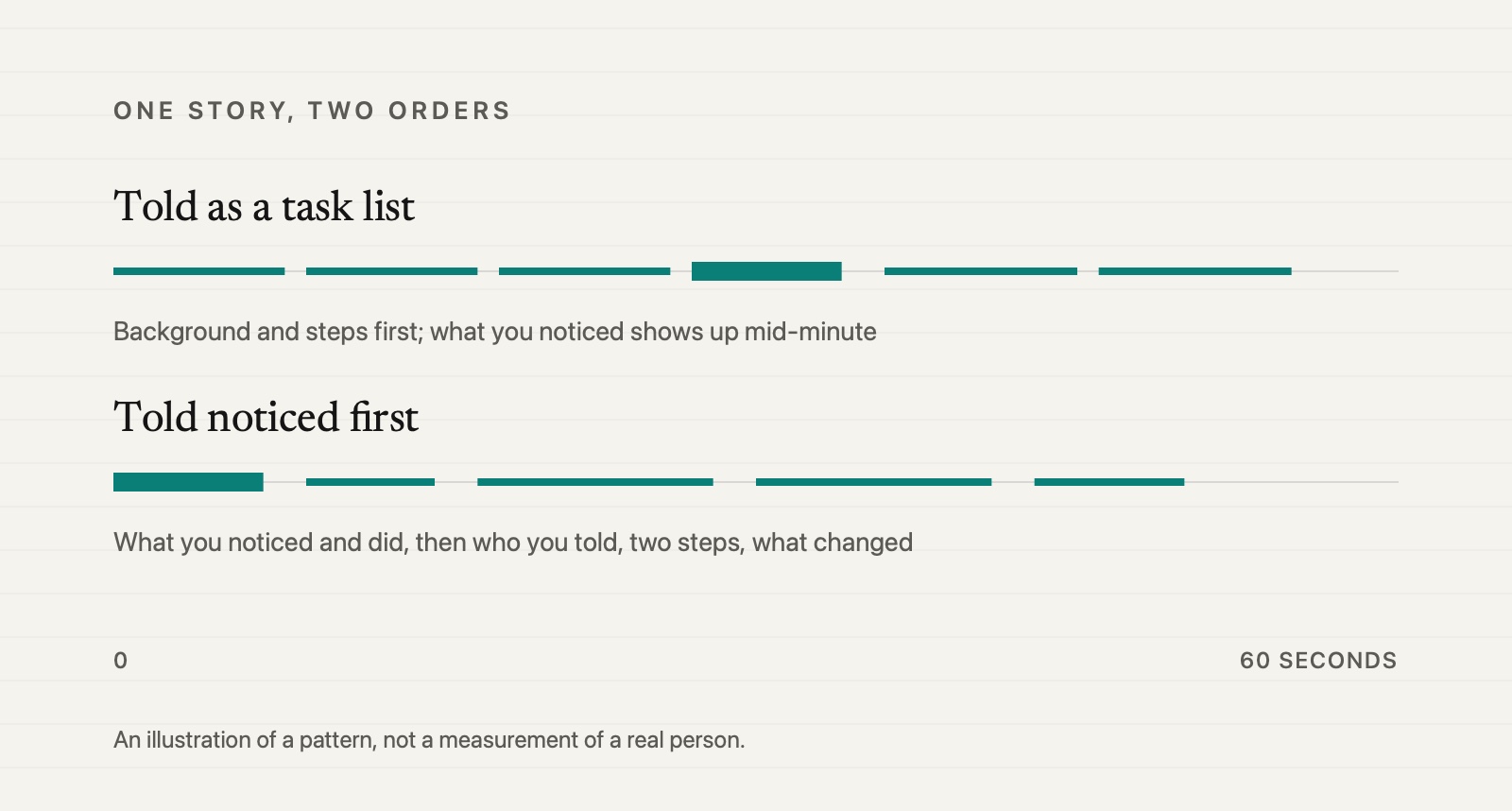
How to answer tell me about a time you took initiative in four parts
Here is one example, built around something many teams have: new people asking the same questions every week.
Part one, what you noticed and what you did, in one sentence. "I noticed new hires on our support team were asking the same handful of questions in their first week, so I wrote a one-page guide that nobody had asked for." This sentence is the whole story in short. If the interviewer remembers only one thing, it should be this.
Part two, why it was yours, and who you told, in one or two sentences. "I had been the newest person on the team six months earlier, so the questions were fresh in my mind. Before I shared it, I showed it to my team lead and asked if anything was wrong." This shows you acted on your own and still used good judgment.
Part three, what you did, in three or four sentences. "I kept a list for two weeks of every question a new person asked me. Then I wrote short answers to the ones that came up more than once and put them on one page. One senior teammate worried it would go out of date, so I put my name and the date at the top and said I would check it every month." That last part is the persistence. Something got in the way, and you handled it.
Part four, what changed, in one sentence. "My lead added the guide to onboarding, and new hires started bringing us harder questions instead of the same easy ones." End there. You do not need a big number. A clear change is enough.
That is about a minute out loud. If you want more on timing, our post on how long an interview answer should be covers it.
Pick a story that was yours to start
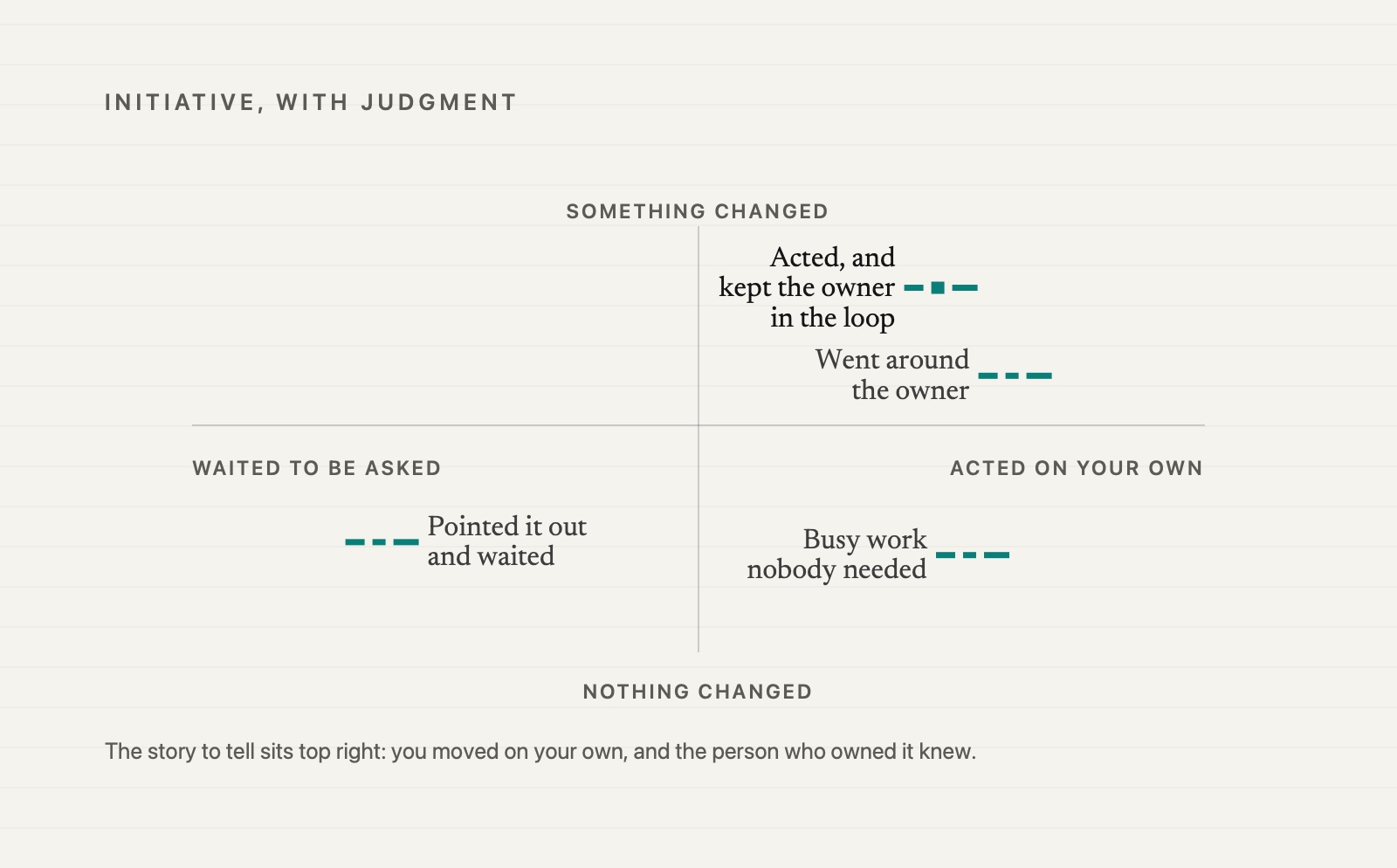
The best answer to "tell me about a time you took initiative" uses a story with three things: nobody asked you, it helped someone, and you can say what changed. Small is fine. A fix to a messy shared folder, a checklist that stopped a repeated mistake, or a question you asked that saved a project from a bad start all count. A big story where your part is unclear is weaker than a small one where it is obvious.
Stories from outside a full-time job work too. A part-time job, a class project, or a volunteer role can all show the same three things.
Avoid two kinds of story. The first is extra work nobody needed, such as staying late on something that did not matter. That shows effort, not judgment. The second is going around the person who owned the problem. Acting on your own does not mean acting in secret. The strongest answers include one short line about who you told, because the interviewer is also asking, quietly, "Will this person surprise me in a bad way?"
If your story is really about getting other people to agree to an idea, that is a different question. Our post on answering "tell me about a time you had to persuade someone" covers that shape. And if it is about a goal you set and reached over months, tell me about a goal you set and achieved fits better.
Say the first sentence in one breath
The first sentence carries the most weight, so say it well. Two things tend to go wrong.
The first is a long run-up. "So, this was a while ago, I was on a team, and we had kind of a situation where..." uses up five seconds and says nothing. Start with "I noticed."
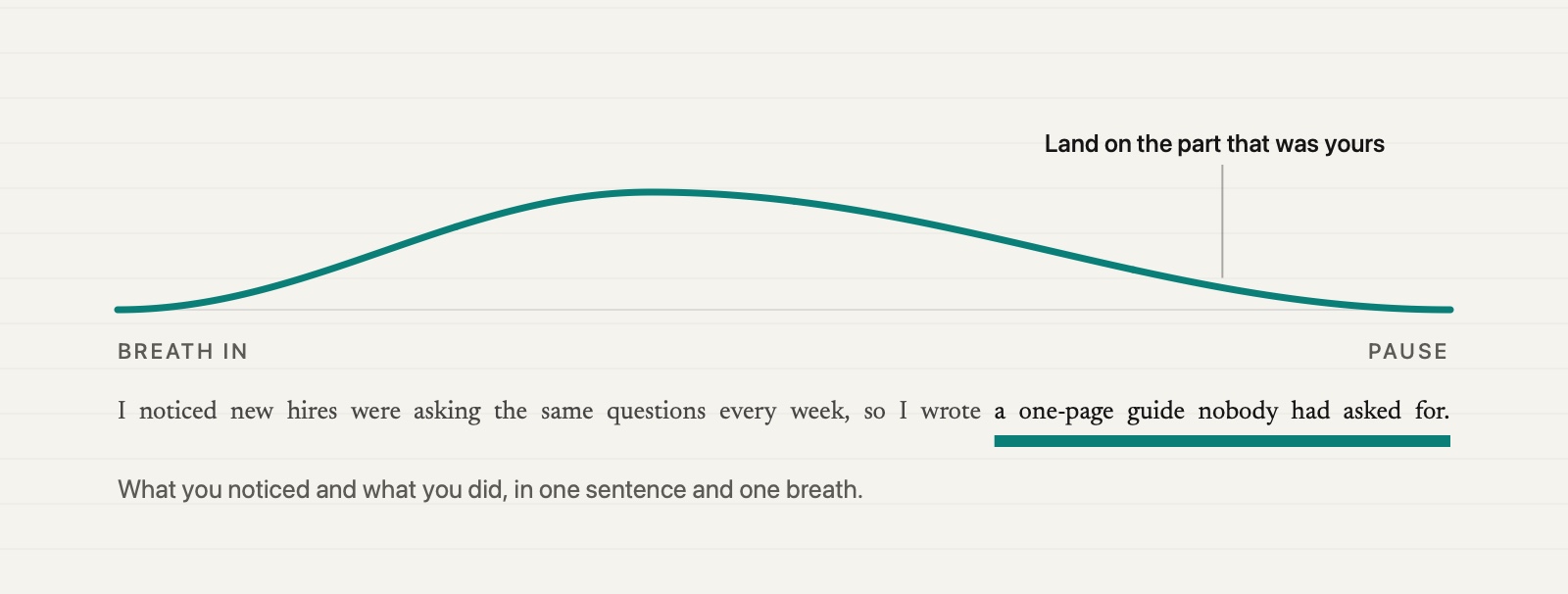
The second is splitting the sentence in two and pausing in between, so the listener hears the problem and waits for the rest. Keep "what you noticed" and "what you did" in one sentence, said in one breath, and let it land on the part that was yours: the thing nobody had asked for. Out loud, the example becomes: "I noticed new hires were asking the same questions every week, so I wrote a one-page guide nobody had asked for." Then pause for a beat before the next sentence. That small pause tells the listener the main point has been said.
When the interviewer asks for more
Short follow-ups are common after "tell me about a time you took initiative." The four-part shape handles each one.
"Why didn't you just tell your manager and let them handle it?" Say why it made sense for you to do it, in one sentence. "It was a small fix I could do in a few hours, and I was the one who had seen the questions." Then say again that you told them.
"What would you have done if your lead said no?" Be honest. "I would have asked what worried them and either fixed that or dropped it." Taking initiative includes knowing when to stop.
"What did you learn?" One sentence, and make it something you still do. "I write down a problem for a week or two before I try to fix it, so I fix the real one."
"Tell me about a time your initiative did not work." Name what you tried, what happened, and what you would change. A plain account of a miss shows judgment, which is part of what this question is about anyway.
Try it now: a five-minute practice
You need your phone's voice recorder and a timer.
- Write one sentence that starts with "I noticed" and ends with what you did about it. Read it out loud. If it needs a second breath, cut words until it does not.
- Write one sentence on why it was yours to act on and who you told.
- Write the two things you did, one short sentence each. If something got in the way, add one sentence on how you handled it.
- Write one sentence on what changed.
- Start the timer and the recorder. Ask yourself out loud, "Tell me about a time you took initiative." Answer from your notes. Count silently to three before you stop.
- Play it back and listen for one thing: how many seconds passed before you said "I noticed"? If it was more than five, change that and record it again.
On the second take, listen for whether the noticed sentence has moved to the front, where it belongs.
If the "I noticed" sentence is clear on paper but slides to the middle the moment someone actually asks, that is a habit you can only hear by speaking. Sayforth is a 30-day iPhone program built for that: one question a day, answered out loud, then shown after you finish as a single speaking line so you can see where your point landed, with one change to try tomorrow. It is coming soon, and you can see how the daily practice works now.
Be first to know when Sayforth is live.
Get launch updatesFrequently Asked Questions
How do you answer "tell me about a time you took initiative"?
Start with one sentence that says what you noticed and what you did about it. Then say why it was yours to act on and who you told, give the two things you did, and end on what changed. About a minute is enough.
What is a good example of taking initiative at work?
Fixing something nobody asked you to fix, where you can say what changed. Writing a short guide for a question people keep asking, cleaning up a shared folder everyone struggles with, or flagging a risk early and offering a fix are all good examples.
What if I have never taken initiative at a job?
Use a story from a part-time job, a class project, or a volunteer role. The interviewer cares that you saw a problem yourself, acted on it, and kept going when something got in the way, not where it happened.
How long should the answer be?
About a minute. One sentence for what you noticed and did, one or two for why it was yours, three or four for what you did, and one for what changed. If the interviewer wants more, they will ask.